So here are 10,000 - or so - words on St. John's football. My apologies in advance. Read it in shifts, if need be. Print it out, take it on a cross-country plane trip. Laminate it, give it as a Christmas gift.
****
A pair of college football games in Minnesota on Saturday were decided by a point. In one, Northwestern beat Minnesota 29-28 in Big Ten action.
Then there was the game people cared about. In Collegeville, St. Thomas defeated St. John's 27-26 in overtime in front of 16,421 people, which set a Division III attendance record. The previous record came in 2003, when 13,107 freezing souls watched the Johnnies edge Bethel for the MIAC title, a victory that gave John Gagliardi a record-setting 409 victories.
It's the first time since 1997 the Tommies beat the Johnnies - and only the second time since 1992 - and when you read that result, nothing makes sense in the world, even if many people expected a St. Thomas victory. St. Thomas defeated St. John's in football. Typing it twice still doesn't make it seem real. I wrote last year about the rivalry between the schools. It's a bitter rivalry, or at least as bitter as a rivalry can get when it's between a pair of schools that have more similarities than differences, schools that are separated by an hour, are both Catholic institutions, attract students from the same small towns and big cities, and send graduates into the same work force to labor for the same companies.
For much of the game the Johnnies appeared to again be the better team, even though St. Thomas came in ranked higher for the first time in a few decades. Unfortunately for the thousands of people dressed in red, SJU failed to take advantage of several St. Thomas turnovers in the first half. With a little more than 3 minutes left in the game, St. Thomas tied it at 20-20, only to miss the extra point. The Johnnies marched down in the closing minutes before a late interception ruined a chance at victory in regulation. After the Tommies started OT with a touchdown and PAT to take a 27-20 lead, the Johnnies scored on a fourth down play. But just as people prepared for a second overtime, the game ended as St. John's missed the extra point and a few thousand people dressed in purple rudely stormed the field to celebrate.
Those are the basic facts. All that's missing are the hundred plays and dozens of what-ifs that swirl around any game that comes down to one play. Johnnie fans feel the Tommies got a bit lucky, and Tommie fans say, even if that's so, it only makes up for the fact the Johnnies needed a bit of luck and a controversial call to win the past two seasons.
Tommie fans rightfully celebrated their victory because it gives them the edge in the race for the conference title and it came against the hated Johnnies and, perhaps best of all, it came on St John's home field, the mecca of Division III football. Beyond that, though, there's been a feeling hanging over the game that perhaps there's a power shift in the MIAC taking place. Maybe the Tommies, who dominate in several sports, have finally - under their outstanding third-year head coach Glenn Caruso - found the formula that will end the Johnnies' control of the league. Many people thought the Tommies would handily defeat the Johnnies today. That didn't happen. Doesn't make it any easier for the St. John's players, coaches or fans - the last time St. John's had a moral victory, Johnny "Blood" McNally stood on the sidelines as coach - but it does show the teams are all-but even this season.
And no matter what Tommie graduates tell themselves during the late-night shift at McDonald's or St. Thomas students tell themselves during drunken parties where they read Vince Flynn passages to each other (cheap jokes are all the losing side's fans have after games like this. Sad, I know.), one game - one season - does not indicate a seismic shift. In 10 years, if the Tommies have won seven conference titles in that span and routinely defeat the Johnnies and also make it to the national semifinals a few times, perhaps people can look back at October 2, 2010 and say, there, that was the day everything changed in the MIAC.
But one day doesn't trump 58 years.
That's how long Gagliardi's coached at St. Johns, after spending four seasons at Carroll. Fifty-eight seasons. During that time with the Johnnies, he's gone 450-122-10. He's basically lost about two games a season. In other words, if history's any indicator, the Johnnies are done losing this year. Yet even if that is the case, some SJU fans will consider the season to be something of a disappointment. That's what happens when you build something up over seven decades of action.
One-hundred-twenty-two losses. Today felt unique because it came against the Tommies, but under Gagliardi, most defeats are heartbreaking, gut-wrenching affairs that leave fans lamenting one missed kick or one fumble. So to ease the pain of Saturday's loss, here's a look at those 122 defeats. Perhaps looking at the past will provide a guide to the future, while presenting comfort for the present.
* Gagliardi's had five unbeaten seasons at St. John's. Thirteen times he's only lost once.
* The last time Gagliardi had a losing record? 1967.
* This was the first time St. Thomas won in Collegeville since 1986, when the Tommies won 56-21. They followed that up with victories over the Johnnies in 1987, 1990 and 1992. That, too, signaled a changing of the guard in the MIAC. The Tommies were taking over the league. The Johnnies - and Gagliardi's - reign over the league had come to an end. And then the Johnnies went on to win 16 of 17 in the series. So a one-point defeat somehow doesn't sound like a mythical, magical impossible-to-define-but-we'll-know-it-when-we-see-it-and-there's-no-stopping-the-Tommies-and-their-millions-and-large-enrollment-and-charismatic-coach changing of the guard. Or put it this way: Imagine St. Thomas now winning every game against St. John's until 2023. Finally, that year the Johnnies break through and win by a point. In overtime, on a missed extra point. Would that mean there was a changing of the guard?
* To save space (too late), let's take a look at the losses since 1989, which sort of signaled the start of the modern Johnnie dynasty. Counting Saturday's game, since 1989 St. John's is 216-39-3. Of those 39 defeats, 15 were by more than 10 points. Two of those double-digit defeats were against Mount Union, two more against Whitewater, the overwhelming Division III forces of the past two decades.
So here are the toughest defeats the Johnnies and Gagliardi have suffered since '89, when the Johnnies went 11-1 and lost to Dayton 28-0 in the national semifinals. Many have been in what-the-hell-happened fashion, the kind of games that probably leave Gagliardi wondering what he did to make God angry, while Johnnie opponents wait impatiently for the football gods to finally even the score. The Johnnies rarely get blown out. They've won countless times in seemingly miracle fashion, but the memorable losses stand out because they are so rare.
- 19-7 loss to Dayton in 1991 semifinals. The Johnnies dominated that entire year, putting together one of their more overwhelming seasons. Their closest game was a 35-25 victory over Hamline. No one else came within 10 points. They beat Carleton 56-7, Macalester 56-0, St. Olaf 67-19 and in the playoffs decimated Coe so badly that everyone in Iowa, including Hayden Fry, felt it, winning 75-2. But then came the semifinals. The Johnnies committed an astounding 1o turnovers - 10! - but still only lost by 12 points. If they commit five turnovers, they probably win by two scores. In addition, star running back Jay Conzemius played injured.
- A superior Johnnies team lost to St. Thomas 15-12 in 1992, a game that ultimately kept the Johnnies out of the playoffs. Carleton improbably earned the playoff berth that year as they shared the conference title with SJU, despite the fact the Johnnies beat them 70-7.
- St. John's went 11-2 in 1994. One loss came on Homecoming against Hamline, as the Pipers won 27-26 (there's that score again), as a failed two-point conversion attempt in the closing seconds cost the Johnnies. That game started the sterling career of quarterback Kurt Ramler, who was just a sophomore that season. In the semifinals, St. John's lost 19-16 at home against Albion, a game famous for a horrific noncall. Albion's winning TD came when a receiver caught a pass that clearly bounced off the ground before the receiver scooped it up. Albion went on to defeat Washington & Jefferson 38-15 to win the national title. It's impossible and dangerous to compare scores. But what the hell. If the Johnnies had won that game and faced Washington & Jefferson in the Stagg Bowl....they'd have won the national championship. Johnnie fans are still very bitter over that defeat.
- The Johnnies won their first 11 games in 1996. In the second round of the playoffs, they led Wisconsin-Lacrosse 23-8 at halftime, but squandered the lead, losing 37-30.
- In 1998, the Johnnies again went unbeaten in the regular season, only to lose in heartbreaking fashion 10-7 to Eau Claire, in another game marked by controversial calls and a goal-line fumble by SJU late in the game, when they were on the verge of winning.
- Pacific-Lutheran beat the Johnnies in the quarterfinals in 1999, 19-9. One of those games the Johnnies have lost by 10 points since 1989. But that one deserves an asterisk. In the fourth quarter, St. John's led 9-6 and was driving for a potential clinching score. Instead, Pacific Lutheran forced a fumble, and scored a pair of touchdowns to end the Johnnies' season, a year immortalized in Austin Murphy's The Sweet Season. Pacific Lutheran won the national title that year.
- Mount Union edged the Johnnies 10-7 in the 2000 title game, as the Johnnies' defense stopped the powerful Raiders offense until the final minutes. Unfortunately, the offense only got one drive going and a field goal in the final five seconds won it.
- 2002. National Semifinals. Texas. St. John's falls behind Trinity 34-13 at halftime. The Johnnies stage a remarkable rally and tie it at 34-34, only to lose it late in the fourth quarter, 41-34. Many members of that team were on the roster the next season, when St. John's went unbeaten and won the national title.
That's a sampling. There are others: In 2004, for instance, in somewhat of a rebuilding season, St. John's lost three games by a total of five points. And now throw Saturday's game onto that list of most heartbreaking defeats. It's a game people will talk about for years, even if St. John's fans, players and coaches would like nothing more than to forget it within the week.
Saturday belonged to the Tommies. But the Johnnies have suffered devastating defeats before. They've lost to key rivals, even if it's rarely been to their biggest one. But one loss does not a changing of the guard make. Not when there are 57 years of history that say, in the end, the Johnnies and Gagliardi will always recover and quickly find themselves back atop the MIAC standings.
Now pass the Johnnie Bread and some wine, please.
Showing posts with label Football. Show all posts
Showing posts with label Football. Show all posts
Sunday, October 3, 2010


Saturday, September 18, 2010
A day with Columbia football
Today I made my annual trek to the first home football game for Columbia University. Construction projects on the subways meant chaos for public transportation in northern Manhattan, but the Lions and their powder-blue uniforms still drew more than 4,000 people. Columbia games are one of my favorite fall activities in New York, an underrated experience in a city few associate with college football.
Columbia hosted another New York City team, the Fordham Rams. This season Columbia opens with a somewhat-bizarre schedule, with four straight home games kicking off the season.
I've seen probably a dozen Columbia games the last four or five years. They've won a couple of those but lost most. Rarely has Columbia been blown out in the games I've attended. Same story today. Columbia took a second-half lead, only to lose it as Fordham rallied to take a 16-9 lead. Then, in the dying moments, with the crowd excited and the Lions on the move, ready to march in for a tying touchdown, a fluke fumble near the goal-line ended their hopes and an opponent's kneel-down ended the game.
But back to the beginning. Norries Wilson is Columbia's head coach. In the Columbia program, though, his official title is the Patricia and Shepard Alexander Head Coach of Football. Columbia's football coach is an endowed position, just like on the tennis team and wrestling team. The Alexanders gave a "major" gift to the program in 1998, sparking the endowment. A true friend of the program. Columbia has a fetish for naming things, whether buildings or jobs. The football team plays its games at Robert K. Kraft Field at Lawrence A. Wien Stadium at the Baker Field Athletics Complex.
Wilson played his college ball at the University of Minnesota, back in the mid-1980s, when the Gophers made a few bowl games and weren't simply a punchline to jokes told by residents of the Dakotas. Wilson's coach at Minnesota was John Gutekunst, who, like all Gopher coaches of the past five decades, had a few big victories peppered in with even more ugly losses. Gutekunst has bounced around college football since leaving Minnesota, most recently serving as a defensive assistant at East Carolina. But Gutekunst reunited with Wilson this year, working as Columbia's defensive secondary coach. As of now, the defensive secondary coach is not an endowed position, but any Columbia grad with a few hundred thousand dollars to spare could probably get their name on that one.
I sat on the Columbia side, in the general vicinity of a man in his fifties who devoured two dozen Reese's Peanut Butter Cups during the game. It's an unconventional diet, though one I admire. What made it strange(r) was that he wore blue rubber gloves the entire game, as if he were prepping for heart surgery just down the road at Columbia-Presbyterian. Staying with the surgery angle, he opened each wrapper with a razor, which he used to slice through the orange wrapping, before unfurling the chocolate from the brown container. It made me wonder if the cups had a horrible flaw. Had they been caked in asbestos, doused with mercury? He didn't cheer for Columbia or Fordham. He sat passively, except when he aggressively dissected his treats.
Probably an old engineering major.
A large group of enthusiastic Fordham students followed their football team to Manhattan. They certainly outperformed their counterparts. At one point the Fordham students erupted into a chant of "Harvard Rejects," a creative - if factually dubious - taunt.
Neither offense did much for most of the game. Columbia finally cobbled together a scoring drive early in the second half, only to have Fordham block the extra point - of course. Fordham kicked a pair of field goals to tie it at 9-9, then took the lead late in the fourth. Trailing 16-9, Columbia drove down the field with an efficiency previously unseen in these parts. The Lions made it to Fordham's 4-yard-line. First-and-goal. A minute to go. This is when the crowd stood. The Columbia students finally cheered, ignoring the Fordham bullies. We were all ready for overtime.
Then the center fired the snap back to the quarterback - who stood in the shotgun - when the QB wasn't expecting it. The ball hit off his hands, somewhat comically bounced into the air and then fell to the ground, where a Fordham defender fell on it, clinching the victory. An exasperated Patricia and Shepard Alexander Head Coach of Football Norries Wilson shook his head. He'd seen this play before, and the ending never seems to change.
As I left the stadium, two guys in front of me lamented another Columbia loss.
"Same as always," one said. "How many times have we seen that?"
A lot. With five more home games left on the schedule, they'll probably see it a few more times. And so will I.
Columbia hosted another New York City team, the Fordham Rams. This season Columbia opens with a somewhat-bizarre schedule, with four straight home games kicking off the season.
I've seen probably a dozen Columbia games the last four or five years. They've won a couple of those but lost most. Rarely has Columbia been blown out in the games I've attended. Same story today. Columbia took a second-half lead, only to lose it as Fordham rallied to take a 16-9 lead. Then, in the dying moments, with the crowd excited and the Lions on the move, ready to march in for a tying touchdown, a fluke fumble near the goal-line ended their hopes and an opponent's kneel-down ended the game.
But back to the beginning. Norries Wilson is Columbia's head coach. In the Columbia program, though, his official title is the Patricia and Shepard Alexander Head Coach of Football. Columbia's football coach is an endowed position, just like on the tennis team and wrestling team. The Alexanders gave a "major" gift to the program in 1998, sparking the endowment. A true friend of the program. Columbia has a fetish for naming things, whether buildings or jobs. The football team plays its games at Robert K. Kraft Field at Lawrence A. Wien Stadium at the Baker Field Athletics Complex.
Wilson played his college ball at the University of Minnesota, back in the mid-1980s, when the Gophers made a few bowl games and weren't simply a punchline to jokes told by residents of the Dakotas. Wilson's coach at Minnesota was John Gutekunst, who, like all Gopher coaches of the past five decades, had a few big victories peppered in with even more ugly losses. Gutekunst has bounced around college football since leaving Minnesota, most recently serving as a defensive assistant at East Carolina. But Gutekunst reunited with Wilson this year, working as Columbia's defensive secondary coach. As of now, the defensive secondary coach is not an endowed position, but any Columbia grad with a few hundred thousand dollars to spare could probably get their name on that one.
I sat on the Columbia side, in the general vicinity of a man in his fifties who devoured two dozen Reese's Peanut Butter Cups during the game. It's an unconventional diet, though one I admire. What made it strange(r) was that he wore blue rubber gloves the entire game, as if he were prepping for heart surgery just down the road at Columbia-Presbyterian. Staying with the surgery angle, he opened each wrapper with a razor, which he used to slice through the orange wrapping, before unfurling the chocolate from the brown container. It made me wonder if the cups had a horrible flaw. Had they been caked in asbestos, doused with mercury? He didn't cheer for Columbia or Fordham. He sat passively, except when he aggressively dissected his treats.
Probably an old engineering major.
A large group of enthusiastic Fordham students followed their football team to Manhattan. They certainly outperformed their counterparts. At one point the Fordham students erupted into a chant of "Harvard Rejects," a creative - if factually dubious - taunt.
Neither offense did much for most of the game. Columbia finally cobbled together a scoring drive early in the second half, only to have Fordham block the extra point - of course. Fordham kicked a pair of field goals to tie it at 9-9, then took the lead late in the fourth. Trailing 16-9, Columbia drove down the field with an efficiency previously unseen in these parts. The Lions made it to Fordham's 4-yard-line. First-and-goal. A minute to go. This is when the crowd stood. The Columbia students finally cheered, ignoring the Fordham bullies. We were all ready for overtime.
Then the center fired the snap back to the quarterback - who stood in the shotgun - when the QB wasn't expecting it. The ball hit off his hands, somewhat comically bounced into the air and then fell to the ground, where a Fordham defender fell on it, clinching the victory. An exasperated Patricia and Shepard Alexander Head Coach of Football Norries Wilson shook his head. He'd seen this play before, and the ending never seems to change.
As I left the stadium, two guys in front of me lamented another Columbia loss.
"Same as always," one said. "How many times have we seen that?"
A lot. With five more home games left on the schedule, they'll probably see it a few more times. And so will I.
Thursday, September 2, 2010
Hail Mary and the Vikings
The Vikings start the season a week from Thursday and it begins where everything ended so horribly in January: New Orleans. That loss in the NFC title game was simply the latest chapter in a heartbreaking book that's become a serialized novel. The story will apparently never conclude and none of the chapters will end in happiness.
There have been highlights of course, games that didn't end with tears and conspiracy theories. It's just that those games take place in the regular season.
Here's perhaps the most famous play in Vikings history, at least for games they won. It came in December 1980 at Met Stadium, and clinched the division title for the Vikings. The Vikings trailed the Browns 23-22 when Tommy Kramer hooked up with Michael Jordan's future spokesman, Ahmad Rashad, for a 47-yard touchdown as time expired. Kramer finished with 456 yards passing on the day. One play earlier, the Vikings had reached the Cleveland 47 thanks to a hook and lateral play between Joe Senser and Teddy Brown. Rashad's catch is one of the coolest Hail Mary completions in football history. He's practically an afterthought on the play, right up until he reaches out and makes the one-handed grab.
The playoffs that year? A 31-16 loss to Philadelphia. Of course.
It's a testament to the tortured history of the franchise that the Vikings could be involved in one of the most famous Hail Mary finishes in league history, but it's not even the most memorable one in team history.
That, of course, came in the 1975 NFC playoffs against the Cowboys, when Roger Staubach connected with Drew Pearson on the play that continues to enrage Vikings fans 35 years later. Actually, it's not just Pearson's winning catch. Two players earlier, Staubach and Pearson came through on a fourth-and-17 play, as Pearson made a catch on the sidelines that, according to Purple fans, should have been ruled incomplete. Here's the whole mess. Pay special attention to the security guard on the Vikings sideline. After Pearson falls to the ground after his fourth down catch, this keeper of the peace throws a little kick at the Cowboys receiver. Maybe the guy knew what was coming.
Even today, there are probably some Viking fans who watch this and throw a beer bottle across the living room, in a homage to the moron who drilled Armen Terzian in the head with one following the game.
Many people expect the Saints to hammer the Vikings in the opening week. Maybe. But there's a decent chance the Vikings will go in there, Favre will look like he's 25 years old, the defense will dominate and Adrian Peterson will manage to run over defenders while holding onto the ball. Regular season games have never been a problem for the Vikings. True debacles come in the playoffs. The countdown to January begins. And the ghosts of Stram, Pearson, Nelson, Anderson and 12 men on the field will be along for the ride, just waiting for the newest chapter to be written.
There have been highlights of course, games that didn't end with tears and conspiracy theories. It's just that those games take place in the regular season.
Here's perhaps the most famous play in Vikings history, at least for games they won. It came in December 1980 at Met Stadium, and clinched the division title for the Vikings. The Vikings trailed the Browns 23-22 when Tommy Kramer hooked up with Michael Jordan's future spokesman, Ahmad Rashad, for a 47-yard touchdown as time expired. Kramer finished with 456 yards passing on the day. One play earlier, the Vikings had reached the Cleveland 47 thanks to a hook and lateral play between Joe Senser and Teddy Brown. Rashad's catch is one of the coolest Hail Mary completions in football history. He's practically an afterthought on the play, right up until he reaches out and makes the one-handed grab.
The playoffs that year? A 31-16 loss to Philadelphia. Of course.
It's a testament to the tortured history of the franchise that the Vikings could be involved in one of the most famous Hail Mary finishes in league history, but it's not even the most memorable one in team history.
That, of course, came in the 1975 NFC playoffs against the Cowboys, when Roger Staubach connected with Drew Pearson on the play that continues to enrage Vikings fans 35 years later. Actually, it's not just Pearson's winning catch. Two players earlier, Staubach and Pearson came through on a fourth-and-17 play, as Pearson made a catch on the sidelines that, according to Purple fans, should have been ruled incomplete. Here's the whole mess. Pay special attention to the security guard on the Vikings sideline. After Pearson falls to the ground after his fourth down catch, this keeper of the peace throws a little kick at the Cowboys receiver. Maybe the guy knew what was coming.
Even today, there are probably some Viking fans who watch this and throw a beer bottle across the living room, in a homage to the moron who drilled Armen Terzian in the head with one following the game.
Many people expect the Saints to hammer the Vikings in the opening week. Maybe. But there's a decent chance the Vikings will go in there, Favre will look like he's 25 years old, the defense will dominate and Adrian Peterson will manage to run over defenders while holding onto the ball. Regular season games have never been a problem for the Vikings. True debacles come in the playoffs. The countdown to January begins. And the ghosts of Stram, Pearson, Nelson, Anderson and 12 men on the field will be along for the ride, just waiting for the newest chapter to be written.
Tuesday, August 17, 2010
The annual St. John's/John Gagliardi propaganda post

In about three weeks the St. John's University - Minnesota version - football team starts its season. Each Saturday during the football season, I sit in front of our computer, listening to the online radio broadcast. With the obvious exception of Lakers games and the occasional Twins debacle, it's the only time I spend really getting worked up over a sports team.
St. John's is one of the most successful Division III programs in history, but certainly not the most successful. Mount Union, for instance, has won an astounding 10 national titles since 1993. Yet there's no doubt the Johnnies receive the most publicity of any Division III program. In fact, the team probably gets more publicity and recognition than any other small-college program, regardless of sport. Stories about the team appear in the Washington Post, New York Times, LA Times, ESPN.com, and on the Today show and NFL Films. The St. Cloud Times provides the type of coverage some Division I schools don't get, while the St. Paul Pioneer Press and Minneapolis Star-Tribune have all done countless features on the program. Sports Illustrated writer Austin Murphy wrote a book about the team - The Sweet Season - and has written several other stories about the program for the magazine.
The reason for all that publicity? John Gagliardi.
When the Johnnies open the season at home against Northwestern on September 4, the 83-year-old Gagliardi will stand on the sidelines, probably in a baseball cap and white shirt. The 2010 season will be Gagliardi's 62nd season as a college head coach, his 58th at St. John's. His coaching career started in Montana in 1949. One of my favorite Gagliardi tidbits is that he was never an assistant coach, at any level. He took over as coach of his high school team when the previous coach went off to war. Gagliardi was 16. After that, he took over at Carroll. But in all those years, he's never had to answer to a superior. He could make up his rules as he went along.
He has a career record of 471-126-11 and he has the most victories in college football history. When a guy started coaching only four years after World War II ended, the career numbers eventually stop making any sense. But if Gagliardi lost 344 consecutive games, he'd still have a winning record.
Gagliardi's famous for his record number of victories and his coaching methods.
It's all about the word no. No tackling in practice. No whistles at practice. No wind sprints or laps. No one calls Gagliardi Coach, they simply call him John. No blocking sleds or tackling dummies. No calisthenics. No goals, just expectations. No hazing. No long practices - they usually last 90 minutes, but are often even shorter. He's the most famous advocate of the word no since Nancy Reagan.
The most famous of Gagliardi's no's is probably the no tackling one. Anyone who ever played football has been crushed during a practice, whether at the highest levels or as a 98-pound seventh-grader who somehow gets locked into a tackling drill with the 185-pound linebacker who was held back a grade and sports a full beard. It's a big part of what makes football practices miserable. But if you've listened to coaches for the past century, it's also what makes football players tough. Makes them men. Beat the hell out of each other in practice and it will carry over into the game. Or something. Except the Johnnies don't tackle in practice.
The rationale is simple, which is perhaps the problem for other people. We've been inundated with the idea that football is the closest thing we have to war outside of Afghanistan. It's supposed to be so incredibly complex that only coaches who spend 18 hours a day in the office and can't name the President of the United States can understand the intricacies.
The Johnnies don't tackle because, in Gagliardi's words, they "work on getting to the ball carrier so that we can make the tackle." Another reason? It cuts down on injuries. It all seems simple, right?
The St. John's coaches assume that by the time a guy gets to them, he knows how to tackle. It's a matter of putting them in the right position to make the play. And every year, St. John's has one of the best - if not the best - defenses in Division III. They don't always lead the country in fewest points or yards allowed, but their dominance has come against the best teams, on the biggest stage. Since 1995, Mount Union - those 10-time NCAA champs - has been held to 10 or fewer points in two games. Both came against St. John's. Mount Union defeated St. John's 10-7 in the 2000 title game. And in 2003, St. John's snapped Mount Union's record 55-game winning streak with a 24-6 victory, the first and only time since 1989 the Purple Raiders scored fewer than 10 points in a game.
Just think how good the Johnnies' defense would be if they tackled in practice.
Former all-pro linebacker Chris Spielman served as the ESPN analyst for that 2003 title game. As a player, Spielman was the ultimate tough guy, both at Ohio State and in the pros. Throughout the game, he kept talking about how he couldn't have played in a system that didn't allow tackling in practice. He said he needed that to be a great player. But he didn't. He had been taught that he needed it, but it wasn't a requirement. He expressed skepticism early in the game about St. John's and Gagliardi's methods. As the game wore on and the Johnnies' defense continued to torment Mount Union while almost never missing a tackle, he finally started to see that their ways do work.
I graduated from St. John's in 1997 but didn't play football. However, I did take Gagliardi's Theory of Football class, one of the most entertaining courses I had in college. Gagliardi spent much of the time doing magic tricks and setting up some of his players with the females in the class, but there was also some occasional football talk. Gagliardi's easygoing and friendly. He's famous for his jokes, though at functions he often breaks out the old reliable ones: He never thinks about retiring but he does think about suicide after every loss. He's only going to coach for one or two more...decades. Hearing him speak at a conference is like going to see The Rolling Stones. Yeah, it's nice to occasionally hear the new stuff, but you're there to hear "Satisfaction" and "Sympathy for the Devil."
On a couple of occasions I bumped into him at the campus post office. One time, when he found out I was from Janesville, we spent about 20 minutes talking about one of his old players who was from my hometown, along with several others who hailed from nearby towns. We talked more about the towns themselves than football.
Gagliardi has proven that his style works perfectly at the Division III level. There's always been discussion about whether Gagliardi's methods would work at a higher level. Could a big college use his ideas and succeed? Could an NFL coach win without running tackling drills in practice? Many people say no. Gagliardi himself doesn't care. One of his most-used quotes is they're not trying to get converts.
But I actually think his style might work even better at a higher level. It seems like the more talented the players, the better the system would work. St. John's gets high-level Division III players, so they don't have to spend time on ridiculous drills. Things like the bear crawl. They run plays in practice. Over and over. They teach the defenders how to get into position. At a higher level, where the athletes are superior, they'd obviously already know how to tackle. So what good does it do to beat each other up in practice all week?
As the NFL season progresses, you often read about coaches cutting back the tackling in practice as they try to preserve the players. It apparently doesn't occur to any of them to do that for the entire season. If NFL coaches are so concerned about being physical - and announcers share this concern, to the point that the word "outphysical" has actually become an accepted term - why don't they insist on tackling throughout the season? Why let up at all? Or do they just feel the need to be physical a few times a week early in the year, because that's the way Halas did it and, god damn it, that's the way we're going to do it? That's part of Gagliardi's methods. Why do you have to do what's always been done?
Offensively, St. John's runs a small number of plays. They practice the ones they are good at over and over. Over the last 20 years, St. John's has possessed an explosive offense, though the offense has struggled a bit the last couple of seasons. But in 1993, for example, St. John's averaged 61 points per game.
"When it comes down to it, we're trying to be good at a certain number of plays, and we're not afraid to run the same play over and over and over again. You've got to be careful trying to run 60 different plays in a game and being pretty good at most of them, as opposed to being great at this core group of plays."
That quote didn't come from Gagliardi. Peyton Manning said it in an interview with Dan Patrick last year, but he might have stolen it from one of Gagliardi's interviews. I don't understand why other "systems" work, but Gagliardi's wouldn't, when his makes more sense than just about any of them. Why can screamers and coaches who have their players drill each other in practice succeed but someone who operates in an opposite manner wouldn't have a chance?
Former Alabama coach Mike DuBose had a successful four-year stint at Millsaps in Division III. He was a former SEC coach of the year. But Millsaps wasn't St. John's when it comes to D3 success. His style worked at a lower level and he had previously shown it works at the highest level in all of college ball. Again, why wouldn't Gagliardi's methods - which have helped the Johnnies dominate at the D3 level since the time when John F. Kennedy was a senator - work? Countless coaches have moved up from the lower-levels and been successful in numerous sports - Bo Ryan at Wisconsin being one. I don't know if a 45-year-old Gagliardi would have found success at Nebraska, but it's impossible to say he wouldn't have had a chance. It's a brutal game, but it doesn't have to be taught in a brutal manner.

Ultimately that speculation doesn't matter. Gagliardi's career is about what he's done, not about what might have been. I still want a movie made about his career someday. Maybe combining The Sweet Season with the 2003 championship year - it's Hollywood, they can mix and match seasons.
There is always talk about who might someday replace Gagliardi. Mike Grant's name is always thrown out as a possibility. Mike - son of Bud - played for Gagliardi and was on the 1976 team. Grant is the most successful big-school high school coach in Minnesota. He's used many of Gagliardi's methods to turn Eden Prairie into a dynasty. He'd seem like a natural fit. Except he's getting, well, a bit old. He's in his fifties and by the time Gagliardi's done, might be close to 60. Who knows if he'd have any desire to take over. John's son Jim, the longtime offensive coordinator, is another possible candidate, as are veteran defensive coaches Jerry Haugen and Gary Fasching.
Whoever they hire will probably be successful. St. John's has many built-in advantages - built up over 58 years - that should help the new coach continue the winning ways. But it won't be the same as it's been with Gagliardi. It's not just about the winning, it's about how he's won. There's no replacing the coach who preaches the value of no. Thankfully - and remarkably - the school, players and fans won't have to worry about that for another one or two...decades.
Gagliardi links:
St. Cloud Times story on start of 2010 season
ESPN Page 2 story from 2003
2009 New York Times story
1998 LA Times story on Gagliardi
Austin Murphy article on "The Natural Bowl"
Sports Illustrated story after Gagliardi's 400th victory
Sports Illustrated story after Gagliardi broke Eddie Robinson's record
1992 Sports Illustrated feature - Gagliardi appeared on the cover of the issue
Athletic Business article
Wednesday, February 3, 2010
The only thing worse than the Pro Bowl
Two days ago, while killing time before dinner, my brother-in-law Anthony turned the channel to a replay of the NFL Pro Bowl. Sensing my need for a dose of American sports in the sea of cricket, rugby and soccer, he stopped on the game for about 10 minutes. He asked if it was an All-Star type game and I said it was, though I then added three minutes of qualifiers relating to injuries, dropouts, players being kicked out and teams who play in fear of an injury in a meaningless contest that could ruin the games that count in 2010. It's tough explaining the ludicrousness of the Pro Bowl in a hundred words or less. It's more difficult than explaining the electoral college to a foreigner.
Anthony watched one play - a run by Chris Johnson that ended with the defensive players standing as motionless as a sculpture at the Met - and said, "That was the slowest play I've ever seen." Anthony's probably seen 50 American football plays in his life, but even he could spot an inferior product.
I then explained that in addition to everything else I had mentioned, the game's often played at half-speed, as teams display the intensity they usually reserve for a flag football game with the relatives at Easter. We watched the AFC score the winning points in their thrilling 41-34 victory, a result that was erased from everyone's mind about three seconds after it entered the official record book.
The Pro Bowl's wretchedness is nothing new, even if the NFL somehow managed to make it even more irrelevant by playing it the week before the Super Bowl, ensuring that even more stars than normal will be missing. At least those players sport a legitimate excuse that doesn't require a handwritten note from a doctor that talks about a nagging hamstring injury or a lingering ankle problem that recently flared up. High school seniors with a week left of classes are the only people with worse attendance marks than stars picked for the Pro Bowl.
Despite all that, I still don't think the Pro Bowl is the worst of the Big Three's all-star games. That designation belongs to baseball. While the Pro Bowl suffers because of what happens on the field, MLB's All-Star game earns its spot at the bottom because of what's at stake on the field. Namely, way too much. Baseball's insistence on using the All-Star Game to determine homefield advantage for the World Series is much more absurd than watching the seventh-best quarterback in the NFC play in the Pro Bowl in front of a stadium that's filled with bored paying customers and prisoners shipped in to stock the remaining seats. All-Star games should be meaningless exhibitions where the top players show off, or at least show up.
Homefield advantage in baseball certainly isn't as crucial as it is in basketball and football, but it does mean quite a bit. And the previous method of deciding homefield - alternating it every year between AL and NL - didn't make much more sense. However, that system receives 86 percent of the credit for the Twins's World Series titles in 1987 and 1991, so no one from Minnesota will ever badmouth the way things were done before.
Baseball's All-Star game provides memorable moments, whether it's Pete Rose's psychotic collison with Ray Fosse or Reggie Jackson's blast at Tiger Stadium. In comparison, the only thing I remember about any Pro Bowl game was when Barry Switzer ate a hot dog on the sidelines in 1995, which somehow led to criticism from those who thought the good old boy wasn't taking the game seriously enough.
The NBA All-Star game remains my favorite. There's no defense, of course, but who cares? The Jeff Van Gundy's of the world can get their fill of weak-side rotations every other day of the season. The NBA's exhibition at least welcomes the top players. It lets them do things that make them great, namely dunk, throw no-look passes and shoot 25-foot three-pointers. The points come in bunches. And at the end of the 48-minute affair, everyone forgets the game and moves on, just like with the Pro Bowl.
But baseball's All-Star Game? Instead of being left in the past, baseball's premier exhibition haunts the rest of the season. Come October, everyone's again reminded that the reason the Series is beginning on a cold night in Yankee Stadium is because of what happened on a warm evening in July, in a game that should have been meaningless to everyone except wide-eyed children and degenerate gamblers.
Anthony watched one play - a run by Chris Johnson that ended with the defensive players standing as motionless as a sculpture at the Met - and said, "That was the slowest play I've ever seen." Anthony's probably seen 50 American football plays in his life, but even he could spot an inferior product.
I then explained that in addition to everything else I had mentioned, the game's often played at half-speed, as teams display the intensity they usually reserve for a flag football game with the relatives at Easter. We watched the AFC score the winning points in their thrilling 41-34 victory, a result that was erased from everyone's mind about three seconds after it entered the official record book.
The Pro Bowl's wretchedness is nothing new, even if the NFL somehow managed to make it even more irrelevant by playing it the week before the Super Bowl, ensuring that even more stars than normal will be missing. At least those players sport a legitimate excuse that doesn't require a handwritten note from a doctor that talks about a nagging hamstring injury or a lingering ankle problem that recently flared up. High school seniors with a week left of classes are the only people with worse attendance marks than stars picked for the Pro Bowl.
Despite all that, I still don't think the Pro Bowl is the worst of the Big Three's all-star games. That designation belongs to baseball. While the Pro Bowl suffers because of what happens on the field, MLB's All-Star game earns its spot at the bottom because of what's at stake on the field. Namely, way too much. Baseball's insistence on using the All-Star Game to determine homefield advantage for the World Series is much more absurd than watching the seventh-best quarterback in the NFC play in the Pro Bowl in front of a stadium that's filled with bored paying customers and prisoners shipped in to stock the remaining seats. All-Star games should be meaningless exhibitions where the top players show off, or at least show up.
Homefield advantage in baseball certainly isn't as crucial as it is in basketball and football, but it does mean quite a bit. And the previous method of deciding homefield - alternating it every year between AL and NL - didn't make much more sense. However, that system receives 86 percent of the credit for the Twins's World Series titles in 1987 and 1991, so no one from Minnesota will ever badmouth the way things were done before.
Baseball's All-Star game provides memorable moments, whether it's Pete Rose's psychotic collison with Ray Fosse or Reggie Jackson's blast at Tiger Stadium. In comparison, the only thing I remember about any Pro Bowl game was when Barry Switzer ate a hot dog on the sidelines in 1995, which somehow led to criticism from those who thought the good old boy wasn't taking the game seriously enough.
The NBA All-Star game remains my favorite. There's no defense, of course, but who cares? The Jeff Van Gundy's of the world can get their fill of weak-side rotations every other day of the season. The NBA's exhibition at least welcomes the top players. It lets them do things that make them great, namely dunk, throw no-look passes and shoot 25-foot three-pointers. The points come in bunches. And at the end of the 48-minute affair, everyone forgets the game and moves on, just like with the Pro Bowl.
But baseball's All-Star Game? Instead of being left in the past, baseball's premier exhibition haunts the rest of the season. Come October, everyone's again reminded that the reason the Series is beginning on a cold night in Yankee Stadium is because of what happened on a warm evening in July, in a game that should have been meaningless to everyone except wide-eyed children and degenerate gamblers.
Thursday, January 14, 2010
The greatest Vikings torment: Stram, Armen and Drew, Nelson or Gary?

With the Vikings prepared to host the Cowboys this week, there have been several stories written about the playoff history between the two teams.
Before their win over Philadelphia last week, the Cowboys' last playoff victory was against the Vikings, during the 1996 season. Troy and Emmitt and Irvin were still around for the Cowboys. Barry Switzer roamed the sidelines. The Vikings trounced them a few years later behind Jeff George and Randy Moss. But the game everyone still remembers came in 1975, also in a Divisional game. That game goes by several aliases. Sometimes called the Hail Mary game, sometimes called the Drew Pearson game, I prefer to think of it as the Armen Terzian game. No matter the name, the pain remains for Vikings fans. I was only six months old, but my family's screams from that day must have left an impression, as the details from the game are as vivid as they would have been if I'd sat in Met Stadium, tossing a beer bottle at Armen Terzian's head.
But was that the most infuriating moment in team history, which is perhaps a bit different than the most heartbreaking? Vikings fans, your thoughts?
The other nominees:
* I say infuriating because one of the possibilities didn't really involve a last-second heartbreak, just three hours of ineptitude. Super Bowl IV. The Vikings, favored by 13 points against the Kansas City Chiefs, came into the game with one of the strongest teams in franchise history. They had a 12-2 record, led the league in points scored and allowed the fewest points in the league. They lost the first and last games of the season, but won 12 in a row in between. Because Super Bowl III lives on in football history, thanks to Joe Namath's guarantee and the Jets upset over the Colts, the Chiefs' dominance the following year sometimes gets lost, but it was just as shocking as the previous year's game. People thought the AFL's win in 1969 was a fluke or a passing fad. Kansas City showed it wasn't, controlling the game throughout, winning 23-7.
But that was only the beginning of the misery. For fans, the true horror came later, with the NFL Films production of the game. For the first time, a coach wore a wire. The coach was the chatty Hank Stram. Forty years later, Stram's words and that voice - that voice - still play on a loop in the nightmares of Minnesotans.
When talking about legendary Vikings defensive end Jim Marshall, the cocky Stram said "it looks like he's in a Chinese fire drill." Politically incorrect, but also accurate. He laughed as the Chiefs ran the "65 toss power trap. What'd I tell ya boys? 65 toss power trap!" He complimented the officials. He criticized them. Perhaps most famously, he bizarrely implored, "Keep matriculating the ball down the field, boys!" At various times he cackled maniacally, like someone performing a parody of a movie madman. Today, reality TV has taught us that otherwise normal people will debase themselves and play to the camera if there's one within 100 feet. Stram might have been the first sports figure who couldn't resist the allure of the camera, or the microphone. Some of his lines almost sounded scripted. Picture Steve Sabol feeding Stram suggestions through an earpiece, helping him find just the right words to infuriate thousands. And now his words live on in the archives of NFL Films, and the damaged psyches of Vikings fans.
Listen, and watch here, Vikings fans.
* Another Super Bowl, another rout. In fact, the final Super Bowl debacle for the Vikings, who had also lost to Miami and Pittsburgh. In 1977, the Raiders did the honors, trouncing the Vikings 32-14. Again, not much in the way of heartbreak in this one. But thanks again to NFL Films, one moment from that game stands out above all others. No, not Jack Tatum's vicious hit on Sammy White, which decimated the Vikings receiver. The image that lives is Willie Brown's interception return for a touchdown in the fourth quarter. Go to the 5:25 mark.
Old Man Willie. The close-up on Brown as he sprints down the field after picking off Tarkenton. The slow-motion. The giddy Raiders announcer, narrating the destruction as he escorts Old Man Willie to the end zone. That shot of Brown became the image that would play on NFL Films recaps for decades to come, the final piece on the soundtrack documenting the Vikings' Super Bowl misery.
* The Vikings plodded along for the next decade, with the only real excitement coming with the hiring of tough guy Les Steckel, followed by his subsequent firing and the return of Bud Grant for one season. But in 1987 a talented team led by Wade Wilson, Keith Millard and Chris Doleman surged at the end of a strike-shortened season. They crushed New Orleans and San Francisco in the playoffs, meeting Washington in the NFC title game. The Redskins dismantled the Broncos in the Super Bowl, but the Vikings played them right to the end.
And in the end it came down to one play, 56 seconds left, fourth down.
It's become known locally as The Drop, since it appeared that Darrin Nelson dropped a potential game-tying pass. But it was a hell of a tough catch and the defender was right there. And not only was a defender there, superstar receiver Anthony Carter loitered nearby, clogging up the area. Still, that game lives on in Vikings infamy, partly because it had been a decade since the Vikings had been that good and also because it would be another decade before they returned to the NFC title game. Those years of futility, both before and after the non-drop, simply added to the misery, since it was the one chance the team had to advance to the Super Bowl, where they could have gone for an unprecedented fifth loss. In between came a handful of arrests, the Herschel trade, Burnsie's departure, a new Sheriff in town and a bunch of first-round exits from the playoffs.
* About that game a decade after the 1987 title loss. There's not much need to recite the details from that NFC title game in January of 1999. Between shots of liquor to drown the pain, all Vikings fans can probably recite the key plays from that day off the top of their Viking-horn-adorned heads. From Denny's call for a kneel down to Morten Andersen's game-winning field goal. But one play stands out above - or would it be below? - all the rest. Gary Anderson's missed field. It stands out because it would have all but clinched the game, giving the Vikings a 10-point lead. Fans remember it because after the miss a feeling of dread invaded the stadium and households throughout the state, as it felt like something had been lost, even if the game hadn't yet been surrendered. But mostly it stands out because it was the first and only blemish on an otherwise perfect season, adding a new layer to the agony. Anderson and his ridiculous helmet made every field goal and extra point that year, until the time when he couldn't afford to miss.
A 38-yarder, one he could have normally made with his left foot. I could not find a single video of that kick anywhere online. Such is the power of the NFL's copyright lawyers, and, perhaps, the reach of former owner Red McCombs, who was certain he was going to hee-haw all the way to the Super Bowl that year. Red's ownership ended without a Super Bowl appearance or a new stadium. Anderson's kick would have ensured the former, and perhaps helped bring about the latter.
There is this: A video-game re-enactment, with the audio from Summerall and Madden. The weirdest thing about the video is that the person who took the time to set the stage and to post it, screwed up the most important detail. Instead of booting a 38-yard field goal, the guy has Anderson trying for an 80-yard field goal. No wonder the kid from South Africa missed.
So which was the most infuriating? Probably Anderson's kick, and that loss following the 15-1 season. Pearson's (alleged) push-off in the 1975 game still enrages diehards, but at least that was a play made by the opposition. Also, a win there would have only put Minnesota in the NFC title game. Anderson's kick meant the Super Bowl, where they would have faced the Broncos. All season the Vikings felt like a team of destiny, right up until the moment they fulfilled the franchise's destiny.
This amusing piece, a parody of the NBA Where Amazing Happens commercials, sums up much of the Vikings' tortured existence. The biggest question for Vikings fans is, will a new chapter be added to their book of torment this week?
Monday, December 28, 2009
Look, Mom, it's Tommy! He's running onto the field at the Yankees game!
One of the great things about YouTube is that it offers a glimpse at a world unknown to regular television viewers. For years now, stations instantly cut away from the on-field action if some attention-seeking idiot sprints onto the field and runs around in circles until security finally tackles him. They do this because showing it would apparently encourage others to do the same thing and they don't want to give attention to someone for committing a crime. Fortunately, the majority of these people are harmless. The only damage they do is to their family's sense of pride.
As security drags the drunken man or woman off in cuffs, the announcers will either ignore it completely, aside from a somber announcement that "security is escorting a gentleman off the field," or they'll ridicule the person, explaining, "Some moron has decided to show off for his friends and will now spend the night in jail. Good."
I have no problem with TV refusing to show these people. Attention-starved people with below-average intelligence already litter our televisions on reality shows; we don't need them polluting sporting events.
Still, there's something exhilarating about watching a fool run onto a baseball field or football field in an attempt to...what? Impress a girlfriend? Win a dare he made with his frat buddies? Prove his parents wrong when they told him he'd never amount to anything in his life? For a few seconds, these people must feel like Barry Sanders breaking free into the open field. They now know what it feels like to be cheered by 30,000 people. Sometimes they'll dodge overweight security guards, who must get some secret thrill out of the chase as well. Most of the time those workers simply watch the stands for drunken brawls.
Here's a chance to beat up a real-life hippie!
Baseball attracts most of these people. Rarely does it happen in basketball, despite the fact it'd seem to be an easier accomplishment. Perhaps baseball fans - who these days sit through games that last anywhere from three and a half hours to six hours - simply have a longer time frame in which to get drunk. I'd like to see a study that analyzes when people run onto a field. My guess is it'd be in the later innings of a game, or in the second half of a football game.
What's the thought process? Does the idea first spark in the fifth inning? Does the guy think about doing it, but fears telling his friend? Then, sometime in the bottom of the seventh, as he's chugged his seventh beer, he finally broaches the subject:
"Hey, wouldn't it be cool if I ran onto the field?"
"No."
"No, it would be. You remember, I was a pretty good running back in high school. Ran for 875 yards senior year. Made all-conference."
"That was 11 years ago. And 85 pounds ago."
"Dude, I'm just saying. I could do it and probably last a minute out there before they'd catch me. Look at those security guys."
The guy's friend forgets the conversation. He passes it off as one of those ideas drunk guys always come up with; it's the same thing he does when his friend openly dreams about opening a bar, a real "kick-ass joint, we can even have live music."
Then, in the bottom of the eighth, it happens. The guy jumps over the short wall down the right field line. As his friend breaks out the camera phone so he can document the carnage for the buddies back home, the guy's off to the races.
You know the drunk guy you hate sitting next to at a professional sporting event? The one who doesn't shut up or sit down and screams at every player? That's the type of guy who runs onto the field. The only good thing is he's no longer bothering you.
Here, then, are some of the finest examples of just how stupid humans can be.
Dodger Stadium. Who says LA fans don't get excited? Here, the crowd acts like Kirk Gibson just took Dennis Eckersley deep again, as they wildly cheer a man getting hammered on the field by security staff, presumably after he got hammered in his seat. Boy, do fans love when someone runs onto the field. It wakes them from their slumber. "Look, dad, someone's zig-zagging across the outfield while four people in jackets chase him! Who-whooooo!" It's the same type of reaction that happens when a beach ball gets tossed into a crowd. Inexplicably, it becomes the highlight of the game for many people as they bounce it to and fro. On the beach, the sight of a beach ball would elicit yawns. But in the stands at Camden Yards? Chaos! Excitement!
And would anyone blame the security staff or police officers if they took a few extra shots at these cretins? Especially when five or six of them gather around the sprinter. It'd be easy to toss in a few jabs to the ribs. Guy's drunk, he's not going to remember anything.
Wrigley Field. This one is labeled Drunk Cubs Fan Gets Tackled on Mother's Day. Again, pure joy from the crowd. Are they cheering the man or the security people who took him down? And would they be anymore excited if the Cubs finally made the World Series? I say no.
Here's one of New York's finest citizens, running around the old Yankee Stadium. The same grass Mickey Mantle used to patrol! The highlight is toward the end, when one of the fans can be heard saying, "He gets to go into the dugout too!" as if police are taking him there so he can give Joe Girardi some advice about whether to bring Rivera in during the 8th inning or save him for the 9th.
Here's the same guy...from a different angle. One known photo exists of Abraham Lincoln during the Gettysburg Address, and it came seconds after he completed the speech. Yet, at least two videos exist of this guy shedding his shirt and tacklers as he makes his way around the basepaths at baseball's most hallowed cathedral.
The one below is an old-school version. From 1989, at a Steelers game. Shirtless, pantsless, shoeless. Thankfully, the guy's wearing boxers, not briefs. He falls on the old, tough artificial turf at Three Rivers Stadium, the type of turf that's all but disappeared today because it was so brutal on players, and, most likely, fans.
Speaking of the Steelers, here's Pittsburgh linebacker James Harrison taking justice into his own hands with a fool from Cleveland. This might also be why more people run onto the field at baseball games. Who's more likely to take out a runaway fan? A right-fielder, or a middle linebacker?
It's not like this is just a problem on the coasts. Not even Minnesota - with its presumably nice security guards and nice fans - is immune. In this one a pair of fans, egged on by their testosterone and low IQs, venture out together. One even makes it to home plate - he's safe - before a Red Sox bat boy flattens him, finally ending the fiasco.
Every year Sports Illustrated publishes a Where are They Now issue. It's always one of the more fascinating issues, as the magazine tracks down athletes and coaches from the past who have fallen off the radar. For the next issue, I hope they track down some of these people, or their brethren. Did any of them go on to become a CEO? Did any of them get promoted to head of sales? Did their hometowns throw them a parade, or present a key to the city? Most importantly, did any of them father any children? And if so, are their children as dumb as their parents?
As security drags the drunken man or woman off in cuffs, the announcers will either ignore it completely, aside from a somber announcement that "security is escorting a gentleman off the field," or they'll ridicule the person, explaining, "Some moron has decided to show off for his friends and will now spend the night in jail. Good."
I have no problem with TV refusing to show these people. Attention-starved people with below-average intelligence already litter our televisions on reality shows; we don't need them polluting sporting events.
Still, there's something exhilarating about watching a fool run onto a baseball field or football field in an attempt to...what? Impress a girlfriend? Win a dare he made with his frat buddies? Prove his parents wrong when they told him he'd never amount to anything in his life? For a few seconds, these people must feel like Barry Sanders breaking free into the open field. They now know what it feels like to be cheered by 30,000 people. Sometimes they'll dodge overweight security guards, who must get some secret thrill out of the chase as well. Most of the time those workers simply watch the stands for drunken brawls.
Here's a chance to beat up a real-life hippie!
Baseball attracts most of these people. Rarely does it happen in basketball, despite the fact it'd seem to be an easier accomplishment. Perhaps baseball fans - who these days sit through games that last anywhere from three and a half hours to six hours - simply have a longer time frame in which to get drunk. I'd like to see a study that analyzes when people run onto a field. My guess is it'd be in the later innings of a game, or in the second half of a football game.
What's the thought process? Does the idea first spark in the fifth inning? Does the guy think about doing it, but fears telling his friend? Then, sometime in the bottom of the seventh, as he's chugged his seventh beer, he finally broaches the subject:
"Hey, wouldn't it be cool if I ran onto the field?"
"No."
"No, it would be. You remember, I was a pretty good running back in high school. Ran for 875 yards senior year. Made all-conference."
"That was 11 years ago. And 85 pounds ago."
"Dude, I'm just saying. I could do it and probably last a minute out there before they'd catch me. Look at those security guys."
The guy's friend forgets the conversation. He passes it off as one of those ideas drunk guys always come up with; it's the same thing he does when his friend openly dreams about opening a bar, a real "kick-ass joint, we can even have live music."
Then, in the bottom of the eighth, it happens. The guy jumps over the short wall down the right field line. As his friend breaks out the camera phone so he can document the carnage for the buddies back home, the guy's off to the races.
You know the drunk guy you hate sitting next to at a professional sporting event? The one who doesn't shut up or sit down and screams at every player? That's the type of guy who runs onto the field. The only good thing is he's no longer bothering you.
Here, then, are some of the finest examples of just how stupid humans can be.
Dodger Stadium. Who says LA fans don't get excited? Here, the crowd acts like Kirk Gibson just took Dennis Eckersley deep again, as they wildly cheer a man getting hammered on the field by security staff, presumably after he got hammered in his seat. Boy, do fans love when someone runs onto the field. It wakes them from their slumber. "Look, dad, someone's zig-zagging across the outfield while four people in jackets chase him! Who-whooooo!" It's the same type of reaction that happens when a beach ball gets tossed into a crowd. Inexplicably, it becomes the highlight of the game for many people as they bounce it to and fro. On the beach, the sight of a beach ball would elicit yawns. But in the stands at Camden Yards? Chaos! Excitement!
And would anyone blame the security staff or police officers if they took a few extra shots at these cretins? Especially when five or six of them gather around the sprinter. It'd be easy to toss in a few jabs to the ribs. Guy's drunk, he's not going to remember anything.
Wrigley Field. This one is labeled Drunk Cubs Fan Gets Tackled on Mother's Day. Again, pure joy from the crowd. Are they cheering the man or the security people who took him down? And would they be anymore excited if the Cubs finally made the World Series? I say no.
Here's one of New York's finest citizens, running around the old Yankee Stadium. The same grass Mickey Mantle used to patrol! The highlight is toward the end, when one of the fans can be heard saying, "He gets to go into the dugout too!" as if police are taking him there so he can give Joe Girardi some advice about whether to bring Rivera in during the 8th inning or save him for the 9th.
Here's the same guy...from a different angle. One known photo exists of Abraham Lincoln during the Gettysburg Address, and it came seconds after he completed the speech. Yet, at least two videos exist of this guy shedding his shirt and tacklers as he makes his way around the basepaths at baseball's most hallowed cathedral.
The one below is an old-school version. From 1989, at a Steelers game. Shirtless, pantsless, shoeless. Thankfully, the guy's wearing boxers, not briefs. He falls on the old, tough artificial turf at Three Rivers Stadium, the type of turf that's all but disappeared today because it was so brutal on players, and, most likely, fans.
Speaking of the Steelers, here's Pittsburgh linebacker James Harrison taking justice into his own hands with a fool from Cleveland. This might also be why more people run onto the field at baseball games. Who's more likely to take out a runaway fan? A right-fielder, or a middle linebacker?
It's not like this is just a problem on the coasts. Not even Minnesota - with its presumably nice security guards and nice fans - is immune. In this one a pair of fans, egged on by their testosterone and low IQs, venture out together. One even makes it to home plate - he's safe - before a Red Sox bat boy flattens him, finally ending the fiasco.
Every year Sports Illustrated publishes a Where are They Now issue. It's always one of the more fascinating issues, as the magazine tracks down athletes and coaches from the past who have fallen off the radar. For the next issue, I hope they track down some of these people, or their brethren. Did any of them go on to become a CEO? Did any of them get promoted to head of sales? Did their hometowns throw them a parade, or present a key to the city? Most importantly, did any of them father any children? And if so, are their children as dumb as their parents?
Monday, November 9, 2009
The haunting allure of racetracks and electric football
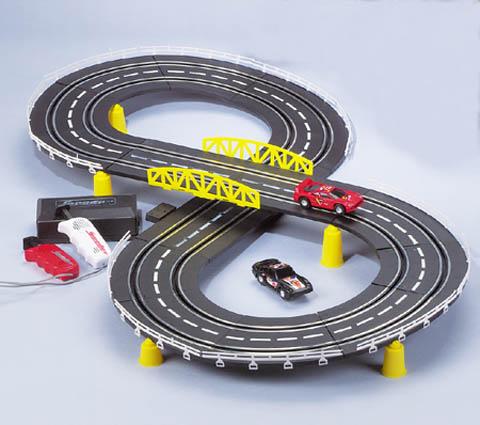
Sunday. Hours of football, a Lakers game and even a little NASCAR on the television. I'm sure some parents watched the same shows I did today and came up with some great ideas for the holidays.
Know what Junior would love? Racetracks!
Get them socks instead.
Two of the coolest Christmas presents the people formerly known as Santa got me as a kid were an electric football game and a toy racetrack. I begged Santa for the gifts and his human helpers came through as always.
They were also the two most frustrating gifts I ever received. Hours of setup, followed by days of frustration and disappointment. It took a few months, or maybe only a few weeks, before each found a home in a basement closet. Every few months we brought them out of hiding and tried them again, only to be met with more confusion and angst. How could two toys that held such promise, that promised hours of fun, deliver so little?
Start with the racetrack. I've never been a big NASCAR or Indy fan. But like every kid I loved toy cars. Along with army men, they're the two toys every male child craves. A racetrack is the next step. Mine looked like the one above. A standard figure-eight with an underpass.
We first set it up on the basement floor, before realizing that carpet fibers are as dangerous to a racetrack as they are a murderer's alibi on CSI. The operation moved to the ping-pong table. There we lovingly pieced the black parts together, eager to finish so we could watch the tiny cars race around it at incredible speeds. Just like in the commercials!
Problems developed immediately after completion of the construction. As the two cars lined up in their tiny grooves - which were already being attacked by dust particles, disrupting the too-fragile ecosystem - inevitably one of the remotes would malfunction. I pushed the trigger and the yellow car sat there, stalled like my old Mercury Zephyr on the side of the road. As if it was just taunting me before, the car fired down the track the next time I pressed the button.
And they're off!
Each car usually made it about four seconds before flying off the track. At first it's an exciting crash, as we were as bloodthirsty in the basement as any drunk NASCAR fan in the grandstand. But the ridiculously high accident rate quickly breeds boredom and outright anger. Teenagers on their cell phones have fewer accidents than our tiny racers, through no fault of ours. Blame the manufacturer, blame the engineers, blame the very science behind the product. For whatever reason, we found it nearly impossible to complete more than a lap or two without one of the cars careening over a rail like a Hollywood stunt car. Victory wasn't the goal in a two-car race. We simply wanted to finish a race, whether we designated it to last two laps or five. No matter how delicately we maneuvered the cars through the turns or opened them up on the short straightaway, the cards did what they wanted to do, the dreams and requests of their human owners meaning nothing. We treated the cars like they were driving under a caution flag: no passing. No risks, and no rewards.
Eventually the remotes faltered completely. Press it for half a second and the car might shoot out like a bullet, apparently hell-bent on going from zero to six in .5 seconds. A few seconds later you might hold the trigger down for five, six seconds and get no reaction from the temperamental vehicles. Then, without any warning, the racing gods might smile down and everything came together. The two cars raced around unharmed for several laps, creating that unique burning smell. A tight race like that teased kids and parents, luring them in for a few more hours of supposed fun. But like always, it would all start falling apart again.
It's why I was never really jealous whenever one of my friends received one of those monstrous tracks as a gift. They had multiple levels, loops, a hundred pieces and room for several cars. No matter. The end result was always going to be the same.
But at least racetracks provided some enjoyment. Electric football?

What were the meetings like at electric football headquarters? What was the designer's pitch to the bosses?
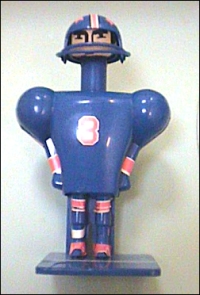
"All right. I've been working with Benson here on a pretty cool game that could drastically change the, pardon the pun, field of electric toys. No, don't worry, the risk of electrocution is almost zero. We're gonna have a little table that will represent the field. Paint it green, put some numbers on it, add some hashmark. Then we have these plastic men who will be the players. Yeah, plastic. The game will last forever. They'll find these figurines after a nuclear war. Anyway, we'll have each guy standing in a different position, so even the dumbest of kids can figure out who they're supposed to be. So for the quarterback, it will be a guy with his right arm sticking straight out, even though a quarterback hasn't thrown like that or even been pictured in such a position since Sid Luckman in the 1940s. A linebacker will be a guy standing slightly hunched, with his arms extended in front. He'll be frozen in position, like the poor people of Pompeii after Vesuvius.
"Now, on the bottom of each player will be a little controlling feature. You move it one way and the player shuffles forward. Move it another and he'll 'run' a different direction. Here's where it gets good: The field vibrates. Yeah, like one of those beds at those motels Henry's always taking his secretary to. Heh, just kidding, Hank. It will shake violently, as if the field's at the epicenter of a 10.0 quake in San Francisco. Kids will love listening to the sound. They'll think the field's about to explode. And depending on how they've arranged their players and the controls, the vibrations will cause the players to move. It'll be 11 on 11, so for those 22 players, the kids will have to spend about 25 minutes per figure setting their control up for each play. We're looking at a game that will last a minimum of 11 hours. With this, we really think we can cut into the monopoly Monopoly has on games that take an entire day to complete.
"Nothing will really happen after the vibrations. See, the controls at the bottom are actually meaningless, meant to distract the child. The players will spin in a circle. Sometime they'll fall down for no reason, almost as if they're afraid of contact. The linemen will move downfield on a pass play, committing an obvious penalty. The running backs will just vibrate up and down, almost like they're suffering a side effect from some some untested medication. It'll be impossible to actually pass the ball or even conceive how a pass is supposed to be executed or completed.
"We'll have twenty-two plastic figures congregated in a small circle at midfield, vibrating incessantly, confusing everyone who might think it's actually a toy rugby game. But I'm telling you, that vibration is hypnotizing. Parents see it in a store and can't resist. Kids hear it and think something cool is happening, even when nothing's taking place on the field. They'll start giving the game pet names, like Old Sparky, even when they have no idea how it actually functions or what the plastic men are supposed to do on the field.
"In two years we're expecting that 98 percent of all American children will have this game. And about 1 percent of those kids will have succeeded in actually scoring a touchdown in the game. World Cup soccer games will have more scoring. With this game, we can help raise the next generation of defensive coordinators.
"In fact, we're so confident that not a single person will know how to control the plastic men, that we're going to give the first child who provides documented proof of an actual touchdown a free racetrack as a reward.
"Now, if you'll let me show me the prototype for the hot new toy of next season. We call him Super Toe. Kids are going to LOVE this."
Monday, October 19, 2009
The Heidi Game Part 2

On November 17, 1968, the famous Heidi Game took place between the Jets and Raiders, when their AFL clash was interrupted before its conclusion by NBC's airing of the movie Heidi. The network broke into the game with 65 seconds left and the Jets leading 32-29. Oakland rallied for a 43-32 victory, and the game - and the outrage that followed from fans who were unable to see the dramatic ending - changed the way networks cover sports. That change was networks finally understood that sports rule America and TV and we don't care if 60 Minutes has to start at midnight, do not interrupt the late football games.
The game was such a fiasco that its Wikipedia page contains about 5,500 words. There are some one-term U.S. presidents - or at least some treasury secretaries - who don't have that many words devoted to them.
I wasn't alive for that game. Fortunately, CBS recreated the experience today.
The Vikings and Ravens played at 1 p.m. on the East Coast. I taped the game as I was with my parents at the Metropolitan Museum of Art for most of the afternoon. When we returned, I set the tape to the beginning. We settled in, avoiding the Internet and the late games so the outcome remained a mystery. Such an old-school feeling; it felt like 1990 all over again.
Vikings struck first. Then again. The game looked like a rout as I fast-forwarded through inane commercials, punts, kickoff returns and at least some of Dan Dierdorf's weighty pontifications, the best of which came after two failed running plays near the goal-line for the Vikings.
"If the offensive linemen could vote, they would vote for another running play, I'm telling you." If true, we should begin to immediately disenfranchise the hogs. Strip them of their right to vote, whether it's for a city council race or a play in the Red Zone. Dierdorf - a former lineman who knows how the big guys up front think, and that's the problem - wanted the Vikings to give the guys who had just failed twice another chance. Fortunately they didn't and Favre threw a touchdown pass on the next play.
Even into the fourth quarter the outcome seemed certain. Then the Vikings defense began its collapse and Baltimore scored with ease on three straight possessions. Shockingly, the Ravens now led. The Metrodome hadn't been that quiet in, well, a week. Fans were probably wondering, what was worse: the Vikings defense or Nick Punto's baserunning?
I was tempted to turn to one of the late games to see what the outcome was, but we'd already gone this far. Favre led them down for another score - another field goal - and we went into commercial with the Vikings leading 33-31 with less than two minutes remaining.
Seconds before that field goal, some of the late games started showing up on the CBS scroll at the bottom of the screen. A thought occurred.
"You know, the Jets are the late game on CBS. They might have cut away from this game if it ran late. We might not see the end of it."
My parents didn't even have time to process the information.
Thirty seconds after I said that, CBS broke away from the game. Instead of an adorable little Swiss girl appearing on the screen, it was a car commercial. My prediction had come true. Seconds later, the Jets and Bills game started their fiasco of a game as I sat with my parents, staring in stunned silence at our television. I fast-forwarded through the soothing voice of Dick Enberg and read the scores on the scroll. Finally the Vikings-Ravens game appeared.
Minnesota 33, Baltimore 31. :02.
Two seconds left. If the game stopped at two seconds, that probably meant the Ravens were going to try a field goal.
Good lord, the Vikings had again allowed Baltimore to march down the field? All we could do was speculate. I could already picture Joe Flacco sprinting up to the line to spike the ball as Dierdorf brags about poise and unflappability and the voting records of left guards. Oblivious to what was going on, we sat at the mercy of whatever underpaid office drone CBS placed in charge of updating its scroll.
We waited for the scores to cycle through again. Steelers-Browns. Redskins-Chiefs...Giants-Saints.
Minnesota 33, Baltimore 31. Final.
Final. They somehow held on.
A minute later, Dick Enberg sent it back to JB in the studio for the highlight and, indeed, the Ravens missed a field goal.
Here's what we didn't see live or on tape but did see as a highlight of a taped event, three hours after it actually happened.
The ending didn't lack for drama, even if it was one of the strangest endings any of us had seen. Or, in this case, not seen. It somehow added even more excitement.
The most frustrating experience I had with following a game without access to a television came about ten years ago. Stuck in my car on a long road trip, I picked up ESPN Radio's NFL show, where the hosts throw the games to various correspondents around the league. Or they introduce a score with bold, end-of-the-world announcements like, "Ladies and gentlemen. You will not believe what happened in the Browns-Chiefs game just moments ago."
What? What? Someone completed a pass? Eric Mangini smiled? The middle linebacker tackled a drunk streaker?
That announcement's usually followed by the reporter at the game saying, "Tim, Cleveland kicks a 24-yard field goal and leads 3-0 with 10:25 remaining in the first quarter. Back to you."
Thanks.
But on this day, I was trying to find the Cowboys score as they played the Eagles. Dallas led all the way. Then the hosts updated the game in the fourth quarter by saying Philadelphia had managed to cut into the lead and it was now a one-possession game.
I drove for 10 more miles with no more updates. The hosts bantered back and forth in that grating way that only talk-radio hosts can do, refusing to give their listeners what they really wanted.
"Whoa!" one suddenly said.
"I don't believe it," added the other.
"Folks...wow."
"Wow."
What in the hell? Were they watching the Hindenburg go down? Or had something happened in the Cowboys game?
"What a game in Philly. The Eagles...the Eagles have...wow."
SPIT IT OUT!
The host took us to Philly. The local reporter breathlessly provided an update over the screaming crowd in the background. The Eagles rallied from 10 points down in the fourth quarter and defeated the hated Cowboys.
Bad news somehow gets worse depending on the way it's delivered. If I have to watch a favorite team lose in the comfort of my own home, where couch cushions, pillows and non-fluffy items can be thrown whenever I see fit, I can deal with it a bit better. Having to listen to Edward Murrow wannabes breathlessly spit out the results while studio hosts crack wise about their co-host's lack of dieting skills makes the entire experience about a hundred times more frustrating.
I turned the station in disgust. If I had a cell phone on me I would have called Delilah and asked for a special song to make everything right, something about loss and love or recovery.
There was no such ultimate frustration tonight. Technology lost, but the Vikings won.
Tuesday, October 13, 2009
When Catholic schools pretend to not like each other
This Saturday, my alma mater, St. John's, faces St. Thomas in a key football game that will likely decide the MIAC title. More importantly, it's a renewal of the Tommies-Johnnies rivalry, which has been playing out on the football field since 1901.
Students of both schools use the game as a prime chance to mock the other institution. St. Thomas students love wearing crude T-shirts that often reference the fact St. John's is an all-male school, and if it's only guys there at the secluded university in the middle of Minnesota, and there aren't any girls around, then, wink, wink, nudge, nudge, the students at St. John's are...well, you know. Wink, wink. Nudge, nudge. No one ever accused St. Thomas grads of having the comic subtlety of Steven Wright.
To counteract those barbs, St. John's students sometimes sport shirts that politely question the beauty of St. Thomas's female students, while also predicting fine futures for Tommie grads that will likely include tours of duty behind the counter at various fast-food franchises.
On the field, St. John's almost always wins. The Johnnies are unbeaten against St. Thomas since 1997, and St. John's is a perennial national contender, led by John Gagliardi, college football's all-time leader in victories. Most years, St. Thomas is nothing but a purple punching bag, more prop than competitor.
Tommies hate Johnnies and Johnnies hate Tommies. Oh, we hate those swell Tommies. Generation after generation of graduates learn those lessons, and they're nearly as important as anything their professors teach in business class or a chemistry lab.
Ultimately it's all pretty harmless, although there are those who really do get worked up if a child chooses to go to a different school than the parent. But, like most rivalries, especially in college, it's all fairly ludicrous. Rationally, it hardly makes sense for there to be any disdain, as the schools are the same in countless ways.
They're both Catholic institutions, but both schools have many students from other faiths. Both have stringent Catholics and those who can already be called "lapsed." St. Thomas is named after St. Thomas Aquinas, while freshmen at St. John's live in Tommy Hall, also named after the favorite theologian of Catholics everywhere. There, as first-year students, they're indoctrinated into why even God agrees it's all right to hate St. Thomas - the school, not the man. Maybe that was part of my problem. As a transfer student from a community college, I never got the early propaganda and only built up a dislike over two years.
Average class size? 21 at St. Thomas, 22 at St. John's (score one for the Tommies). The student/faculty ratio at St. John's is 12:1, compared to 15:1 at St. Thomas (score one for the Johnnies).
Many who attend St. John's seriously considered St. Thomas, and vice versa. For many, including myself, it's the location of each that helps seal their decision. St. John's is located in Collegeville in central Minnesota, situated in peaceful surroundings, with woods and water providing picture-perfect moments.
 St. John's seemingly exists in its own world, about 70 miles from the Twin Cities. St. Thomas, meanwhile, calls St. Paul home, perfect for students who prefer their college life in a real city, giving them the types of opportunities unavailable to the St. John's kids going to school in the country. The odd thing about many St. John's people who denigrate the city existence of St. Thomas is that many come from the Twin Cities, while those who ridicule the isolation of St. John's now that they're Tommies are veterans of the rural life.
And St. Thomas - the largest private university in Minnesota - has nearly 11,000 students in its undergraduate and graduate programs while St. John's has an enrollment of 4,000. That's the enrollment with its sister school, the College of St. Benedict. While St. John's is, indeed, still an all-male school, in many ways that's in name only. They're partner schools. Men and women share classes, libraries, campuses, and carnal relations.
St. Thomas and St. John's have much in common, siblings nearly themselves, right down to the nicknames of each. Add an extra consonant and "ies" to the end of the name and slap it on the uniforms. Disliking one just because you go to the other seems almost like an act of self-loathing. But then, it's like that with so many rivalries. Harvard-Yale. Michigan-Ohio State. Army-Navy. The similarities of the schools and student bodies dwarf any perceived differences.
St. John's hating St. Thomas is like America considering Canada to be its biggest rival and most dangerous threat.
What's a real rivalry? With real reasons for hatred? How about the India-Pakistan cricket battles? Here you have two nations who threaten each other with nuclear destruction. When the athletes meet - Hindus vs. Muslims - it's for a bit more than bragging rights.
Yeah, but do the fans wear T-shirts with witty sexual innuendo?
So, rationally it doesn't make sense for St. John's and St. Thomas to be such rivals. Where's the enmity come from, and why?
But this is sports and specifically football and rational thought doesn't have much to do with it. I see the purple of St. Thomas and my stomach churns, even if in high school I did contemplate what life would be like on the St. Paul campus. I listen to a St. Thomas graduate and I hear an arrogance that seems unique to Tommies. I see their T-shirts and read their insults about St. John's and pity the thinking that passes for creativity at St. Thomas.
If St. Thomas actually does what it never does and beats St. John's this Saturday it will ruin part of my day, in a way a loss to any other team wouldn't.
It's illogical, nonsensical.
In the end, that doesn't matter. It's the Tommies, and they're not Johnnies, even if they are alike in so many ways. It's the Johnnie-Tommie game, with the winner being the favorite for the conference.
A rational rivalry, no. But what fun would that be?
Average class size? 21 at St. Thomas, 22 at St. John's (score one for the Tommies). The student/faculty ratio at St. John's is 12:1, compared to 15:1 at St. Thomas (score one for the Johnnies).
Many who attend St. John's seriously considered St. Thomas, and vice versa. For many, including myself, it's the location of each that helps seal their decision. St. John's is located in Collegeville in central Minnesota, situated in peaceful surroundings, with woods and water providing picture-perfect moments.
 St. John's seemingly exists in its own world, about 70 miles from the Twin Cities. St. Thomas, meanwhile, calls St. Paul home, perfect for students who prefer their college life in a real city, giving them the types of opportunities unavailable to the St. John's kids going to school in the country. The odd thing about many St. John's people who denigrate the city existence of St. Thomas is that many come from the Twin Cities, while those who ridicule the isolation of St. John's now that they're Tommies are veterans of the rural life.
And St. Thomas - the largest private university in Minnesota - has nearly 11,000 students in its undergraduate and graduate programs while St. John's has an enrollment of 4,000. That's the enrollment with its sister school, the College of St. Benedict. While St. John's is, indeed, still an all-male school, in many ways that's in name only. They're partner schools. Men and women share classes, libraries, campuses, and carnal relations.
St. Thomas and St. John's have much in common, siblings nearly themselves, right down to the nicknames of each. Add an extra consonant and "ies" to the end of the name and slap it on the uniforms. Disliking one just because you go to the other seems almost like an act of self-loathing. But then, it's like that with so many rivalries. Harvard-Yale. Michigan-Ohio State. Army-Navy. The similarities of the schools and student bodies dwarf any perceived differences.
St. John's hating St. Thomas is like America considering Canada to be its biggest rival and most dangerous threat.
What's a real rivalry? With real reasons for hatred? How about the India-Pakistan cricket battles? Here you have two nations who threaten each other with nuclear destruction. When the athletes meet - Hindus vs. Muslims - it's for a bit more than bragging rights.
"The phrase sporting event can't begin to contain the religious extremism, unforgiven deeds and rabid jingoism that swirl around each India-Pakistan cricket match; the game is haunted by battle dead, and the air is charged with the ongoing dispute between the two countries over control of Kashmir."
Yeah, but do the fans wear T-shirts with witty sexual innuendo?
So, rationally it doesn't make sense for St. John's and St. Thomas to be such rivals. Where's the enmity come from, and why?
But this is sports and specifically football and rational thought doesn't have much to do with it. I see the purple of St. Thomas and my stomach churns, even if in high school I did contemplate what life would be like on the St. Paul campus. I listen to a St. Thomas graduate and I hear an arrogance that seems unique to Tommies. I see their T-shirts and read their insults about St. John's and pity the thinking that passes for creativity at St. Thomas.
If St. Thomas actually does what it never does and beats St. John's this Saturday it will ruin part of my day, in a way a loss to any other team wouldn't.
It's illogical, nonsensical.
In the end, that doesn't matter. It's the Tommies, and they're not Johnnies, even if they are alike in so many ways. It's the Johnnie-Tommie game, with the winner being the favorite for the conference.
A rational rivalry, no. But what fun would that be?
Saturday, September 26, 2009
College football in upper Manhattan

With perfect weather in New York today, I went to Columbia University's first home football game of the season.
Although this isn't a picture of the stadium from today's game against Central Connecticut State, the crowd was pretty similar.
Actually there were 3,000 people in attendance and the stadium, nestled in northern Manhattan in a picturesque setting near the Hudson and Harlem Rivers, is a great place to watch a game. It's Lawrence Wien Stadium, but the field itself is named after Robert Kraft, the owner of the New England Patriots and a Columbia grad who only had to give up $5 million for the naming rights. Technically, the entire complex is called Robert K. Kraft Field at Lawrence A. Wien Stadium at the Baker Field Athletics Complex. With any luck - or a donation from another NFL owner - another "at" could be added along with a fourth name, perhaps a new parking lot or a men's bathroom could be named in honor of the donor.
We live a block from the stadium, which has been home to Columbia football since 1984. Before that the team played near its campus at 116th Street, where a decent future baseball player named Lou Gehrig was a standout fullback for the Columbia football team. But since winning the Ivy League title in 1961, Columbia's had just three winning seasons, although it still managed to become a nationally known program. Between 1983 and 1988, Columbia got sand kicked in its face on a regular basis by fellow Ivy League nerds and lost 44 straight games, a Division I-AA record at the time.
I blame the baby-blue uniforms, which fail to intimidate the opposition and sedate the Columbia players.

A game at Columbia doesn't exactly rival a contest in the Swamp in Florida as far as intensity and atmosphere. Then again, while Columbia hasn't produced anyone like Emmitt Smith or Tim Tebow on the field, Florida hasn't produced four U.S. Presidents, nine Supreme Court justices, 96 Pulitzer winners and 78 Nobel Prize winners. But who's counting?
I went to the game with my friend Chris, a Dutchman who only started watching football the past couple of years. He's already as passionate about the Giants as any born-and-bred New Yorker with a stereotypical accent who paints his face on Sundays and was raised on tales of Y.A. Tittle and Lawrence Taylor. He's become a true football fanatic. This was his first time attending a college game.
We enjoyed $4 hot dogs and $4 cups of soda and found a seat near the 30-yard line, surrounded by no one. The three hours of action that followed were a great representation of five decades of Columbia football. The Lions led 13-0 late in the second half and had dominated to that point. In the first quarter, they stopped Central Connecticut four times from the 1-yard line. Connecticut helped out by calling the same play four straight times - a run up the middle, in an apparent nod to play-calling from the 1950s.
But after going up 13-0, Columbia had its extra-point blocked and returned for a safety. That for some reason turned the momentum and it didn't take long before the awkward-looking 2 on the scoreboard was replaced by a 9 thanks to a late first-half touchdown. Central Connecticut dominated the second half to win going away, 22-13.
In addition to the troubles on the field, the game represented a career low point for whoever the poor soul was operating the scoreboard. On at least a dozen occasions, the exasperated referee announced "Please reset the game clock," as the itchy trigger finger in the booth kept running the clock when he shouldn't and stopped it when it should have kept running. It added a junior high element to a high-level college game but somehow seemed fitting for the poor Lions. Columbia's now 1-1.
The sparse crowd began filing out with about 2 minutes left in the game and the outcome decided. We stayed until the end. It's not big-time college football, but it is live college football and on a day with perfect weather, it didn't make sense to leave early.
I'll go to their other home games this season.
Columbia will fight another day. And on that day they'll probably lose. But there are worse ways to spend a perfect Saturday afternoon in northern Manhattan.
Sunday, September 6, 2009
105-0
Six years ago today, Rockford defeated Trinity Bible College 105-0 in the season opener for both teams. The game was my introduction to Trinity. At the time I was working at The Forum newspaper in Fargo. Despite the fact Trinity was in the same state, I had never heard of the school and neither had many others in the newsroom. In fact, when we first saw the score on the wire, we talked about it for a few minutes before realizing Trinity was located in Ellendale, near the South Dakota border.
A few days later the sports editor suggested a feature on the school, to try and figure out what the program was all about.
This is one of the stories that came out of that trip.
I continued to follow the team's travails that season. And a year later, I wrote to several publishers, pitching the idea of a book on Trinity's program. The result, obviously, was Keeping the Faith: In the trenches with college football's worst team. In the years since, Trinity's fortunes haven't changed.
Trinity kicked off its 2009 season last week, falling to Haskell 53-12. On Saturday, Minnesota-Morris defeated Trinity 49-0.
Most of the people I wrote about in the book are now gone from Trinity, from head coach Rusty Bentley to assistant coach Eric Slivoskey. One of the characters in Keeping the Faith, quarterback Dusty Hess, is now an assistant with the team.
Here's Trinity's schedule for 2009.
Coach Slivoskey eventually served as the team's head coach for three seasons before leaving at the end of last school year. A devoted world traveler, his newest adventure took him to Finland, where he coached a team over the summer and blogged about it at Coaching out of Bounds.
Every year brings new questions about the future of Trinity's program, with doubts always being raised about the viability of having a football team at such a small school. As long as they do have a program, I'll certainly be following closely. The results, though, probably will never change much.
A few days later the sports editor suggested a feature on the school, to try and figure out what the program was all about.
This is one of the stories that came out of that trip.
I continued to follow the team's travails that season. And a year later, I wrote to several publishers, pitching the idea of a book on Trinity's program. The result, obviously, was Keeping the Faith: In the trenches with college football's worst team. In the years since, Trinity's fortunes haven't changed.
Trinity kicked off its 2009 season last week, falling to Haskell 53-12. On Saturday, Minnesota-Morris defeated Trinity 49-0.
Most of the people I wrote about in the book are now gone from Trinity, from head coach Rusty Bentley to assistant coach Eric Slivoskey. One of the characters in Keeping the Faith, quarterback Dusty Hess, is now an assistant with the team.
Here's Trinity's schedule for 2009.
Coach Slivoskey eventually served as the team's head coach for three seasons before leaving at the end of last school year. A devoted world traveler, his newest adventure took him to Finland, where he coached a team over the summer and blogged about it at Coaching out of Bounds.
Every year brings new questions about the future of Trinity's program, with doubts always being raised about the viability of having a football team at such a small school. As long as they do have a program, I'll certainly be following closely. The results, though, probably will never change much.
Subscribe to:
Posts (Atom)