Showing posts with label Inwood. Show all posts

Saturday, November 20, 2010

A meandering, disjointed, unfocused ode to New York


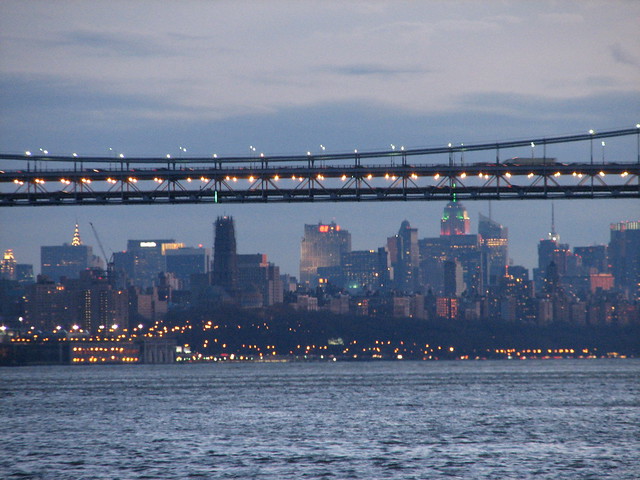
Every night after work I sit in the rear of a New Jersey Transit bus and cross the George Washington Bridge. Tonight, like it will be for the next several months, it was dark as the bus barreled over the bridge, and the New York City skyline looked something like it does above. There's really not any view like it in the world; the only rivals might be from other New York City bridges. I'm often grouchy or annoyed on the trip home, depending on how long everyone had to wait for the bus to arrive. Still, I try to look out the window most nights to gaze south. Maybe native New Yorkers get used to such views and maybe transplanted New Yorkers are too cool to appreciate the view, but more often than not, I still find myself looking at it with the same wonder I had the first time I drove over it in February 2002. At least these days I know where I'm going.

I've been in New York City six and a half years now, and I still don't fully appreciate where I live. Maybe I never will. But it's not because of laziness or complacency or indifference. It's simply that a person could live here for a hundred years and venture out every day and they still wouldn't have enough time to soak in all of the history that's a part of the city.

So much has happened here. So much still happens. So much will happen. Remembering how I walked around the city my first few weeks here, my head tilted back, looking up, only needing a fanny pack to complete the caricature of the type of tourist longtime New Yorkers love to complain about, it's hard to believe that it's only taken six years for me to get used to the fact this is now my home.

Last Sunday, about 20 blocks south of our apartment, dozens of people dressed up in strange garb to re-enact an event that happened three centuries ago. November 16 was the 234th anniversary of the Battle of Fort Washington, a key fight in the Revolutionary War that saw the Brits rout the Americans. It was a crushing defeat for the Continental Army, but being that the people in this country can now read about Prince William's upcoming nuptials but don't have to worry about one day being ruled by him, you know that it was not a decisive victory for the Brits.

The Battle of Fort Washington isn't among the most well-known battles in American history, but maybe that's because the wrong side - depending on your accent - won. Still, it's a vital piece of history, a crucial battle that was followed by some of George Washington's greatest victories. And it happened three subway stops from our apartment. Cool.

I can walk five minutes and be on the spot where the Dutch bought Manhattan, an event that changed the fortunes of millions, for better and worse. It practically took place in my backyard - a backyard I, of course, share with tens of thousands of people.

Sometimes it takes a movie to remind me that I live in Manhattan and that I always dreamed of living here but never thought it'd happen, especially after my first attempt failed. We'll be sitting in the theater and New York appears on the screen - perhaps as the setting for a horrible romantic comedy, perhaps while being destroyed by an asteroid or tsunami - and I think, hey, we live there. Millions of people across the world are watching the same thing in different theaters and are thinking about New York's size and chaos and regard it as more of a character than a real city where real people live.

The city can be exhausting, especially on weekends when the subways aren't running on a normal schedule and the lines that are running are improbably crammed even more than usual. The city's not just a museum. People live here and struggle here, fighting traffic, rats, garbage, pollution, neighbors, cockroaches, bed bugs, terrorist threats and ridiculous rents. With all of that, it's easy for a person to forget what drew them here: the lights, the opportunities, the culture, the people, the sites, the sounds and, yes, the history, whether it's the Met or a long-ago battle fought before the United States was even really a country.

I do my best to appreciate the history of any place I visit, so I certainly try and appreciate the history of New York. It's easy to get distracted or caught up in the present. But I want to remember the city's past because that's why I originally dreamed of coming here and is part of the reason I stay here. The myths and the legends helped bring me here.

Right now thousands of people of all ages are dreaming of coming to New York, whether for a week or a lifetime. They want to escape their problems or seize an opportunity. They want to climb the skyscrapers or party underground. They're dreaming of New York. They're dreaming about my home. And that I do appreciate.


Monday, November 1, 2010

Chin up: The futile quest for the presidential fitness award

On the way home tonight, I walked past the restaurant that's about half a block from our building. Construction scaffolding stands in front of all the buildings along the row. Tonight, for about the third or fourth time in the last two months, I walked past a guy performing gymnastics on one of the scaffolding bars. It's been a few different men. Tonight's participant was about 35. Muscular. Goatee. Black sweatpants.

Like the others, he did his best Mary Lou Retton routine, swinging along a higher bar before gracefully dropping to a lower one. The judges all gave him 9.0, except for the Russian who handed out a 7.2, much to Al Trautwig's dismay. The guy tonight took a break from the low-wire theatrics to work on his pull-ups. He eased up and down, all the while making eye contact with pedestrians, especially a couple of females. Forget picking up women at a bar, online or in a church. Why woo with words when you can awe them with feats of strength on construction equipment? The gymnastics are impressive, though at this stage in his life where's he going with the skills? While male Olympic gymnasts are older than their 15-year-old female counterparts, he's way past his prime. Perhaps he could be used in a large-scale robbery, at a Vegas casino or a Boston bank, someplace with a laser-secured vault that requires a trustworthy man who's good with a gun and knows how to keep his mouth shut while sneaking into small spaces.

While I'm not entirely sure what this man gets out of his current exploits, I have no doubt that he won a Presidential Physical Fitness Award when he was 11 years old. Every school kid remembers taking the fitness test, striving for that mystical 85th percentile. The 85th percentile. A magical phrase. Percentiles held such power as a kid, whether it was in the Iowa Basics or the presidential fitness test. I envied the kids who achieved this award. A Medal of Honor wouldn't have impressed me as much at that age.

Sit-ups, pull-ups, distance run, sit-and-reach and the maddening shuttle run. Those were the events. Until about fifth grade, I dominated in nearly all of the events. Through fourth grade I was one of the fastest kids in our class, chasing down the slow-moving targets during tag. I managed a respectable number of chin-ups and always cruised through the sit-ups. Then something happened. I lost speed. I lost strength. My flexibility stopped improving and never got any better after that. I no longer had a shot at earning the president's praise for my physical fitness.

The shuttle run seemed like the most unfair event. Our little gym's floor tormented runners, as if an ice rink resided beneath the shoddy wood surface. It was impossible to stop to pick up the little bricks before turning around and speeding toward the other one. That's one excuse I used, anyway.

But chin-ups remained the most humiliating event, from the time I was 12 until the day I turned 18. In a shuttle run, no one can really see just how slow you are. You're talking tenths of a second. Sit-and-reach? Who cares? Everyone - except future cross country stars - hates the mile run. But chin-ups, they're you're out in the open, exposed, dangling from the bar, kicking, grunting, groaning, straining, fighting, weeping, quitting. How long would you hang there before finally giving up? A minute? Two? Occasionally I got away with one pull-up, by doing the jump-up-and-count-that-as-one-and-hope-the-teacher-doesn't-notice trick. The snickers echoed through the gym as your body swayed and your arms shook from the strain. You weren't just disappointing yourself and your parents. You were letting down the president. You were letting down your country. I remember one year they changed it so your palms were no longer facing you, making it even tougher.

An 11-year-old boy is supposed to be able to do six chin-ups. What's the point? What's this measuring? What's the shuttle run measuring, other than shoe traction? Why didn't the president make free throw shooting part of the challenge, or track the speed of a 12-year-old's tennis serve?

I didn't get any stronger in high school, at least not in categories that could be measured with a chart. I had the upper-body strength of a patient who's spent two months in a hospital bed. Only the muscular and light thrived, along with anyone in the wrestling program. An average kid with an average physique didn't stand a chance.

In high school we had a kid who could do like a dozen chin-ups, but on each one he slithered up to the bar, his long red hair wiggling back and forth. It remains the most unique style I've ever seen, not that I've witnessed many chin-up competitions since high school graduation. It was a snake technique and for all I know the president eventually banned it. At first we all laughed, but he quickly earned our respect, especially those of us who remained in the hanging group. Who the hell were we to laugh at anyone?

The fitness challenge isn't just for children. Adults can torture themselves, too. There's apparently an adult fitness competition, but it looks like chin-ups are not part of it. Sit-ups remain, and you can do push-ups to measure strength. Too bad about the chin-ups. It'd be a great way to relive some childhood memories. Find a construction site, round up some local teens who can gawk and verbally mock you, and put on an ill-fitting shirt that rides up as you hang helplessly in the air while your pale stomach dangles over your shorts.

Go for that 85th percentile. Do it for your health. Damn it, do it for your country.

Monday, July 26, 2010

Lightning and other natural disasters in New York


Two really cool videos taken in New York City on Friday night. The first one shows the most famous skyline in the world being lit up with the type of storm you normally associate with the plains of Oklahoma or the prairies of Minnesota. The second video shows the lightning bolts emerging from the sky, followed by the torrential rains that blanketed the boroughs. It's the types of scenes that conjure up words like apocalyptic, at least when they happen in New York. The storms rolled through the city shortly before 9 p.m. I boarded a bus in New Jersey at 8:10 p.m. and was on the A train in Manhattan by 8:35. It was dry in Jersey. By the time I stepped out of the subway at 207th Street in upper Manhattan, the rain had started to fall.

Because I forgot an umbrella when I left the house nine hours earlier, I cursed the gods and my own incompetence. I stopped at McDonald's to pick up some dinner. By the time I stepped out of the restaurant five minutes later, the rain had turned into a downpour. Lightning decorated the sky in every direction. By the sound of the thunder, it seemed like the storm was centered directly over Inwood, maybe over the local 99-cent store, maybe over our apartment building. I'd never seen a storm like this during my time in New York. It reminded me of the storms that precede tornado warnings in Minnesota. The cities hit the sirens, meaning it's time to find a basement, though many people use them as a signal to step out on the porch or into the car to see what all the excitement's about.

"Wanna go find the storms?" is an actual question sober people ask their friends and family.

With my McNuggets and fries jammed into my black bag, I sprinted six blocks to our apartment, avoiding puddles while searching the sky for bolts. An ear-piercing thunder strike - which brought about cries of "Holy Shit! Let's get into the subway!" from a group of four cowering men - actually made me jump higher than I have since grabbing a rebound my senior year of basketball.

My run took me past a city park, which means my run took me under some trees, which means my run freaked me out for about 30 seconds. Good god, do not go under a tree during a storm. How many times have I heard that over the years? A hundred? Two hundred? I finally made it home, soaked but safe. Only later did I learn that a woman got struck by lightning around this same time in the Bronx. A man got drilled in Brooklyn. Both, fortunately, survived. Only later did I learn that there had actually been a tornado warning issued for New York City, an occurrence that is seemingly as rare as a hurricane warning for Minneapolis. But tornadoes have actually hit the city. A twister did severe damage to Brooklyn in 2007 - the first tornado to hit Brooklyn since 1889. There have been some brief touchdowns in Staten Island. Manhattan seems immune.

Except in the movies:


Are trailers about scary movies supposed to look and sound like an Onion News Video?

There were no tornado terrors in NYC on Friday night, but it was as close to the real thing as possible, minus the funnel clouds.

One thing I actually love about living in New York is that we are, for the most part, immune to natural disasters. We're in Manhattan, so we should be safe from tornadoes. Even Hollywood has only been able to come up with laughable scenarios like the one above to document the threat. If it did ever happen and you were going to describe it as being something out of a movie, you'd have to be much more specific: "It looked like something out of that hideous 2008 movie starring Nicole de Boer."

Experts always say a hurricane could one day strike New York. Call me complacent or naive, but hurricanes still aren't something I worry about. Blizzards hit the city, but during my six years in New York I've learned that if you don't have to drive in the treacherous weather - and driving through whiteout conditions in rural Minnesota is often a great time for internal conversations like, "God, if you do exist, and you get me out of this alive, I promise to live a better life" - blizzards really aren't too bad. We don't worry about earthquakes or tsunamis.

We're safe from natural disasters here. Man-made horrors delivered by terrorists are another story. But even with those I operate on the assumption that it's pointless to worry about something that's out of my control and I fear those as much as I fear a tornado strike. Being naive is occasionally a good way to go through life.

I've often thought about where the perfect city would be to avoid natural disasters. Minnesotans loathe blizzards. They fear being caught on the road during one and swear at meteorologists who deliver news about them, but they accept them as a part of life. You usually have two or three days warning. When they survive them, they talk about the storms with pride, or compare them to blizzards from two decades earlier so they can say, "You know, when I was younger, our blizzards were ten times worse than this. This was nothing." But tornadoes terrify. They can emerge from nowhere, and the damage can be totally random. Tornadoes have completely destroyed small towns, flattening every home and business. But they can also hit larger cities and crush an entire neighborhood, while leaving one house standing in pristine condition. For the first seven years of my life we didn't have a basement. When the Janesville sirens blared, we hustled into the car and drove to my dad's aunt's house. There we huddled under the pool table, riding the storm out. Basements feel safe. But while they can protect human life, they do nothing to prepare people for the heartbreaking damage they often encounter above when they emerge from below.

The entire Midwest faces these threats. So they're not ideal places to avoid natural disasters. Earthquakes, to me, are even more frightening. The randomness, the potential for collapses - from buildings and the ground. The stories we keep hearing about "The big one" that's bound to hit. Add it all up and the West Coast is no place to live, for those seeking to avoid Mother Nature's wrath. The south has its hurricanes. Idaho and Montana have...whatever Idaho and Montana have.

In the end, New York City is probably the best place for avoiding all of that, for avoiding earthquakes and hurricanes. It's the best place for dealing with snowstorms and it's the best place for avoiding tornadoes. At least, that's what I'll tell myself the next time I'm sprinting through lightning strikes and downpours.

Friday, April 16, 2010

Inwood: We're No. 31!

Nate Silver - whose official name changed to Renowned Statistician Nate Silver sometime after he came close to perfectly predicting the 2008 presidential election - ranked the best neighborhoods in New York City for the newest issue of New York magazine. He used precise criteria for the imprecise exercise, relying on things like housing costs, restaurants, schools, safety, transit and diversity. The top spot went to Park Slope in Brooklyn, followed by the Lower East Side and Sunnyside in Queens. There's no trophy awarded, only bragging rights over other New Yorkers. People definitely get defensive about their neighborhoods, as if someone's telling them they have an ugly child.

Inwood comes in at No. 31, just behind Brighton Beach in Brooklyn and a spot ahead of Corona Park. The most surprising ranking to me was the Upper West Side, our favorite place to hang out and Louise's former stomping grounds. Seinfeld, the TV version and the real guy, is among the celebrities calling the neighborhood home. The sites include Central Park and the Museum of Natural History. Silver ranked it only 36th. Of Inwood, the magazine wrote "In Manhattan, but not of it; on balance, less convenient than many neighborhoods in Brooklyn and Queens."

In Manhattan but not of it is a perfect way to describe Inwood. We live on Broadway, the Broadway, but far away from the bright lights and skyscrapers. Inwood doesn't feel like the rest of the Manhattan, but that's also one of its strengths, since it offers things that can't be found in the more famous zip codes.

I disagree slightly with the idea it's less convenient than places in Brooklyn and Queens. For us it's a bit different than some people who live west of us in Inwood, since we're only a block from the 1 train and about four blocks from the A train, a pair of subway lines that take us anywhere we need to go in Manhattan. Getting to the east side is never the most enjoyable chore from where we live. But our commute to the Upper West Side, Times Square and downtown seems more convenient than it is for many people in the other boroughs, who often have to switch trains to get to Midtown.

After six years in the neighborhood, I definitely feel like an Inwoodite, or Inwoodian, depending on your preference. Like a mid-major supporter complaining about his team not being able to crack the AP's top 25 men's basketball poll, I wish Inwood had been ranked slightly higher, but it's not like I'm so upset I'm going to write a letter to the editor or sign an online petition demanding a recalibration of the numbers. Silver did the best job possible objectively ranking something that residents will almost always view in a subjective manner.

Right now it's hard for me to picture us living anywhere else, and I don't just mean in another part of the country. Two weeks ago I walked half a block to the Columbia baseball field for an Ivy League doubleheader. Division I baseball two minutes away, and in the fall football. It's an experience unique to Inwood. About a week before the baseball game, I attended an open house held by Columbia, designed to answer questions about upcoming construction projects the university has planned for the upcoming years. Many residents are upset about the plans. Many of those people attended the open house and expressed their concerns. Their anger rose as they spoke to the Columbia representatives, though their voices rarely did. My friend who works for Columbia listened to all of them with empathy and a smile on his face, even when the insults outnumbered the constructive criticism. I strenuously disagree with the people opposed to the projects but appreciate their passion and concern for the neighborhood. For their home. For my home.

I now feel like a member of the community and not just a resident who fled to Inwood because of ludicrous rent in another part of the city. I track construction projects. I play ball in the area park. I followed the discussions between police and neighborhood people after a series of muggings in a nearby park rattled the area. I stand on the sidewalk and watch workers put the finishing touches on a new sushi joint just down the street, a welcome addition to the neighborhood, even though I'll rarely step foot inside and will rarely, if ever, taste anything on the menu. I look online for cool stories about Inwood, like this one, which focuses on what the neighborhood was like during the depression. And where else can you find a picture like this, at a historical intersection? Only in Inwood.

One of the coolest things about Silver's story is that his formula allows people to tweak the rankings, depending on what's more important to them. If schools are more critical than cheap housing, that can change an area's rating. For Inwood, the big thing in its favor is its parks, whether it's Inwood Hill Park or Isham Park. People who first come to the area can't believe how green it is up here. Last weekend an arsonist set five fires in Inwood Hill Park. I felt protective of the park, and not just outraged at the arsonist. That's our park, in our neighborhood. It's not the best neighborhood in the city, certainly not the coolest. Not everyone even knows it's actually in Manhattan. But it's now our favorite. And it's home. And next year? We're cracking the Top 25.

Sunday, January 10, 2010

Inwood: A hidden gem in the Bronx, make that Manhattan


Some time ago, I took a late-night taxi home from work and gave the address to my middle-aged New Jersey driver.

"Up in the Bronx, right?" he asked while turning on the meter.

"No, it's Manhattan. Inwood."

"Nah, nah, that's the Bronx, not Manhattan."

"I've lived there five years. It's Manhattan. We're a few blocks from a bridge that goes into the Bronx."

At this point he smirked. He shook his bald head slowly side to side, the motion of an arrogant philosophy professor who's now tired of arguing with a freshman student. What could I say to convince him? Perhaps the judicial system's stringent rules could do the job.

"I got called for jury duty in Manhattan. You can't be on a Manhattan jury if you live in the Bronx."

That finally swayed him, but he didn't accept the argument for good until we drove past a pizza joint that's four blocks from our apartment. "My friend owns that place," he said. "Hey, this is Manhattan."

Yes, Inwood is in Manhattan, even if many people who live anywhere south on the island don't really believe it. The neighborhood stretches from Dyckman Street to the south up to the Harlem River on the north and east, and the Hudson on the west. The skyline's not elevated here, but the subway is. Not many tourists visit the neighborhood, unless they're lost. But it's as much a part of Manhattan as the West Village or the Upper East Side.

Inwood is known for its parks, among them Inwood Hill Park. The park, which has the largest remaining forest land in Manhattan, has great views of the Henry Hudson Bridge, softball fields, tennis courts and basketball courts.

And it has this guy.


A year ago this older gentleman walked in front of us as we sat in the park. Moments after stripping down, he climbed the tree with the agility and fearlessness of a 10-year-old going up a newly constructed treehouse. For the next hour, he basked in the sun and the stares. He didn't go hungry, devouring a bag of food that included a healthy balance of meats and oats. Eventually people stopped staring and he blended into the background, just another part of the park and the city.


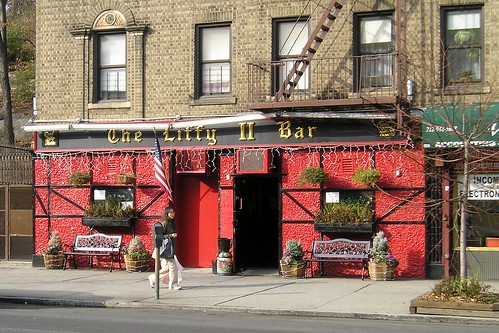
Here's Liffy's, an old Irish bar on Broadway near 213th Street that's often filled with drunks both old and new. There's a karaoke night that packs the house, but usually it's not crowded. The bartenders are friendly and easygoing, as are most of the regulars. They sometimes allow cigarettes inside. If you want to sit and silently drink by yourself, you can. But not always. A Chuck Klosterman acolyte accosted me for a half hour one night, regaling me with tidbits and insight from each of his books, even after I told her I too had read them all. I finally escaped a few moments after she began detailing what she'd do to him and herself if Klosterman "walked through that door right now." Book groupies are a rare species, but just as fascinating as their sport and rock 'n' roll counterparts.

Inwood has been home to a few famous people. Future sky-hooker Kareem-Abdul Jabbar grew up on Dyckman Street. Basketball Diaries author Jim Carroll lived here. So did Houdini's wife (we take what we can get). A few years ago I saw Colin Farrell emerge out of the Irish Eyes bar, where he was filming a scene for Pride and Glory.

These are the famous steps at 215th Street, which connect Broadway to the residential streets to the west. In recent years residents have complained about the safety of the steps, often using words like dilapidated, outdated and decaying, when not simply calling them dangerous. Following the first snowstorm of the year three weeks ago, I walked south on Broadway. A hunched-over lady in her 70s stood in the middle of the sidewalk, motionless, as if she was posing for a portrait. As I approached, she asked if I could help her navigate the 10 feet in front of her, rendered dangerous by the snow and ice.

Holding her arm, I helped her cross the obstacle. Now on dry land, I asked her if she was okay.

"Maybe just a few more feet, if you don't mind."

We slowly made our way up the street, until we were standing in front of these steps. Looking around, I wondered where she had come from, and where she was headed.

"Are you okay now?" I asked again.

Giving a sheepish smile she probably first broke out 60 years ago while wooing the boys, she glanced up at the steps and shrugged her shoulders. "I could use some help up the steps."

She'd manipulated me, physically and emotionally. Seducing me with her feminine wiles and elderly vulnerability, she'd walked me to the brink of the steps while I remained oblivious to her plan. She didn't want me to help her get over a short patch of snow; it was to get me to help her up the 100 steps. We walked up the first flight, with me holding her left arm while she grabbed the railing. Each step was labored, and as tentative as a toddler going down the basement steps. Two flights up, again on dry land, she assured me she could make it up the rest of the way, telling me she does it every day.

"And I live on my own."

I felt a little guilty leaving her, even if the original walk of 10 feet had turned into a 10-minute excursion. But I was also grateful, because who knows how many more blocks she had to go once she reached the top of the picturesque but decaying steps.

For three years, the old Twin Donut store at 218th Street and Broadway remained closed. A blight on the eyes and the neighborhood, its future was always murky. One day someone would see construction workers inside. Then two months would pass with no activity. It looked like a great place for squatters, but few could picture it turning into an actual restaurant again. It was like the haunted house of Inwood, home to outrageous rumors and speculation but no sugar or coffee.

But finally...it did reopen, proving critics and donut lovers wrong. Clean, bright, inexpensive and open 24 hours, Twin Donut's become a fairly popular hangout.


A branch of New York-Presbyterian - the recently renamed Allen Hospital - sits just blocks from us at 220th Street and Broadway.


It's always been reassuring having a hospital this close, although that confidence was dented a bit last summer, when we made our first visit to the facility. Louise cut her foot on some glass so we made our way north. About five hours later, she saw a doctor. By that time I'd left with my nephew, who was visiting from Minnesota. We were there at the height of the H1N1 panic. Folks of all ages littered the emergency room, coughing, sneezing and wheezing into their blue surgical masks, waiting for a doctor or death. It didn't concern me much, but the two germophobes I was with didn't enjoy the experience much. But we'll certainly go there again if need be, especially since it gets Mariano Rivera's seal of approval.

An ad for the Inwood Chamber of Commerce might include the line "All your favorite 99 Cent stores in one neighborhood." One of the best of them just reopened at 207th Street after a devastating fire damaged the building. Louise mourned then, but celebrated its return. Another staple of the Inwood business scene is the banner. Seemingly every new restaurant or shop or hardware store or cafe or deli opens under a parade of celebratory pennants and banners, the kind that usually trumpet great financing deals on new and used cars.

Inwood's home to the Dyckman Court, a perfect spot for hoops fanatics, whether they're players or fans. It's not as famous as Rucker Park, but it's a great spot for playground basketball. Two years ago I went there with my parents on a Friday night for some league games. Fans packed the stands on both sides, as cool of an environment for basketball as anything at the Division I level. Also that night, some guy sitting next to us offered my mom some marijuana. She politely declined.


This shot, from bouncemag.com, is a shot of Inwood's own Kareem, and was believed to be taken at the Dyckman Court in 1969, when the Captain was at the height of his powers. He'd probably still be a decent player at a Friday night game under the lights.


See, Inwood does have it all. Decent rent prices, basketball legends, parks and access to a pair of subway lines. And to the surprise of many, it has a Manhattan zip code.

Tuesday, November 17, 2009

Up close with the George Washington Bridge Bus Station

Every workday I ride the A train four stops to 175th Street, where I transfer to a New Jersey Transit bus located in the George Washington Bridge Bus Station. As New York City commutes go, it's about as painless as it gets. While thousands - millions - of angry, perturbed, tired, confused, beaten-down worker bees spend an hour or much more on the subways or buses, transferring several times, I ride the subway for less than 10 minutes. From the bus station, the good old 186 New Jersey bus takes about 10 minutes to get to work. Still, I give myself 45 minutes to an hour for the trip, as traffic and a late subway or bus can crush any well-intended schedule. By car, the trip takes about 20 minutes if traffic cooperates, though that knowledge only frustrates me when my commute home via public transportation does last an hour.

So I actually spend little time on the subway during the week. Instead, the majority of my commuting time is spent in the confines of the GWB Bridge Bus Station, a terminal located in Washington Heights between 178th and 179th Streets.

And what a terminal.

The higher you are, the easier it is to appreciate the terminal, sort of like a Pink Floyd album or 2001: A Space Odyssey. In this case, it's about elevation, as from above the terminal's unique design captures the eye. From this angle the building looks sleek, almost futuristic.


Pier Luigi Nervi, a famed Italian engineer who also created Rome's 1960 Olympic Stadium, designed the terminal, which opened in 1963. That same year, the building received the Concrete Industry Board's Award, though I didn't see any mention of other contenders for the plainly named honor. Here's an extensive story about the history of the terminal.

That's the history and the architecture. Inside...inside life's a little different, starting with the 175th Street subway stop. Seemingly burrowed even deeper underground than other subway stops, the platform areas attract a decent number of unhinged people.

One night after work, I walked down the steps with a friend. Behind us a lady ranted nonsensically, stringing together unrelated words and thoughts that were impossible to follow. It's a standard sight. But her mannerisms perfectly communicated the idea that she was a person to avoid. As we waited for the train, we heard a gasp and louder yelling. Finally two girls in their early 20s walked past and up the steps, with one of the women holding her cheek, attempting to cover up a growing red spot. The screamer had stopped yelling long enough to slug the poor woman. After hitting her victim, the lady continued walking and talking, as everyone else avoided eye contact. Livened up the commute home.

To get to the waiting area for the buses, you walk up a lengthy tunnel, where performers of varying skill and panhandlers greet you. It's a fairly regular cast of characters, from the kindly guy who simply tells everyone who walks by how good-looking they are - "Hello, there, My Princess... Hello there my good-looking brother" - to the middle-aged man who rests against a wall and softly, politely asks, "Excuse me, sir. Can you help me?" Performers include a saxophone player who sounds like he could play with nearly any band in the country, and an elderly, tough-looking crooner who sings but one song day after day, and sings it poorly. Of the many people at work who have heard him, no one knows the song. The only words anyone understands are, "It's all riiiight. Oh yeaaaah," which he repeats on an endless loop. The saxophonist deserves money and applause. But I've seen the warbler bring in just as much money, perhaps misguided attempts to bribe him quitting for a new career.

Inside the main waiting area, a pair of newsstands share space with a handful of other businesses, including an optometrist's office, donut and coffee shops, and a barber. The biggest crowd each day gathers in the off-track betting parlor. No matter when I walk by, it sounds like someone just hit a Pick 6. The 70,000 people at the 1973 Belmont who stood and wildly cheered as Secretariat blew away the field and completed the Triple Crown didn't show the type of excitement displayed daily at the off-track site at the GWB Bus Station. I don't know if any fortunes are won and lost, but bragging rights surely are.


Waiting passengers fill the metal chairs, watching on black-and-white video screens for their bus to roll in. At their feet, dozens of pigeons wander around, searching for scraps of food and taking off in flight on a moment's notice, often directly at someone's head. Kids love the pigeons. Fools feed them. Everyone else just avoids the crap and carnage.

A cop from an in-house station lightly nudges anyone who nods off in a chair, like a parent jolting a sleeping kid awake during a church sermon. Sometimes the person's homeless. The cop ushers them out. Other times it's simply someone who had to wake up at 5 a.m. and is waiting for a 6:30 bus. At the GWB Bus station, fatigue, apparently, isn't allowed. A week ago, as I sat reading the paper a few minutes before noon, I looked up just in time to see a young guy fall to his face, inches from my feet, the ever-present cop hovering nearby. He fell all on his own, but didn't leave under his own willpower. The cop escorted the intoxicated man out of the terminal and onto the street. No one raised an eyebrow.

The floor is home to more than a half-dozen pay phones, relics that fit in perfectly in 1963, but always seem weirdly out of place in modern-day New York. But as a person who remains cell phone-less, I can say I have actually used the pay phones, braving germs, outdated technology and the looks of cell phone snobs.

Have to use the bathroom? Hold it. I don't care if the bus won't arrive for another 20 minutes and your destination's 45 minutes away. Don't use these bathrooms. All of your senses, and inner belief in the basic goodness of humanity, will thank you later.

I've become a regular at one of the delis, so well-known and predictable with my order that the owner and other workers now pull out a white-frosted donut if they spot me from 10 feet away. Even if I wanted to order something different now - and there have been times I've desired just that - I don't know if they'd allow it.

That type of service almost makes me feel at home in the terminal. Of course, the station is not the type of place you want to get too comfortable in. The station leads to the George Washington Bridge, one of the wonders of the city. But in this case, the beauty really is on the outside, not on the inside.


Saturday, September 26, 2009

College football in upper Manhattan


With perfect weather in New York today, I went to Columbia University's first home football game of the season.

Although this isn't a picture of the stadium from today's game against Central Connecticut State, the crowd was pretty similar.

Actually there were 3,000 people in attendance and the stadium, nestled in northern Manhattan in a picturesque setting near the Hudson and Harlem Rivers, is a great place to watch a game. It's Lawrence Wien Stadium, but the field itself is named after Robert Kraft, the owner of the New England Patriots and a Columbia grad who only had to give up $5 million for the naming rights. Technically, the entire complex is called Robert K. Kraft Field at Lawrence A. Wien Stadium at the Baker Field Athletics Complex. With any luck - or a donation from another NFL owner - another "at" could be added along with a fourth name, perhaps a new parking lot or a men's bathroom could be named in honor of the donor.

We live a block from the stadium, which has been home to Columbia football since 1984. Before that the team played near its campus at 116th Street, where a decent future baseball player named Lou Gehrig was a standout fullback for the Columbia football team. But since winning the Ivy League title in 1961, Columbia's had just three winning seasons, although it still managed to become a nationally known program. Between 1983 and 1988, Columbia got sand kicked in its face on a regular basis by fellow Ivy League nerds and lost 44 straight games, a Division I-AA record at the time.

I blame the baby-blue uniforms, which fail to intimidate the opposition and sedate the Columbia players.


A game at Columbia doesn't exactly rival a contest in the Swamp in Florida as far as intensity and atmosphere. Then again, while Columbia hasn't produced anyone like Emmitt Smith or Tim Tebow on the field, Florida hasn't produced four U.S. Presidents, nine Supreme Court justices, 96 Pulitzer winners and 78 Nobel Prize winners. But who's counting?

I went to the game with my friend Chris, a Dutchman who only started watching football the past couple of years. He's already as passionate about the Giants as any born-and-bred New Yorker with a stereotypical accent who paints his face on Sundays and was raised on tales of Y.A. Tittle and Lawrence Taylor. He's become a true football fanatic. This was his first time attending a college game.

We enjoyed $4 hot dogs and $4 cups of soda and found a seat near the 30-yard line, surrounded by no one. The three hours of action that followed were a great representation of five decades of Columbia football. The Lions led 13-0 late in the second half and had dominated to that point. In the first quarter, they stopped Central Connecticut four times from the 1-yard line. Connecticut helped out by calling the same play four straight times - a run up the middle, in an apparent nod to play-calling from the 1950s.

But after going up 13-0, Columbia had its extra-point blocked and returned for a safety. That for some reason turned the momentum and it didn't take long before the awkward-looking 2 on the scoreboard was replaced by a 9 thanks to a late first-half touchdown. Central Connecticut dominated the second half to win going away, 22-13.

In addition to the troubles on the field, the game represented a career low point for whoever the poor soul was operating the scoreboard. On at least a dozen occasions, the exasperated referee announced "Please reset the game clock," as the itchy trigger finger in the booth kept running the clock when he shouldn't and stopped it when it should have kept running. It added a junior high element to a high-level college game but somehow seemed fitting for the poor Lions. Columbia's now 1-1.

The sparse crowd began filing out with about 2 minutes left in the game and the outcome decided. We stayed until the end. It's not big-time college football, but it is live college football and on a day with perfect weather, it didn't make sense to leave early.

I'll go to their other home games this season.

Columbia will fight another day. And on that day they'll probably lose. But there are worse ways to spend a perfect Saturday afternoon in northern Manhattan.