Louise says fuck maybe 20 times a year. She used 15 of them today. It's what happens when we install an air-conditioner. Today it was the bedroom one.
We moved into our apartment in January 2005 and the bedroom A.C. went in about four months later. It stayed there until this past January, through six summers and just as many winters. We knew we'd have to put the old gal out of her misery after last summer, when it seemed ready to die every time it powered on. It coughed and wheezed, rumbled and sputtered. Occasionally we had to adjust the power cord because if you held it...just...so, it would run.
The A.C. lasted as long as it did simply because we dreaded replacing it. We don't have a good history with air conditioners. More specifically, I don't have a good history with them.
Years ago - I think when they were still dreading their upcoming 50th birthdays instead of lamenting being on the other side of 60 - my parents bought a three-ton apparatus that still survives. It lives in the rear of the garage nine months of the year. Every year my mom fights to get the beast installed the first time the Janesville Bank announces a temperature of 80 degrees, and every year my dad fights it off until temperatures reach triple digits. You'd think the person who's melting would hold the upper-hand in the debate, but it's not always so. When I lived at home I carried it in with my dad, up the flimsy porch steps that verge on collapse even under the best of circumstances, through the sliding door and around the TV.
The curse words fly there too, usually in relation to a bad back, a wayward chair or crushed fingers. It never goes smoothly. Occasionally feelings are hurt, in addition to limbs. Legend has it my brother-in-law, or was it one of his friends, carried the damn thing by themselves one year but that might just be a Janesville myth. The A.C. goes in the living room, an old bucket sits on the porch underneath it collecting water. It's a monumental moment the first time someone flicks it on. A 747 on takeoff makes less sound than my parents' air conditioner but the thing keeps blasting out that cold air in the hot summer months. My nephew has taken over my role in the installation process. It's nearly a hundred in Minnesota now. I'm guessing there's some cursing and aching backs in the near-future for those in the Fury household.
During my time in Fargo, I never paid for utilities. I took this as a reason to abuse the environment. In the summer months my A.C. ran constantly, even if I was at work. When I lived in the infamous Universal Building, I had an A.C. that cost about as much as a supersized value meal at McDonald's. Remarkably it worked, and I got the most out of my purchase. It ran night and day, when I was at home and when I was away. To turn it off meant courting death, as the temperature and humidity in my upper-floor apartment rivaled anything found in the tropics. Eventually ice formed in the window. Big chunks. Large, white chunks. It looked like the inside of an unthawed refrigerator. It was time to turn it off.
In New York, we went without an A.C. in our living room for two years. My two oldest nephews visited in the summer of 2005, right when a suffocating, evil heat wave hit the city. As we relaxed in our cool bedroom, they slept on our living-room futon. I think there's probably still some bitterness there on their part. One morning I walked out and saw Brady sprawled out on the floor, a miniature fan - really miniature, like three inches high - pathetically blowing about three inches from his face. It was a sad sight. He's a teenager, I figured. He's in New York, on a once-in-a-lifetime trip. He shouldn't be complaining. Actually I felt terrible but there was nothing I could do so I retreated back to the safety of the bedroom.
A few years later we put one in the living room. We fought and perspired. We wept and swore - at the machine, and each other. Finally we stuffed it into the window, convinced it'd eventually plummet six floors down to a vacant lot, killing our chances at a cool summer, if not an actual person. Louise plugged it in. She hit power.
Nothing.
If this had been a badly written sitcom, the credits would have rolled down the screen while I held the power cord, baffled. The crowd would cheer while someone said, "SHAWN AND LOUISE IS FILMED IN FRONT OF A LIVE STUDIO AUDIENCE." We tried a different socket and received the same result. Uninstalling it proved as difficult as installing. But soon enough I hailed a cab and hauled it back 40 blocks south to the electronics store that sold it. Ninety minutes later I found Louise in a puddle of a sweat - or were those tears? By that point, with our spirits broken, we had no time for anger or swearing or annoyance. We installed the new machine, hit the power button and relaxed, knowing we wouldn't have to do that for another two, three...four years.
Today was the day. Temperatures will reach into the upper 90s in NYC this week. For a week or so, Louise has left the bedroom in the middle of the night, surrendering to the heat, so she can sleep in the cool living room. So we gave it a go today. I did the heavy lifting, Louise did the heavy work, handling the drill, screws, fans, sides and swearing. I hovered on our fire escape at one point, six floors up, again imagining what would happen if something - an air conditioner or, say, a 35-year-old man who weighs about 215 pounds - fell six stories to the cement below.
Our security gate complicated the efforts, caging Louse in at one point, pinning her against the window while I went to the bathroom to find a Band-Aid and some NeoSporin for a cut, which came courtesy of some stray metal at the back of the air conditioner. While Louise helpfully told me I would likely die of tetanus, I climbed back onto the fire escape as she put the final screws in. We slammed the window shut and plugged it in. We hit power. And it came on without a problem.
Louise is relaxing in the bedroom now. I'd join her. But first I'm going to let her cool off.
Showing posts with label New York. Show all posts
Showing posts with label New York. Show all posts
Tuesday, June 7, 2011


Saturday, November 20, 2010
A meandering, disjointed, unfocused ode to New York
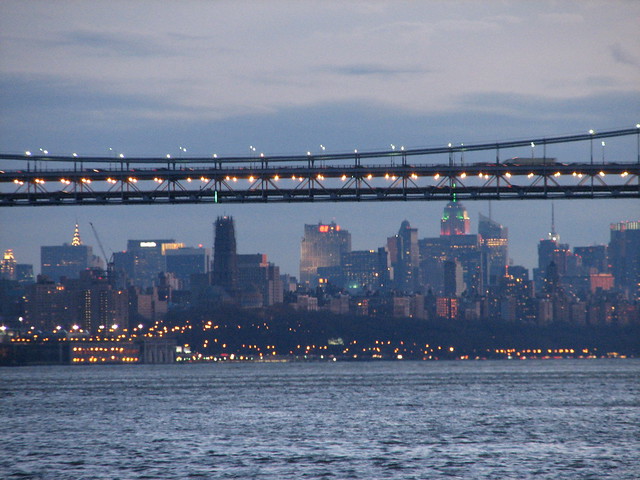
Every night after work I sit in the rear of a New Jersey Transit bus and cross the George Washington Bridge. Tonight, like it will be for the next several months, it was dark as the bus barreled over the bridge, and the New York City skyline looked something like it does above. There's really not any view like it in the world; the only rivals might be from other New York City bridges. I'm often grouchy or annoyed on the trip home, depending on how long everyone had to wait for the bus to arrive. Still, I try to look out the window most nights to gaze south. Maybe native New Yorkers get used to such views and maybe transplanted New Yorkers are too cool to appreciate the view, but more often than not, I still find myself looking at it with the same wonder I had the first time I drove over it in February 2002. At least these days I know where I'm going.
I've been in New York City six and a half years now, and I still don't fully appreciate where I live. Maybe I never will. But it's not because of laziness or complacency or indifference. It's simply that a person could live here for a hundred years and venture out every day and they still wouldn't have enough time to soak in all of the history that's a part of the city.
So much has happened here. So much still happens. So much will happen. Remembering how I walked around the city my first few weeks here, my head tilted back, looking up, only needing a fanny pack to complete the caricature of the type of tourist longtime New Yorkers love to complain about, it's hard to believe that it's only taken six years for me to get used to the fact this is now my home.
Last Sunday, about 20 blocks south of our apartment, dozens of people dressed up in strange garb to re-enact an event that happened three centuries ago. November 16 was the 234th anniversary of the Battle of Fort Washington, a key fight in the Revolutionary War that saw the Brits rout the Americans. It was a crushing defeat for the Continental Army, but being that the people in this country can now read about Prince William's upcoming nuptials but don't have to worry about one day being ruled by him, you know that it was not a decisive victory for the Brits.
The Battle of Fort Washington isn't among the most well-known battles in American history, but maybe that's because the wrong side - depending on your accent - won. Still, it's a vital piece of history, a crucial battle that was followed by some of George Washington's greatest victories. And it happened three subway stops from our apartment. Cool.
I can walk five minutes and be on the spot where the Dutch bought Manhattan, an event that changed the fortunes of millions, for better and worse. It practically took place in my backyard - a backyard I, of course, share with tens of thousands of people.
Sometimes it takes a movie to remind me that I live in Manhattan and that I always dreamed of living here but never thought it'd happen, especially after my first attempt failed. We'll be sitting in the theater and New York appears on the screen - perhaps as the setting for a horrible romantic comedy, perhaps while being destroyed by an asteroid or tsunami - and I think, hey, we live there. Millions of people across the world are watching the same thing in different theaters and are thinking about New York's size and chaos and regard it as more of a character than a real city where real people live.
The city can be exhausting, especially on weekends when the subways aren't running on a normal schedule and the lines that are running are improbably crammed even more than usual. The city's not just a museum. People live here and struggle here, fighting traffic, rats, garbage, pollution, neighbors, cockroaches, bed bugs, terrorist threats and ridiculous rents. With all of that, it's easy for a person to forget what drew them here: the lights, the opportunities, the culture, the people, the sites, the sounds and, yes, the history, whether it's the Met or a long-ago battle fought before the United States was even really a country.
I do my best to appreciate the history of any place I visit, so I certainly try and appreciate the history of New York. It's easy to get distracted or caught up in the present. But I want to remember the city's past because that's why I originally dreamed of coming here and is part of the reason I stay here. The myths and the legends helped bring me here.
Right now thousands of people of all ages are dreaming of coming to New York, whether for a week or a lifetime. They want to escape their problems or seize an opportunity. They want to climb the skyscrapers or party underground. They're dreaming of New York. They're dreaming about my home. And that I do appreciate.
Saturday, November 6, 2010
Saturday potpourri: The Godfather, SNL, and KEYC
Louise is unable to sit still and do just one thing at a time. If we watch a DVD, she can not simply watch the movie. She folds clothes, or files papers, or edits manuscripts or talks about how she wishes she could be doing something extra. This occasionally perturbs me, especially if there's a great scene she's just missed because she's distracted by a 12-step plan to reorganize her closet.
"I saw it, honey," she'll say. Yes, but did she appreciate it? Did she laugh at an appropriate volume or was she distracted by her address book? She explains it by saying she can't just watch a movie or do just one thing at a time when she knows she could be using the time to do five, six or seven other things. It's a miracle I ever get her to a movie theater, because I'm sure she feels like a prisoner, locked in darkness, surrounded by germs, forced to focus on the big screen for two hours. I normally don't understand this psychosis.
But today I do. I'm currently watching the tape of last night's Lakers game while also working on a story that's due in two weeks for the St. John's alumni magazine. On the computer I've called up the video feed of the St John's-St. Olaf football game, but I've turned down the audio on that so I can listen to the radio broadcast from the Johnnies announcers. I'm also typing away on the blog and occasionally turning off the Lakers game to watch The Godfather II, which is in our DVD player. Louise refers to this as putting a whole day's activity into one hour.
Some Saturday thoughts:
* This is probably, I don't know, the 50th time I've seen Godfather II. One scene always confused me. After the attempt on his life early in the movie, Michael travels to New York to talk with Frank Pentangeli and plot his revenge against Hyman Roth. During a meeting with the Rosato brothers, a would-be and mouthy assassin attacks Pentangeli and attempts to kill him after saying, "Michael Corleone says hello." Frankie escapes and later, thinking Michael betrayed him, agrees to testify against the godfather. Yet Michael didn't have anything to do with the assassination attempt. It was Roth. So why would an assassin give credit to Corleone as he kills Pentangeli? Wouldn't he want his victim to know who really gave the order? Why say "Michael Corleone says hello" when Michael really said no such thing? It worked out for Roth because Pentangeli later does turn against Michael but the assassin couldn't have known things would break that way. This guy dissects this and other issues with one of the best movies ever made.
* Newspapers are dying. That's the accepted wisdom and to protest means you're stuck in the past and unwilling to acknowledge the present or face the future. Okay. But I still read them. The paper versions, the ones that stain your hands with ink and prove unwieldy on any type of public transportation. I buy a couple every day at the newsstands and read them before and after work. I'll almost always have one on the subway. And a few times a week, a fellow passenger peers down or leans over on the subway to read the paper along with me, as if it's a community activity. I'm reading about the Yankees or chaos in the state legislature and I'll sense - and eventually see - my 1 train neighbor gazing over my shoulder, intently poring over the headlines and text. Maybe he giggles at a cartoon or shakes his head at a ludicrous editorial from Charles Krauthammer. I'll always hesitate for a few seconds, as if I'm really concerned that the freeloader has finished the story. Occasionally the other person will actually sigh when I turn the page, annoyed that I've dared to move on to the next page. Can't I see they're still dissecting the movie review of The Expendables? Buddy, it's 50 cents. A bit more if you buy the Times. You obviously enjoy reading newspapers, you appreciate the reporting, the witty tabloid headlines and the writing. So toss a few quarters on the newsstand and support this dying industry. Or at least stop breathing on my cheek.
* Everyone remembers the classic Schwetty - or is it Schweddy? - Balls skit on Saturday Night Live.
I think I found one of the inspirations for the sketch. Here's another classic from KEYC-TV. This appeared on the Noon News, and apparently aired in 1986. That was a year before I started going home for lunch, so I probably missed this thorough examination of sugar, its benefits and dangers. Some people are meant to be on TV. Some people are meant to work in extension offices and help the public with valuable initiatives that teach people how to live healthy lives. Very few people are meant to work in an extension office and appear on TV.
I'd have more but I have to get back to my article and The Godfather. Also, the Lakers game is now in the fourth quarter. And, my uncle Mike's basketball team at Minnesota West just started their second game of the season and the school broadcasts the games online. I'm learning to multitask. And I'm learning from the best.
"I saw it, honey," she'll say. Yes, but did she appreciate it? Did she laugh at an appropriate volume or was she distracted by her address book? She explains it by saying she can't just watch a movie or do just one thing at a time when she knows she could be using the time to do five, six or seven other things. It's a miracle I ever get her to a movie theater, because I'm sure she feels like a prisoner, locked in darkness, surrounded by germs, forced to focus on the big screen for two hours. I normally don't understand this psychosis.
But today I do. I'm currently watching the tape of last night's Lakers game while also working on a story that's due in two weeks for the St. John's alumni magazine. On the computer I've called up the video feed of the St John's-St. Olaf football game, but I've turned down the audio on that so I can listen to the radio broadcast from the Johnnies announcers. I'm also typing away on the blog and occasionally turning off the Lakers game to watch The Godfather II, which is in our DVD player. Louise refers to this as putting a whole day's activity into one hour.
Some Saturday thoughts:
* This is probably, I don't know, the 50th time I've seen Godfather II. One scene always confused me. After the attempt on his life early in the movie, Michael travels to New York to talk with Frank Pentangeli and plot his revenge against Hyman Roth. During a meeting with the Rosato brothers, a would-be and mouthy assassin attacks Pentangeli and attempts to kill him after saying, "Michael Corleone says hello." Frankie escapes and later, thinking Michael betrayed him, agrees to testify against the godfather. Yet Michael didn't have anything to do with the assassination attempt. It was Roth. So why would an assassin give credit to Corleone as he kills Pentangeli? Wouldn't he want his victim to know who really gave the order? Why say "Michael Corleone says hello" when Michael really said no such thing? It worked out for Roth because Pentangeli later does turn against Michael but the assassin couldn't have known things would break that way. This guy dissects this and other issues with one of the best movies ever made.
* Newspapers are dying. That's the accepted wisdom and to protest means you're stuck in the past and unwilling to acknowledge the present or face the future. Okay. But I still read them. The paper versions, the ones that stain your hands with ink and prove unwieldy on any type of public transportation. I buy a couple every day at the newsstands and read them before and after work. I'll almost always have one on the subway. And a few times a week, a fellow passenger peers down or leans over on the subway to read the paper along with me, as if it's a community activity. I'm reading about the Yankees or chaos in the state legislature and I'll sense - and eventually see - my 1 train neighbor gazing over my shoulder, intently poring over the headlines and text. Maybe he giggles at a cartoon or shakes his head at a ludicrous editorial from Charles Krauthammer. I'll always hesitate for a few seconds, as if I'm really concerned that the freeloader has finished the story. Occasionally the other person will actually sigh when I turn the page, annoyed that I've dared to move on to the next page. Can't I see they're still dissecting the movie review of The Expendables? Buddy, it's 50 cents. A bit more if you buy the Times. You obviously enjoy reading newspapers, you appreciate the reporting, the witty tabloid headlines and the writing. So toss a few quarters on the newsstand and support this dying industry. Or at least stop breathing on my cheek.
* Everyone remembers the classic Schwetty - or is it Schweddy? - Balls skit on Saturday Night Live.
I think I found one of the inspirations for the sketch. Here's another classic from KEYC-TV. This appeared on the Noon News, and apparently aired in 1986. That was a year before I started going home for lunch, so I probably missed this thorough examination of sugar, its benefits and dangers. Some people are meant to be on TV. Some people are meant to work in extension offices and help the public with valuable initiatives that teach people how to live healthy lives. Very few people are meant to work in an extension office and appear on TV.
I'd have more but I have to get back to my article and The Godfather. Also, the Lakers game is now in the fourth quarter. And, my uncle Mike's basketball team at Minnesota West just started their second game of the season and the school broadcasts the games online. I'm learning to multitask. And I'm learning from the best.
Monday, November 1, 2010
Chin up: The futile quest for the presidential fitness award
On the way home tonight, I walked past the restaurant that's about half a block from our building. Construction scaffolding stands in front of all the buildings along the row. Tonight, for about the third or fourth time in the last two months, I walked past a guy performing gymnastics on one of the scaffolding bars. It's been a few different men. Tonight's participant was about 35. Muscular. Goatee. Black sweatpants.
Like the others, he did his best Mary Lou Retton routine, swinging along a higher bar before gracefully dropping to a lower one. The judges all gave him 9.0, except for the Russian who handed out a 7.2, much to Al Trautwig's dismay. The guy tonight took a break from the low-wire theatrics to work on his pull-ups. He eased up and down, all the while making eye contact with pedestrians, especially a couple of females. Forget picking up women at a bar, online or in a church. Why woo with words when you can awe them with feats of strength on construction equipment? The gymnastics are impressive, though at this stage in his life where's he going with the skills? While male Olympic gymnasts are older than their 15-year-old female counterparts, he's way past his prime. Perhaps he could be used in a large-scale robbery, at a Vegas casino or a Boston bank, someplace with a laser-secured vault that requires a trustworthy man who's good with a gun and knows how to keep his mouth shut while sneaking into small spaces.
While I'm not entirely sure what this man gets out of his current exploits, I have no doubt that he won a Presidential Physical Fitness Award when he was 11 years old. Every school kid remembers taking the fitness test, striving for that mystical 85th percentile. The 85th percentile. A magical phrase. Percentiles held such power as a kid, whether it was in the Iowa Basics or the presidential fitness test. I envied the kids who achieved this award. A Medal of Honor wouldn't have impressed me as much at that age.
Sit-ups, pull-ups, distance run, sit-and-reach and the maddening shuttle run. Those were the events. Until about fifth grade, I dominated in nearly all of the events. Through fourth grade I was one of the fastest kids in our class, chasing down the slow-moving targets during tag. I managed a respectable number of chin-ups and always cruised through the sit-ups. Then something happened. I lost speed. I lost strength. My flexibility stopped improving and never got any better after that. I no longer had a shot at earning the president's praise for my physical fitness.
The shuttle run seemed like the most unfair event. Our little gym's floor tormented runners, as if an ice rink resided beneath the shoddy wood surface. It was impossible to stop to pick up the little bricks before turning around and speeding toward the other one. That's one excuse I used, anyway.
But chin-ups remained the most humiliating event, from the time I was 12 until the day I turned 18. In a shuttle run, no one can really see just how slow you are. You're talking tenths of a second. Sit-and-reach? Who cares? Everyone - except future cross country stars - hates the mile run. But chin-ups, they're you're out in the open, exposed, dangling from the bar, kicking, grunting, groaning, straining, fighting, weeping, quitting. How long would you hang there before finally giving up? A minute? Two? Occasionally I got away with one pull-up, by doing the jump-up-and-count-that-as-one-and-hope-the-teacher-doesn't-notice trick. The snickers echoed through the gym as your body swayed and your arms shook from the strain. You weren't just disappointing yourself and your parents. You were letting down the president. You were letting down your country. I remember one year they changed it so your palms were no longer facing you, making it even tougher.
An 11-year-old boy is supposed to be able to do six chin-ups. What's the point? What's this measuring? What's the shuttle run measuring, other than shoe traction? Why didn't the president make free throw shooting part of the challenge, or track the speed of a 12-year-old's tennis serve?
I didn't get any stronger in high school, at least not in categories that could be measured with a chart. I had the upper-body strength of a patient who's spent two months in a hospital bed. Only the muscular and light thrived, along with anyone in the wrestling program. An average kid with an average physique didn't stand a chance.
In high school we had a kid who could do like a dozen chin-ups, but on each one he slithered up to the bar, his long red hair wiggling back and forth. It remains the most unique style I've ever seen, not that I've witnessed many chin-up competitions since high school graduation. It was a snake technique and for all I know the president eventually banned it. At first we all laughed, but he quickly earned our respect, especially those of us who remained in the hanging group. Who the hell were we to laugh at anyone?
The fitness challenge isn't just for children. Adults can torture themselves, too. There's apparently an adult fitness competition, but it looks like chin-ups are not part of it. Sit-ups remain, and you can do push-ups to measure strength. Too bad about the chin-ups. It'd be a great way to relive some childhood memories. Find a construction site, round up some local teens who can gawk and verbally mock you, and put on an ill-fitting shirt that rides up as you hang helplessly in the air while your pale stomach dangles over your shorts.
Go for that 85th percentile. Do it for your health. Damn it, do it for your country.
Like the others, he did his best Mary Lou Retton routine, swinging along a higher bar before gracefully dropping to a lower one. The judges all gave him 9.0, except for the Russian who handed out a 7.2, much to Al Trautwig's dismay. The guy tonight took a break from the low-wire theatrics to work on his pull-ups. He eased up and down, all the while making eye contact with pedestrians, especially a couple of females. Forget picking up women at a bar, online or in a church. Why woo with words when you can awe them with feats of strength on construction equipment? The gymnastics are impressive, though at this stage in his life where's he going with the skills? While male Olympic gymnasts are older than their 15-year-old female counterparts, he's way past his prime. Perhaps he could be used in a large-scale robbery, at a Vegas casino or a Boston bank, someplace with a laser-secured vault that requires a trustworthy man who's good with a gun and knows how to keep his mouth shut while sneaking into small spaces.
While I'm not entirely sure what this man gets out of his current exploits, I have no doubt that he won a Presidential Physical Fitness Award when he was 11 years old. Every school kid remembers taking the fitness test, striving for that mystical 85th percentile. The 85th percentile. A magical phrase. Percentiles held such power as a kid, whether it was in the Iowa Basics or the presidential fitness test. I envied the kids who achieved this award. A Medal of Honor wouldn't have impressed me as much at that age.
Sit-ups, pull-ups, distance run, sit-and-reach and the maddening shuttle run. Those were the events. Until about fifth grade, I dominated in nearly all of the events. Through fourth grade I was one of the fastest kids in our class, chasing down the slow-moving targets during tag. I managed a respectable number of chin-ups and always cruised through the sit-ups. Then something happened. I lost speed. I lost strength. My flexibility stopped improving and never got any better after that. I no longer had a shot at earning the president's praise for my physical fitness.
The shuttle run seemed like the most unfair event. Our little gym's floor tormented runners, as if an ice rink resided beneath the shoddy wood surface. It was impossible to stop to pick up the little bricks before turning around and speeding toward the other one. That's one excuse I used, anyway.
But chin-ups remained the most humiliating event, from the time I was 12 until the day I turned 18. In a shuttle run, no one can really see just how slow you are. You're talking tenths of a second. Sit-and-reach? Who cares? Everyone - except future cross country stars - hates the mile run. But chin-ups, they're you're out in the open, exposed, dangling from the bar, kicking, grunting, groaning, straining, fighting, weeping, quitting. How long would you hang there before finally giving up? A minute? Two? Occasionally I got away with one pull-up, by doing the jump-up-and-count-that-as-one-and-hope-the-teacher-doesn't-notice trick. The snickers echoed through the gym as your body swayed and your arms shook from the strain. You weren't just disappointing yourself and your parents. You were letting down the president. You were letting down your country. I remember one year they changed it so your palms were no longer facing you, making it even tougher.
An 11-year-old boy is supposed to be able to do six chin-ups. What's the point? What's this measuring? What's the shuttle run measuring, other than shoe traction? Why didn't the president make free throw shooting part of the challenge, or track the speed of a 12-year-old's tennis serve?
I didn't get any stronger in high school, at least not in categories that could be measured with a chart. I had the upper-body strength of a patient who's spent two months in a hospital bed. Only the muscular and light thrived, along with anyone in the wrestling program. An average kid with an average physique didn't stand a chance.
In high school we had a kid who could do like a dozen chin-ups, but on each one he slithered up to the bar, his long red hair wiggling back and forth. It remains the most unique style I've ever seen, not that I've witnessed many chin-up competitions since high school graduation. It was a snake technique and for all I know the president eventually banned it. At first we all laughed, but he quickly earned our respect, especially those of us who remained in the hanging group. Who the hell were we to laugh at anyone?
The fitness challenge isn't just for children. Adults can torture themselves, too. There's apparently an adult fitness competition, but it looks like chin-ups are not part of it. Sit-ups remain, and you can do push-ups to measure strength. Too bad about the chin-ups. It'd be a great way to relive some childhood memories. Find a construction site, round up some local teens who can gawk and verbally mock you, and put on an ill-fitting shirt that rides up as you hang helplessly in the air while your pale stomach dangles over your shorts.
Go for that 85th percentile. Do it for your health. Damn it, do it for your country.
Friday, October 15, 2010
Fear of fire
Two nights ago, I sat in our apartment and listened as fire trucks roared past our window, heading south on Broadway. The sirens started a little after 9:30 and didn't stop for a half-hour.
Like everywhere else in the city, sirens on Broadway in upper Manhattan are not rare occurrences. Sometimes they're like a background orchestra to a day in the life of Inwood.
A few years ago a pair of men broke into the apartment of a building resident. They roughed him up as they searched for money in the apartment. A few minutes into their break-in, they heard sirens roaring up Broadway. The hoodlums figured someone in the building had called the police, apparently not realizing that the sound of a fire truck driving up the street was likely just a routine call and not the police swarming the building. The men scrambled down the fire escape but police soon apprehended them. The lesson: Just because you hear sirens, it doesn't necessarily mean anything's wrong. Could be a false alarm, could be something serious, could be a police car, could be an ambulance.
So we rarely react to any siren. But when those sirens last for 30 minutes, we notice. I checked out Twitter and saw Inwood residents talking about a fire near 204th Street. They used exclamation points and OMG, so it must have been serious. Sounded like a big one.
It was. A vacant storefront burned. It took 106 firefighters three hours to contain the blaze. A couple of them suffered injuries. I wandered down near the fire a little after 10 p.m. A block from my house, the smell of smoke overwhelmed everything. A cloud of smoke drifted over the neighborhood. As I got closer, several people walked with their faces buried in shirt sleeves or their hands. The firefighters and police officers blocked off the area so I stood with the other gawkers a few blocks from the scene. At one point it seemed like a little block party. Weird scene. A pair of girls in short skirts and high heels escaped their dates and took pictures in front of firetrucks and with a group of five firefighters. A large group of people hung out in front of a deli, watching the action, talking Yankees. I saw my fill and saw that it wasn't an apocalyptic blaze, despite the number of trucks that went racing by our apartment.
This was the second devastating fire of the week in the neighborhood. Earlier, fire destroyed a bodega and cafe. I hate those stories. People lose businesses they've spent years building, and families lose homes they've been in for generations. One apartment building goes up in flames and hundreds of people suffer. And those, of course, aren't even the most tragic outcomes.
Fire. It's about the only thing I fear in the city, aside from the ever-present possibility that there exists - somewhere in the city's subway system but perhaps in basement buildings - a creature that's unique to New York, a type of half-rat, half-cockroach, which is simply waiting for the right time to show itself off to the cowering masses. Nuclear war won't kill it, and neither will glue traps.
I'm not scared of the possibility of terrorist attacks in the city and I've never felt in danger on the city streets, no matter the time of day. But fire. That sometimes gives me pause, or plays tricks on my mind at 2 in the morning. Specifically, fear of an accidental - or not - fire in our apartment building. Even more specifically, fear of some bored 8-year-old kid who finds Mom's cigarettes and lighter and decides it'd be fun to light the couch on fire one day after school. Or I picture a guy who lives on one of the lower floors falling asleep one night with a beer on his ample gut, forgetting that he left a Swanson's chicken TV dinner - white meat - in the oven and it's ready to go up in flames, along with the whole building. When you live in a large apartment building with a hundred neighbors, you have to sort of trust that everyone's been taught proper fire safety and I'm not talking about stop, drop and roll. As I sit and watch Law & Order reruns, I contemplate what I'd grab if we had to scramble down our aging, does-it-really-support-adults fire escape. Louise's jewelry. Some pictures, perhaps. Lakers tapes, of course.
A few months ago, the smell of burning wood invaded our apartment. I figured it came from outside. Why wouldn't it? But it was about 9 at night and there's always that nagging thought, what if it is coming from floor five? Louise wandered out from the bedroom and ordered an investigation. I walked down to the lobby. No flames. It floated in from outside. Perhaps an abandoned storefront. Maybe some bored kids.
Realistically I know there is probably nothing to worry about. Maybe I should be worried more about being mugged on the way home from work. But it's that idea that everything you own can disappear in a flash. The idea that you can go to bed one night and never wake up, all because Jay Leno lulled someone to sleep on their couch while a lit cigarette dropped from their fingers and onto the carpet.
Louise arrived home a short time ago and said she picked up some batteries.
"The smoke alarm needed one, remember?" she said.
Ah, yes, that's right, it did. As I said, some people in the building could use some fire education reminders.
Like everywhere else in the city, sirens on Broadway in upper Manhattan are not rare occurrences. Sometimes they're like a background orchestra to a day in the life of Inwood.
A few years ago a pair of men broke into the apartment of a building resident. They roughed him up as they searched for money in the apartment. A few minutes into their break-in, they heard sirens roaring up Broadway. The hoodlums figured someone in the building had called the police, apparently not realizing that the sound of a fire truck driving up the street was likely just a routine call and not the police swarming the building. The men scrambled down the fire escape but police soon apprehended them. The lesson: Just because you hear sirens, it doesn't necessarily mean anything's wrong. Could be a false alarm, could be something serious, could be a police car, could be an ambulance.
So we rarely react to any siren. But when those sirens last for 30 minutes, we notice. I checked out Twitter and saw Inwood residents talking about a fire near 204th Street. They used exclamation points and OMG, so it must have been serious. Sounded like a big one.
It was. A vacant storefront burned. It took 106 firefighters three hours to contain the blaze. A couple of them suffered injuries. I wandered down near the fire a little after 10 p.m. A block from my house, the smell of smoke overwhelmed everything. A cloud of smoke drifted over the neighborhood. As I got closer, several people walked with their faces buried in shirt sleeves or their hands. The firefighters and police officers blocked off the area so I stood with the other gawkers a few blocks from the scene. At one point it seemed like a little block party. Weird scene. A pair of girls in short skirts and high heels escaped their dates and took pictures in front of firetrucks and with a group of five firefighters. A large group of people hung out in front of a deli, watching the action, talking Yankees. I saw my fill and saw that it wasn't an apocalyptic blaze, despite the number of trucks that went racing by our apartment.
This was the second devastating fire of the week in the neighborhood. Earlier, fire destroyed a bodega and cafe. I hate those stories. People lose businesses they've spent years building, and families lose homes they've been in for generations. One apartment building goes up in flames and hundreds of people suffer. And those, of course, aren't even the most tragic outcomes.
Fire. It's about the only thing I fear in the city, aside from the ever-present possibility that there exists - somewhere in the city's subway system but perhaps in basement buildings - a creature that's unique to New York, a type of half-rat, half-cockroach, which is simply waiting for the right time to show itself off to the cowering masses. Nuclear war won't kill it, and neither will glue traps.
I'm not scared of the possibility of terrorist attacks in the city and I've never felt in danger on the city streets, no matter the time of day. But fire. That sometimes gives me pause, or plays tricks on my mind at 2 in the morning. Specifically, fear of an accidental - or not - fire in our apartment building. Even more specifically, fear of some bored 8-year-old kid who finds Mom's cigarettes and lighter and decides it'd be fun to light the couch on fire one day after school. Or I picture a guy who lives on one of the lower floors falling asleep one night with a beer on his ample gut, forgetting that he left a Swanson's chicken TV dinner - white meat - in the oven and it's ready to go up in flames, along with the whole building. When you live in a large apartment building with a hundred neighbors, you have to sort of trust that everyone's been taught proper fire safety and I'm not talking about stop, drop and roll. As I sit and watch Law & Order reruns, I contemplate what I'd grab if we had to scramble down our aging, does-it-really-support-adults fire escape. Louise's jewelry. Some pictures, perhaps. Lakers tapes, of course.
A few months ago, the smell of burning wood invaded our apartment. I figured it came from outside. Why wouldn't it? But it was about 9 at night and there's always that nagging thought, what if it is coming from floor five? Louise wandered out from the bedroom and ordered an investigation. I walked down to the lobby. No flames. It floated in from outside. Perhaps an abandoned storefront. Maybe some bored kids.
Realistically I know there is probably nothing to worry about. Maybe I should be worried more about being mugged on the way home from work. But it's that idea that everything you own can disappear in a flash. The idea that you can go to bed one night and never wake up, all because Jay Leno lulled someone to sleep on their couch while a lit cigarette dropped from their fingers and onto the carpet.
Louise arrived home a short time ago and said she picked up some batteries.
"The smoke alarm needed one, remember?" she said.
Ah, yes, that's right, it did. As I said, some people in the building could use some fire education reminders.
Saturday, October 2, 2010
Coughing with Michael Chabon
The New Yorker Festival opened Friday, the annual three-day bonanza where famous authors, writers, directors, actors and editors sit on stages in front of large audiences and discuss their craft in theaters across the city. I'd never gone before. Usually I'd see an ad in the New Yorker touting the event, but I'd see it a week or two after tickets went on sale, which is what happens when the magazines pile up on a table in the living room. Finally this year I saw the ad in time. Two minutes after tickets went on sale, I bought a pair of them.
Sunday I'm attending a conversation between New Yorker editor David Remnick and writer Ian Frazier. Two of the best in nonfiction.
But on Friday I saw one of my writing idols, Michael Chabon. The author of Wonder Boys, The Yiddish Policemen's Union, The Amazing Adventures of Kavalier & Clay, numerous other novels and a couple of nonfiction collections appeared onstage with fellow author Zadie Smith, another writer who can not be introduced at an event without the moderator throwing the word "acclaimed" before her name.
Smith read a nonfiction piece, a story about her father, a World War II veteran who didn't want to be known as a hero or brave, even though he was both.
Chabon followed. Instead of reciting passages from one of his famous books, he read a work in progress, a treat for those in the audience, many of whom have surely consumed all of his published words. The piece focused on a home birth. To describe it beyond that would be impossible, except to say all of Chabon's skills - from the descriptions to the humor to the incomparable word play - were on display.
About three-quarters of a way through Chabon's reading, I suddenly, inexplicably, horrifyingly, embarrassingly, choked. I wasn't drinking or eating. I didn't have any gum in my mouth. But somehow I found myself blurting out a cough, followed quickly by another and the feeling in my chest and throat let me know this would be a long coughing spell, which quickly devolved into a coughing fit. I left my seat almost immediately and retreated to the rear of the theater. It felt like a piece of popcorn had lodged in my throat, but the last time I ate popcorn was at a movie three weeks ago. If it was popcorn, I had more problems than a cough.
I coughed several more times in the back of the theater before finally going out the door to compose myself. Thankfully, another attendee took attention away from my mysterious medical issue. As I walked to the rear of the theater, I watched three people drag a young man who had fainted. They pulled him out into the waiting area, sat him in a chair and stayed with him until he recovered. Could have been the heat. Or maybe it was Chabon's graphic description of a bloody vagina that made the poor guy woozy. As brilliant as Chabon's writing is, a bloody vagina is still a bloody vagina. And, actually, because of Chabon's skills, the mental images are even clearer. I'm sure the guy blamed the heat.
My coughing stopped and I returned to my sixth-row seat for the question and answer session. One woman asked how the writers feel about fiction compared to nonfiction. Smith finds nonfiction easier to write, Chabon's the opposite. Another woman said she'd come all the way from Berkeley to see Chabon. It quickly became obvious - from her body language, longing in her voice and reluctance to leave the microphone, even after Chabon answered her question - that I didn't have to worry about being accused of being the attendee who would most likely stalk Chabon. If the moderator hadn't pointed to another person who had a question, the lady might still be standing there.
Like many in the audience, she was impressed by Chabon's ability to write about childbirth and wondered if there'd be an equivalent event that men go through. "Whaling," he said.
I walked to one of the two microphones and asked my question. I've spoken with other writers about Chabon's famous use of similes and metaphors. No one uses them like Chabon. They pop off the page, one after another, sometimes three or four in a paragraph. On a journalism board, during a discussion of similes, a few writers debated whether you should use a simile if it takes more than a few minutes to think of it. In other words, if you have to slave over it for too long, it's probably not any good. I asked Chabon what's it like for him. He conjures up phrases that no one else would think of, but after you've read them, it becomes impossible to imagine the person or event being described in any other way. He writes sentences I've memorized by heart, lines that should be required reading in all English classes and recited even before schoolchildren say the Pledge of Allegiance each morning. In his review for The Yiddish Policemen's Union in New York Magazine, Sam Anderson listed some of Chabon's best lines:
The detective's ex-wife "accepts a compliment as if it's a can of soda that she suspects him of having shaken." In a crowded apartment, two babies are "stashed away on the balcony like disused skis." Rain is "tossed in vandalistic handfuls at the windshield."
Similes! I was talking to Michael Chabon about similes. This is like asking Magic Johnson about the art of the half-court bounce pass. It's like asking Warren Buffett about investments. It's like...well, some other simile.
His answer? They're easy for him. When writing fiction, he might occasionally struggle with plotting the story or other big-picture situations. But those unique phrases that liven up every page of his books are practically effortless. I don't know for sure whether he believes a simile is worthless if you have to spend more than a minute thinking of it, but that's only because he's probably never done it himself.
The event lasted a little over an hour. On my walk back to the subway, I strolled in front of the poor guy who passed out at the event, as he asked his female companion what exactly happened. Nothing much. He fainted and had to be hauled out of a theater in front of a few hundred people while ushers and security looked at him with a mixture of pity and anxiety.
And he missed hearing the best writer of his generation read his work and discuss his craft.
Sunday I'm attending a conversation between New Yorker editor David Remnick and writer Ian Frazier. Two of the best in nonfiction.
But on Friday I saw one of my writing idols, Michael Chabon. The author of Wonder Boys, The Yiddish Policemen's Union, The Amazing Adventures of Kavalier & Clay, numerous other novels and a couple of nonfiction collections appeared onstage with fellow author Zadie Smith, another writer who can not be introduced at an event without the moderator throwing the word "acclaimed" before her name.
Smith read a nonfiction piece, a story about her father, a World War II veteran who didn't want to be known as a hero or brave, even though he was both.
Chabon followed. Instead of reciting passages from one of his famous books, he read a work in progress, a treat for those in the audience, many of whom have surely consumed all of his published words. The piece focused on a home birth. To describe it beyond that would be impossible, except to say all of Chabon's skills - from the descriptions to the humor to the incomparable word play - were on display.
About three-quarters of a way through Chabon's reading, I suddenly, inexplicably, horrifyingly, embarrassingly, choked. I wasn't drinking or eating. I didn't have any gum in my mouth. But somehow I found myself blurting out a cough, followed quickly by another and the feeling in my chest and throat let me know this would be a long coughing spell, which quickly devolved into a coughing fit. I left my seat almost immediately and retreated to the rear of the theater. It felt like a piece of popcorn had lodged in my throat, but the last time I ate popcorn was at a movie three weeks ago. If it was popcorn, I had more problems than a cough.
I coughed several more times in the back of the theater before finally going out the door to compose myself. Thankfully, another attendee took attention away from my mysterious medical issue. As I walked to the rear of the theater, I watched three people drag a young man who had fainted. They pulled him out into the waiting area, sat him in a chair and stayed with him until he recovered. Could have been the heat. Or maybe it was Chabon's graphic description of a bloody vagina that made the poor guy woozy. As brilliant as Chabon's writing is, a bloody vagina is still a bloody vagina. And, actually, because of Chabon's skills, the mental images are even clearer. I'm sure the guy blamed the heat.
My coughing stopped and I returned to my sixth-row seat for the question and answer session. One woman asked how the writers feel about fiction compared to nonfiction. Smith finds nonfiction easier to write, Chabon's the opposite. Another woman said she'd come all the way from Berkeley to see Chabon. It quickly became obvious - from her body language, longing in her voice and reluctance to leave the microphone, even after Chabon answered her question - that I didn't have to worry about being accused of being the attendee who would most likely stalk Chabon. If the moderator hadn't pointed to another person who had a question, the lady might still be standing there.
Like many in the audience, she was impressed by Chabon's ability to write about childbirth and wondered if there'd be an equivalent event that men go through. "Whaling," he said.
I walked to one of the two microphones and asked my question. I've spoken with other writers about Chabon's famous use of similes and metaphors. No one uses them like Chabon. They pop off the page, one after another, sometimes three or four in a paragraph. On a journalism board, during a discussion of similes, a few writers debated whether you should use a simile if it takes more than a few minutes to think of it. In other words, if you have to slave over it for too long, it's probably not any good. I asked Chabon what's it like for him. He conjures up phrases that no one else would think of, but after you've read them, it becomes impossible to imagine the person or event being described in any other way. He writes sentences I've memorized by heart, lines that should be required reading in all English classes and recited even before schoolchildren say the Pledge of Allegiance each morning. In his review for The Yiddish Policemen's Union in New York Magazine, Sam Anderson listed some of Chabon's best lines:
The detective's ex-wife "accepts a compliment as if it's a can of soda that she suspects him of having shaken." In a crowded apartment, two babies are "stashed away on the balcony like disused skis." Rain is "tossed in vandalistic handfuls at the windshield."
Similes! I was talking to Michael Chabon about similes. This is like asking Magic Johnson about the art of the half-court bounce pass. It's like asking Warren Buffett about investments. It's like...well, some other simile.
His answer? They're easy for him. When writing fiction, he might occasionally struggle with plotting the story or other big-picture situations. But those unique phrases that liven up every page of his books are practically effortless. I don't know for sure whether he believes a simile is worthless if you have to spend more than a minute thinking of it, but that's only because he's probably never done it himself.
The event lasted a little over an hour. On my walk back to the subway, I strolled in front of the poor guy who passed out at the event, as he asked his female companion what exactly happened. Nothing much. He fainted and had to be hauled out of a theater in front of a few hundred people while ushers and security looked at him with a mixture of pity and anxiety.
And he missed hearing the best writer of his generation read his work and discuss his craft.
Thursday, September 23, 2010
Death of a bookstore
The first time I went to the Barnes & Noble at 66th Street and Broadway in New York City, a mentally disturbed middle-aged man in blue jeans and a Yankees hat screamed at me in the store's cafe area. He accused me of being a gay Irishman. He said I was in for an ass-kicking. It was April of 2004 and I'd only been in the city a week or two, so the confrontation served as my introduction to that Barnes & Noble and life in New York. He sat at a nearby table, ignoring his book while yelling at me. I briefly made eye contact and immediately regretted it. Finally I picked up my bag and left the cafe. The other customers probably considered me a coward, even as they cowered away from the lunatic who now sought a new target.
In the six years since that incident, that Barnes & Noble became our most frequently visited store in the city. Over the years I've bought dozens of books from there and spent hundreds of hours wandering around the massive store. It had three stories of books, a basement full of DVDs and CDs, and a fourth floor cafe that was also home to hundreds of magazine titles and, on at least one day, a deranged reader who loved the Yanks. It will all be gone in four months.
Last month, Barnes & Noble announced it would close the store this coming January. The thing that kills million of New Yorkers - high rent - fatally wounded the store. The current lease was ending and the increased rent "made it economically impossible for us to extend the lease," said a spokeswoman. A Century 21 clothing store will take its place. Barnes & Noble itself is in trouble, as Amazon, e-books and a changing publishing world conspire to damage the behemoth chain that has, of course, also been the downfall of smaller bookstores.
Some people feel little sympathy for the company's plight, citing those closures of small, independent bookstores who may have been victims of Barnes & Noble's once-overwhelming success. Feel bad for Barnes & Noble? Might as well feel pity for the fall of the Soviet Union.
But I will mourn this store's closing, for what it means to the company's future and, more importantly, what it means for publishing.
The store at 66th Street holds special memories for me. One day in September 2005, I sprinted up the escalator to the third floor, then walked to the sports books. There in the football section, near some John Feinstein books, sat my just-released book, Keeping the Faith. There were three copies. It was, obviously, one of the coolest moments of my life. Nineteen months after sitting in the cafe while a disturbed man threatened me and I wondered what in the hell life was going to be like in New York, I bought a copy of my own book from that store.
However, nostalgia has little to do with my regrets about the store's demise. There are still numerous Barnes & Noble stores in the city - there's actually another branch just up the street, at 82nd and Broadway. The closing frightens because it's just one more sign - a four-story sign - that the book industry is going through tough times. Like newspapers, magazines, movies, and television, the book world is struggling to adapt to the difficult economy and the changing media world.
Walk into any Barnes & Noble today and you'll be greeted by a display for the Nook, the company's entry into e-book readers. The sales folks are helpful, knowledgeable and enthusiastic. They talk about its virtues, reliability and convenience. And I have absolutely no desire to ever own one.
No matter what happens to bookstores, people will keep reading and they'll keep reading books, only they might be reading them on screens instead of on paper. Whatever keeps the industry alive, I support, though the money authors earn on e-books is nothing compared to what they now make on the real thing. Maybe that can change.
But I still want book books. I want to browse and buy, hold them, drop them, write in them and page through them. In the end it's always about the words, but for me it's also about the packaging. I read a screen all day at work and sit in front of one while writing or surfing online. Books provide me the one chance to unplug while unwinding.
And in today's world Barnes & Noble provides some of the best chances to do all of those things. Some people speculate that if the large chains eventually completely flounder, independent stores will regain their prominence. It's a romantic idea, though one that might not do much to help the publishing industry. I love independent bookstores and many still, thankfully, thrive in the city. But aside from The Strand - my true favorite store in the city, which, unfortunately, is something of a trek for us - the 66th Street Barnes & Noble has long been our book-buying paradise.
It has three levels of books. Like every Barnes & Noble store, this one possesses a unique smell, which I can't trace but was probably created in a lab devoted to soothing aromas. Company scientists mixed some old books and new coffee beans and created a perfume that each store pumps through the vents. First floor holds the new releases, which I'll always browse. Oh, Bob Woodward's got another new one. Guy's prolific. There's that new biography on Roosevelt. Michael Chabon's book of essays is finally out? Great. Glenn Beck writes novels?
The fiction's on the second floor, the classics mixing with romances and thrillers, poets mingling with hacks and essayists. I'll search for a good paperback or a classic I somehow avoided in school. The third floor's my favorite, the nonfiction. Sports, biography, history, film, TV, music, true crime, writing books, humor, everything. It's nearly impossible for me to spend time in that section without heading down the escalator clutching a book that will set us back between $11 and $25.
If Louise is with me, I'll inevitably end up in the cafe, where she will have worked on securing us a table. Unlike the stores in Minnesota, where there's always ample free space, the tables at this cafe seem to have a waiting list that's longer than the one for Green Bay Packer season tickets. The cafe workers frequently make announcements over the loudspeaker, declaring that cafe seating is for cafe customers only, and that if you do not have an overpriced coffee in your hand or a chocolate chip cookie stuffed into your face, you will either be buying one or ejected from the area. Your choice.
We'll sit there for an hour or so, reading through the books we've brought up, taking notes, sipping orange juice, avoiding the bookstore bouncers. By the time we leave, we'll have spent two or three hours on the premises. As we wind our way down and again pass through the nonfiction and fiction sections, we might stop to browse some more, entranced by the sight of all those books and the smell of all that coffee and paper. That's how we've spent dozens of nights during our six years together in New York City.
The store closes in January and we'll take our little family tradition to another store, in another part of the city. Our bookstore nights will survive, just as long as bookstores themselves stay alive.
However, nostalgia has little to do with my regrets about the store's demise. There are still numerous Barnes & Noble stores in the city - there's actually another branch just up the street, at 82nd and Broadway. The closing frightens because it's just one more sign - a four-story sign - that the book industry is going through tough times. Like newspapers, magazines, movies, and television, the book world is struggling to adapt to the difficult economy and the changing media world.
Walk into any Barnes & Noble today and you'll be greeted by a display for the Nook, the company's entry into e-book readers. The sales folks are helpful, knowledgeable and enthusiastic. They talk about its virtues, reliability and convenience. And I have absolutely no desire to ever own one.
No matter what happens to bookstores, people will keep reading and they'll keep reading books, only they might be reading them on screens instead of on paper. Whatever keeps the industry alive, I support, though the money authors earn on e-books is nothing compared to what they now make on the real thing. Maybe that can change.
But I still want book books. I want to browse and buy, hold them, drop them, write in them and page through them. In the end it's always about the words, but for me it's also about the packaging. I read a screen all day at work and sit in front of one while writing or surfing online. Books provide me the one chance to unplug while unwinding.
And in today's world Barnes & Noble provides some of the best chances to do all of those things. Some people speculate that if the large chains eventually completely flounder, independent stores will regain their prominence. It's a romantic idea, though one that might not do much to help the publishing industry. I love independent bookstores and many still, thankfully, thrive in the city. But aside from The Strand - my true favorite store in the city, which, unfortunately, is something of a trek for us - the 66th Street Barnes & Noble has long been our book-buying paradise.
It has three levels of books. Like every Barnes & Noble store, this one possesses a unique smell, which I can't trace but was probably created in a lab devoted to soothing aromas. Company scientists mixed some old books and new coffee beans and created a perfume that each store pumps through the vents. First floor holds the new releases, which I'll always browse. Oh, Bob Woodward's got another new one. Guy's prolific. There's that new biography on Roosevelt. Michael Chabon's book of essays is finally out? Great. Glenn Beck writes novels?
The fiction's on the second floor, the classics mixing with romances and thrillers, poets mingling with hacks and essayists. I'll search for a good paperback or a classic I somehow avoided in school. The third floor's my favorite, the nonfiction. Sports, biography, history, film, TV, music, true crime, writing books, humor, everything. It's nearly impossible for me to spend time in that section without heading down the escalator clutching a book that will set us back between $11 and $25.
If Louise is with me, I'll inevitably end up in the cafe, where she will have worked on securing us a table. Unlike the stores in Minnesota, where there's always ample free space, the tables at this cafe seem to have a waiting list that's longer than the one for Green Bay Packer season tickets. The cafe workers frequently make announcements over the loudspeaker, declaring that cafe seating is for cafe customers only, and that if you do not have an overpriced coffee in your hand or a chocolate chip cookie stuffed into your face, you will either be buying one or ejected from the area. Your choice.
We'll sit there for an hour or so, reading through the books we've brought up, taking notes, sipping orange juice, avoiding the bookstore bouncers. By the time we leave, we'll have spent two or three hours on the premises. As we wind our way down and again pass through the nonfiction and fiction sections, we might stop to browse some more, entranced by the sight of all those books and the smell of all that coffee and paper. That's how we've spent dozens of nights during our six years together in New York City.
The store closes in January and we'll take our little family tradition to another store, in another part of the city. Our bookstore nights will survive, just as long as bookstores themselves stay alive.
Saturday, September 18, 2010
A day with Columbia football
Today I made my annual trek to the first home football game for Columbia University. Construction projects on the subways meant chaos for public transportation in northern Manhattan, but the Lions and their powder-blue uniforms still drew more than 4,000 people. Columbia games are one of my favorite fall activities in New York, an underrated experience in a city few associate with college football.
Columbia hosted another New York City team, the Fordham Rams. This season Columbia opens with a somewhat-bizarre schedule, with four straight home games kicking off the season.
I've seen probably a dozen Columbia games the last four or five years. They've won a couple of those but lost most. Rarely has Columbia been blown out in the games I've attended. Same story today. Columbia took a second-half lead, only to lose it as Fordham rallied to take a 16-9 lead. Then, in the dying moments, with the crowd excited and the Lions on the move, ready to march in for a tying touchdown, a fluke fumble near the goal-line ended their hopes and an opponent's kneel-down ended the game.
But back to the beginning. Norries Wilson is Columbia's head coach. In the Columbia program, though, his official title is the Patricia and Shepard Alexander Head Coach of Football. Columbia's football coach is an endowed position, just like on the tennis team and wrestling team. The Alexanders gave a "major" gift to the program in 1998, sparking the endowment. A true friend of the program. Columbia has a fetish for naming things, whether buildings or jobs. The football team plays its games at Robert K. Kraft Field at Lawrence A. Wien Stadium at the Baker Field Athletics Complex.
Wilson played his college ball at the University of Minnesota, back in the mid-1980s, when the Gophers made a few bowl games and weren't simply a punchline to jokes told by residents of the Dakotas. Wilson's coach at Minnesota was John Gutekunst, who, like all Gopher coaches of the past five decades, had a few big victories peppered in with even more ugly losses. Gutekunst has bounced around college football since leaving Minnesota, most recently serving as a defensive assistant at East Carolina. But Gutekunst reunited with Wilson this year, working as Columbia's defensive secondary coach. As of now, the defensive secondary coach is not an endowed position, but any Columbia grad with a few hundred thousand dollars to spare could probably get their name on that one.
I sat on the Columbia side, in the general vicinity of a man in his fifties who devoured two dozen Reese's Peanut Butter Cups during the game. It's an unconventional diet, though one I admire. What made it strange(r) was that he wore blue rubber gloves the entire game, as if he were prepping for heart surgery just down the road at Columbia-Presbyterian. Staying with the surgery angle, he opened each wrapper with a razor, which he used to slice through the orange wrapping, before unfurling the chocolate from the brown container. It made me wonder if the cups had a horrible flaw. Had they been caked in asbestos, doused with mercury? He didn't cheer for Columbia or Fordham. He sat passively, except when he aggressively dissected his treats.
Probably an old engineering major.
A large group of enthusiastic Fordham students followed their football team to Manhattan. They certainly outperformed their counterparts. At one point the Fordham students erupted into a chant of "Harvard Rejects," a creative - if factually dubious - taunt.
Neither offense did much for most of the game. Columbia finally cobbled together a scoring drive early in the second half, only to have Fordham block the extra point - of course. Fordham kicked a pair of field goals to tie it at 9-9, then took the lead late in the fourth. Trailing 16-9, Columbia drove down the field with an efficiency previously unseen in these parts. The Lions made it to Fordham's 4-yard-line. First-and-goal. A minute to go. This is when the crowd stood. The Columbia students finally cheered, ignoring the Fordham bullies. We were all ready for overtime.
Then the center fired the snap back to the quarterback - who stood in the shotgun - when the QB wasn't expecting it. The ball hit off his hands, somewhat comically bounced into the air and then fell to the ground, where a Fordham defender fell on it, clinching the victory. An exasperated Patricia and Shepard Alexander Head Coach of Football Norries Wilson shook his head. He'd seen this play before, and the ending never seems to change.
As I left the stadium, two guys in front of me lamented another Columbia loss.
"Same as always," one said. "How many times have we seen that?"
A lot. With five more home games left on the schedule, they'll probably see it a few more times. And so will I.
Columbia hosted another New York City team, the Fordham Rams. This season Columbia opens with a somewhat-bizarre schedule, with four straight home games kicking off the season.
I've seen probably a dozen Columbia games the last four or five years. They've won a couple of those but lost most. Rarely has Columbia been blown out in the games I've attended. Same story today. Columbia took a second-half lead, only to lose it as Fordham rallied to take a 16-9 lead. Then, in the dying moments, with the crowd excited and the Lions on the move, ready to march in for a tying touchdown, a fluke fumble near the goal-line ended their hopes and an opponent's kneel-down ended the game.
But back to the beginning. Norries Wilson is Columbia's head coach. In the Columbia program, though, his official title is the Patricia and Shepard Alexander Head Coach of Football. Columbia's football coach is an endowed position, just like on the tennis team and wrestling team. The Alexanders gave a "major" gift to the program in 1998, sparking the endowment. A true friend of the program. Columbia has a fetish for naming things, whether buildings or jobs. The football team plays its games at Robert K. Kraft Field at Lawrence A. Wien Stadium at the Baker Field Athletics Complex.
Wilson played his college ball at the University of Minnesota, back in the mid-1980s, when the Gophers made a few bowl games and weren't simply a punchline to jokes told by residents of the Dakotas. Wilson's coach at Minnesota was John Gutekunst, who, like all Gopher coaches of the past five decades, had a few big victories peppered in with even more ugly losses. Gutekunst has bounced around college football since leaving Minnesota, most recently serving as a defensive assistant at East Carolina. But Gutekunst reunited with Wilson this year, working as Columbia's defensive secondary coach. As of now, the defensive secondary coach is not an endowed position, but any Columbia grad with a few hundred thousand dollars to spare could probably get their name on that one.
I sat on the Columbia side, in the general vicinity of a man in his fifties who devoured two dozen Reese's Peanut Butter Cups during the game. It's an unconventional diet, though one I admire. What made it strange(r) was that he wore blue rubber gloves the entire game, as if he were prepping for heart surgery just down the road at Columbia-Presbyterian. Staying with the surgery angle, he opened each wrapper with a razor, which he used to slice through the orange wrapping, before unfurling the chocolate from the brown container. It made me wonder if the cups had a horrible flaw. Had they been caked in asbestos, doused with mercury? He didn't cheer for Columbia or Fordham. He sat passively, except when he aggressively dissected his treats.
Probably an old engineering major.
A large group of enthusiastic Fordham students followed their football team to Manhattan. They certainly outperformed their counterparts. At one point the Fordham students erupted into a chant of "Harvard Rejects," a creative - if factually dubious - taunt.
Neither offense did much for most of the game. Columbia finally cobbled together a scoring drive early in the second half, only to have Fordham block the extra point - of course. Fordham kicked a pair of field goals to tie it at 9-9, then took the lead late in the fourth. Trailing 16-9, Columbia drove down the field with an efficiency previously unseen in these parts. The Lions made it to Fordham's 4-yard-line. First-and-goal. A minute to go. This is when the crowd stood. The Columbia students finally cheered, ignoring the Fordham bullies. We were all ready for overtime.
Then the center fired the snap back to the quarterback - who stood in the shotgun - when the QB wasn't expecting it. The ball hit off his hands, somewhat comically bounced into the air and then fell to the ground, where a Fordham defender fell on it, clinching the victory. An exasperated Patricia and Shepard Alexander Head Coach of Football Norries Wilson shook his head. He'd seen this play before, and the ending never seems to change.
As I left the stadium, two guys in front of me lamented another Columbia loss.
"Same as always," one said. "How many times have we seen that?"
A lot. With five more home games left on the schedule, they'll probably see it a few more times. And so will I.
Sunday, August 22, 2010
The time New York City beat me up, took my car and $700
Thursday night we attended a reading downtown. We left at 6:30 but didn't arrive until 8, thanks to a series of delays caused by the dreaded transportation phrase "an earlier incident." It was another hour on the way back. Three stops from home, on the A train, a man in his twenties stumbled into our car. He sported a bushy red beard and a green shirt. I mistakenly thought he was blind. As the doors opened, his eyes also remained opened but he didn't step on. Instead he felt around for the door before staggering inside. He sat about three feet away from us. When I said the guy was blind, Louise responded, "What? He's drunk. Didn't you see the puke on his shirt?" Since the vomit apparently matched his shirt color, I had not.
Thirty seconds after he sat down, the man added to his shirt's decorations by vomiting on the floor and his clothes. Fellow riders scrambled away while we waited for the next stop so we could switch cars. The guy didn't react, other than to wipe his mouth with the soiled shirt. Surely this was a low point in his life, or perhaps not. Might have just been a typical Thursday night in Washington Heights for him. He changed seats but not his behavior. He puked again, further debasing himself, New York, the MTA, guys with beards, the Irish (presumably), and humanity itself. We changed cars but saw him get off at Dyckman Street. He staggered toward the exit, looking very much like Joe Frazier in the final seconds of his bout against George Foreman.
Several times throughout the night - whether we were stuck on the train going nowhere or stuck on the train watching the green-shirted demon lose his intestines - I wished we had a car. How much easier life would be without having to deal with the subway delays and the pukers. During the work week, I often have the same thought, usually when I walk into our apartment at 7:15, ending my hour-long commute that takes about 15 minutes in a car. God I wish we had a car, I'll think.
But then I remember my first night in the city after I moved here in 2004. I remember my car being towed and the $715 it took to rescue it. I remember the three months I had my car here and the fact the only times I drove it was to move it from one side of the street to the other. Then I realize that being caught up in endless subway delays and being trapped with violently ill drunks is one type of hell, but not the worst kind.
When I moved out here in 2004, I drove with Louise from Minnesota to New York in my 1998 Chevy Cavalier. We pulled into the city on a Sunday, about 10 p.m. It was the end of our three-day trip. We'd seen Wisconsin, Illinois, Ohio, Pennsylvania and points in between. All I had to do now was find a parking space. Forty-five minutes later, I was still searching. Louise patiently explained that this was normal, especially on a weekend night. Finally a spot opened up. A small slot, but plenty of room for someone with my incomparable, Minnesota-trained parallel parking skills. Unfortunately, I overrated both my parking abilities and the size of the spot, because I eventually realized there was no way I could fit in without bumping the car in front of me.
"Go ahead and bump it," Louise said. "It's what New Yorkers do."
"They do?"
"Yes."
So I did. I gently nudged an SUV (Damn gas guzzler, serves it right!), moving it maybe six inches, just enough room to let me slide in. When I stepped out of the car, I realized a woman with a rottweiler - or some other type of dog that has been trained to eat men - watched the entire spectacle from the steps of her brownstone. When I walked past she shook her head, probably wondering what in the hell the city had come to. Or maybe she recognized me for what I was: a newcomer, a wannabe. An inexperienced, hapless, overmatched Midwesterner who would have already been robbed of his dignity and belongings if I didn't have Louise watching over me.
Tuesday morning I woke up at 8, grabbed a donut and walked the three blocks to my car. I turned the corner on Manhattan Avenue and saw...nothing. The same small spot that existed before I crammed my Cavalier into it two nights earlier again sat unoccupied. Two possibilities: It'd been stolen or, most likely, it'd been towed.
I was a ticket fugitive, but until that moment I guess I always thought I'd get away with my sins. A year earlier I racked up four tickets during a summer trip to the city, but I didn't pay any of them. I figured I could pay them if I ever moved to New York. But I thought I'd have a grace period, a few weeks to fix the situation. The city obviously had other ideas. Panicked, I sprinted back to the apartment, called Louise, blubbered incoherently, listened to her do the same, watched the final moments of The Pretender on TNT and waited for her to figure out what had happened. She said she'd look at a website that would show if it'd been stolen - by the city. And indeed, New York had taken my car.
Total cost of the unpaid tickets and tow job: $715. Payable only in cash.
Louise gave me the instructions to the place holding my car hostage. Some dump in Brooklyn. I'd never been to Brooklyn. Didn't really know anything about it other than it had a bridge named after it and the inhabitants still loved a baseball team that hadn't played there in 50 years. But I set out for Brooklyn - without my dignity but with the cash. When I emerged from the subway, I only had to walk a few blocks to my destination. Unfortunately, this wasn't a one-step exercise. Instead it was like some type of perverse treasure hunt. I paid the fee here. The car? That's in another area To get there, I would learn, all you have to do is follow the incomprehensible directions provided by a guy who looked like a former Navy SEAL.
It was a small office, run by the SEAL, a middle-aged secretary and an elderly woman with a harsh hairdo and kind face. I gave the woman my license and registration.
"This isn't your registration," said the old woman, who, until that point, had sort of reminded me of my grandmother.
"Well, the registration's in the car. Here's my license. Can I just pay the fine, please?"
"Is it valid?" (What, the license or my existence?)
"Yes."
"Is it valid?"
"I'm sorry. Is what valid?"
"Your registration."
"Yes. But I don't have that with me. Can I just pay the fine?"
By that time the woman no longer reminded me of grandma. Perhaps my kindly grandmother would have acted like this after a lifetime in New York, enjoying these little power plays, toying with the emotions of the beaten-down, ticket-evading masses. I doubt it. There was something sinister in this woman that had been there since birth. A lifetime spent in this cramped office certainly didn't help her disposition, but she'd enjoyed busting balls long before she ever stepped foot into these suffocating, poorly decorated confines.
As we conducted our updated "Who's on First" gag, the secretary screamed at a person on the phone, telling them that it was "CASH ONLY! How many times do you have to hear that to understand it?" Finally the head guy told the elderly woman to run my license to see if it was "valid." It was and I paid the parking fees. But I still needed to claim my car.
"The vehicles are kept elsewhere," he told me.
The man gave me directions, which seemed designed to provide the minimum amount of help with the maximum amount of confusion. I eventually asked a cop, who was fighting street crime and the war on terror while yawning and checking out the assets of passing females, how to find the B61 bus. He pointed the way and a few minutes later I settled in for what I figured would be a short ride to my car. My precious, blue, beloved Cavalier. I hope no one hurt you, baby.
I waited patiently for Coffey Street. By the 45-minute mark I started to worry. The guy made it sound like a short trip, not a tour around greater Brooklyn. I finally asked the driver if my stop was coming soon. The soft, pitying chuckle gave me fair warning about the coming answer. But still, I needed to hear the words.
"Son, that's the other direction. You're going the wrong way."
At this point in my New York City life, I didn't quite understand the public transportation system. It hadn't dawned on me to ask the policeman which way I wanted to go on the bus. In retrospect, that seems like information he could have volunteered. Instead, I hopped on the first one I saw. The driver told me to get off and walk a block over to the correct bus. When I finally found myself on the proper one, I asked the driver how long it'd be to my stop. Fifty minutes, he estimated. Fifty plus 45. Ninety-five minutes. That's how long I spent on the New York City bus that day, searching for the lot that held my car. Now going the correct direction, I settled in and listened to my fellow passengers. A young rapper regaled the bus with tales of hookers and heroin. A middle-aged woman with a large bosom and bigger voice provided a running historical commentary on every third building we drove by. "That used to be a hospital before they shut it down. That's where they tore down the grocery store."
When we reached my stop, I wandered off in a daze, beaten down by the parking tickets and the bus's fumes. The tour guide walked off with me. Sensing my confusion, she grabbed my arm. She asked if everything was okay. I told her I didn't know where to find Coffey Street. She told me to walk a few blocks and I'd see it.
The lot finally came into sight. Turns out it was a father-son operation. Junior manned the desk. He was about five inches short of six-feet and six pounds shy of 300. He wore a smirk, as if he'd just convinced a customer to pay $500 for a $29 oil change. I claimed my car and paid the rest of the fine. He retrieved the Cavalier while I asked his proud father how to get back to Manhattan. He pulled out some directions that looked like they'd been written by a child, for a child.
A native New Yorker - or anyone who'd spent more than, say, four hours in Brooklyn - would have surely crossed over a bridge and into Manhattan in a few moments. A guy spending his first day in New York? A frazzled, defeated guy? Two hours. I'd see the skyline and head in that direction, only to get discombobulated and realize I was now driving away from the skyline. Three times I stopped to ask for directions, but the helpers only confirmed my suspicions that ninety-eight percent of any city's population is utterly incapable of providing even the most elementary directions. Even if they've lived there for two decades, they won't be able to articulate how to get to Point A to Point B.
I found my salvation in McDonald's. The old gal had always provided comfort in the form of her chicken-like McNuggets. Now she provided me with a way home. The 10-year-old in a hairnet behind the counter gave clear, easy-to-understand directions. A short time later, I drove over the Manhattan Bridge and into downtown Manhattan. Now all I had to do was drive 104 blocks in rush-hour traffic. I nearly killed a pedestrian, a well-groomed businessman who responded by slapping the hood with his rolled-up Wall Street Journal. I wanted to roll down the window and apologize, maybe offer to shine his shoes. I was vulnerable. In that 50-minute drive through hell, I transformed from a meek Midwesterner into a New York driver. At first I let people in and waited for the hand to acknowledge my good deed. Then I'd patiently wait for someone to let me into whatever lane I needed. After being honked at a half-dozen times and never once being allowed into a lane - not even by some farmer with Iowa plates who really should know better - I simply started veering into traffic without looking, depending on the below-average reflexes of my fellow drivers to keep me from getting into an accident.
Finally, at 7:10 p.m. seven hours after I had walked onto the subway for a simple ride to Brooklyn and back, I double-parked in front of our apartment. I sprinted inside, used the bathroom, hugged Louise and ingested some Coke - the capital C version.
My ordeal was nearly over. Now I all I had to do was find a place to park.
Thirty seconds after he sat down, the man added to his shirt's decorations by vomiting on the floor and his clothes. Fellow riders scrambled away while we waited for the next stop so we could switch cars. The guy didn't react, other than to wipe his mouth with the soiled shirt. Surely this was a low point in his life, or perhaps not. Might have just been a typical Thursday night in Washington Heights for him. He changed seats but not his behavior. He puked again, further debasing himself, New York, the MTA, guys with beards, the Irish (presumably), and humanity itself. We changed cars but saw him get off at Dyckman Street. He staggered toward the exit, looking very much like Joe Frazier in the final seconds of his bout against George Foreman.
Several times throughout the night - whether we were stuck on the train going nowhere or stuck on the train watching the green-shirted demon lose his intestines - I wished we had a car. How much easier life would be without having to deal with the subway delays and the pukers. During the work week, I often have the same thought, usually when I walk into our apartment at 7:15, ending my hour-long commute that takes about 15 minutes in a car. God I wish we had a car, I'll think.
But then I remember my first night in the city after I moved here in 2004. I remember my car being towed and the $715 it took to rescue it. I remember the three months I had my car here and the fact the only times I drove it was to move it from one side of the street to the other. Then I realize that being caught up in endless subway delays and being trapped with violently ill drunks is one type of hell, but not the worst kind.
When I moved out here in 2004, I drove with Louise from Minnesota to New York in my 1998 Chevy Cavalier. We pulled into the city on a Sunday, about 10 p.m. It was the end of our three-day trip. We'd seen Wisconsin, Illinois, Ohio, Pennsylvania and points in between. All I had to do now was find a parking space. Forty-five minutes later, I was still searching. Louise patiently explained that this was normal, especially on a weekend night. Finally a spot opened up. A small slot, but plenty of room for someone with my incomparable, Minnesota-trained parallel parking skills. Unfortunately, I overrated both my parking abilities and the size of the spot, because I eventually realized there was no way I could fit in without bumping the car in front of me.
"Go ahead and bump it," Louise said. "It's what New Yorkers do."
"They do?"
"Yes."
So I did. I gently nudged an SUV (Damn gas guzzler, serves it right!), moving it maybe six inches, just enough room to let me slide in. When I stepped out of the car, I realized a woman with a rottweiler - or some other type of dog that has been trained to eat men - watched the entire spectacle from the steps of her brownstone. When I walked past she shook her head, probably wondering what in the hell the city had come to. Or maybe she recognized me for what I was: a newcomer, a wannabe. An inexperienced, hapless, overmatched Midwesterner who would have already been robbed of his dignity and belongings if I didn't have Louise watching over me.
Tuesday morning I woke up at 8, grabbed a donut and walked the three blocks to my car. I turned the corner on Manhattan Avenue and saw...nothing. The same small spot that existed before I crammed my Cavalier into it two nights earlier again sat unoccupied. Two possibilities: It'd been stolen or, most likely, it'd been towed.
I was a ticket fugitive, but until that moment I guess I always thought I'd get away with my sins. A year earlier I racked up four tickets during a summer trip to the city, but I didn't pay any of them. I figured I could pay them if I ever moved to New York. But I thought I'd have a grace period, a few weeks to fix the situation. The city obviously had other ideas. Panicked, I sprinted back to the apartment, called Louise, blubbered incoherently, listened to her do the same, watched the final moments of The Pretender on TNT and waited for her to figure out what had happened. She said she'd look at a website that would show if it'd been stolen - by the city. And indeed, New York had taken my car.
Total cost of the unpaid tickets and tow job: $715. Payable only in cash.
Louise gave me the instructions to the place holding my car hostage. Some dump in Brooklyn. I'd never been to Brooklyn. Didn't really know anything about it other than it had a bridge named after it and the inhabitants still loved a baseball team that hadn't played there in 50 years. But I set out for Brooklyn - without my dignity but with the cash. When I emerged from the subway, I only had to walk a few blocks to my destination. Unfortunately, this wasn't a one-step exercise. Instead it was like some type of perverse treasure hunt. I paid the fee here. The car? That's in another area To get there, I would learn, all you have to do is follow the incomprehensible directions provided by a guy who looked like a former Navy SEAL.
It was a small office, run by the SEAL, a middle-aged secretary and an elderly woman with a harsh hairdo and kind face. I gave the woman my license and registration.
"This isn't your registration," said the old woman, who, until that point, had sort of reminded me of my grandmother.
"Well, the registration's in the car. Here's my license. Can I just pay the fine, please?"
"Is it valid?" (What, the license or my existence?)
"Yes."
"Is it valid?"
"I'm sorry. Is what valid?"
"Your registration."
"Yes. But I don't have that with me. Can I just pay the fine?"
By that time the woman no longer reminded me of grandma. Perhaps my kindly grandmother would have acted like this after a lifetime in New York, enjoying these little power plays, toying with the emotions of the beaten-down, ticket-evading masses. I doubt it. There was something sinister in this woman that had been there since birth. A lifetime spent in this cramped office certainly didn't help her disposition, but she'd enjoyed busting balls long before she ever stepped foot into these suffocating, poorly decorated confines.
As we conducted our updated "Who's on First" gag, the secretary screamed at a person on the phone, telling them that it was "CASH ONLY! How many times do you have to hear that to understand it?" Finally the head guy told the elderly woman to run my license to see if it was "valid." It was and I paid the parking fees. But I still needed to claim my car.
"The vehicles are kept elsewhere," he told me.
The man gave me directions, which seemed designed to provide the minimum amount of help with the maximum amount of confusion. I eventually asked a cop, who was fighting street crime and the war on terror while yawning and checking out the assets of passing females, how to find the B61 bus. He pointed the way and a few minutes later I settled in for what I figured would be a short ride to my car. My precious, blue, beloved Cavalier. I hope no one hurt you, baby.
I waited patiently for Coffey Street. By the 45-minute mark I started to worry. The guy made it sound like a short trip, not a tour around greater Brooklyn. I finally asked the driver if my stop was coming soon. The soft, pitying chuckle gave me fair warning about the coming answer. But still, I needed to hear the words.
"Son, that's the other direction. You're going the wrong way."
At this point in my New York City life, I didn't quite understand the public transportation system. It hadn't dawned on me to ask the policeman which way I wanted to go on the bus. In retrospect, that seems like information he could have volunteered. Instead, I hopped on the first one I saw. The driver told me to get off and walk a block over to the correct bus. When I finally found myself on the proper one, I asked the driver how long it'd be to my stop. Fifty minutes, he estimated. Fifty plus 45. Ninety-five minutes. That's how long I spent on the New York City bus that day, searching for the lot that held my car. Now going the correct direction, I settled in and listened to my fellow passengers. A young rapper regaled the bus with tales of hookers and heroin. A middle-aged woman with a large bosom and bigger voice provided a running historical commentary on every third building we drove by. "That used to be a hospital before they shut it down. That's where they tore down the grocery store."
When we reached my stop, I wandered off in a daze, beaten down by the parking tickets and the bus's fumes. The tour guide walked off with me. Sensing my confusion, she grabbed my arm. She asked if everything was okay. I told her I didn't know where to find Coffey Street. She told me to walk a few blocks and I'd see it.
The lot finally came into sight. Turns out it was a father-son operation. Junior manned the desk. He was about five inches short of six-feet and six pounds shy of 300. He wore a smirk, as if he'd just convinced a customer to pay $500 for a $29 oil change. I claimed my car and paid the rest of the fine. He retrieved the Cavalier while I asked his proud father how to get back to Manhattan. He pulled out some directions that looked like they'd been written by a child, for a child.
A native New Yorker - or anyone who'd spent more than, say, four hours in Brooklyn - would have surely crossed over a bridge and into Manhattan in a few moments. A guy spending his first day in New York? A frazzled, defeated guy? Two hours. I'd see the skyline and head in that direction, only to get discombobulated and realize I was now driving away from the skyline. Three times I stopped to ask for directions, but the helpers only confirmed my suspicions that ninety-eight percent of any city's population is utterly incapable of providing even the most elementary directions. Even if they've lived there for two decades, they won't be able to articulate how to get to Point A to Point B.
I found my salvation in McDonald's. The old gal had always provided comfort in the form of her chicken-like McNuggets. Now she provided me with a way home. The 10-year-old in a hairnet behind the counter gave clear, easy-to-understand directions. A short time later, I drove over the Manhattan Bridge and into downtown Manhattan. Now all I had to do was drive 104 blocks in rush-hour traffic. I nearly killed a pedestrian, a well-groomed businessman who responded by slapping the hood with his rolled-up Wall Street Journal. I wanted to roll down the window and apologize, maybe offer to shine his shoes. I was vulnerable. In that 50-minute drive through hell, I transformed from a meek Midwesterner into a New York driver. At first I let people in and waited for the hand to acknowledge my good deed. Then I'd patiently wait for someone to let me into whatever lane I needed. After being honked at a half-dozen times and never once being allowed into a lane - not even by some farmer with Iowa plates who really should know better - I simply started veering into traffic without looking, depending on the below-average reflexes of my fellow drivers to keep me from getting into an accident.
Finally, at 7:10 p.m. seven hours after I had walked onto the subway for a simple ride to Brooklyn and back, I double-parked in front of our apartment. I sprinted inside, used the bathroom, hugged Louise and ingested some Coke - the capital C version.
My ordeal was nearly over. Now I all I had to do was find a place to park.
Monday, July 26, 2010
Lightning and other natural disasters in New York
Two really cool videos taken in New York City on Friday night. The first one shows the most famous skyline in the world being lit up with the type of storm you normally associate with the plains of Oklahoma or the prairies of Minnesota. The second video shows the lightning bolts emerging from the sky, followed by the torrential rains that blanketed the boroughs. It's the types of scenes that conjure up words like apocalyptic, at least when they happen in New York. The storms rolled through the city shortly before 9 p.m. I boarded a bus in New Jersey at 8:10 p.m. and was on the A train in Manhattan by 8:35. It was dry in Jersey. By the time I stepped out of the subway at 207th Street in upper Manhattan, the rain had started to fall.
Because I forgot an umbrella when I left the house nine hours earlier, I cursed the gods and my own incompetence. I stopped at McDonald's to pick up some dinner. By the time I stepped out of the restaurant five minutes later, the rain had turned into a downpour. Lightning decorated the sky in every direction. By the sound of the thunder, it seemed like the storm was centered directly over Inwood, maybe over the local 99-cent store, maybe over our apartment building. I'd never seen a storm like this during my time in New York. It reminded me of the storms that precede tornado warnings in Minnesota. The cities hit the sirens, meaning it's time to find a basement, though many people use them as a signal to step out on the porch or into the car to see what all the excitement's about.
"Wanna go find the storms?" is an actual question sober people ask their friends and family.
With my McNuggets and fries jammed into my black bag, I sprinted six blocks to our apartment, avoiding puddles while searching the sky for bolts. An ear-piercing thunder strike - which brought about cries of "Holy Shit! Let's get into the subway!" from a group of four cowering men - actually made me jump higher than I have since grabbing a rebound my senior year of basketball.
My run took me past a city park, which means my run took me under some trees, which means my run freaked me out for about 30 seconds. Good god, do not go under a tree during a storm. How many times have I heard that over the years? A hundred? Two hundred? I finally made it home, soaked but safe. Only later did I learn that a woman got struck by lightning around this same time in the Bronx. A man got drilled in Brooklyn. Both, fortunately, survived. Only later did I learn that there had actually been a tornado warning issued for New York City, an occurrence that is seemingly as rare as a hurricane warning for Minneapolis. But tornadoes have actually hit the city. A twister did severe damage to Brooklyn in 2007 - the first tornado to hit Brooklyn since 1889. There have been some brief touchdowns in Staten Island. Manhattan seems immune.
Except in the movies:
Are trailers about scary movies supposed to look and sound like an Onion News Video?
There were no tornado terrors in NYC on Friday night, but it was as close to the real thing as possible, minus the funnel clouds.
One thing I actually love about living in New York is that we are, for the most part, immune to natural disasters. We're in Manhattan, so we should be safe from tornadoes. Even Hollywood has only been able to come up with laughable scenarios like the one above to document the threat. If it did ever happen and you were going to describe it as being something out of a movie, you'd have to be much more specific: "It looked like something out of that hideous 2008 movie starring Nicole de Boer."
Experts always say a hurricane could one day strike New York. Call me complacent or naive, but hurricanes still aren't something I worry about. Blizzards hit the city, but during my six years in New York I've learned that if you don't have to drive in the treacherous weather - and driving through whiteout conditions in rural Minnesota is often a great time for internal conversations like, "God, if you do exist, and you get me out of this alive, I promise to live a better life" - blizzards really aren't too bad. We don't worry about earthquakes or tsunamis.
We're safe from natural disasters here. Man-made horrors delivered by terrorists are another story. But even with those I operate on the assumption that it's pointless to worry about something that's out of my control and I fear those as much as I fear a tornado strike. Being naive is occasionally a good way to go through life.
I've often thought about where the perfect city would be to avoid natural disasters. Minnesotans loathe blizzards. They fear being caught on the road during one and swear at meteorologists who deliver news about them, but they accept them as a part of life. You usually have two or three days warning. When they survive them, they talk about the storms with pride, or compare them to blizzards from two decades earlier so they can say, "You know, when I was younger, our blizzards were ten times worse than this. This was nothing." But tornadoes terrify. They can emerge from nowhere, and the damage can be totally random. Tornadoes have completely destroyed small towns, flattening every home and business. But they can also hit larger cities and crush an entire neighborhood, while leaving one house standing in pristine condition. For the first seven years of my life we didn't have a basement. When the Janesville sirens blared, we hustled into the car and drove to my dad's aunt's house. There we huddled under the pool table, riding the storm out. Basements feel safe. But while they can protect human life, they do nothing to prepare people for the heartbreaking damage they often encounter above when they emerge from below.
The entire Midwest faces these threats. So they're not ideal places to avoid natural disasters. Earthquakes, to me, are even more frightening. The randomness, the potential for collapses - from buildings and the ground. The stories we keep hearing about "The big one" that's bound to hit. Add it all up and the West Coast is no place to live, for those seeking to avoid Mother Nature's wrath. The south has its hurricanes. Idaho and Montana have...whatever Idaho and Montana have.
In the end, New York City is probably the best place for avoiding all of that, for avoiding earthquakes and hurricanes. It's the best place for dealing with snowstorms and it's the best place for avoiding tornadoes. At least, that's what I'll tell myself the next time I'm sprinting through lightning strikes and downpours.
Tuesday, June 29, 2010
Playing tour guide in New York City
My aunt and uncle spent the past weekend visiting New York for the first time. They live on a farm in southwestern Minnesota, near a town whose entire population could probably squeeze onto a pair of subway cars. They arrived Thursday afternoon, left Monday morning and in between walked about 19.8765 miles, give or take .0023 miles - at least according to the gadget on my uncle's cell phone.
I love having friends and family members visit the city but it hasn't happened often the last six years. When they do come east I go into full tour guide mode. If it's someone's first visit, they certainly want to see the most famous tourist spots - Times Square, Empire State Building, Central Park. On subsequent visits you might hit a few more museums, or a few more out-of-the-way spots. After that, they're showing me new parts of the city.
I love playing tour guide because I love living here and want to show people just some of the reasons I do savor every day in this city. I love playing tour guide because it helps keep me from becoming complacent about where we live. It helps me appreciate the fact I live in a city that's often at the top of people's desired destinations. Perhaps most of all, I love playing tour guide because when you visit a landmark or a building or a park with someone who is seeing it for the first time, it helps you see it through their eyes. In a way, it's like seeing it for the first time yourself, as you notice different things about sites you might otherwise look at without a second glance, even though most people in the world spend countless hours thinking about seeing them just once.
Mary and Steve came out for her 50th birthday, which was on Friday. Steve bought her tickets to the Twins-Mets game that night at Citi Field. The seats were down the third-base line, just past the Twins dugout and the section where photographers sit. They were basically on the field. If I had decided to run out onto the field, I'd have been twenty feet out before a security guard could have reacted. Great seats. We watched both teams take batting practice and before the game we wandered up to the Delta Club, where we bought overpriced beer but only after being asked to prove we were of legal drinking age. But we wanted to be near the action.
The worst part about the seats - the only negative - was the possibility of dangerous foul balls rocketing toward our faces. The security guards and usher warned us multiple times to be aware at all times. One guy told the tale of a woman who had her face smashed after her boyfriend ducked out of the way. During previous times to a stadium, I've probably ridiculed people who brought their gloves to the game. What were the chances they'd need to snare a ball while sitting in the upper deck in right field? Now I wished I had my old Fred Lynn-signed special. I debated the chances of catching one with my bare hands. I thought about whether I'd throw myself in front of my aunt. It was her birthday, after all. Hopefully Steve would be doing the same thing, so maybe my sacrifice wouldn't be necessary. On Monday, I talked with a friend at work about these internal discussions. He said my courage reminded him of Martin Sheen's character in the movie The Dead Zone. Specifically, the final scene.
Come on, I'd never put an infant in harm's way like that. In the end it didn't matter. Foul balls did rocket down the third-base line, but they stayed away from our little area.
We met a great group of characters who mingled with us, from fellow fans to the workers. Mr. Met even showed up.
One of the ushers was a man named Gil, an elderly fellow with a quick wit and an endless library of anecdotes. Gil first worked as an usher at Ebbets Field in Brooklyn in 1946, a year before Jackie Robinson made his Dodger debut. He hated the Yankees during his days at Ebbets and disliked them to this day. Even after the Dodgers left the city, he refused to cheer for the Pinstripes, and he's now a fixture with the Mets, who started play in 1962. When Citi Field becomes obsolete in about 2035 and they build another new stadium, Gil will probably still be wearing the same green shirt, still serving as an usher.
My aunt's favorite player is Minnesota's Michael Cuddyer. She has the type of ballplayer crush that's cute and endearing, until the restraining orders come into play and everyone - including her children - becomes a bit creeped out. But Friday night she wore her Cuddyer jersey and entered the stadium hoping to secure his autograph. Shortly before first pitch, Steve finally got Cuddyer's attention. The big lug wandered over. He signed her autograph and also took a picture with her. Mary's never washing the shirt she was wearing again. At the end of the first inning, Denard Span fired the ball into our section as he jogged off the field. Steve caught it and they had yet another souvenir.
We saw everything and we saw it up close, except for a Twins victory. Unfortunately, I don't think Mary made it on TV back home. She came with a Circle Me Bert sign, a placard she spent 30 minutes creating back home and hauled halfway across the country, in hopes that Twins broadcaster Bert Blyleven would circle her with a telestrator during the Twins telecast (I know. It's a Minnesota thing).
If anyone in Minnesota saw us let me know. It would have been a (just turned) 50-year-old woman holding up a bright yellow sign while two men cowered next to her out of embarrassment. To her credit, she stood up after every half inning, held the sign and turned toward a camera, any camera. Some Mets fans probably thought she was one of those criminals who's sentenced to a bizarre penalty by a wacky judge, like the guys who have to stand on a street corner with a sign that reads I BOUGHT BEER INSTEAD OF PAYING CHILD SUPPORT. To the fans' credit, they never threw hot dogs or a baseball at us, though that might have changed if the Twins had ever done anything on the field. In the later innings, a group of kids even broke out into song, serenading Mary with "Happy Birthday."
After the game we hit a bar near the Hotel Pennsylvania, where Mary and Steve stayed. We sipped on our drinks in peace until a pair of blowhards dressed in Mets jerseys stumbled in, freshly ousted from a nearby establishment. They were drunk, loud, obnoxious, fun (for three minutes), graceless, tactless, and annoying. When most people think Loudmouth New Yorker, these guys' voices are what they hear. When they call into talk radio to complain about Jerry Manuel or A-Rod, they're Vinnie from the Bronx or Billy from Brooklyn. They claimed to hold important jobs with "Fortune 500 companies," though that was impossible to confirm and I still have my doubts. Boasts about careers have as much credibility in bars as tales of bedroom conquests.
The bouncer at the previous joint kicked them out because one buddy convinced a total stranger to punch his friend in the face, which the guy did. The friend, taking exception to the blow, punched back. Mayhem ensued. Very funny, according to them. I'm guessing you had to be there. Like all drunks, they kept telling the same story over and over, getting sidetracked from baseball talk by another retelling of the hilarious punching tale. I began to see why that complete stranger found the idea of punching one of these men so damn appealing. We left shortly after their arrival. My guess is they were still telling the story three hours later.
On Sunday afternoon, following a visit to the Intrepid, we took a three-hour tour around Manhattan on a Circle Line cruise. Four women sat in front of us. After one overheard Steve talking about hog barns, they started talking and it turned out they were from Amboy, Minnesota, a small town in southern Minnesota that's maybe a half hour from Janesville. It's a big city, but still a small world.
We all enjoyed the cruise, a relaxing three hours that go by quickly as you coast south down the Hudson before going north up the East River. We saw the Statue of Liberty and all the bridges and even our neighborhood Target. Our tour guide provided a running commentary, though some of his information was wrong, leaving me to wonder how much other incorrect information he delivered. To be fair, he was probably delusional from the oppressive heat. And after delivering the same lines while wearing the same white shirt day after day, a slipup has to be expected. But he had a few. He told us the Intrepid fought in the Korean War (it didn't). He pointed out Governor's Island (it was Roosevelt Island). He told us the Statue of Liberty's index finger was 2-feet long (it's 8 feet).
At one point, near the end of the adventure, numerous people on Jet-Skis came flying past the boat, splashing waves near the people on the lower level. Some passengers (like Louise) even got soaked. The guide told us the cruise has previously called the Coast Guard on the "hooligans" and while he chuckled as the crowd enjoyed the show, it seemed obvious he was just waiting for an excuse to call in the machine guns and air support to take out the miscreants. It must be an ongoing war, the cruise lines versus the Jet Skis. On the 4:30 cruise on June 27, the personal watercraft prevailed. But Bill the guide will again have his day.
Throughout the cruise - and again at the end - he reminded us that if we wanted to thank him "personally" that would be very much appreciated. He said this while clutching a roll of dollar bills, evidence of the thanks he had already received. He repeated the refrain four or five times, as persistent as any subway panhandler. As we walked off, it looked like people gave him plenty of thanks, despite the fact they'll be spouting off several wrong facts about New York to their friends.
Mary and Steve hopped back onto a taxi Monday morning and were back in Minnesota by late in the afternoon.
They saw a lot on their trip, from Ground Zero to St. Patrick's. They discovered several little Irish pubs in the neighborhood and even adopted one as their own. We took them to a couple of cool New York City restaurants during their stay, both on the Upper West Side: Flor de Mayo and Carmine's. They walked countless blocks and rode on a horse-drawn carriage. They effortlessly swiped their MetroCards. They drank plenty of beer and ate some new food. They bought a mug at Mickey Mantle's restaurant and some shorts at Macy's. They spoke with lifelong locals and fellow tourists, with Muslim taxi drivers and folks from a bible camp.
They had a fun time. They probably appreciated the return to the farm and a bit of silence, but I think they'd love to return again for another visit.
If they do I'll be here ready to again play tour guide, anxious to show them the city I now call home, a city I never stop appreciating. A city I love seeing for the first time, time and time again.
I love having friends and family members visit the city but it hasn't happened often the last six years. When they do come east I go into full tour guide mode. If it's someone's first visit, they certainly want to see the most famous tourist spots - Times Square, Empire State Building, Central Park. On subsequent visits you might hit a few more museums, or a few more out-of-the-way spots. After that, they're showing me new parts of the city.
I love playing tour guide because I love living here and want to show people just some of the reasons I do savor every day in this city. I love playing tour guide because it helps keep me from becoming complacent about where we live. It helps me appreciate the fact I live in a city that's often at the top of people's desired destinations. Perhaps most of all, I love playing tour guide because when you visit a landmark or a building or a park with someone who is seeing it for the first time, it helps you see it through their eyes. In a way, it's like seeing it for the first time yourself, as you notice different things about sites you might otherwise look at without a second glance, even though most people in the world spend countless hours thinking about seeing them just once.
Mary and Steve came out for her 50th birthday, which was on Friday. Steve bought her tickets to the Twins-Mets game that night at Citi Field. The seats were down the third-base line, just past the Twins dugout and the section where photographers sit. They were basically on the field. If I had decided to run out onto the field, I'd have been twenty feet out before a security guard could have reacted. Great seats. We watched both teams take batting practice and before the game we wandered up to the Delta Club, where we bought overpriced beer but only after being asked to prove we were of legal drinking age. But we wanted to be near the action.
The worst part about the seats - the only negative - was the possibility of dangerous foul balls rocketing toward our faces. The security guards and usher warned us multiple times to be aware at all times. One guy told the tale of a woman who had her face smashed after her boyfriend ducked out of the way. During previous times to a stadium, I've probably ridiculed people who brought their gloves to the game. What were the chances they'd need to snare a ball while sitting in the upper deck in right field? Now I wished I had my old Fred Lynn-signed special. I debated the chances of catching one with my bare hands. I thought about whether I'd throw myself in front of my aunt. It was her birthday, after all. Hopefully Steve would be doing the same thing, so maybe my sacrifice wouldn't be necessary. On Monday, I talked with a friend at work about these internal discussions. He said my courage reminded him of Martin Sheen's character in the movie The Dead Zone. Specifically, the final scene.
Come on, I'd never put an infant in harm's way like that. In the end it didn't matter. Foul balls did rocket down the third-base line, but they stayed away from our little area.
We met a great group of characters who mingled with us, from fellow fans to the workers. Mr. Met even showed up.
One of the ushers was a man named Gil, an elderly fellow with a quick wit and an endless library of anecdotes. Gil first worked as an usher at Ebbets Field in Brooklyn in 1946, a year before Jackie Robinson made his Dodger debut. He hated the Yankees during his days at Ebbets and disliked them to this day. Even after the Dodgers left the city, he refused to cheer for the Pinstripes, and he's now a fixture with the Mets, who started play in 1962. When Citi Field becomes obsolete in about 2035 and they build another new stadium, Gil will probably still be wearing the same green shirt, still serving as an usher.
My aunt's favorite player is Minnesota's Michael Cuddyer. She has the type of ballplayer crush that's cute and endearing, until the restraining orders come into play and everyone - including her children - becomes a bit creeped out. But Friday night she wore her Cuddyer jersey and entered the stadium hoping to secure his autograph. Shortly before first pitch, Steve finally got Cuddyer's attention. The big lug wandered over. He signed her autograph and also took a picture with her. Mary's never washing the shirt she was wearing again. At the end of the first inning, Denard Span fired the ball into our section as he jogged off the field. Steve caught it and they had yet another souvenir.
We saw everything and we saw it up close, except for a Twins victory. Unfortunately, I don't think Mary made it on TV back home. She came with a Circle Me Bert sign, a placard she spent 30 minutes creating back home and hauled halfway across the country, in hopes that Twins broadcaster Bert Blyleven would circle her with a telestrator during the Twins telecast (I know. It's a Minnesota thing).
If anyone in Minnesota saw us let me know. It would have been a (just turned) 50-year-old woman holding up a bright yellow sign while two men cowered next to her out of embarrassment. To her credit, she stood up after every half inning, held the sign and turned toward a camera, any camera. Some Mets fans probably thought she was one of those criminals who's sentenced to a bizarre penalty by a wacky judge, like the guys who have to stand on a street corner with a sign that reads I BOUGHT BEER INSTEAD OF PAYING CHILD SUPPORT. To the fans' credit, they never threw hot dogs or a baseball at us, though that might have changed if the Twins had ever done anything on the field. In the later innings, a group of kids even broke out into song, serenading Mary with "Happy Birthday."
After the game we hit a bar near the Hotel Pennsylvania, where Mary and Steve stayed. We sipped on our drinks in peace until a pair of blowhards dressed in Mets jerseys stumbled in, freshly ousted from a nearby establishment. They were drunk, loud, obnoxious, fun (for three minutes), graceless, tactless, and annoying. When most people think Loudmouth New Yorker, these guys' voices are what they hear. When they call into talk radio to complain about Jerry Manuel or A-Rod, they're Vinnie from the Bronx or Billy from Brooklyn. They claimed to hold important jobs with "Fortune 500 companies," though that was impossible to confirm and I still have my doubts. Boasts about careers have as much credibility in bars as tales of bedroom conquests.
The bouncer at the previous joint kicked them out because one buddy convinced a total stranger to punch his friend in the face, which the guy did. The friend, taking exception to the blow, punched back. Mayhem ensued. Very funny, according to them. I'm guessing you had to be there. Like all drunks, they kept telling the same story over and over, getting sidetracked from baseball talk by another retelling of the hilarious punching tale. I began to see why that complete stranger found the idea of punching one of these men so damn appealing. We left shortly after their arrival. My guess is they were still telling the story three hours later.
On Sunday afternoon, following a visit to the Intrepid, we took a three-hour tour around Manhattan on a Circle Line cruise. Four women sat in front of us. After one overheard Steve talking about hog barns, they started talking and it turned out they were from Amboy, Minnesota, a small town in southern Minnesota that's maybe a half hour from Janesville. It's a big city, but still a small world.
We all enjoyed the cruise, a relaxing three hours that go by quickly as you coast south down the Hudson before going north up the East River. We saw the Statue of Liberty and all the bridges and even our neighborhood Target. Our tour guide provided a running commentary, though some of his information was wrong, leaving me to wonder how much other incorrect information he delivered. To be fair, he was probably delusional from the oppressive heat. And after delivering the same lines while wearing the same white shirt day after day, a slipup has to be expected. But he had a few. He told us the Intrepid fought in the Korean War (it didn't). He pointed out Governor's Island (it was Roosevelt Island). He told us the Statue of Liberty's index finger was 2-feet long (it's 8 feet).
At one point, near the end of the adventure, numerous people on Jet-Skis came flying past the boat, splashing waves near the people on the lower level. Some passengers (like Louise) even got soaked. The guide told us the cruise has previously called the Coast Guard on the "hooligans" and while he chuckled as the crowd enjoyed the show, it seemed obvious he was just waiting for an excuse to call in the machine guns and air support to take out the miscreants. It must be an ongoing war, the cruise lines versus the Jet Skis. On the 4:30 cruise on June 27, the personal watercraft prevailed. But Bill the guide will again have his day.
Throughout the cruise - and again at the end - he reminded us that if we wanted to thank him "personally" that would be very much appreciated. He said this while clutching a roll of dollar bills, evidence of the thanks he had already received. He repeated the refrain four or five times, as persistent as any subway panhandler. As we walked off, it looked like people gave him plenty of thanks, despite the fact they'll be spouting off several wrong facts about New York to their friends.
Mary and Steve hopped back onto a taxi Monday morning and were back in Minnesota by late in the afternoon.
They saw a lot on their trip, from Ground Zero to St. Patrick's. They discovered several little Irish pubs in the neighborhood and even adopted one as their own. We took them to a couple of cool New York City restaurants during their stay, both on the Upper West Side: Flor de Mayo and Carmine's. They walked countless blocks and rode on a horse-drawn carriage. They effortlessly swiped their MetroCards. They drank plenty of beer and ate some new food. They bought a mug at Mickey Mantle's restaurant and some shorts at Macy's. They spoke with lifelong locals and fellow tourists, with Muslim taxi drivers and folks from a bible camp.
They had a fun time. They probably appreciated the return to the farm and a bit of silence, but I think they'd love to return again for another visit.
If they do I'll be here ready to again play tour guide, anxious to show them the city I now call home, a city I never stop appreciating. A city I love seeing for the first time, time and time again.
Thursday, June 17, 2010
The rats of New York
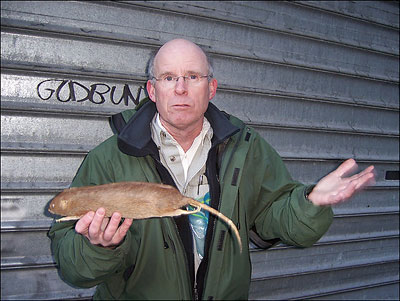
"Not every station has rats, although plenty do. Of 18 stations examined in Lower Manhattan, about half of the subway lines got a fair or poor rating for infestation, meaning they exhibited the telltale culprits - overflowing trash cans, too much track litter - that can lead to a rodent jamboree."
Rodent jamboree. A good phrase, and a disgusting image. That's the New York Times writing about a study the city conducted that attempted to finally analyze just how prevalent the evil rats are in the subway system. There are lots of them, just not the millions that people fear. The good news, as reporter Michael M. Grynbaum wrote, is that "the legend of teeming rat cities tucked deep into subway tunnels is, in fact, a myth. The electrified tracks, scientists said, are far too dangerous."
So the rats don't actually own the city, it just seems that way. Most people are lucky if they only see them while waiting for a subway. Inevitably my eyes gaze down onto the tracks as I wait, searching for any movement. A rat shows up often enough, usually alone although sometimes with family members. They'll devour some food or drag a McDonald's bag to their secret home. The creepy thing about seeing a rat in a subway tunnel isn't that they're invading our space. It's the feeling that we're invading their space.
Unfortunately, I see them everywhere, not just on public transportation. But start with the subway. For years I'd only seen them on the tunnel, never the platforms. When my parents, aunt and uncle and cousins visited three years ago, I assured them the rats didn't patrol the platform. Maybe we'd see one on the tracks, I teased, as if I was a safari guide explaining the likelihood of seeing a lion. But as we sat at the 145th Street stop, waiting to go to Yankee Stadium, a rat scampered on the platform, right next to us, bringing out screams and shattering my assurances. Since then I've seen a rat on two other occasions on the platform. Once the creature scattered behind a ticket machine and I was the only person who saw him take up residence there. I walked past and through the turnstile, while waiting for the panicked cries of some poor soul destined to encounter the rat while buying a weekly Metrocard.
If the rats stayed underground they'd be curiosities, a tourist attraction. But they do invade our space, or at least the land we've taken over and now live on. Several years ago all our building's garbage went in one place - the couches, computer chairs and newspapers mingled with rotting food. Four containers held the garbage in the building's basement. On weekends or on holidays when the garbage didn't get taken out, it was a miserable experience going down there. The stench overwhelmed the senses. Still, I never thought of rodents living down there. I was naive.
One day I went down with a bag, stepped off the elevator and threw it on top of the mountain that had formed. Out of the corner of my eye, I saw something dart toward my foot. It was a large (is there another kind?) rat. It scurried over my foot. I had sandals on the time, no socks. A rat ran over my barefoot and disappeared into a dark corner of the basement. Too shocked to scream or to weep, I jumped up and back, while simultaneously pushing the button for our floor. Back in the safety of our apartment, I wondered if the plague could be transferred from rat hair to human skin.
From that moment on I never did the laundry in the basement, which I'd done for years. The area's been cleaned up. All the food now goes into a separate chute and the super keeps things as clean as possible.
The residents don't always help.
One day I went down with a bag, stepped off the elevator and threw it on top of the mountain that had formed. Out of the corner of my eye, I saw something dart toward my foot. It was a large (is there another kind?) rat. It scurried over my foot. I had sandals on the time, no socks. A rat ran over my barefoot and disappeared into a dark corner of the basement. Too shocked to scream or to weep, I jumped up and back, while simultaneously pushing the button for our floor. Back in the safety of our apartment, I wondered if the plague could be transferred from rat hair to human skin.
From that moment on I never did the laundry in the basement, which I'd done for years. The area's been cleaned up. All the food now goes into a separate chute and the super keeps things as clean as possible.
The residents don't always help.
Several weeks ago our building's management posted a brief letter in the elevator, explaining that an unknown person - but a resident of our building - had been throwing garbage bags out the window and onto an adjoining building. I'd seen the bags down there. It's a hell of a toss.
This, the letter stated, was unacceptable, not to mention against the law and a violation of the lease. Plus, the refuse would attract rodents, specifically, rats. I hoped they would catch the garbage tosser, and subject them to strict interrogation. There'd be only one question: Why? Who thinks it's okay to take a large garbage bag, filled with meat and milk cartons, and heave it out a window, onto an adjoining building? The building has chutes for food and the regular garbage for everything else. Is the 18-second trip on the elevator too much? Do they want their children attacked at night by roving gangs of rats?
Everyone in the city has a rat story. Maybe their favorite restaurant popped up on a WNBC investigation as a secret camera recorded dozens of rats running over the grills at a place that charges $50 for a steak. Maybe they saw one "as big as a cat" prowling a park. When I first moved to the city some guy made the papers because he went around at night on the Upper West Side with a baseball bat hammering away on rats that terrorized the neighborhood. To many he was a local hero, but some people objected to the treatment of the rats (not sure what the argument was; it's not like he was using an aluminum bat).
One morning a month, I stand outside our apartment building at 4:30, waiting for a car to pick me up for work. It's a time for drunks who stumble home. It's a time for those with long commutes to leave their homes. And it's the time for rats. A few weeks ago I stood and watched a pair of them run out from a building down the block and into the garbage sitting on the curb. I stood there for five minutes and they never re-emerged. One middle-aged woman walked past with her dogs, who apparently didn't smell a thing. She was comfortable in her obliviousness, while I squirmed with my knowledge.
The car finally arrived. I quickly hopped in and tried to forget about them. But the message was clear, no matter what the studies say: the rats run this city.
This, the letter stated, was unacceptable, not to mention against the law and a violation of the lease. Plus, the refuse would attract rodents, specifically, rats. I hoped they would catch the garbage tosser, and subject them to strict interrogation. There'd be only one question: Why? Who thinks it's okay to take a large garbage bag, filled with meat and milk cartons, and heave it out a window, onto an adjoining building? The building has chutes for food and the regular garbage for everything else. Is the 18-second trip on the elevator too much? Do they want their children attacked at night by roving gangs of rats?
Everyone in the city has a rat story. Maybe their favorite restaurant popped up on a WNBC investigation as a secret camera recorded dozens of rats running over the grills at a place that charges $50 for a steak. Maybe they saw one "as big as a cat" prowling a park. When I first moved to the city some guy made the papers because he went around at night on the Upper West Side with a baseball bat hammering away on rats that terrorized the neighborhood. To many he was a local hero, but some people objected to the treatment of the rats (not sure what the argument was; it's not like he was using an aluminum bat).
One morning a month, I stand outside our apartment building at 4:30, waiting for a car to pick me up for work. It's a time for drunks who stumble home. It's a time for those with long commutes to leave their homes. And it's the time for rats. A few weeks ago I stood and watched a pair of them run out from a building down the block and into the garbage sitting on the curb. I stood there for five minutes and they never re-emerged. One middle-aged woman walked past with her dogs, who apparently didn't smell a thing. She was comfortable in her obliviousness, while I squirmed with my knowledge.
The car finally arrived. I quickly hopped in and tried to forget about them. But the message was clear, no matter what the studies say: the rats run this city.
Tuesday, May 11, 2010
Shhhhhhhhhhhh


In the past week, I've spent two days at the main branch of the New York City Public Library, one of the most famous libraries in the world. The building is on Fifth Avenue, between 40th and 42nd Streets. It's known as one of the great research libraries and is an architectural marvel. Spider Man's uncle, Ben, also died outside the building in the first movie.
I've spent most of my time working in the reading room, pictured above. Much of the library's material is actually located underground. The library added miles of bookshelves starting in the 1980s, as facilities were built below famed Bryant Park. Visitors often come to the library looking for mountains of bookshelves, but if they actually wanted to find them they'd have to burrow below.
The outside of the building - perhaps best known for the two lions standing guard - is basically unrecognizable now as it undergoes a renovation that is supposedly going to be completed sometime this year.
I come here when I really need to finish some work. Few distractions. I feel more studious, sitting underneath the chandeliers, my laptop sharing space on the long wooden tables with the brass lamps. It feels like I'm in a movie, maybe something like The Pelican Brief where I'm searching for clues in an international conspiracy, or Philadelphia, where I'm scouring the books for obscure laws that will win the big case. A friendly but stern security guard enforces the rules, telling my neighbors to take out earphones and put away soda bottles (my Coke was well-hidden). He is more intimidating than the stereotypical 68-year-old woman who reminds people to be quiet, although that's only because he's armed. When it comes to verbal intimidation, there's nothing quite like an elderly librarian. Someone coughs more than once and another patron shoots them a dirty look.
Earlier I was down in the room that houses the library's microfiche collection. They have practically every issue of every New York City paper - and numerous out-of-city papers - just waiting to be read. After an early fiasco with the microfiche, I finally received some help on the machine. I'm very old school when it comes to technology - no iPod, no Facebook, no TiVo, pro-VCR - but even I wish there was something out there that could have replaced microfiche. But they are invaluable, as they're the only record that remains for countless newspapers and magazines. And there's nothing like looking at old newspapers (I now sound like a 58-year-old former journalism professor). Today I was looking at Daily News issues from July of 1961. There are the standard stories and photos that would rightfully shock people today: pictures of car accident victims or murder victims. They're horrific, even in black and white. But by God, readers needed to see the crumpled remains of those six people killed in a head-on collision.
Then there are the ads. How about a 3/4-page ad for Alpine cigarettes? A picture of a middle-aged man, smirking. The ad text: Now the menthol cigarette is as much at home in a man's shirt pocket as it is in a woman's handbag...the reason is Alpine.
Cancer: not just for women anymore.
Reminds me of the old Onion story: New 'Small 'n' Flaccid Ad Campaign Least Successful Ever
I could have spent the entire day poring over the film and old papers, but I eventually had to work in the reading room. It's peaceful, civilized, a tribute to what man can accomplish.
Quite different than the subway ride here. The car only had about 20 people. A well-dressed woman in her 40s sat on the other end of the car. A younger woman, looked like her daughter, sat next to her. I only noticed the older woman when I heard someone sneezing at 150 decibels. It's hard to phonetically replicate the sound. Something like, "KAPAFLOOOOEY." I looked up to see her doing it time and again, and each time, she sprayed liquid out of her mouth and nose and on to the pole in front of her and the opposite seats. Good lord. She did it five times as people moved to the opposite end. A middle-aged black guy, who looked like he'd seen it all in his time in New York, even said, "God damn. What the fuck lady?" He spoke for all of us. We watched her spray her germs and Ebola. She acted like nothing was wrong. Finally the younger woman got up and walked to the end of the car, through the end door that you're never supposed to go through and into the next car. About five minutes later they returned, this time right next to me and another gentleman.
Typhoid Mary stood over him, again ready to explode. He gingerly tried moving toward the wall while staring at her. She looked down at him and yelled, "What is your problem?"
"Nothing," he replied. He returned to his newspaper. Like me with my magazine, I assume he read the same paragraph six times. Meanwhile, the younger companion kept wordlessly moving around while the woman followed. They finally went to the next car while everyone on ours breathed a sigh of relief, while trying not to actually inhale. An incident like that does bond passengers. Usually everyone has their nose buried in a book or stares straight ahead. But when something like this happens, and in the moments afterward, we make eye contact and grin, sharing war stories.
"Did you see the snot?"
"What was that other lady doing with her?"
"We should warn someone not to grab that pole."
Maybe the woman didn't want to give everyone a disease. Maybe she just wanted everyone to chat, get to know our subway neighbor.
The library proved to be a refuge. And it had a lot of great research material about infectious diseases.
Friday, April 23, 2010
Baseball in NYC
Last week I attended the Yankees home opener. The fans packed Yankee Stadium to watch the defending World Series champions receive their rings. After that ceremony, they dispatched the Angels. On Thursday night, I went to Queens to watch the Mets defeat the Cubs. The announced attendance was 28,535, though it seems they reached that number by counting some people twice. Despite this difference in atmosphere, the Mets game was as enjoyable as the Yankees one, even if the commute was twice as long.
It's not necessarily about the majesty of outdoor baseball. I was probably one of the few people who didn't mind watching baseball in the Metrodome. Or at least I was one of the few people who didn't despise it. And it's really not about tradition anymore, now that the ruins of the old Yankee Stadium sit across the street from the newest palace while Shea Stadium bears a striking resemblance to a well-paved parking lot.
It's everything: Riding the subway to the game in cars filled with old guys in throwback jerseys and young kids with with tiny Yankees helmets. It's gladly handing over 10 bucks for bad beer and eight dollars for "chicken tenders" that are neither fowl nor tender. It's watching the subway go by while sitting in the upper deck at Yankee Stadium and watching the planes fly overhead at Citi Field. It's about reveling in the East Coast bias that wants people to believe any game that is played in New York City has to be the most important sporting event of the day and should be the top story on ESPN. Twins? Indians? Cardinals? Padres? Dodgers? Who? Going to games in New York isn't better than games in other parks. But it's a unique experience, even if the play on the field is the same as in every other city.
On Thursday I went with my friend John Rosengren, a Minnesota author (and fellow Johnnie) who is in town for a conference. As we stood in line 10 minutes before first pitch, a guy who looked to be about 40 approached us and said, "Looking for a deal? Follow me." He looked like he had a terrible secret, maybe the location of a dead body he wanted to show us. But we had to listen to the deal. A few years ago, when I went to a Yankees game with John, a similar offer led to a pair of free tickets down the first base line. Our guy in Queens offered his "company's" suite for 50 bucks each. All the food and drinking would be on the house. We turned it down; neither of us is an alcoholic and on a nice spring night, we wanted to sit out in the stands instead of mingling with the high-rollers.
The seats we bought, from a reputable ticket agent with a goofy hat and a green uniform, were in left field. A group of Cubs fans sat four rows in front of us. They exchanged insults with the Mets fans in the section. Their girlfriends looked on in disgust, except when their boyfriends landed a really good zinger. Then they looked like they wanted to return to the hotel room right then and there to reward their hero for the clever retort.
Alcohol fueled the debates, which was helpful, because logic certainly didn't. I'm always leery of sitting next to fans from the road team. At my first Yankee Stadium game in 2004, a member of Red Sox Nation who possessed below-average intelligence and worse looks sat behind us, screaming at every one he saw in pinstripes. In his own beer-addled mind, he owned the comedic chops of a young Eddie Murphy. Eventually, sometime in the seventh inning, another patron fired a beer at the man's large head. It connected with the back of his skull. But I suffered collateral damage as the splash went all over my shirt. I couldn't really blame the thrower. Red Sox Fan with his ridiculous haircut scuffled with some fans. Security tossed all of them. I wanted to hit the guy with something, too. Not because he was a Red Sox fan, but because he was so unoriginal. Modern English has been around since the 16th century. Lots of words to choose from. The Yankees and Red Sox have played for more than a hundred years. Yet the best insult he could come up with was "Yankees suck."
Thankfully on Thursday there were no projectile liquids. Johan Santana picked up the win for the Mets. I'd never seen Santana pitch in person; by the time he became a dominant pitcher with the Twins, I was already in New York, and this was my first time seeing him as a Met. One thing that seemingly has never changed for Santana is that he struggled to find run support. He didn't get any in his last start - which came during the 20-inning marathon last Saturday - and it took some time Thursday for the feeble Mets to strike. But they did, Santana pitched out of trouble like he always does and the Mets fans among the "28,000" in attendance went home happy.
A note for Minnesota Twins fans. The newest Met is youngster Ike Davis. He's a hot prospect with a cool name who might be overhyped simply because he now plays in New York but might also be a really good ballplayer. Yesterday I learned his dad is Ron Davis, the former Yankee pitcher who became infamous as a closer for the Twins during the 1980s. This was before the World Series team in 1987. It was in the mid-80s, when the Twins and their core of future champions - Puckett, Hrbek, Viola, Gaetti - had respectable records but were not true contenders. And every time it appeared the Twins might be on the verge of making a big step, the bespectacled and befuddled Ron Davis appeared in the final innings to blow a lead. Twins fans hated poor RD. Minnesotans hated him more than Drew Pearson. My friend's brother from next door did a superb Ron Davis impression when we were 10 years old, which involved him miming a pitch and then violently turning his head to watch another ball fly out of the park. Very entertaining stuff for youngsters. By all accounts Davis was an outstanding man but it was his role as an ineffective closer that Twins fans remember. And that's unfortunate.
According to this article, Davis thrived as a setup man with the Yankees before coming to the Twins. He might have been the only player in baseball history who handled pressure well in New York but wilted in Minnesota. The story notes that during the 1981 players strike, Davis took a job as a waiter at a Kansas City hotel. Wait...he took a job as a waiter at a hotel in Kansas City. Yes, times have changed. While working, Davis helped with rescue efforts after a collapse at the hotel killed more than 100 people. Again, great guy. Feel bad for loathing him as a child. In my defense, many adults shared those feelings. In reality, Davis wasn't as bad as Twins fans remember, it's just that the games he did blow were particularly scarring. In particular, a home run by Jamie Quirk continues to haunt the state.

The Twins come to New York to play the Mets in June. I don't know if it'd be irony or justice if Ike Davis ends up winning one of those games for the Mets with a big home run in the bottom of the ninth.
For 15 years, the anti-RD has ruled in the Bronx. I've now been to six Yankee games in New York. The Yankees are 6-0. And in every one of those games, Mariano Rivera has earned the save. Rivera's entrance into a game is one of the coolest moments in sports, as the unemotional closer jogs in from the outfield while Metallica blares and the crowd rises. He fires his one pitch and always gets his man, at least when I'm in attendance. Last week it seemed like Rivera wouldn't be needed, as the Yankees led 7-1 in the ninth. A grand slam later, Joe Girardi wandered out to call in Rivera. As Rivera arrived on the mound, the crowd continued to cheer. Louise - not a baseball fan - asked, "Why are they so excited? Is it because they think the game is over with him in the game?"
Yes, a perfect way to describe the reaction.
A highlight of my trip to the new Yankee Stadium occurred during a long wait in a concessions line. Two women behind me complained the entire 10-minute wait, whining about poorly trained staff. They kept watching one of the workers fill beer cups and grew enraged with her technique. Every cup she filled was half-filled with foam.
"Look at that! How can she not know how to pour a beer? How do they not train them?"
Each beer brought a new complaint. Finally I ordered my food and stood off to the side to wait for it. One of the women behind me gave her order. She then reached across the counter to grab a beer cup out of the worker's hand.
"If you tilt it like this, you won't get as much foam. Come on, like this!"
Everyone just watched the crazy woman give a beer lesson to an underpaid, frightened worker, who looked like she wanted to take flight instead of fight.
"I am not paying 10 dollars for foam," the customer screamed.
I walked away with my soda and tenders as the beer-pouring lesson continued. I'm assuming the foamy, overpriced beer ended up drenching someone's head - the employee's or a fan's. That's a part of baseball in New York. But just a small part.
It's not necessarily about the majesty of outdoor baseball. I was probably one of the few people who didn't mind watching baseball in the Metrodome. Or at least I was one of the few people who didn't despise it. And it's really not about tradition anymore, now that the ruins of the old Yankee Stadium sit across the street from the newest palace while Shea Stadium bears a striking resemblance to a well-paved parking lot.
It's everything: Riding the subway to the game in cars filled with old guys in throwback jerseys and young kids with with tiny Yankees helmets. It's gladly handing over 10 bucks for bad beer and eight dollars for "chicken tenders" that are neither fowl nor tender. It's watching the subway go by while sitting in the upper deck at Yankee Stadium and watching the planes fly overhead at Citi Field. It's about reveling in the East Coast bias that wants people to believe any game that is played in New York City has to be the most important sporting event of the day and should be the top story on ESPN. Twins? Indians? Cardinals? Padres? Dodgers? Who? Going to games in New York isn't better than games in other parks. But it's a unique experience, even if the play on the field is the same as in every other city.
On Thursday I went with my friend John Rosengren, a Minnesota author (and fellow Johnnie) who is in town for a conference. As we stood in line 10 minutes before first pitch, a guy who looked to be about 40 approached us and said, "Looking for a deal? Follow me." He looked like he had a terrible secret, maybe the location of a dead body he wanted to show us. But we had to listen to the deal. A few years ago, when I went to a Yankees game with John, a similar offer led to a pair of free tickets down the first base line. Our guy in Queens offered his "company's" suite for 50 bucks each. All the food and drinking would be on the house. We turned it down; neither of us is an alcoholic and on a nice spring night, we wanted to sit out in the stands instead of mingling with the high-rollers.
The seats we bought, from a reputable ticket agent with a goofy hat and a green uniform, were in left field. A group of Cubs fans sat four rows in front of us. They exchanged insults with the Mets fans in the section. Their girlfriends looked on in disgust, except when their boyfriends landed a really good zinger. Then they looked like they wanted to return to the hotel room right then and there to reward their hero for the clever retort.
Alcohol fueled the debates, which was helpful, because logic certainly didn't. I'm always leery of sitting next to fans from the road team. At my first Yankee Stadium game in 2004, a member of Red Sox Nation who possessed below-average intelligence and worse looks sat behind us, screaming at every one he saw in pinstripes. In his own beer-addled mind, he owned the comedic chops of a young Eddie Murphy. Eventually, sometime in the seventh inning, another patron fired a beer at the man's large head. It connected with the back of his skull. But I suffered collateral damage as the splash went all over my shirt. I couldn't really blame the thrower. Red Sox Fan with his ridiculous haircut scuffled with some fans. Security tossed all of them. I wanted to hit the guy with something, too. Not because he was a Red Sox fan, but because he was so unoriginal. Modern English has been around since the 16th century. Lots of words to choose from. The Yankees and Red Sox have played for more than a hundred years. Yet the best insult he could come up with was "Yankees suck."
Thankfully on Thursday there were no projectile liquids. Johan Santana picked up the win for the Mets. I'd never seen Santana pitch in person; by the time he became a dominant pitcher with the Twins, I was already in New York, and this was my first time seeing him as a Met. One thing that seemingly has never changed for Santana is that he struggled to find run support. He didn't get any in his last start - which came during the 20-inning marathon last Saturday - and it took some time Thursday for the feeble Mets to strike. But they did, Santana pitched out of trouble like he always does and the Mets fans among the "28,000" in attendance went home happy.
A note for Minnesota Twins fans. The newest Met is youngster Ike Davis. He's a hot prospect with a cool name who might be overhyped simply because he now plays in New York but might also be a really good ballplayer. Yesterday I learned his dad is Ron Davis, the former Yankee pitcher who became infamous as a closer for the Twins during the 1980s. This was before the World Series team in 1987. It was in the mid-80s, when the Twins and their core of future champions - Puckett, Hrbek, Viola, Gaetti - had respectable records but were not true contenders. And every time it appeared the Twins might be on the verge of making a big step, the bespectacled and befuddled Ron Davis appeared in the final innings to blow a lead. Twins fans hated poor RD. Minnesotans hated him more than Drew Pearson. My friend's brother from next door did a superb Ron Davis impression when we were 10 years old, which involved him miming a pitch and then violently turning his head to watch another ball fly out of the park. Very entertaining stuff for youngsters. By all accounts Davis was an outstanding man but it was his role as an ineffective closer that Twins fans remember. And that's unfortunate.
According to this article, Davis thrived as a setup man with the Yankees before coming to the Twins. He might have been the only player in baseball history who handled pressure well in New York but wilted in Minnesota. The story notes that during the 1981 players strike, Davis took a job as a waiter at a Kansas City hotel. Wait...he took a job as a waiter at a hotel in Kansas City. Yes, times have changed. While working, Davis helped with rescue efforts after a collapse at the hotel killed more than 100 people. Again, great guy. Feel bad for loathing him as a child. In my defense, many adults shared those feelings. In reality, Davis wasn't as bad as Twins fans remember, it's just that the games he did blow were particularly scarring. In particular, a home run by Jamie Quirk continues to haunt the state.

The Twins come to New York to play the Mets in June. I don't know if it'd be irony or justice if Ike Davis ends up winning one of those games for the Mets with a big home run in the bottom of the ninth.
For 15 years, the anti-RD has ruled in the Bronx. I've now been to six Yankee games in New York. The Yankees are 6-0. And in every one of those games, Mariano Rivera has earned the save. Rivera's entrance into a game is one of the coolest moments in sports, as the unemotional closer jogs in from the outfield while Metallica blares and the crowd rises. He fires his one pitch and always gets his man, at least when I'm in attendance. Last week it seemed like Rivera wouldn't be needed, as the Yankees led 7-1 in the ninth. A grand slam later, Joe Girardi wandered out to call in Rivera. As Rivera arrived on the mound, the crowd continued to cheer. Louise - not a baseball fan - asked, "Why are they so excited? Is it because they think the game is over with him in the game?"
Yes, a perfect way to describe the reaction.
A highlight of my trip to the new Yankee Stadium occurred during a long wait in a concessions line. Two women behind me complained the entire 10-minute wait, whining about poorly trained staff. They kept watching one of the workers fill beer cups and grew enraged with her technique. Every cup she filled was half-filled with foam.
"Look at that! How can she not know how to pour a beer? How do they not train them?"
Each beer brought a new complaint. Finally I ordered my food and stood off to the side to wait for it. One of the women behind me gave her order. She then reached across the counter to grab a beer cup out of the worker's hand.
"If you tilt it like this, you won't get as much foam. Come on, like this!"
Everyone just watched the crazy woman give a beer lesson to an underpaid, frightened worker, who looked like she wanted to take flight instead of fight.
"I am not paying 10 dollars for foam," the customer screamed.
I walked away with my soda and tenders as the beer-pouring lesson continued. I'm assuming the foamy, overpriced beer ended up drenching someone's head - the employee's or a fan's. That's a part of baseball in New York. But just a small part.
Subscribe to:
Posts (Atom)