Showing posts with label College. Show all posts

Tuesday, August 17, 2010

The annual St. John's/John Gagliardi propaganda post


In about three weeks the St. John's University - Minnesota version - football team starts its season. Each Saturday during the football season, I sit in front of our computer, listening to the online radio broadcast. With the obvious exception of Lakers games and the occasional Twins debacle, it's the only time I spend really getting worked up over a sports team.

St. John's is one of the most successful Division III programs in history, but certainly not the most successful. Mount Union, for instance, has won an astounding 10 national titles since 1993. Yet there's no doubt the Johnnies receive the most publicity of any Division III program. In fact, the team probably gets more publicity and recognition than any other small-college program, regardless of sport. Stories about the team appear in the Washington Post, New York Times, LA Times, ESPN.com, and on the Today show and NFL Films. The St. Cloud Times provides the type of coverage some Division I schools don't get, while the St. Paul Pioneer Press and Minneapolis Star-Tribune have all done countless features on the program. Sports Illustrated writer Austin Murphy wrote a book about the team - The Sweet Season - and has written several other stories about the program for the magazine.

The reason for all that publicity? John Gagliardi.

When the Johnnies open the season at home against Northwestern on September 4, the 83-year-old Gagliardi will stand on the sidelines, probably in a baseball cap and white shirt. The 2010 season will be Gagliardi's 62nd season as a college head coach, his 58th at St. John's. His coaching career started in Montana in 1949. One of my favorite Gagliardi tidbits is that he was never an assistant coach, at any level. He took over as coach of his high school team when the previous coach went off to war. Gagliardi was 16. After that, he took over at Carroll. But in all those years, he's never had to answer to a superior. He could make up his rules as he went along.

He has a career record of 471-126-11 and he has the most victories in college football history. When a guy started coaching only four years after World War II ended, the career numbers eventually stop making any sense. But if Gagliardi lost 344 consecutive games, he'd still have a winning record.

Gagliardi's famous for his record number of victories and his coaching methods.


It's all about the word no. No tackling in practice. No whistles at practice. No wind sprints or laps. No one calls Gagliardi Coach, they simply call him John. No blocking sleds or tackling dummies. No calisthenics. No goals, just expectations. No hazing. No long practices - they usually last 90 minutes, but are often even shorter. He's the most famous advocate of the word no since Nancy Reagan.

The most famous of Gagliardi's no's is probably the no tackling one. Anyone who ever played football has been crushed during a practice, whether at the highest levels or as a 98-pound seventh-grader who somehow gets locked into a tackling drill with the 185-pound linebacker who was held back a grade and sports a full beard. It's a big part of what makes football practices miserable. But if you've listened to coaches for the past century, it's also what makes football players tough. Makes them men. Beat the hell out of each other in practice and it will carry over into the game. Or something. Except the Johnnies don't tackle in practice.

The rationale is simple, which is perhaps the problem for other people. We've been inundated with the idea that football is the closest thing we have to war outside of Afghanistan. It's supposed to be so incredibly complex that only coaches who spend 18 hours a day in the office and can't name the President of the United States can understand the intricacies.

The Johnnies don't tackle because, in Gagliardi's words, they "work on getting to the ball carrier so that we can make the tackle." Another reason? It cuts down on injuries. It all seems simple, right?

The St. John's coaches assume that by the time a guy gets to them, he knows how to tackle. It's a matter of putting them in the right position to make the play. And every year, St. John's has one of the best - if not the best - defenses in Division III. They don't always lead the country in fewest points or yards allowed, but their dominance has come against the best teams, on the biggest stage. Since 1995, Mount Union - those 10-time NCAA champs - has been held to 10 or fewer points in two games. Both came against St. John's. Mount Union defeated St. John's 10-7 in the 2000 title game. And in 2003, St. John's snapped Mount Union's record 55-game winning streak with a 24-6 victory, the first and only time since 1989 the Purple Raiders scored fewer than 10 points in a game.

Just think how good the Johnnies' defense would be if they tackled in practice.

Former all-pro linebacker Chris Spielman served as the ESPN analyst for that 2003 title game. As a player, Spielman was the ultimate tough guy, both at Ohio State and in the pros. Throughout the game, he kept talking about how he couldn't have played in a system that didn't allow tackling in practice. He said he needed that to be a great player. But he didn't. He had been taught that he needed it, but it wasn't a requirement. He expressed skepticism early in the game about St. John's and Gagliardi's methods. As the game wore on and the Johnnies' defense continued to torment Mount Union while almost never missing a tackle, he finally started to see that their ways do work.


I graduated from St. John's in 1997 but didn't play football. However, I did take Gagliardi's Theory of Football class, one of the most entertaining courses I had in college. Gagliardi spent much of the time doing magic tricks and setting up some of his players with the females in the class, but there was also some occasional football talk. Gagliardi's easygoing and friendly. He's famous for his jokes, though at functions he often breaks out the old reliable ones: He never thinks about retiring but he does think about suicide after every loss. He's only going to coach for one or two more...decades. Hearing him speak at a conference is like going to see The Rolling Stones. Yeah, it's nice to occasionally hear the new stuff, but you're there to hear "Satisfaction" and "Sympathy for the Devil."

On a couple of occasions I bumped into him at the campus post office. One time, when he found out I was from Janesville, we spent about 20 minutes talking about one of his old players who was from my hometown, along with several others who hailed from nearby towns. We talked more about the towns themselves than football.

Gagliardi has proven that his style works perfectly at the Division III level. There's always been discussion about whether Gagliardi's methods would work at a higher level. Could a big college use his ideas and succeed? Could an NFL coach win without running tackling drills in practice? Many people say no. Gagliardi himself doesn't care. One of his most-used quotes is they're not trying to get converts.

But I actually think his style might work even better at a higher level. It seems like the more talented the players, the better the system would work. St. John's gets high-level Division III players, so they don't have to spend time on ridiculous drills. Things like the bear crawl. They run plays in practice. Over and over. They teach the defenders how to get into position. At a higher level, where the athletes are superior, they'd obviously already know how to tackle. So what good does it do to beat each other up in practice all week?

As the NFL season progresses, you often read about coaches cutting back the tackling in practice as they try to preserve the players. It apparently doesn't occur to any of them to do that for the entire season. If NFL coaches are so concerned about being physical - and announcers share this concern, to the point that the word "outphysical" has actually become an accepted term - why don't they insist on tackling throughout the season? Why let up at all? Or do they just feel the need to be physical a few times a week early in the year, because that's the way Halas did it and, god damn it, that's the way we're going to do it? That's part of Gagliardi's methods. Why do you have to do what's always been done?

Offensively, St. John's runs a small number of plays. They practice the ones they are good at over and over. Over the last 20 years, St. John's has possessed an explosive offense, though the offense has struggled a bit the last couple of seasons. But in 1993, for example, St. John's averaged 61 points per game.

"When it comes down to it, we're trying to be good at a certain number of plays, and we're not afraid to run the same play over and over and over again. You've got to be careful trying to run 60 different plays in a game and being pretty good at most of them, as opposed to being great at this core group of plays."

That quote didn't come from Gagliardi. Peyton Manning said it in an interview with Dan Patrick last year, but he might have stolen it from one of Gagliardi's interviews. I don't understand why other "systems" work, but Gagliardi's wouldn't, when his makes more sense than just about any of them. Why can screamers and coaches who have their players drill each other in practice succeed but someone who operates in an opposite manner wouldn't have a chance?

Former Alabama coach Mike DuBose had a successful four-year stint at Millsaps in Division III. He was a former SEC coach of the year. But Millsaps wasn't St. John's when it comes to D3 success. His style worked at a lower level and he had previously shown it works at the highest level in all of college ball. Again, why wouldn't Gagliardi's methods - which have helped the Johnnies dominate at the D3 level since the time when John F. Kennedy was a senator - work? Countless coaches have moved up from the lower-levels and been successful in numerous sports - Bo Ryan at Wisconsin being one. I don't know if a 45-year-old Gagliardi would have found success at Nebraska, but it's impossible to say he wouldn't have had a chance. It's a brutal game, but it doesn't have to be taught in a brutal manner.


Ultimately that speculation doesn't matter. Gagliardi's career is about what he's done, not about what might have been. I still want a movie made about his career someday. Maybe combining The Sweet Season with the 2003 championship year - it's Hollywood, they can mix and match seasons.

There is always talk about who might someday replace Gagliardi. Mike Grant's name is always thrown out as a possibility. Mike - son of Bud - played for Gagliardi and was on the 1976 team. Grant is the most successful big-school high school coach in Minnesota. He's used many of Gagliardi's methods to turn Eden Prairie into a dynasty. He'd seem like a natural fit. Except he's getting, well, a bit old. He's in his fifties and by the time Gagliardi's done, might be close to 60. Who knows if he'd have any desire to take over. John's son Jim, the longtime offensive coordinator, is another possible candidate, as are veteran defensive coaches Jerry Haugen and Gary Fasching.

Whoever they hire will probably be successful. St. John's has many built-in advantages - built up over 58 years - that should help the new coach continue the winning ways. But it won't be the same as it's been with Gagliardi. It's not just about the winning, it's about how he's won. There's no replacing the coach who preaches the value of no. Thankfully - and remarkably - the school, players and fans won't have to worry about that for another one or two...decades.

Gagliardi links:
St. Cloud Times story on start of 2010 season
ESPN Page 2 story from 2003
2009 New York Times story
1998 LA Times story on Gagliardi
Austin Murphy article on "The Natural Bowl"
Sports Illustrated story after Gagliardi's 400th victory
Sports Illustrated story after Gagliardi broke Eddie Robinson's record
1992 Sports Illustrated feature - Gagliardi appeared on the cover of the issue
Athletic Business article

Sunday, July 18, 2010

Professors: Ease up on chemistry and math students


Did you know that English majors are smarter than chemistry majors? And education majors are brighter than math majors? It's true, at least according to GPAs.

A recent study by Wake Forest University analyzed grade point averages at an unnamed liberal arts school. The five majors that had the lowest GPAs were chemistry (2.78), math (2.90), economics (2.95), psychology (2.98) and biology (3.02). The five highest GPAs came from education majors (3.36), language (3.34), English (3.33), music (3.30) and religion (3.22).

The study reports that students get discouraged early by the tough grades in those majors and drop out for ones that offer the chance for higher GPAs. So people are debating whether professors should perhaps ease up on the grading in those disciplines, since the world needs more scientists, engineers and mathematicians. If the students can get through the early courses, maybe they'll stick with it for four years.

Thankfully I never had to take a chemistry class in college. A roommate took organic chemistry, which was regarded as perhaps the toughest course at St. John's. The roomie and his somewhat odd chemistry buddies - who appeared to have sniffed too much butane - gathered each week for marathon study sessions while I spent time playing Tecmo and writing my 10-page papers a day before the due date. I felt bad for them, even if a few of the guys gave off an uncomfortable vibe. They seemed like the type of people who might one day have the New York Times publish their poorly punctuated manifesto.

Another roomie took high-level math classes. He spent eight hours working on a single proof, absurd problems that left him drained but ultimately proud when he solved them. I'd go play basketball with the other roommate and we'd leave Mike at his desk, his head buried in his hands. When we'd return two hours later, he'd be in the same position. We'd leave for dinner and come back an hour later, only to find him still seated, still holding his head in his hands. It was no way to live. Still, the guy owns his own company today, so the hard work paid off, even though I don't think he makes much use now of his ability to solve 10-hour math problems.

I thrived in math through elementary school. I dominated in the flash-card multiplication game. Things started going bad in about eighth grade, which was about the time I decided to be a reporter when I grew up. State regulations were the only reason I took any more math classes.

At Worthington, I took calculus and trigonometry, the victim of a transfer coordinator at St. John's who insisted I had to take those classes before leaving community college. Each day I went into the classroom thinking, "This is the day I'm going to really listen. This is the day I will figure out what trigonometry is all about." And each day I stared at the board in disbelief, struggling to understand a professor whose fourth language was English. The night before my trig final, I spent all night studying, trying to cram in 10 weeks of information. The plan failed.

Once I finally arrived at St. John's, I learned I could take a math theory class and I spent a semester breezing through it, writing papers about famous mathematicians. That still didn't make up for the suffering I endured taking calculus and trigonometry, nor did it provide relief for the professors who graded my exams in those two classes. I didn't test well in those courses - in the finals or during the semester. Professors probably carried my exams over to their colleague's office so they could mock my answers while mourning for the future of the country.

"Can you believe this kid didn't know how to obtain a positive coterminal angle? God. And just look at how he tried to prove the law of sines. Look at it."

I majored in communications at St. John's, which included the journalism courses. It's not listed as being among the easiest majors for GPAs, which I find a bit surprising. I took several challenging classes at St. John's and had a couple of brilliant professors who were also hard-asses when it came to grading papers and tests. But overall it wasn't the most difficult of majors.

St. John's requires students to take a couple of religion classes. I breezed through one of mine, bored the entire semester. But the other one challenged me every day and actually made me interested in the Old Testament. The professor graduated from the Harvard Divinity School and was probably the second most-brilliant person I ever encountered in school. His passion inspired all the students, even atheists and agnostics. I say second most-brilliant because the smartest person I saw in school was one of the students in that theology class, a guy named Phil. Each day Phil sat in his chair, long legs stretched out in front of him, goofy hat on his head. He majored in theology. He battled the professor, debating theories and facts. The arguments usually sailed over the heads of everyone else in the class, but they still fascinated us. If Jesus had walked into class one day and heard Phil talk, he would have pulled up a seat and thought, "Now that's something I never thought about." Phil was probably a genius, even if, like other religion majors, he likely benefited from grade inflation.

By the time I turned 14, I knew I didn't have a future as a scientist, a chemist or an engineer. My college grades only reaffirmed that belief. But for those wide-eyed nerdy students who enter those disciplines only to find themselves crushed by impossible tests and low grades, I express my sympathy. I urge them to stick with it. Grades aren't everything. Besides, if the really smart people invade English, education, journalism, and language classes, all they're going to do is ruin the curve for the rest of us.

Wednesday, May 26, 2010

1948 NCAA title game: March...whatever the opposite of madness is


Another video from the YouTube legend WiltatKansas. I thought I had a lot of videotapes. This guy, or gal, must be drowning in them. There's a decent chance a future episode of Hoarders will be devoted to helping this man clean out his basement. They'll find three or four dead pets under old tapes from the 1963 NBA playoffs and the 1958 NAIA national title game. But until that moment, I'll continue to enjoy his incredible array of old basketball games. Seriously, the guy has a game from 1942 involving Minnesota and Illinois. Spend some time browsing his selection.

The one above is the 1948 NCAA title game between Kentucky and Baylor. The 1948 tournament wasn't quite the tourney we picture when thinking about March Madness. Eight teams competed in the tourney. It started on March 19 and finished four days later. Adolph Rupp's Kentucky team defeated Baylor 58-42 for the championship.

What an odd game. Start with the introductions. They actually were a precursor to the spotlight intros of today, with some unique variations. Baylor comes out first. Each player dribbles a ball to center court as the spotlight follows them. It's the type of setup that someone probably organized seven minutes before tipoff. After dribbling to halfcourt, they then fire a pass back to a teammate, the next person introduced. They throw it in the dark. Meaning the next guy has to make a great catch. As seen immediately on the video, it wasn't easy. The second guy fumbles the pass and has it bounce off his foot as he bends down to scoop it up. Embarrassing. The third player, who looks like a point guard, is more eager than a 5-year-old who just learned to ride a bike and now wants to show off for daddy. He finishes with a flourish, a pass back followed by outstretched hands. It's the best pass of the game.

The fact there's no sound on the video adds to the strangeness. And this was obviously before basketball was desegregated. In fact, it'd be another 18 years before Texas Western famously upset Kentucky.

Kentucky's introduced second. The players are impressively bulky, though an average 8-year-old with minimal experience today has better ballhandling skills than guys who competed in the national title game in 1948. If anyone ever talks about the glory days and how better everything was back when guys knew fundamentals and knew the right way to play the game, please interrupt them if they in anyway reference 1948 and the NCAA title game.

I should say I believe Baylor's wearing the dark jerseys. It's hard to tell, but during the highlights, the team in dark scores much more than the team in white.

Some more highlights:
* At the 1:30 mark, an incredibly ghastly underhanded free throw. Ghastly because of the result, not the form. Rick Barry proved the granny shot works. This Baylor player proves you still need to practice. Not sure when the first chant of "airball, airball" appeared at a basketball game. Might have been this one, since the crowd would have had about 17 opportunities to use it.

* To me, it looks like the refs called a lot of cheap pushing fouls. I think they mistook the clumsiness of many of the players for infractions on the defender. Let 'em play.

* Every time I watch Ron Artest brick a 3-pointer, I'll rewatch this video and be thankful that at least he has better form than the Baylor player at the 2:45 mark, who unleashes a running one-handed shot that hits nothing but air.

* Between the 3:10 and 3:15 mark, the teams combine for three turnovers. Three TOs in five seconds, a record that lasted 41 years, until a pair of 7th grade girls basketball teams in Iowa broke it with four turnovers in five seconds.

* There are almost no points shown in the first four minutes of the video. It's almost like a video a prosecutor would splice together to show the jury at a point-shaving trial. A trial where players from both teams stand accused.
"Ladies and gentlemen. If you watch at the 3:48 mark, you'll see someone attempt the worst 'dipsy do' layup in history, followed by a fullcourt pass that didn't come within 10 feet of its intended target. These players weren't trying to score. They weren't trying to win. The fix was in. And it's obvious."

Speaking of point-shaving...Kentucky's star was Alex Groza. The NBA suspended Groza for life after he was implicated in the point-shaving scandals that rocked college hoops in the early 1950s. He was arrested for his involvement in a 1949 game. I guess this '48 game was clean. Watching the video, I have my doubts. Groza received a suspended sentence for his involvement, but he never again played in the NBA. He averaged 22.5 points per game in his two years.

* At the 4:31 mark, a Kentucky...marksman, launches a two-handed setshot that falls woefully short of the rim. I couldn't help but think back to a 3-on-3 tournament I played in. It was called Weir Hoopin', a play on words as an insurance agency named Weir sponsored the event. One year a friend of mine, who shall remain nameless to protect the guilty, shot a two-handed set shot from about 18 feet. Unfortunately the shot went 15 feet. He knew this would happen the moment the ball left his tiny hands, which is why, as the ball floated 25 feet in the air and got caught by a gust of wind, he announced, "I'm sorry," before it even had a chance to miss the rim by three feet. We've never let him live this moment down. He apologized as his shot was in the air. But I can say this Kentucky shot was worse. At least Mike, er, John Doe's shot in the Weir Hoopin' tourney was outdoors.

I love watching these old games for a variety of reasons. One, it's just cool to see this type of history, when the game was really in its infancy, even though it was decades after Naismith created his little sport. The video quality's bad and the play worse, but it's still an important game in the best game around. Secondly, it allows me to fantasize about going back in time to dominate play back then. Can you imagine being transported back in time to play in this game? Obviously both teams had great athletes--for their time. But dribbles with the offhand were simply a rumor. The jumper was as foreign as the idea of landing a man on the moon. No-look passes probably led to revoked scholarships.

I cant' say this video shows basketball at its finest. But it is YouTube at its finest.

Tuesday, January 5, 2010

Who was the best college team that never existed?


USC announced this week that it was vacating victories from the brief O.J. Mayo era, a form of self-flagellation for the improper cash and gifts the talented guard received while in school.

The Trojans won 21 games in 2008, but now they didn't. It was one of the more memorable vacated seasons in all of 2008. That USC squad doesn't compare to the team that was seconds away from the national title two years ago, the Memphis Tigers. Memphis and star guard Derrick Rose won 38 games that year and advanced to the national title game, where the Tigers lost in overtime to Kansas. Unfortunately for Memphis and future historians trying to decipher the asterisks that litter the NCAA record book, that season never happened either, as violations forced the school to vacate every victory.

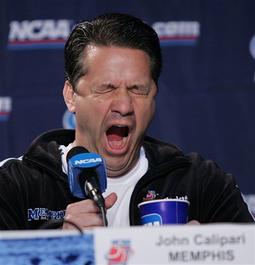
This happens periodically, every few years, or whenever John Calipari takes a new job. For Calipari, the 2008 Tigers were his second team to receive the ultimate in erasing punishment, following in the now-invisible footsteps of his 1996 Massachusetts team, another Final Four entrant lost in a sea of illegal cash and NCAA retribution.

Not quite enough teams have earned this punishment to fill out a 64-team bracket, but there would at least be a decent Elite 8. So here are some of the best teams who now only exist in the memories of fans and NCAA investigators.

* The 1997 Minnesota Gophers. Bobby Jackson, John Thomas, Eric Harris, Sam Jacobson, Courtney James. A dozen years later those names are as familiar to Gophers fans as the players on the current roster. Led by Clem Haskins, that team electrified old Williams Arena, sparked by Jackson's tenacious defense and high socks. Tutor-gate wiped out that team's season. A Pulitzer Prize-winning series in the St. Paul Pioneer Press eventually revealed that a woman named Jan Gangelhoff wrote hundreds of papers for basketball players over the years, including for guys on that 1997 team. Gangelhoff - who died in 2005 - was more prolific than Nora Roberts, completing more than 400 pieces of homework for players, or, 400 more pieces of homework than Jackson probably completed during his college career.

On the court, though, that team thrived, and it makes sense, since few of the players were likely burdened by classroom concerns. They devoted all their attention to the hardwood. Although Jackson was the MVP of that team, Jacobson might have been the most intriguing player.

A fan favorite, Jacobson went to Park-Cottage Grove High School in Minnesota, where he was one of the leading scorers in the state's history. Known for his great leaping ability, fans expected great things from him in the maroon and gold. He had a decent career, averaging 13 points. But fans were often frustrated, primarily because Haskins always seemed to be pulling him after about four minutes of action, attributing it to a vague breathing problem Jacobson suffered from, which severely limited his endurance. He went on to a brief career in the NBA, including a short stint with the Lakers.

I remember a story from his time with the Lakers when Shaq called Jacobson the team's best three-point shooter, which might have been part of Shaq's act but still made me beam with pride. That's a Minnesota kid Shaq's talking about! Jacobson played five games with the Lakers, scoring 18 total points. Still, he got himself a basketball card. But I'm not sure what's going on in that Beckett card above. I guess it's supposed to show him soaring, displaying his impressive vertical leap. But the odd angle of the photograph almost makes it look like his feet remain planted to the ground, turning him into a grotesque giant who dunks without jumping.

The Gophers went 31-4 that season, losing to Kentucky in the national semifinals. They returned to campus depressed, but surely grateful their 25-page report on the Gettysburg Address had already been completed by Gangelhoff.

* The 1977 Minnesota Gophers.

Looking through the history of the Gophers program, it's a wonder they haven't been called the UNLV of the Midwest. The program's had it all, from the famous brawl with Ohio State to a rape scandal. And even without Calipari, the Gophers have managed to have a pair of seasons expunged by the NCAA. The 1977 team went 24-3, but retroactively forfeited every game due to violations involving star Mychal Thompson. That team had already been cursed. Violations from the previous regime - led by hard-ass coach Bill Musselman - meant they were ineligible for the postseason, despite their sterling record. Big names dotted the roster. From Phil Saunders, better known today as Flip, to Ray Williams, to future top draft pick Thompson, to future Hall of Famer Kevin McHale, that was probably the best team in school history. They're surely the best 0-27 team in NCAA history.

* The 1985 Memphis team. Also a Final Four squad. Also vacated after a myriad of NCAA violations. As a kid, I enjoyed watching that team whenever they appeared on TV, as I was a big fan of their star Keith Lee, a dominant low-post presence with a sweet left-handed shot who went on to a middling NBA career. Villanova beat the Tigers in the Final Four semifinals, before going on to upset Georgetown for the title. A guy named Baskerville Holmes played for Memphis, one of the most famous names in NCAA basketball history. Holmes was a tragic figure on a team filled with them. In 1997, he killed his girlfriend and then himself. The coach, Dana Kirk, served time in federal prison for tax-related problems. Most impressively, Kirk's teams graduated six players in his seven years at the school.

* Michigan in 1992 and 1993. The Fab Five. Webber's timeout. The long shorts. The trash-talking. The losses to Duke and North Carolina. All gone, at least officially. Off the court, the Wolverines were done in by the antics of booster Ed Marin. On the court, they fell to a Duke dynasty and a balanced North Carolina team. Bill Walton - who's usually not known for outlandish statements that have little basis in reality - once said the Fab Five were one of the most underrated and underachieving teams in history. Of course, they weren't either of those things, and not just because there's no NCAA record that they ever existed.

Underachieving teams don't make it to two consecutive finals and an overrated team wouldn't still be remembered by the majority of college basketball fans 18 years after they first stepped foot on the Michigan campus.

I might revisit this post in two or three years, right around the time the NCAA vacates Kentucky's 2010 Final Four appearance. The only question left then will be, where will Calipari go next?

Tuesday, October 13, 2009

When Catholic schools pretend to not like each other

This Saturday, my alma mater, St. John's, faces St. Thomas in a key football game that will likely decide the MIAC title. More importantly, it's a renewal of the Tommies-Johnnies rivalry, which has been playing out on the football field since 1901.

Students of both schools use the game as a prime chance to mock the other institution. St. Thomas students love wearing crude T-shirts that often reference the fact St. John's is an all-male school, and if it's only guys there at the secluded university in the middle of Minnesota, and there aren't any girls around, then, wink, wink, nudge, nudge, the students at St. John's are...well, you know. Wink, wink. Nudge, nudge. No one ever accused St. Thomas grads of having the comic subtlety of Steven Wright.

To counteract those barbs, St. John's students sometimes sport shirts that politely question the beauty of St. Thomas's female students, while also predicting fine futures for Tommie grads that will likely include tours of duty behind the counter at various fast-food franchises.

On the field, St. John's almost always wins. The Johnnies are unbeaten against St. Thomas since 1997, and St. John's is a perennial national contender, led by John Gagliardi, college football's all-time leader in victories. Most years, St. Thomas is nothing but a purple punching bag, more prop than competitor.

Tommies hate Johnnies and Johnnies hate Tommies. Oh, we hate those swell Tommies. Generation after generation of graduates learn those lessons, and they're nearly as important as anything their professors teach in business class or a chemistry lab.

Ultimately it's all pretty harmless, although there are those who really do get worked up if a child chooses to go to a different school than the parent. But, like most rivalries, especially in college, it's all fairly ludicrous. Rationally, it hardly makes sense for there to be any disdain, as the schools are the same in countless ways.

They're both Catholic institutions, but both schools have many students from other faiths. Both have stringent Catholics and those who can already be called "lapsed." St. Thomas is named after St. Thomas Aquinas, while freshmen at St. John's live in Tommy Hall, also named after the favorite theologian of Catholics everywhere. There, as first-year students, they're indoctrinated into why even God agrees it's all right to hate St. Thomas - the school, not the man. Maybe that was part of my problem. As a transfer student from a community college, I never got the early propaganda and only built up a dislike over two years.

Average class size? 21 at St. Thomas, 22 at St. John's (score one for the Tommies). The student/faculty ratio at St. John's is 12:1, compared to 15:1 at St. Thomas (score one for the Johnnies).

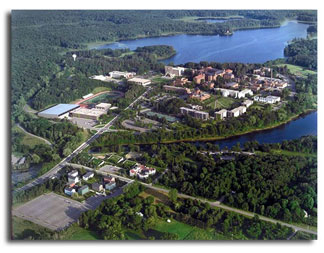
Many who attend St. John's seriously considered St. Thomas, and vice versa. For many, including myself, it's the location of each that helps seal their decision. St. John's is located in Collegeville in central Minnesota, situated in peaceful surroundings, with woods and water providing picture-perfect moments.

St. John's seemingly exists in its own world, about 70 miles from the Twin Cities. St. Thomas, meanwhile, calls St. Paul home, perfect for students who prefer their college life in a real city, giving them the types of opportunities unavailable to the St. John's kids going to school in the country. The odd thing about many St. John's people who denigrate the city existence of St. Thomas is that many come from the Twin Cities, while those who ridicule the isolation of St. John's now that they're Tommies are veterans of the rural life.

And St. Thomas - the largest private university in Minnesota - has nearly 11,000 students in its undergraduate and graduate programs while St. John's has an enrollment of 4,000. That's the enrollment with its sister school, the College of St. Benedict. While St. John's is, indeed, still an all-male school, in many ways that's in name only. They're partner schools. Men and women share classes, libraries, campuses, and carnal relations.

St. Thomas and St. John's have much in common, siblings nearly themselves, right down to the nicknames of each. Add an extra consonant and "ies" to the end of the name and slap it on the uniforms. Disliking one just because you go to the other seems almost like an act of self-loathing. But then, it's like that with so many rivalries. Harvard-Yale. Michigan-Ohio State. Army-Navy. The similarities of the schools and student bodies dwarf any perceived differences.

St. John's hating St. Thomas is like America considering Canada to be its biggest rival and most dangerous threat.

What's a real rivalry? With real reasons for hatred? How about the India-Pakistan cricket battles? Here you have two nations who threaten each other with nuclear destruction. When the athletes meet - Hindus vs. Muslims - it's for a bit more than bragging rights.

"The phrase sporting event can't begin to contain the religious extremism, unforgiven deeds and rabid jingoism that swirl around each India-Pakistan cricket match; the game is haunted by battle dead, and the air is charged with the ongoing dispute between the two countries over control of Kashmir."

Yeah, but do the fans wear T-shirts with witty sexual innuendo?

So, rationally it doesn't make sense for St. John's and St. Thomas to be such rivals. Where's the enmity come from, and why?

But this is sports and specifically football and rational thought doesn't have much to do with it. I see the purple of St. Thomas and my stomach churns, even if in high school I did contemplate what life would be like on the St. Paul campus. I listen to a St. Thomas graduate and I hear an arrogance that seems unique to Tommies. I see their T-shirts and read their insults about St. John's and pity the thinking that passes for creativity at St. Thomas.

If St. Thomas actually does what it never does and beats St. John's this Saturday it will ruin part of my day, in a way a loss to any other team wouldn't.

It's illogical, nonsensical.

In the end, that doesn't matter. It's the Tommies, and they're not Johnnies, even if they are alike in so many ways. It's the Johnnie-Tommie game, with the winner being the favorite for the conference.

A rational rivalry, no. But what fun would that be?

Friday, September 18, 2009

So a community college student walks into a bar...

Last night I unfortunately missed the premiere of NBC's "Community." The sitcom focuses on a lawyer who returns to community college because his degree wasn't real. Hijinks ensue. Critics give it decent reviews, and the show also marks the return of Chevy Chase to the land of the living (if he can be in this, is it too much to ask for him to get the lead role in the long-rumored remake of "Fletch?").


Community college advocates expressed concern that the show would portray two-year schools in an unflattering light. In the same way PETA writes letters of protest whenever a celebrity dons a fur coat or a cow is milked against its will, I pictured community college leaders penning notes of disappointment and outrage to NBC. Only they'd be misspelled...because they're from community colleges! (Could be a decent joke for the new show, NBC.)


I attended Worthington Community College in southwestern Minnesota for two years. Nearly everyone on my father's side of the family attended WCC, which now carries the longer and geographically vague name Minnesota West Community and Technical College. Louise took classes at a community college while pursuing her nursing degree. Over the years, I've heard pretty much every joke possible about two-year schools. I've made some of my own.


When people ask where I went to school, I say "St. John's. The Minnesota one," and will only occasionally mention that my college life started at a JUCO. Community colleges often still remain more punchline than destination.


And my time at WCC included many bizarre moments that might only be possible at two-year institutions. A chronically confused professor of mine once asked a question that a student answered, "I think it was Teddy Roosevelt." To which she replied, "No, no, it was Theodore Roosevelt." I engaged in passionate debates in history class with a 45-year-old woman who had three kids and thought she knew everything. She might have been right.


Housing choices were limited. No dorms. Sophomore year I lived with four other guys in a house that had four bedrooms. I discovered that only after agreeing to move in. For nine months I slept in the dining room. I had my bed, a side table, and a poorly constructed curtain that provided less privacy than a hospital gown. My roommates stayed up until three, four in the morning, ending their nights by watching comedies or action movies, meaning I went to sleep with the sounds of belly laughter or explosions ringing in my head.


However, in the 16 years since I first started school in Worthington, I've come to a realization: I'd love for my (for now theoretical) child to go to community college. The price is the most obvious reason. At a time when private schools and state universities continue to raise tuition to the point where parents have to offer to sell their second-born to allow their firstborn to go to college, the low, low costs of community colleges welcome you with open arms.


It's easy to transfer to a four-year school. Kids do miss out on freshman hazing. They have to make a new group of friends when they transfer. They have to attend orientation as a 20-year-old surrounded by wide-eyed 18-year-olds. They have to listen to clichéd jokes about community colleges. There are worse things in the world, like being the poster child for documentaries about college students weighed down and destroyed by debt. So why not take advantage of the financial breaks?


But community colleges don't have to just be treated like a cheap prison sentence ("I'm doing a two-year stint up at Bronx Community College. I hope to get paroled in a year.") Students actually...learn quite a lot at community colleges. Smart, passionate professors teach there. The best journalism teacher I had taught at Worthington, a former newspaper editor who had superb insight into the business and was extremely encouraging with my writing from the first class I had with him. True, the rest of the class was filled with kids who would hold a newspaper upside down if told to read it - "the words don't make sense" - but as I learned at St. John's, every class in every school has swell students who make their peers go, huh? Another English professor inspired me with his life story, and his writing.


And you can make friends for life at community colleges, just as easily as you can at a fraternity or sorority and there isn't even any paddling. The four guys I lived with in the four-bedroom-and-one-dining-room home were all great guys. One became a longtime friend.


Attending WCC gave me the chance to play college basketball for two years. My old coach, Mike Augustine, remains a valued friend. He's also an example of what community colleges can do for people. At the same time he was coaching us, he was a fellow student, a middle-aged guy who returned to school to get his teaching degree. He earned his associate's, and went on to a four-year school, followed by a successful career as a teacher. Augie was a nontraditional student who experienced a traditional benefit of two-year schools: his life improved.


A few months into my freshman year at WCC, I wanted to transfer to St. John's. My parents explained that it wasn't financially viable at the time. For a few weeks I was upset. But as I settled in and became comfortable, I grew to love my time at WCC. Sixteen years later, I'm even more grateful I spent my first two years there. My student loans were half of what they would have been. The lessons I learned in my classes remain with me. I extended my basketball career. I made friends for life.


Community college advocates shouldn't fear "Community," unless Chevy Chase's performance mirrors his effort on his talk show. Any publicity helps, and community colleges are havens for odd people and strange situations - a sitcom really should have been set in one long ago. They just happen to also be the perfect schools for hundreds of thousands of students, of all ages.