Last week I emailed a book proposal I've been working on to Louise, hoping to get her thoughts on the content and the format. Louise has always been my most trusted editor, even if she's reading about sports, a subject that's so foreign to her, the only thing she really knows is that the word itself is spelled with six letters. But she knows writing. She knows what works, and, more importantly, what doesn't.
But she can be a brutal editor. Straight-forward, occasionally tactless, always honest - even when I simply want her to lie to me.
And even from Cape Town, her edits and thoughts have the ability to eviscerate my confidence. She offered a few suggestions and she delivered them in a cheery voice with a great accent. Still they cut. Like always when she offers critiques, I felt like crawling into a ball on the couch while cursing everything about writing. Why do I do this? Why did my old English teacher ever encourage me? Why does my mom always say she loves my writing? Can I still go to law school, and, if so, would Louise be this harsh when reading my closing arguments? Eventually I calm down and regain my poise, if not my confidence. I consider Louise's suggestions and realize they're perfect edits and that she's only helping me. She's not trying to break me down. In fact, this is why I go to her for advice, because she is so spot on with her thoughts and words.
But a guy could use a confidence boost. So I turn to the spam comments on my blog. This isn't the traditional spam, the ones everyone's so familiar with. There are no pleas from Nigerian princes or housewives for money and no products offering up unique - and cheap - ways to enlarge male genitalia. No, these messages are more subtle, kinder. They soothe and encourage. They flatter and praise. And they can make anyone believe they've written something worthwhile.
The comments appear on my blog and occasionally break through the spam detector and get published. But most get caught. Maybe I should let them all slide through.
"I am really glad I came across this blog. Added shawnfury.blogspot.com to my bookmark!"
So kind, especially the exclamation point.
After a blog post about New York, some anonymous computer or bored Russian said, "What a nice post. I really enjoy reading these types of articles. I can't wait to see what others have to say."
Sure, perhaps Louise thinks one of my chapter ideas needs to be fleshed out a bit, but why should that make me question my projects when someone writes - in response to a blog about newspaper comments - "Fine article! Could you follow up on this great matter!" I could, and did, and why wouldn't I when a spammer is so eager to see more of my work?
In a post centered on high school basketball records, a spammer said, simply yet eloquently, "Beautiful post, great ))" I don't know if the double parenthesis were supposed to be smiley faces or what, but the sentiment is still appreciated.
Occasionally the comments do have concerns, they're not always encouraging. But they're still not as harsh as Louise's edits:
"Hey, great post. Though I'm not sure I agree with you 100% Keep em coming. Are you interested in having anyone guest post opposing views?"
No.
Another added, "Nice post, kind of drawn out though. Really good subject matter though." Kind of drawn out? I realize I sometimes write long, but do the robots have to point it out? Or, if written in the form of spam, do the robots have to point it out, though.
Even those from other countries appreciate my posts. "British isn't my main language yet I could comprehend this when using the google translator. Terrific publish, have them coming. Say thanks!"
A spam that demands good manners. So, thanks. British isn't my first language, either, and, really, that comment is more a compliment for the engineers at Google. Still, it's a nice thought, something any writer would enjoy.
In the end, of course, Louise's critiques are much more valuable than the ones offered up by some computer located thousands of miles away. And she's actually mostly encouraging. She's my most enthusiastic fan, in addition to being a brilliant editor.
The spams are a mirage, offering up praise without, I'm guessing, really reading all of the material. Does the spam really agree with me about the absurdity of the comments on newspaper websites? Was it really a brilliant post? I wonder.
Besides, I sort of suspect those comments aren't really spam at all. I think mom left them.
Showing posts with label writing. Show all posts
Showing posts with label writing. Show all posts
Saturday, January 15, 2011


Thursday, December 23, 2010
The continuing adventures of InDesign's spellcheck
A few weeks ago at work, we had an updated version of InDesign installed on our computers. I briefly worried that the most fascinating aspect of our InDesign - the crazed, angry, prophetic, cruel, sympathetic, sophomoric, harsh, unforgiving, all-knowing spellcheck - would have been altered in the new version. Would it still offer up Satan as a correction for Ashton? Would psychobiology still be a suggested change for Scooby-Doo? Or would InDesign go legit and normalize, blending in with all the other boring spellchecks in the world?
No worries. Some more examples of InDesign spellcheck's peculiar outlook on the world:
Salma (as in Hayek): Slimy, salami
Katy (as in Perry): Kooky, kitty
Volkswagen: Folksinger - Surely many unkempt hippie folksingers drove Volkswagens back in the day. But how does InDesign know this?
Lorenzo (as in Lamas): Low-rent, reruns - A bit harsh. Then again, if I turned on Lifetime at 3 in the morning some time and discovered an old episode of Falcon Crest, those would probably be two of the first words out of my mouth.
Mischa: Mescal, miscue
Ziering: Swearing, syringe
Cibrian: Aspiring, Siberian
Danielle: Dunghill, dingle
Beyonce: Bouncy, bones - When the singing superstar invariably becomes scary-skinny at some point in her career, those two words will appear in a review of her concerts.
Lautner: Latent, Latino - I think this was one of the primary concerns of the controversial Arizona immigration law from a few months ago. Undocumented workers, anchor babies, illegal aliens, latent Latinos.
Disick: Disco, dashiki.
Fallon: Fallen, felon - Only if the late-night gig really goes bad.
Speaking of the late-night television wars, InDesign suggests horny, auburn, uterine, ovarian, and ob-gyn for O'Brien. InDesign is not shy when it comes to mattes of the human anatomy.
Baskett: Back-seat, basked, bisect - Not sure why InDesign hyphenates backseat, but it is the perfect way to describe Hank Baskett's spot in his marriage to former Playboy playmate and current disgruntled Minnesota resident Kendra Wilkinson.
InDesign expert David Blatner noted that he couldn't get his settings to duplicate our results. I'm a bit disappointed in that, since everyone should get to enjoy InDesign spellcheck's perversions and sly sense of humor. But I also like that we possess an apparently unique spellcheck, one that has seemingly gone rogue and no longer cares what writers and editors think. It will continue offering nonsensical suggestions for common words and proper nouns. Yes, our computers got an upgrade but InDesign spellcheck stayed the same.
Thank God.
No worries. Some more examples of InDesign spellcheck's peculiar outlook on the world:
Salma (as in Hayek): Slimy, salami
Katy (as in Perry): Kooky, kitty
Volkswagen: Folksinger - Surely many unkempt hippie folksingers drove Volkswagens back in the day. But how does InDesign know this?
Lorenzo (as in Lamas): Low-rent, reruns - A bit harsh. Then again, if I turned on Lifetime at 3 in the morning some time and discovered an old episode of Falcon Crest, those would probably be two of the first words out of my mouth.
Mischa: Mescal, miscue
Ziering: Swearing, syringe
Cibrian: Aspiring, Siberian
Danielle: Dunghill, dingle
Beyonce: Bouncy, bones - When the singing superstar invariably becomes scary-skinny at some point in her career, those two words will appear in a review of her concerts.
Lautner: Latent, Latino - I think this was one of the primary concerns of the controversial Arizona immigration law from a few months ago. Undocumented workers, anchor babies, illegal aliens, latent Latinos.
Disick: Disco, dashiki.
Fallon: Fallen, felon - Only if the late-night gig really goes bad.
Speaking of the late-night television wars, InDesign suggests horny, auburn, uterine, ovarian, and ob-gyn for O'Brien. InDesign is not shy when it comes to mattes of the human anatomy.
Baskett: Back-seat, basked, bisect - Not sure why InDesign hyphenates backseat, but it is the perfect way to describe Hank Baskett's spot in his marriage to former Playboy playmate and current disgruntled Minnesota resident Kendra Wilkinson.
InDesign expert David Blatner noted that he couldn't get his settings to duplicate our results. I'm a bit disappointed in that, since everyone should get to enjoy InDesign spellcheck's perversions and sly sense of humor. But I also like that we possess an apparently unique spellcheck, one that has seemingly gone rogue and no longer cares what writers and editors think. It will continue offering nonsensical suggestions for common words and proper nouns. Yes, our computers got an upgrade but InDesign spellcheck stayed the same.
Thank God.
Sunday, December 5, 2010
Browsing the bookstore
Fought the crowds today and wandered through our favorite Barnes & Noble in the city, the one on the Upper West Side that's shutting down in just a few weeks, to be replaced by a clothing store. Because there's a distinct lack of quality clothing stores in New York City.
Some observations.
* One book in particular caught my eye in the new releases section. Fury: A Memoir, by Koren Zailckas. The book, from the author of Smashed, has earned rave reviews. But apparently no one is concerned that the book ruins any chance I'd ever have of using my name in a future memoir. Salman Rushdie used Fury for the name of a novel and Faulkner had it as part of one of his most famous works. Those classic works are different, those are fiction. This is a memoir. I think the word Fury should have been saved for someone with that name who was penning their autobiography, or, at the least, it should have been reserved for someone writing a biography of a person named Fury. Now what can I name my memoir that could possibly sound as cool as Fury? Zailckas: A Memoir by Shawn Fury doesn't quite have the same ring.
* It's not a new book but is one I hadn't seen before. Washed Up: The Curious Journeys of Flotsam and Jetsam. Another entry in the seemingly never-ending list of books that are a detailed history of something you'd never think needed a detailed history. Like books on salt, cod, toilets and menstrual cycles, this one looks fairly fascinating, as author Skye Moody attempts to figure out where everything that washes up on shores comes from. We're only a few years away from the story of Floss, and how it changed the world.
* The Best American writing books are always popular gifts. Each year I buy the sports one and usually pick up the crime, science and essay titles as well, along with the non-required reading entry. They're great anthologies and for writers, something to strive for. The sports one this year was, as usual, superb. Buy the book for all the stories, but I'll give a link to one of the best. It's Mike Sager's profile of Todd Marinovich, which ran in Esquire in April 2009. For the longest time Marinovich was the poster boy for everything that could go wrong for a kid under the direction of a sports-crazed parent. I can remember watching a special on Marinovich when he was maybe a junior in high school. Even then the stories of his father, Marv, were legendary. Todd was raised from birth to be a quarterback and, in many ways, his dad's plan worked. Todd played at USC and in the NFL. Of course, it ultimately didn't work out, unless Marv's plan also involved turning his son into an often-jailed addict who squandered his physical talents because of the emotional problems caused, in large part, by his upbringing. Sager's story catches up with both Marinovich men. The only problem is, instead of seeing it as a warning about what not to do, many parents might read the story and regard it as a how-to guide. "Sure, the kid did some heroin, but he got a Division I scholarship!"
* Speaking of dads who might not have done the best job of preparing their prodigies for life in the real world, I saw this book: His Father's Son. Earl and Tiger Woods. It's by Tom Callahan, who knew the late Earl Woods very well. He details Tiger's upbringing and also writes about Earl's, um, issues with women. The issue being he liked them a lot, especially ones who weren't his wife. This, as you may have read, also became an issue in Tiger's life.
* Today Michael Lewis is probably best known for his books Moneyball and The Blind Side. But before he became one of the top nonfiction writers in the country, he worked for Salomon Brothers. He had a brief career there but it led to his first book, Liar's Poker, which I finally bought today. Lewis made a lot of money with Salomon and he's made a lot of money as a writer, thanks to his best-selling books and magazine work. How valued were Lewis's contributions? When the short-lived Portfolio magazine started, a rumor circulated that Lewis made $12 a word for his 4,000-word-plus features. This in a business where a dollar a word is considered to be a pretty good deal. Many people dismissed the rumor and Lewis eventually left for Vanity Fair, where's probably pulling in less than $12 a word but quite a bit more than a buck a word.
Still, I'm sure he'll be grateful for the $2 I added to his next royalty statement.
Some observations.
* One book in particular caught my eye in the new releases section. Fury: A Memoir, by Koren Zailckas. The book, from the author of Smashed, has earned rave reviews. But apparently no one is concerned that the book ruins any chance I'd ever have of using my name in a future memoir. Salman Rushdie used Fury for the name of a novel and Faulkner had it as part of one of his most famous works. Those classic works are different, those are fiction. This is a memoir. I think the word Fury should have been saved for someone with that name who was penning their autobiography, or, at the least, it should have been reserved for someone writing a biography of a person named Fury. Now what can I name my memoir that could possibly sound as cool as Fury? Zailckas: A Memoir by Shawn Fury doesn't quite have the same ring.
* It's not a new book but is one I hadn't seen before. Washed Up: The Curious Journeys of Flotsam and Jetsam. Another entry in the seemingly never-ending list of books that are a detailed history of something you'd never think needed a detailed history. Like books on salt, cod, toilets and menstrual cycles, this one looks fairly fascinating, as author Skye Moody attempts to figure out where everything that washes up on shores comes from. We're only a few years away from the story of Floss, and how it changed the world.
* The Best American writing books are always popular gifts. Each year I buy the sports one and usually pick up the crime, science and essay titles as well, along with the non-required reading entry. They're great anthologies and for writers, something to strive for. The sports one this year was, as usual, superb. Buy the book for all the stories, but I'll give a link to one of the best. It's Mike Sager's profile of Todd Marinovich, which ran in Esquire in April 2009. For the longest time Marinovich was the poster boy for everything that could go wrong for a kid under the direction of a sports-crazed parent. I can remember watching a special on Marinovich when he was maybe a junior in high school. Even then the stories of his father, Marv, were legendary. Todd was raised from birth to be a quarterback and, in many ways, his dad's plan worked. Todd played at USC and in the NFL. Of course, it ultimately didn't work out, unless Marv's plan also involved turning his son into an often-jailed addict who squandered his physical talents because of the emotional problems caused, in large part, by his upbringing. Sager's story catches up with both Marinovich men. The only problem is, instead of seeing it as a warning about what not to do, many parents might read the story and regard it as a how-to guide. "Sure, the kid did some heroin, but he got a Division I scholarship!"
* Speaking of dads who might not have done the best job of preparing their prodigies for life in the real world, I saw this book: His Father's Son. Earl and Tiger Woods. It's by Tom Callahan, who knew the late Earl Woods very well. He details Tiger's upbringing and also writes about Earl's, um, issues with women. The issue being he liked them a lot, especially ones who weren't his wife. This, as you may have read, also became an issue in Tiger's life.
* Today Michael Lewis is probably best known for his books Moneyball and The Blind Side. But before he became one of the top nonfiction writers in the country, he worked for Salomon Brothers. He had a brief career there but it led to his first book, Liar's Poker, which I finally bought today. Lewis made a lot of money with Salomon and he's made a lot of money as a writer, thanks to his best-selling books and magazine work. How valued were Lewis's contributions? When the short-lived Portfolio magazine started, a rumor circulated that Lewis made $12 a word for his 4,000-word-plus features. This in a business where a dollar a word is considered to be a pretty good deal. Many people dismissed the rumor and Lewis eventually left for Vanity Fair, where's probably pulling in less than $12 a word but quite a bit more than a buck a word.
Still, I'm sure he'll be grateful for the $2 I added to his next royalty statement.
Saturday, October 2, 2010
Coughing with Michael Chabon
The New Yorker Festival opened Friday, the annual three-day bonanza where famous authors, writers, directors, actors and editors sit on stages in front of large audiences and discuss their craft in theaters across the city. I'd never gone before. Usually I'd see an ad in the New Yorker touting the event, but I'd see it a week or two after tickets went on sale, which is what happens when the magazines pile up on a table in the living room. Finally this year I saw the ad in time. Two minutes after tickets went on sale, I bought a pair of them.
Sunday I'm attending a conversation between New Yorker editor David Remnick and writer Ian Frazier. Two of the best in nonfiction.
But on Friday I saw one of my writing idols, Michael Chabon. The author of Wonder Boys, The Yiddish Policemen's Union, The Amazing Adventures of Kavalier & Clay, numerous other novels and a couple of nonfiction collections appeared onstage with fellow author Zadie Smith, another writer who can not be introduced at an event without the moderator throwing the word "acclaimed" before her name.
Smith read a nonfiction piece, a story about her father, a World War II veteran who didn't want to be known as a hero or brave, even though he was both.
Chabon followed. Instead of reciting passages from one of his famous books, he read a work in progress, a treat for those in the audience, many of whom have surely consumed all of his published words. The piece focused on a home birth. To describe it beyond that would be impossible, except to say all of Chabon's skills - from the descriptions to the humor to the incomparable word play - were on display.
About three-quarters of a way through Chabon's reading, I suddenly, inexplicably, horrifyingly, embarrassingly, choked. I wasn't drinking or eating. I didn't have any gum in my mouth. But somehow I found myself blurting out a cough, followed quickly by another and the feeling in my chest and throat let me know this would be a long coughing spell, which quickly devolved into a coughing fit. I left my seat almost immediately and retreated to the rear of the theater. It felt like a piece of popcorn had lodged in my throat, but the last time I ate popcorn was at a movie three weeks ago. If it was popcorn, I had more problems than a cough.
I coughed several more times in the back of the theater before finally going out the door to compose myself. Thankfully, another attendee took attention away from my mysterious medical issue. As I walked to the rear of the theater, I watched three people drag a young man who had fainted. They pulled him out into the waiting area, sat him in a chair and stayed with him until he recovered. Could have been the heat. Or maybe it was Chabon's graphic description of a bloody vagina that made the poor guy woozy. As brilliant as Chabon's writing is, a bloody vagina is still a bloody vagina. And, actually, because of Chabon's skills, the mental images are even clearer. I'm sure the guy blamed the heat.
My coughing stopped and I returned to my sixth-row seat for the question and answer session. One woman asked how the writers feel about fiction compared to nonfiction. Smith finds nonfiction easier to write, Chabon's the opposite. Another woman said she'd come all the way from Berkeley to see Chabon. It quickly became obvious - from her body language, longing in her voice and reluctance to leave the microphone, even after Chabon answered her question - that I didn't have to worry about being accused of being the attendee who would most likely stalk Chabon. If the moderator hadn't pointed to another person who had a question, the lady might still be standing there.
Like many in the audience, she was impressed by Chabon's ability to write about childbirth and wondered if there'd be an equivalent event that men go through. "Whaling," he said.
I walked to one of the two microphones and asked my question. I've spoken with other writers about Chabon's famous use of similes and metaphors. No one uses them like Chabon. They pop off the page, one after another, sometimes three or four in a paragraph. On a journalism board, during a discussion of similes, a few writers debated whether you should use a simile if it takes more than a few minutes to think of it. In other words, if you have to slave over it for too long, it's probably not any good. I asked Chabon what's it like for him. He conjures up phrases that no one else would think of, but after you've read them, it becomes impossible to imagine the person or event being described in any other way. He writes sentences I've memorized by heart, lines that should be required reading in all English classes and recited even before schoolchildren say the Pledge of Allegiance each morning. In his review for The Yiddish Policemen's Union in New York Magazine, Sam Anderson listed some of Chabon's best lines:
The detective's ex-wife "accepts a compliment as if it's a can of soda that she suspects him of having shaken." In a crowded apartment, two babies are "stashed away on the balcony like disused skis." Rain is "tossed in vandalistic handfuls at the windshield."
Similes! I was talking to Michael Chabon about similes. This is like asking Magic Johnson about the art of the half-court bounce pass. It's like asking Warren Buffett about investments. It's like...well, some other simile.
His answer? They're easy for him. When writing fiction, he might occasionally struggle with plotting the story or other big-picture situations. But those unique phrases that liven up every page of his books are practically effortless. I don't know for sure whether he believes a simile is worthless if you have to spend more than a minute thinking of it, but that's only because he's probably never done it himself.
The event lasted a little over an hour. On my walk back to the subway, I strolled in front of the poor guy who passed out at the event, as he asked his female companion what exactly happened. Nothing much. He fainted and had to be hauled out of a theater in front of a few hundred people while ushers and security looked at him with a mixture of pity and anxiety.
And he missed hearing the best writer of his generation read his work and discuss his craft.
Sunday I'm attending a conversation between New Yorker editor David Remnick and writer Ian Frazier. Two of the best in nonfiction.
But on Friday I saw one of my writing idols, Michael Chabon. The author of Wonder Boys, The Yiddish Policemen's Union, The Amazing Adventures of Kavalier & Clay, numerous other novels and a couple of nonfiction collections appeared onstage with fellow author Zadie Smith, another writer who can not be introduced at an event without the moderator throwing the word "acclaimed" before her name.
Smith read a nonfiction piece, a story about her father, a World War II veteran who didn't want to be known as a hero or brave, even though he was both.
Chabon followed. Instead of reciting passages from one of his famous books, he read a work in progress, a treat for those in the audience, many of whom have surely consumed all of his published words. The piece focused on a home birth. To describe it beyond that would be impossible, except to say all of Chabon's skills - from the descriptions to the humor to the incomparable word play - were on display.
About three-quarters of a way through Chabon's reading, I suddenly, inexplicably, horrifyingly, embarrassingly, choked. I wasn't drinking or eating. I didn't have any gum in my mouth. But somehow I found myself blurting out a cough, followed quickly by another and the feeling in my chest and throat let me know this would be a long coughing spell, which quickly devolved into a coughing fit. I left my seat almost immediately and retreated to the rear of the theater. It felt like a piece of popcorn had lodged in my throat, but the last time I ate popcorn was at a movie three weeks ago. If it was popcorn, I had more problems than a cough.
I coughed several more times in the back of the theater before finally going out the door to compose myself. Thankfully, another attendee took attention away from my mysterious medical issue. As I walked to the rear of the theater, I watched three people drag a young man who had fainted. They pulled him out into the waiting area, sat him in a chair and stayed with him until he recovered. Could have been the heat. Or maybe it was Chabon's graphic description of a bloody vagina that made the poor guy woozy. As brilliant as Chabon's writing is, a bloody vagina is still a bloody vagina. And, actually, because of Chabon's skills, the mental images are even clearer. I'm sure the guy blamed the heat.
My coughing stopped and I returned to my sixth-row seat for the question and answer session. One woman asked how the writers feel about fiction compared to nonfiction. Smith finds nonfiction easier to write, Chabon's the opposite. Another woman said she'd come all the way from Berkeley to see Chabon. It quickly became obvious - from her body language, longing in her voice and reluctance to leave the microphone, even after Chabon answered her question - that I didn't have to worry about being accused of being the attendee who would most likely stalk Chabon. If the moderator hadn't pointed to another person who had a question, the lady might still be standing there.
Like many in the audience, she was impressed by Chabon's ability to write about childbirth and wondered if there'd be an equivalent event that men go through. "Whaling," he said.
I walked to one of the two microphones and asked my question. I've spoken with other writers about Chabon's famous use of similes and metaphors. No one uses them like Chabon. They pop off the page, one after another, sometimes three or four in a paragraph. On a journalism board, during a discussion of similes, a few writers debated whether you should use a simile if it takes more than a few minutes to think of it. In other words, if you have to slave over it for too long, it's probably not any good. I asked Chabon what's it like for him. He conjures up phrases that no one else would think of, but after you've read them, it becomes impossible to imagine the person or event being described in any other way. He writes sentences I've memorized by heart, lines that should be required reading in all English classes and recited even before schoolchildren say the Pledge of Allegiance each morning. In his review for The Yiddish Policemen's Union in New York Magazine, Sam Anderson listed some of Chabon's best lines:
The detective's ex-wife "accepts a compliment as if it's a can of soda that she suspects him of having shaken." In a crowded apartment, two babies are "stashed away on the balcony like disused skis." Rain is "tossed in vandalistic handfuls at the windshield."
Similes! I was talking to Michael Chabon about similes. This is like asking Magic Johnson about the art of the half-court bounce pass. It's like asking Warren Buffett about investments. It's like...well, some other simile.
His answer? They're easy for him. When writing fiction, he might occasionally struggle with plotting the story or other big-picture situations. But those unique phrases that liven up every page of his books are practically effortless. I don't know for sure whether he believes a simile is worthless if you have to spend more than a minute thinking of it, but that's only because he's probably never done it himself.
The event lasted a little over an hour. On my walk back to the subway, I strolled in front of the poor guy who passed out at the event, as he asked his female companion what exactly happened. Nothing much. He fainted and had to be hauled out of a theater in front of a few hundred people while ushers and security looked at him with a mixture of pity and anxiety.
And he missed hearing the best writer of his generation read his work and discuss his craft.
Friday, July 23, 2010
Hunting for more treasures in the Sports Illustrated vault
 Sports Illustrated's online vault remains one of my favorite spots on the Internet. The site remains free, though there are always rumors that someday Time-Warner may start charging for access to the incredible archives inside the vault. I'd pay. Then again, I still actually buy newspapers and I know that's a dwindling minority, so who knows if other people would fork over money for access to SI's treasured past.
This cover above has John and Evelyn Olin, or, as they're called, "Mr. And Mrs. John Olin." It's from November 17, 1958. This issue came four years after Sports Illustrated premiered. It still focused on things like sailing, hunting and bridge. College football reigned, not the NFL. Baseball was certainly a popular subject, but no more so than the America's Cup.
Some of the stories in this issue:
Smile of Champions Recap of class-boat titles
Fair Game for Monsieur Louis "The chef at 21 can prepare anything from baby pheasants to black bear chops"
When Ely Deserted Culbertson Riveting story about contact bridge.
And it's fair to say Sports Illustrated originally targeted an elite readership. Today the Faces in the Crowd features high school phenoms, small-college standouts and the occasional middle-aged guy who won five straight league bowling titles in Alabama. In this issue?
"Pierre du Pont III, Wilmington, Del. corporation executive, sailed his schooner Barlovento over rainswept 100-mile Chesapeake Bay course, won Skipper Regatta in corrected 17:25:05.
Yes, he's one of the Du Ponts. A normal guy. Just your average face in the crowd.
There was another story in the issue, a completely non-sexist feature called "The Question: Should a husband try to teach his wife to ski?" There's an answer from Gary Cooper (who says yes), and from Mrs. Nelson A. Rockefeller, who wrote, "I think it's fine for a husband to teach his wife to ski, providing, of course, that he himself is a good skier and a good teacher." Rockefellers on skiing, Du Ponts on sailing. All that's missing is a blurb about a Mellon heir dominating croquet.
SI always loved dogs, as evidenced by this odd cover. Or this one. And then there's the February 8, 1960 cover: Are Dog Shows Ruining Dogs? I say yes.
In its early years, Sports Illustrated often relied on drawings for its covers, like this Masters one. The week after that issue, the "6th Annual Baseball" issue also featured a sketch, not a photo. In the May 16, 1960 issue, SI boldly labeled Australia the "leading sports nation," and as proof featured a cover of half-naked men and over-dressed girls playing tennis.
The old Sports Illustrated just loved bridge. Noted bridge expert Charles Goren appeared on the cover twice and had a cover byline a third time. Goren's byline appeared on the February 17, 1964 issue, the last time bridge graced the SI cover.
 By the 1970s, SI had drifted toward the major sports, though the magazine still saved countless pages for national track and field events and regional swimming competitions, the type of stories that basically only appear every four years today.
Fran Tarkenton was the first Viking to make it on the cover, in 1962. Sports Illustrated's famous NFL writer Tex Maule wrote the cover story on the young quarterback, who would be traded by the team five years later before returning to Minnesota in the 1970s for the team's glory years. Maule's story ran with the headline "His Sundays are Murder: Fran Tarkenton, quarterback of the Minnesota Vikings, has to scramble to save his young life." The second Viking player to make the cover? Ron Vander Kelen. A year after publishing the story on Tarkenton, SI wrote a lengthy feature on the rookie quarterback Vander Kelen, who came to the Vikings after playing college ball at Wisconsin and winning the Big Ten MVP in 1962. The story ran in August, as the rookie adjusted to the pros. Vander Kelen did not exactly match his college success; he threw six touchdown passes in his career. He's probably best known for being a trivia question answer: who started at quarterback in Bud Grant's first game as Vikings coach?
Incidentally, Bud Grant never made it on the cover of SI. In other words, Charles Goren made it two more times than one of the most successful coaches in NFL history. Then again, Charles Goren never lost four Super Bowls.
So many great strange covers from the magazine's early decades. Bud Ogden played two years in the NBA. He scored a total of 257 points. Yet in 1969, Ogden, then a star at Santa Clara, made the cover of the most famous sports magazine in the land, in this artsy, odd cover shot that was apparently conceived by a photographer who was enjoying some of that decade's finest pharmaceutical products:

In the current SI, there's a story on Atlanta manager Bobby Cox. But in 1957, a different Bobby Cox became the first Minnesota sports figure to make the Sports Illustrated cover. The magazine declared Gophers quarterback Bobby Cox the best quarterback in America. As far as I can tell, Cox is the only Gopher football player to ever make the cover. And, based on the last fifty years of Gophers football, it's more likely SI will put a bridge player on the cover before a Gopher.
But at least the program doesn't have to worry about being jinxed.
By the 1970s, SI had drifted toward the major sports, though the magazine still saved countless pages for national track and field events and regional swimming competitions, the type of stories that basically only appear every four years today.Fran Tarkenton was the first Viking to make it on the cover, in 1962. Sports Illustrated's famous NFL writer Tex Maule wrote the cover story on the young quarterback, who would be traded by the team five years later before returning to Minnesota in the 1970s for the team's glory years. Maule's story ran with the headline "His Sundays are Murder: Fran Tarkenton, quarterback of the Minnesota Vikings, has to scramble to save his young life." The second Viking player to make the cover? Ron Vander Kelen. A year after publishing the story on Tarkenton, SI wrote a lengthy feature on the rookie quarterback Vander Kelen, who came to the Vikings after playing college ball at Wisconsin and winning the Big Ten MVP in 1962. The story ran in August, as the rookie adjusted to the pros. Vander Kelen did not exactly match his college success; he threw six touchdown passes in his career. He's probably best known for being a trivia question answer: who started at quarterback in Bud Grant's first game as Vikings coach?
Incidentally, Bud Grant never made it on the cover of SI. In other words, Charles Goren made it two more times than one of the most successful coaches in NFL history. Then again, Charles Goren never lost four Super Bowls.
So many great strange covers from the magazine's early decades. Bud Ogden played two years in the NBA. He scored a total of 257 points. Yet in 1969, Ogden, then a star at Santa Clara, made the cover of the most famous sports magazine in the land, in this artsy, odd cover shot that was apparently conceived by a photographer who was enjoying some of that decade's finest pharmaceutical products:
In the current SI, there's a story on Atlanta manager Bobby Cox. But in 1957, a different Bobby Cox became the first Minnesota sports figure to make the Sports Illustrated cover. The magazine declared Gophers quarterback Bobby Cox the best quarterback in America. As far as I can tell, Cox is the only Gopher football player to ever make the cover. And, based on the last fifty years of Gophers football, it's more likely SI will put a bridge player on the cover before a Gopher.
But at least the program doesn't have to worry about being jinxed.
Friday, July 16, 2010
Witty headline goes here
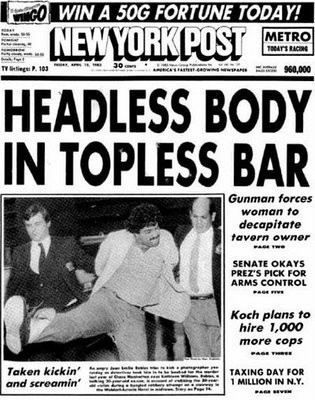
Pulitzer Prize winner Gene Weingarten wrote a column for the Washington Post about the lost art of writing headlines. Like circulation and ad dollars, headlines - good ones - are becoming a victim of online media. As papers transition to the web (don't people use the word transition as a euphemism when people die? Anyway.), witty, clever, amusing and outrageous headlines are no longer needed, or even desired. Instead, as Weingarten wrote, headlines are now "designed for search engine optimization." Great. Paper versions can still deliver the goods, but fewer people see the hard copy version so fewer readers get to appreciate the creativity of copy editors, who are usually seen as a dour group of people only obsessed with proper use of commas.
When I worked as a newspaper copy editor, we wrote the headlines and I liked that part of the job more than anything. We also designed the pages, and some people enjoy that aspect more. But give me the headline writing.
It's not as fun if you're on a news desk. Earthquakes, budget deals and city council meetings rarely lend themselves to creative headlines. Also, copy editors on the news desk often write headlines for stories about investigations. Investigations into politicians and corrupt cops. Investigations into bankers who embezzle and dads who write bad checks. Investigations into college basketball players who cheat on tests and coaches who cheat on their wives. Unfortunately, there are very few synonyms for "investigation." And, for the most part, there's only one similar word that fits into a small one-column space: Probe. And copy editors hate using the word probe. It conjures up images of alien abductions and doctor visits that end with a punchline and humiliation. But no matter how much they dislike the word, a news copy editor will inevitably use the word probe in a one-column headline and probably once a month.
Senate
launches
Goldman
probe
Police
probe
burglaries
Yuck. Back to fun headlines. In sports you get away with more, within reason. A colleague of mine once wrote the headline: FLIP'S FLIP FLIPS FLIP'S WOLVES
Personally, I thought it was genius. Flip Murray tossed in a lucky shot at the buzzer to defeat the Timberwolves, coached by Flip Saunders. Another editor thought it was a bit too much.
The highlight of my time on the sports desk at The Forum in Fargo was when one of our headlines made The Tonight Show, years before everyone hated Jay Leno and stopped watching his show. Most of the headlines Leno displays are mistakes or a typo or an unfortunate picture choice. We knew ours had a chance to get on the air. A few weeks after publication, Leno showed it on his show. This was more thrilling to a copy editor than catching an award-winning reporter misusing there and their.
A writer at the paper, Terry Vandrovec, came up with the headline. All I did was type it onto the page:
FRIKKEN LAYUP DOOMS BISON
The story was about a basketball player named Frikken, who hit a game-winning shot to defeat the North Dakota State men's basketball team. We exchanged high-fives in the newsroom that night.
An old editor of mine, Bob Van Enkenvoort, won an Associated Press award when he penned the perfect headline "Mmm, mmm, goodbye" when the Campbell's Soup factory closed in Worthington.
I still have a dusty file that contains some of my clippings, including old headlines. I have a printout from 2003, when our sports editor sent around a list of some of the department's best headlines of the year, as we debated which ones to enter for competitions.
If I may, some of mine that were up for consideration:
UDDERLY AMAZING (about a kid who owned a dairy herd, had a 4.0 GPA and was a great basketball player. Come on).
BACK ON THE HORSE (gymnastics coach returns to powerhouse he built years earlier)
DEAR JOHN (Feature about a beloved wrestling coach named John who retired)
TWINS PLAY CREDIT CARD (Twins were whining about lack of respect while facing Yankees, who then dispatched Minnesota in the playoffs, proving everyone right, unfortunately)
ANOTHER YANKEE DANDY (Clemens dominates Twins)
HOT COCO BURNS COYOTOES (Player named Coco has big basketball game)
SPANDEX SWAPPER SPARKS SPUDS (Former swimmer became a top-notch wrestler)
And on and on. Some of them are certainly a bit cheesy. But that's part of the fun. Copy editors rely too much on movie and book titles. They rely too much on possibly cliched sayings, but they use them in a way that's usually ironic and puts a new spin on an old line.
You bring readers in with the headline, then tell the real story in the dek right below, then follow with the reporter's story. An older reader used to call periodically and a few times he wanted to know who wrote a particular headline, because he enjoyed it so much. Most of the times readers call to demand why the newspaper hates high school swimming. Or they asks us if we know we possess below-average intelligence. So calls like the headline lover's boost the self-esteem of copy jockeys.
Living in New York, of course, affords me the opportunity to see true headline-writing geniuses at work. I read the Daily News and New York Post every day. Without fail, each paper delivers superb headlines in every edition. I savor papers like The New York Times because of the in-depth reporting and I subscribe to magazines like Esquire and The New Yorker because of the 10,000-word feature stories. But when it comes to summing up a story, a scandal, an arrest, a death or a victory in a short headline, no one competes with the tabloids. Several years ago I had a tryout at the New York Post. It didn't result in a job offer, but during my tryout, I did get to pen a headline that ran with one of the sports section's main stories. It was a simple Mets game story, but it involved Pedro Martinez pitching against the Nationals and Jose Guillen. A game earlier, Pedro had plunked several Nationals hitters, including Guillen. But on that night he shut Guillen down, and the Nationals. The headline: NO WAY, JOSE. Nothing spectacular. An old saying. But seeing it in the next day's newspaper in a giant font gave me a thrill.
Copy editors don't get any credit and if there's a mistake they get all the blame. Many readers think reporters write their own headlines, which proves convenient when an irate subscriber calls in to complain about a headline that "your reporter" wrote. But it also means they don't get the kudos for a superbly crafted headline. And in today's media world, those opportunities are dwindling.
In the big picture, the loss of great headlines obviously isn't the same as the loss of jobs and even entire newspapers. But if newspapers ever do go completely online and great headlines disappear, it means papers would be a little less fun to read. And they'd be a hell of a lot less fun to work at.
UPDATE: Added a link in the post to the Leno clip of The Forum headline. And it's here.
Sunday, July 11, 2010
Use your writing skills to make a buck an hour
When I first started working at newspapers, I always grumbled about writing certain stories. Bowling results, for example. Love participating in the sport, despite the germ-infested shoes and even though I'm so inferior at it I've literally been defeated by a 5-year-old girl (it was bumper bowling, which somehow makes it worse, since I lost despite not having any gutter balls). But writing up weekly reports about the happenings at the local alley always seemed tedious and somewhat pointless.
But eventually you learn that at a newspaper - especially a small daily and especially when you're just starting and don't know anything even though you think you know everything - it's a skill to be able to write about anything, and a necessity. Whether it's track and field agate or dance team, everything you write matters to someone, even if you think it shouldn't matter to anyone. You learn how to write about a wide variety of subjects and take pride in it. You work for a valuable organization and that helps you keep your self-respect, through the horrible hours and worse pay.
Freelancers have a tougher life. Pride is not always a luxury they can afford. They have to endlessly search for jobs, especially freelancers who aren't writing feature pieces for magazines or respectable websites. There are thousands of people who make a living doing low-paid work that is surely beneath their skill set. Maybe they write about napkins. Or write college essays about William Randolph Hearst for frat boys who are too drunk to turn on their computer the night before a 10-page paper is due. Freelance writing: a glamorous life.
Here are some of the latest job atrocities available to eager freelancers.
Writer for title and job description. A job title and description that doesn't read like a title and doesn't have a description. Very 1984, Newspeakish. I spent 20 minutes trying to figure out what the job entailed. I still don't know. Which means I lack the technical ability that will be so critical for all writers in the next decade and beyond. Damn it.
"Basically, you will be writing the main Title and Description for my niche websites. These should not take more than 10 minutes to do, I am looking to pay someone $1 for writing 2 titles and descriptions for the topic I give you."
Here's an eight-minute youtube video about the job that has replaced Ambien and Jay Leno's monologue as America's leading sleep-aid. The person posting this ad notes that he set his budget at $5. Say one lucky freelancer lands that whole budget. Those five bucks would perhaps - but not likely - be enough to buy a single Prozac tablet the freelancer would need to work through the depression that sets in once the paycheck from the job appears in his bank account.
The same person has posted other jobs, ones that he filled. Like this one to be a "blog commenter." Description:
"I need you to comment on blogs. I will give you the blog post to comment on, but you will have to double check and see if the comment backlinks are 'dofollow.' Only apply if you have experience in commenting."
It's one dollar for every 10 posts and a candidate should expect to comment on 100 posts in a week. So, you're looking at 10 bucks a week. Hey, it could be beer money, at least. And by beer money I mean - if you live in Manhattan - you can buy a single beer and have two bucks left for a tip.
Here's a mysterious job: When applying, all applicants "must start their replies with 'Halloween Project' or they will not be considered." Halloween Project? It sounds like a CIA codename for an attempted coup in a South American country that will go into motion on October 31. The job actually entails writing about costumes for various websites. It's estimated to be a 30-hour-a-week gig, with the budget set at a precise $65. So two bucks an hour, or, twice as much as you'd make writing comments on 10 blogs focused on the majesty and mystery of Halloween costumes. See, freelancers do have options. The poster is a stickler for manners, as every reply must end with Thank You. If you end it with Thank You Very Much, you might be eligible to make $67 for the project.
For you business writers...Five-year strategic plan writer.
"I am looking for someone to write a five-year strategic plan for a fictional company. I have 17 pages of data and information on this fictional company, which you will have access to. The strategic plan should include background, major issues and specific recommendations in detail."
Okay. When reading that, this scene came to mind.
Here's a job that at least sounds like it could be entertaining, even if the wages are the type normally associated with overseas shoe factories. Writer for movie rumors and news.
"I need 5 articles on movie rumors and news per week for the next 8 weeks."
So basically you'll be writing movie news. And rumors. Nothing in there says the rumors have to be accurate. So...
1. Leonardo DiCaprio has reportedly pulled out of talks for the Titanic sequel.
2. A 35-year-old man in New York City stood in something sticky during a viewing of the delightful Knight & Day. Who was he, and what was the substance?
3. When Arnold Schwarzenegger leaves office, don't be surprised if The Governator reprises his role as John Matrix in a remake of Commando. Steven Spielberg is tentatively scheduled to direct.
4. No one in Hollywood wants to go on the record, but it's looking more and more like Godfather IV will be a reality. Marlon Brando will star, thanks to CGI technology.
5. As part of his contract, Wilford Brimley insists on performing all his own stunts.
Five rumors, that's 50 cents right there.
In a few years maybe there won't even be a job called freelance writer. Instead, everyone will be freelance tweeters, which sounds less like a job and more like a part-time recreational drug user. Yes, you're a great writer. You wowed your mom with that essay about ponies in the third grade and you have a 900-page novel set during the fall of the Berlin Wall that you're certain will make you a literary superstar. But in the meantime, to pay the therapy bills, there's this job, where you'll "write simple tweets, will provide urls where you can get the information for the product, from there you will write the tweets. Must be a good writer and know how to sell. ...Our budget for 500 tweets is $12."
In today's world, where teachers and professionals regularly bemoan the writing abilities of students and employees - which is what happens in a land of lol, omg, wut, :), and roflmao - you'd think people who can string sentences (and sometimes even paragraphs) together would be valuable workers. Apparently not.
There are obviously worse jobs out there and being a writer is still a pretty good way to make a living. Yes, there are worse jobs. But there might not be any worse-paying professions.
But eventually you learn that at a newspaper - especially a small daily and especially when you're just starting and don't know anything even though you think you know everything - it's a skill to be able to write about anything, and a necessity. Whether it's track and field agate or dance team, everything you write matters to someone, even if you think it shouldn't matter to anyone. You learn how to write about a wide variety of subjects and take pride in it. You work for a valuable organization and that helps you keep your self-respect, through the horrible hours and worse pay.
Freelancers have a tougher life. Pride is not always a luxury they can afford. They have to endlessly search for jobs, especially freelancers who aren't writing feature pieces for magazines or respectable websites. There are thousands of people who make a living doing low-paid work that is surely beneath their skill set. Maybe they write about napkins. Or write college essays about William Randolph Hearst for frat boys who are too drunk to turn on their computer the night before a 10-page paper is due. Freelance writing: a glamorous life.
Here are some of the latest job atrocities available to eager freelancers.
Writer for title and job description. A job title and description that doesn't read like a title and doesn't have a description. Very 1984, Newspeakish. I spent 20 minutes trying to figure out what the job entailed. I still don't know. Which means I lack the technical ability that will be so critical for all writers in the next decade and beyond. Damn it.
"Basically, you will be writing the main Title and Description for my niche websites. These should not take more than 10 minutes to do, I am looking to pay someone $1 for writing 2 titles and descriptions for the topic I give you."
Here's an eight-minute youtube video about the job that has replaced Ambien and Jay Leno's monologue as America's leading sleep-aid. The person posting this ad notes that he set his budget at $5. Say one lucky freelancer lands that whole budget. Those five bucks would perhaps - but not likely - be enough to buy a single Prozac tablet the freelancer would need to work through the depression that sets in once the paycheck from the job appears in his bank account.
The same person has posted other jobs, ones that he filled. Like this one to be a "blog commenter." Description:
"I need you to comment on blogs. I will give you the blog post to comment on, but you will have to double check and see if the comment backlinks are 'dofollow.' Only apply if you have experience in commenting."
It's one dollar for every 10 posts and a candidate should expect to comment on 100 posts in a week. So, you're looking at 10 bucks a week. Hey, it could be beer money, at least. And by beer money I mean - if you live in Manhattan - you can buy a single beer and have two bucks left for a tip.
Here's a mysterious job: When applying, all applicants "must start their replies with 'Halloween Project' or they will not be considered." Halloween Project? It sounds like a CIA codename for an attempted coup in a South American country that will go into motion on October 31. The job actually entails writing about costumes for various websites. It's estimated to be a 30-hour-a-week gig, with the budget set at a precise $65. So two bucks an hour, or, twice as much as you'd make writing comments on 10 blogs focused on the majesty and mystery of Halloween costumes. See, freelancers do have options. The poster is a stickler for manners, as every reply must end with Thank You. If you end it with Thank You Very Much, you might be eligible to make $67 for the project.
For you business writers...Five-year strategic plan writer.
"I am looking for someone to write a five-year strategic plan for a fictional company. I have 17 pages of data and information on this fictional company, which you will have access to. The strategic plan should include background, major issues and specific recommendations in detail."
Okay. When reading that, this scene came to mind.
Here's a job that at least sounds like it could be entertaining, even if the wages are the type normally associated with overseas shoe factories. Writer for movie rumors and news.
"I need 5 articles on movie rumors and news per week for the next 8 weeks."
So basically you'll be writing movie news. And rumors. Nothing in there says the rumors have to be accurate. So...
1. Leonardo DiCaprio has reportedly pulled out of talks for the Titanic sequel.
2. A 35-year-old man in New York City stood in something sticky during a viewing of the delightful Knight & Day. Who was he, and what was the substance?
3. When Arnold Schwarzenegger leaves office, don't be surprised if The Governator reprises his role as John Matrix in a remake of Commando. Steven Spielberg is tentatively scheduled to direct.
4. No one in Hollywood wants to go on the record, but it's looking more and more like Godfather IV will be a reality. Marlon Brando will star, thanks to CGI technology.
5. As part of his contract, Wilford Brimley insists on performing all his own stunts.
Five rumors, that's 50 cents right there.
In a few years maybe there won't even be a job called freelance writer. Instead, everyone will be freelance tweeters, which sounds less like a job and more like a part-time recreational drug user. Yes, you're a great writer. You wowed your mom with that essay about ponies in the third grade and you have a 900-page novel set during the fall of the Berlin Wall that you're certain will make you a literary superstar. But in the meantime, to pay the therapy bills, there's this job, where you'll "write simple tweets, will provide urls where you can get the information for the product, from there you will write the tweets. Must be a good writer and know how to sell. ...Our budget for 500 tweets is $12."
In today's world, where teachers and professionals regularly bemoan the writing abilities of students and employees - which is what happens in a land of lol, omg, wut, :), and roflmao - you'd think people who can string sentences (and sometimes even paragraphs) together would be valuable workers. Apparently not.
There are obviously worse jobs out there and being a writer is still a pretty good way to make a living. Yes, there are worse jobs. But there might not be any worse-paying professions.
Thursday, July 8, 2010
The writing life

An old refrain among newspaper reporters is that everyone has a story. It means a gas station attendant could have a tale in his life that's every bit as fascinating as the life of a U.S. senator. It's just a matter of reporting and finding the details - both big and small - that make a great story. This isn't always necessarily true. Giggling 13-year-old gymnasts who serve as ventriloquist dummies for hyperactive stage moms do not always have a good story. But most people do.
In the past few months, I've also learned that everyone has a novel. And there's a decent chance it's a novel about a vampire or a werewolf or life in Regency England or a demon that emerged from the sun's rays. It very well might be about a cop - probably divorced, likely an alcoholic, certainly grizzled. It could be about a cop who's a vampire. Or a cop who's a vampire in Regency England.
Everyone has a novel, and I've learned this because Louise is a literary agent. She focuses on romance, young adult, middle grade, pop culture, and steampunk. But she's always on the lookout for anything good, regardless of genre.
The agency she works at - like all agencies - receives a constant barrage of submissions, from published authors to those who only have a dream and a keyboard. The agents wade through the unsolicited emails, which usually include the synopsis and a few chapters. Manuscripts come from all over, from all walks of life. They arrive from penthouses and prisons. They arrive from 20-year-old boys and 70-year-old women, all of them just hoping for that one break that leads to a contract and a cover. Agents spend a lot of time fulfilling dreams, but they spend just as much time breaking hearts.
If the agents like something, they ask for the full manuscript. That's with fiction. Nonfiction, I think, is a little easier, at least from the writer's perspective. There, like I did with my book, you need the idea and perhaps a few sample chapters, not the whole book. On the other hand, it could be tougher for an agent to sell just an idea to a big publishing house. How do they know a writer can pull off what they propose? With fiction, an agent can send an editor a knockout book - about a vampire, or a menacing cop, or a grizzled werewolf - and the publisher knows what they're getting, they know right away if it's something they want, if the author can deliver.
Two things strike me when reading some of the submissions: the sheer number of them, and the incredibly diverse backgrounds of the writers. Retired doctors ask if they can send in a 99,000-word pirate adventure story they've been working on for years. Yeah, yeah, they've saved lives, but what they've wanted to do for 30 years is write.
Housewives send in their 110,000-word science fiction epic, a novel they wrote while raising five kids and one husband. They have ambition, certainly - the dream of being published is a powerful one and partly explains why I wanted to be a newspaper writer from about the time I was 11 years old. But most of the people have to understand the odds are against them ever seeing their work in the local bookstore, no matter how many times you read something and think, I could do that.
Housewives send in their 110,000-word science fiction epic, a novel they wrote while raising five kids and one husband. They have ambition, certainly - the dream of being published is a powerful one and partly explains why I wanted to be a newspaper writer from about the time I was 11 years old. But most of the people have to understand the odds are against them ever seeing their work in the local bookstore, no matter how many times you read something and think, I could do that.
So the avalanche of submissions isn't simply about the dream of being published. They write their romance novels or middle grade fiction because they have a story to tell and they want to write it. They want to create new worlds and characters, they want to dive deep into their own imagination and discover what emerges. Everyone has a story. And everyone seemingly has a story to tell.
Is telling stories a human instinct? Long before there were books, people told stories out loud, passing them down from generation to generation, tales that imparted life lessons but also ones that entertained. I don't know how many of the people find time in their incredibly busy lives to carve out these stories, many of which are outstanding and simply need someone in the business to push it to a publisher. In their pitches, you can sense how much they care about the work, how they've slaved over creating fictional they sent on amazing adventures. When reading an especially good line or paragraph, you can envision them at their kitchen table, late at night, after a long day of work at the office, long after the kids have been put to the bed, writing the sentence and thinking to themselves: That's a good line. And you see them hoping that someone else will read it and think the same thing.
Not that all the pitches or manuscripts are good. Many are bad. Some are inexplicable - I have nothing against midgets, sex, angels or midgets who died while having sex and became angels, but I don't know if I, or anyone else, would want to read an entire book focused on that storyline. Sometimes it seems the people with the worst chance of being published have the most confidence, bordering on arrogance. I'm envious of that self-belief. The self-confidence of the delusional is often a powerful thing.
But even with the people whose pitches to an agency or publisher probably never have a chance, I still admire the courage it takes to send your work out to strangers, to professionals who will judge it. I know the nerves that can hit with every query and every published article. I know what it's like to wait for reviews. But I don't know the satisfaction that comes from working on novel for five years and hearing, "We want it." And I don't know the crushing disappointment that comes from working on a novel for five years and hearing, "Thanks, but no thanks."
The people who pitch agents believe in their heroines and their villains. They believe in their complicated plots and simple sentences. And I do admire all of them.
People say the book industry is in trouble. Many believe books are doomed for extinction, perhaps around the same time the last newspaper rolls off the printing press, only to be discarded by a bored 22-year-old. Yet nearly every time I'm in a bookstore, it's crowded. I'm now convinced that all of those people crowding the aisles have a file on their computers back home, an unfinished romance or the first of a proposed eight-part science fiction series. They love writing, and love reading. Maybe the statements in that sentence will be enough to save the industry.
No matter what the future holds, people will still want to tell their stories, whatever the format. Writers of all ages and abilities work hard and they dream big. They think their books are outstanding, and some of them are even right.
They all have a story, all right. And it's 90,000 words long.
Not that all the pitches or manuscripts are good. Many are bad. Some are inexplicable - I have nothing against midgets, sex, angels or midgets who died while having sex and became angels, but I don't know if I, or anyone else, would want to read an entire book focused on that storyline. Sometimes it seems the people with the worst chance of being published have the most confidence, bordering on arrogance. I'm envious of that self-belief. The self-confidence of the delusional is often a powerful thing.
But even with the people whose pitches to an agency or publisher probably never have a chance, I still admire the courage it takes to send your work out to strangers, to professionals who will judge it. I know the nerves that can hit with every query and every published article. I know what it's like to wait for reviews. But I don't know the satisfaction that comes from working on novel for five years and hearing, "We want it." And I don't know the crushing disappointment that comes from working on a novel for five years and hearing, "Thanks, but no thanks."
The people who pitch agents believe in their heroines and their villains. They believe in their complicated plots and simple sentences. And I do admire all of them.
People say the book industry is in trouble. Many believe books are doomed for extinction, perhaps around the same time the last newspaper rolls off the printing press, only to be discarded by a bored 22-year-old. Yet nearly every time I'm in a bookstore, it's crowded. I'm now convinced that all of those people crowding the aisles have a file on their computers back home, an unfinished romance or the first of a proposed eight-part science fiction series. They love writing, and love reading. Maybe the statements in that sentence will be enough to save the industry.
No matter what the future holds, people will still want to tell their stories, whatever the format. Writers of all ages and abilities work hard and they dream big. They think their books are outstanding, and some of them are even right.
They all have a story, all right. And it's 90,000 words long.
Thursday, June 10, 2010
The madness - and genius - of InDesign spellcheck

Publishing people always debate the merits of the page-design programs Quark and InDesign. It's the layout equivalent of Mays vs. Mantle or Magic vs. Bird, except about 98 percent dorkier. Different magazines and newspapers use different systems and editors and artists often have to adapt and learn both, as a publication might switch systems. I don't have the technical knowledge to really debate the strengths and weaknesses of either. I know how to use the basics of both but certainly don't know enough to be called an expert.
But I do know that InDesign has the best spellcheck system in publishing. Now, using spellcheck isn't the most exciting thing for many people, and rightfully so. It's a vital tool, but not one that usually brings joy, confusion and wonder. It's there to correct typos, not entertain. InDesign is the exception.
Shortly after we started using InDesign, everyone noticed bizarre suggestions popping up on spellcheck. Often the suggestions shared but a single letter with the offending word, as if InDesign simply threw out random words that had no connection to the highlighted choice. Other times InDesign seemed to have psychological insight into the highlighted word. InDesign could be petty, occasionally cruel. A few years ago I put together a list of some of our greatest hits from InDesign. That list has been lost, but I've been accumulating new ones. Here, some favorites.
Ashton (as in Kutcher): Satan - that's a bit harsh, though I briefly considered the possibility the first time I saw the adorable fetus strangle himself at the conclusion of the director's cut of Ashton's Butterfly Effect.
Snooki: Snake, snaky, sneaky - Have never watched an episode of Jersey Shore. But like 93 percent of Americans, I've absorbed the show through osmosis and feel comfortable that InDesign knows what it's talking about with these choices.
Armstrong: Harum-scarum - One of my favorite suggestions. Think of someone editing a story about the seven-time Tour de France champion. Spellcheck flags Armstrong. Great, thinks the writer. Maybe I used two g's or typed an extra m. Instead, InDesign asks if you didn't really mean to spell harum-scarum, which, for the record, means "acting in a reckless or rash way."
Pacino: Pacing, passion, pausing, posing, policing - InDesign nicely sums up Al Pacino's career in five words.
Rihanna: urinal - InDesign possesses a juvenile sense of humor.
Octomom - Ottoman, economy, actinium, outman, etymon
Suleman (Octomom's last name) - Yes-man, Somalian, seaming, sliming, semen
Showtime: Sheikhdom - One of InDesign's more confusing entries. How would anyone possibly spell sheikhdom as showtime? At Adobe, which engineer in charge of InDesign put that in as one of the suggestions for showtime? Okay, they share the first two letters. But the o and e are separated by five keys. The h and w are on different lines and different parts of each line. Just realize that if you ever see a paper talk about Magic Johnson's Sheikhdom Lakers, they most certainly use InDesign and not Quark.
Scooby-Doo: Psychobiology - ?
Wahlberg: liberal, whalebone
Stepkids: seedpods, setbacks, stupidities - The person in charge of InDesign's spellcheck must have had a difficult experience with the new wife's kids as he's obviously not a fan of children that didn't come from his seed.
Stepdad: styptic, skeptic, stupid, estopped, stoppled - InDesign teaches me new things every day. I like to think I have a decent vocabulary, but InDesign has words at its disposal that haven't been used since they were created hundreds of years ago. Ever hear a plumber use the word stopple? And, again, how does InDesign not recognize stepdad, but is perfectly fine with estopped, which is called "archaic" by the dictionary, a Middle English word, meaning it probably came before 1500.. InDesign...so confounding, yet learned.
Aniston: Einstein, nesting, moisten, ingesting, amnestying, nauseating - Einstein, nauseating...okay. But moisten? A girl I used to work with hated the word moist. Moist and probe, two words she refused to ever use when writing headlines.
Beatles: Ablates, oblates, boletus - The most famous group in music history. Perhaps the most influential group in music history. But not to InDesign. InDesign believes Beatles isn't a real word, that you need something that people are actually familiar with. Like ablates (to remove or destroy, especially by cutting), oblates (flattened or depressed at the poles), and boletus (any of a genus of boletes - as a porcini - some of which are poisonous and others edible). John Lennon said the Beatles were bigger than Jesus. But to InDesign they're not even bigger than a mushroom.
Jovi: Devil, Jehovah - InDesign can't decide if it likes the group or hates it.
Gingrich: Gonorrhea - No comment.
B-Cup: Built-up
Tac-toe: Oatcake - Huh?
Google: Gigolo
December: Dismember - A fairly memorable month. Most people are familiar with it. InDesign, though, tends to have more violent thoughts. It asks: In that Christmas story where you mention December 25, are you sure you didn't mean to spell dismember?
Hamptons: Moppets, impaction, impotent
Baldwin: Bulgarian
Beckham: Belching
Beckham: Belching
Minibar: Namibian
Celine: Senile
Celine: Senile
Former Playboy Playmate Kendra Wilkinson (that's her full name, sort of like Rookie Phenom Stephen Strasburg or Radical Cleric Moktada al-Sadr) has been in the news recently for a leaked sex tape. InDesign was ahead of the game. It's suggestion for Kendra? Kinkier. And for Wilkinson: Leakiness, wildness.
Hunky: Andy, hunt, unyoke - Who's Andy? And what's the relation to hunky? Seems obvious that whoever inserted suggestions for "hunky" was busy daydreaming about a strapping youngster named Andrew, perhaps the guy in the adjoining cubicle. The worker couldn't express this love - workplace rules frown on such things - so he/she put a sly joke into the system, so that now, whenever someone using InDesign uses the word hunky in a sentence, they'll be asked if they want to change it to Andy, since Andrew - that handsome co-worker - is just so hot.
Drescher: Deerstalker
Boybander: Bobsledder
Beckinsale: Pekingese
Pitt: Pate, Pete, pita
Gosselin: Tussling, outselling, gassing, goosing
Whisperer: Horsewhipper - Exactly what it sounds like, to flog a horse with a whip. A bit disappointed InDesign didn't offer up Horse Whisperer as an alternate.
Bambi: Bimbo - InDesign has little respect for the classics, or it's been programmed to think of Bambi as a stripper instead of a cartoon. But the suggestion isn't that strange once you've seen that InDesign doesn't even recognize Disney. Suggestions for the most famous animation company in the world? Addison, dowsing.
Baywatch's: Brachiate's, brachial's - InDesign apparently didn't watch TV in the early 1990s. Or, maybe it did and simply didn't like the cast, as its suggestion for actress Yasmine Bleeth is "asinine."
I sometimes look at InDesign's spellcheck as being a living organism, capable of causing great harm, like the computer system that starts the war in Terminator. Or it's a cousin to HAL from 2001: A Space Odyssey. A year ago, the Brigham Young University student newspaper, The Daily Universe, recalled 18,500 copies of the paper after InDesign's spellcheck caused chaos on the campus.
Hunky: Andy, hunt, unyoke - Who's Andy? And what's the relation to hunky? Seems obvious that whoever inserted suggestions for "hunky" was busy daydreaming about a strapping youngster named Andrew, perhaps the guy in the adjoining cubicle. The worker couldn't express this love - workplace rules frown on such things - so he/she put a sly joke into the system, so that now, whenever someone using InDesign uses the word hunky in a sentence, they'll be asked if they want to change it to Andy, since Andrew - that handsome co-worker - is just so hot.
Drescher: Deerstalker
Boybander: Bobsledder
Beckinsale: Pekingese
Pitt: Pate, Pete, pita
Gosselin: Tussling, outselling, gassing, goosing
Whisperer: Horsewhipper - Exactly what it sounds like, to flog a horse with a whip. A bit disappointed InDesign didn't offer up Horse Whisperer as an alternate.
Bambi: Bimbo - InDesign has little respect for the classics, or it's been programmed to think of Bambi as a stripper instead of a cartoon. But the suggestion isn't that strange once you've seen that InDesign doesn't even recognize Disney. Suggestions for the most famous animation company in the world? Addison, dowsing.
Baywatch's: Brachiate's, brachial's - InDesign apparently didn't watch TV in the early 1990s. Or, maybe it did and simply didn't like the cast, as its suggestion for actress Yasmine Bleeth is "asinine."
I sometimes look at InDesign's spellcheck as being a living organism, capable of causing great harm, like the computer system that starts the war in Terminator. Or it's a cousin to HAL from 2001: A Space Odyssey. A year ago, the Brigham Young University student newspaper, The Daily Universe, recalled 18,500 copies of the paper after InDesign's spellcheck caused chaos on the campus.
Some poor copy editor ran spellcheck on a photo caption and clicked a change for the word apostle, making it apostate. So instead of talking about the "members of the Quorum of the Twelve Apostles," it referred to the Twelve Apostates. But that's the evil genius of InDesign spellcheck. By putting apostate as a suggestion, there was a chance - a small chance - that some poor editor would accidentally click on it, changing apostle to apostate. InDesign spellcheck simply waited for the right moment to strike. And what better place to do it than at one of the most religious campuses in the country? Maybe the mistake gets laughed off at a secular school. At Brigham Young it caused a crisis.
One student, a media arts major named Hillary Miller, said, "I hope someone isn't just fooling around. It would be sad if someone was trying to do harm to our church."
No one was trying to harm the church. It was just the InDesign spellcheck, the most playful, arrogant, wise, confounding and mischievous spellcheck in the land.
One student, a media arts major named Hillary Miller, said, "I hope someone isn't just fooling around. It would be sad if someone was trying to do harm to our church."
No one was trying to harm the church. It was just the InDesign spellcheck, the most playful, arrogant, wise, confounding and mischievous spellcheck in the land.
Wednesday, April 28, 2010
The saddest book of the year

In March 1996, writer David Lipsky spent five days with author David Foster Wallace, for a piece in Rolling Stone. He stayed overnight in Wallace's house, rode in the car with him, played chess against him and traveled to book readings. In September 2008, Wallace committed suicide in his California home. He was 46. A year and a half later, Lipsky wrote a book called Although of Course You End Up Becoming Yourself. The book is basically a transcription of the days Lipsky spent with Wallace fourteen years ago. Reading their discussions sheds light on the type of demons that drove Wallace to take his life. They talk about depression and suicide and the future of reading and a thousand other topics, all recorded by Lipsky's ever-present tape recorder. But the book also highlights the mundane: Lipsky and Wallace play with the author's dogs. They eat gigantic meals at Denny's.
All of it gives an insight into who Wallace was at that moment. At the start of his afterword, Lipsky writes, "Suicide is such a powerful end, it reaches back and scrambles the beginning. It has an event gravity: Eventually, every memory and impression gets tugged in its direction." Later, he adds, "That's the other thing this book would like to be: a record of what David was like, when he was thirty-four and all his cards had turned over good, every one of his ships had sailed back into harbor."
He succeeds.
All of it gives an insight into who Wallace was at that moment. At the start of his afterword, Lipsky writes, "Suicide is such a powerful end, it reaches back and scrambles the beginning. It has an event gravity: Eventually, every memory and impression gets tugged in its direction." Later, he adds, "That's the other thing this book would like to be: a record of what David was like, when he was thirty-four and all his cards had turned over good, every one of his ships had sailed back into harbor."
He succeeds.
By the end, I wished I had been in the backseat of the car, just listening to the two writers banter and debate. The book ends with Lipsky leaving Illinois while Wallace heads to a church dance. It's a heartbreaking book because you know how the story ultimately ends, even if that ending came 12 years later.
Wallace's most famous work is Infinite Jest, the thousand-page novel published in 1996 that made him a writing superstar. I never completed the book; it's a tough read, though several of my friends who have finished it loved it. So I'll give it another shot. Lipsky followed Wallace around as he went on tour for Infinite Jest and dealt with the newfound fame (one of the more amusing episodes centers around a nice - but passive-aggressive - reading escort who accompanies Wallace to his event in Minneapolis).
Wallace might have been best known for his fiction, but his nonfiction works are also classics. His essays and features on John McCain, Roger Federer, cruise ships, state fairs, and David Lynch remain the definitive pieces on those subjects. His nonfiction is more accessible to readers, so anyone intimidated by the size and scope of Infinite Jest might want to start with his essays.
The story Lipsky researched for Rolling Stone back in 1996 never ran; he got called away for another story. But the tapes of his days with Wallace remained, just waiting to be published. And reading those conversations now, fourteen years later and nearly two years after Wallace died, brings the writer to life. And that makes it even harder to accept how he died.
Some links:
Sunday, April 25, 2010
Writers as rock stars and a kid with a clarinet
I had to work until 8 on Friday night, so I was unable to attend a concert by the Rock Bottom Remainders. The group has never topped any chart, at least on Billboard. But the band members have ruled the best-seller lists for decades. The band consists of some of the most famous writers in the country, stars of fiction and nonfiction. Stephen King, Mitch Albom, Dave Barry, Roy Blount Jr. Greg Iles, Matt Groening, Amy Tan, Ridley Pearson, Scott Turow, James McBride and Kathi Kamen Goldmark.
Every once in awhile, the members step away from the computer and pretend to be rock stars, performing for charity. Barry says Blount Jr. has coined their genre "hard-listening music," but the group's performed with Springsteen, Warren Zevon and at the Rock and Roll Hall of Fame. Sure, they've gotten their gigs primarily because of their day jobs and not the music, but they aren't terrible.
Louise scored a free ticket on her way to buy one and stood in the first row. After the show she mingled with some of the band members. I've read nearly every book by most of the authors in the band. Their books spill off our shelves. Louise, meanwhile, knows who they are and has read a few of their works. But she was the one standing front and center Friday night at the theater in Times Square. Life's not fair.
Unfortunately, even if I someday sell 10 million books with my series of novels about a hard-scrabbled copy editor who tracks down killers and corrects their punctuation in the taunting letters sent to the police and press, I'll never be allowed to join the Rock Bottom Remainders. I'm assuming possessing a shred of music ability is a prerequisite. I don't have any, whether it means singing or playing an instrument. My voice sounds great on the radio, provided I'm bantering with the host about a boys basketball game. I can't sing. I have a worse voice than the guy in church who belts out every hymn, oblivious to the fact the children are weeping because of the damage he's inflicting on their ears. In junior high choir, I provided backup humming. Anything else, like singing real lyrics, was a stretch.
I'm even worse with instruments. In fourth grade we all learned how to play the recorder, that staple of elementary schools throughout the land.

Each kid had to perform a solo at some point. When my turn arrived, the damn thing barely made a sound, as my hands were shaking and I was unable to properly operate the most rudimentary of instruments. The teacher eventually passed me by as I looked at the instrument and shook my head, conveying the idea to my classmates, "Hey, why did I get the defective recorder? Anyone want to switch with me, because this one doesn't work." I hated pulling the white instrument out of its cloth covering. Even at 10 years old, I wondered, what's the point?
In fifth grade we picked real band instruments. Except I missed school the day everyone else chose their instrument. So of course the boys picked the cool things like the saxophone or drums while the girls followed gender stereotypes and grabbed their flutes and clarinets. By the time I returned to school, all the good boy instruments had been swiped. The band director remembered that my sister had previously played the clarinet.
"Why don't you just use hers and you can play the clarinet." Should I also follow in her footsteps and become a Brownie?
At 34, I can now understand that it's absurd to look down on a kid who picks any musical instrument. It's ridiculous, and sexist, to label something a girl instrument or a boy instrument. But in the mid 1980s, in small town America, fifth-grade boys did not play the clarinet, unless they had a burning desire to be verbally mocked or physically beaten. I meekly agreed to the suggestion, perhaps because I knew it'd be a short-term problem. Back home I grabbed the case out of my sister's closet and put it together, loathing the taste of the wooden reed. I didn't have any more skill with the clarinet than I did with a recorder, although I did stop shaking while playing. This was no longer about nerves, it was all about competence. Look, in fifth grade I could do things that most of classmates couldn't do, like hit 20 free throws in a row or make diving stops on a baseball field. People possess different physical skills. Hand-eye coordination helped me dominate at ping-pong but proved worthless when fumbling around with a recorder. So why force someone with below-average musical dexterity into an activity he doesn't enjoy and isn't any good at? This is why I always felt bad for kids who got picked on in phy ed class. I knew quite well what it was like to be the prey, to be an overmatched, frightened performer at the mercy of teachers and classmates. Of course, I didn't have to worry about being hit in the head during dodgeball.
Kids snickered whenever I left class for a clarinet lesson. Christ.
I lasted two weeks. I'm all for not giving up and toughing things out. Except when it comes to forcing a 10-year-old boy to play clarinet. My parents agreed with the decision - they'd heard me play. Music teaches students many wonderful things. And I wholeheartedly support efforts to keep music programs alive in schools. For many kids, they're a way to college, and a path to a better life. For others, it's a great way to expose them to art. Wasn't for me. And while the clarinet ensured my stay in band only lasted a fortnight, the end result wouldn't have been any different with the sax, drums or trumpet.
Still, when I sell my 10 millionth book and the Remainders are looking for a fill-in on a Saturday night in New York City, maybe I'll offer up my services. Don't all bands have a spot for a guy with shaky hands who plays the recorder?
Every once in awhile, the members step away from the computer and pretend to be rock stars, performing for charity. Barry says Blount Jr. has coined their genre "hard-listening music," but the group's performed with Springsteen, Warren Zevon and at the Rock and Roll Hall of Fame. Sure, they've gotten their gigs primarily because of their day jobs and not the music, but they aren't terrible.
Louise scored a free ticket on her way to buy one and stood in the first row. After the show she mingled with some of the band members. I've read nearly every book by most of the authors in the band. Their books spill off our shelves. Louise, meanwhile, knows who they are and has read a few of their works. But she was the one standing front and center Friday night at the theater in Times Square. Life's not fair.
Unfortunately, even if I someday sell 10 million books with my series of novels about a hard-scrabbled copy editor who tracks down killers and corrects their punctuation in the taunting letters sent to the police and press, I'll never be allowed to join the Rock Bottom Remainders. I'm assuming possessing a shred of music ability is a prerequisite. I don't have any, whether it means singing or playing an instrument. My voice sounds great on the radio, provided I'm bantering with the host about a boys basketball game. I can't sing. I have a worse voice than the guy in church who belts out every hymn, oblivious to the fact the children are weeping because of the damage he's inflicting on their ears. In junior high choir, I provided backup humming. Anything else, like singing real lyrics, was a stretch.
I'm even worse with instruments. In fourth grade we all learned how to play the recorder, that staple of elementary schools throughout the land.
Each kid had to perform a solo at some point. When my turn arrived, the damn thing barely made a sound, as my hands were shaking and I was unable to properly operate the most rudimentary of instruments. The teacher eventually passed me by as I looked at the instrument and shook my head, conveying the idea to my classmates, "Hey, why did I get the defective recorder? Anyone want to switch with me, because this one doesn't work." I hated pulling the white instrument out of its cloth covering. Even at 10 years old, I wondered, what's the point?
In fifth grade we picked real band instruments. Except I missed school the day everyone else chose their instrument. So of course the boys picked the cool things like the saxophone or drums while the girls followed gender stereotypes and grabbed their flutes and clarinets. By the time I returned to school, all the good boy instruments had been swiped. The band director remembered that my sister had previously played the clarinet.
"Why don't you just use hers and you can play the clarinet." Should I also follow in her footsteps and become a Brownie?
At 34, I can now understand that it's absurd to look down on a kid who picks any musical instrument. It's ridiculous, and sexist, to label something a girl instrument or a boy instrument. But in the mid 1980s, in small town America, fifth-grade boys did not play the clarinet, unless they had a burning desire to be verbally mocked or physically beaten. I meekly agreed to the suggestion, perhaps because I knew it'd be a short-term problem. Back home I grabbed the case out of my sister's closet and put it together, loathing the taste of the wooden reed. I didn't have any more skill with the clarinet than I did with a recorder, although I did stop shaking while playing. This was no longer about nerves, it was all about competence. Look, in fifth grade I could do things that most of classmates couldn't do, like hit 20 free throws in a row or make diving stops on a baseball field. People possess different physical skills. Hand-eye coordination helped me dominate at ping-pong but proved worthless when fumbling around with a recorder. So why force someone with below-average musical dexterity into an activity he doesn't enjoy and isn't any good at? This is why I always felt bad for kids who got picked on in phy ed class. I knew quite well what it was like to be the prey, to be an overmatched, frightened performer at the mercy of teachers and classmates. Of course, I didn't have to worry about being hit in the head during dodgeball.
Kids snickered whenever I left class for a clarinet lesson. Christ.
I lasted two weeks. I'm all for not giving up and toughing things out. Except when it comes to forcing a 10-year-old boy to play clarinet. My parents agreed with the decision - they'd heard me play. Music teaches students many wonderful things. And I wholeheartedly support efforts to keep music programs alive in schools. For many kids, they're a way to college, and a path to a better life. For others, it's a great way to expose them to art. Wasn't for me. And while the clarinet ensured my stay in band only lasted a fortnight, the end result wouldn't have been any different with the sax, drums or trumpet.
Still, when I sell my 10 millionth book and the Remainders are looking for a fill-in on a Saturday night in New York City, maybe I'll offer up my services. Don't all bands have a spot for a guy with shaky hands who plays the recorder?
Thursday, March 18, 2010
I paid someone $50 to write this post - AND LOVED THE RESULT!
Our company seeks experienced writers to complete college and university level essays, research papers, book reports and business plans. The job can be done from home or other remote location. The orders are completed and sent over the Internet. ...Most of our part-time writers receive from $500 to $1,500 per month. Our full-time writers receive about $1,500-$2,500 per month.
Interested? Apply here. I like to think that at one point in my life I was probably one of the top research paper writers - artists - in the university system. I liked the research and loved the writing. Just as importantly, research papers meant no math problems, no formulas or proofs. No science experiments conducted with burners and goggles, no interpreting the results. When people in the mid-1990s wrote about Americans falling behind the rest of the civilized world in math and science proficiency, they could have published a picture of my face as I stared at the board in my trigonometry class, confusion and fear mixing with an occasional tear.
But papers, I could write papers. No matter the topic, from the Exxon Valdez catastrophe to Pat Buchanan's speech at the 1992 Republican convention, I could write 5,000 words and come out the other side with an A and a written compliment from the professor. I loved classes that had few exams, unless those tests involved writing essays for the final.
But papers, I could write papers. No matter the topic, from the Exxon Valdez catastrophe to Pat Buchanan's speech at the 1992 Republican convention, I could write 5,000 words and come out the other side with an A and a written compliment from the professor. I loved classes that had few exams, unless those tests involved writing essays for the final.
My skills peaked during my senior year at St. John's, when nearly every class I took required research papers instead of exams. The summer before that final year at SJU, I bought a word processor, the type of machine a collector might pay a buck for at a garage sale today, something to show the kids: "Look at what people used to write on!" In my last two semesters of college, I sat in front of that word processor for hundreds of hours, fueled by Dr Pepper and Zevon, typing away on projects that seemed to take hundreds of hours to print.
I often saved the writing for the two nights before the project was due, bringing together the mountain of information I'd found during my research and spinning it into a coherent paper. Thankfully, I even found a math class that allowed me to utilize these skills. After flaming out my first two years in trigonometry and calculus - an academic adviser provided horrifically wrong information about math requirements - I discovered Math Theory at St. John's. We solved a few problems here and there. Mostly we wrote essays about great mathematicians and the problems that vexed them for hundreds of years. I didn't understand their arguments or how they came up with their solutions, but I could write a biography about them or summarize their struggles.
All that bragging aside, I would return to the world of airport wheelchair attendants before I'd become a writer who types up term papers or book reports for college kids desperate for a 10-page submission on the effects of Brown v. Board of Education. Ghostwriting a book for a former Major League Baseball player who was once a heroin addict would be one thing; doing that same thing for a freshman who is too lazy to research or too incompetent to write is completely different.
Yet obviously the countless companies that offer up these services have a big pool of talent at their disposal. Especially in today's publishing world, many writers will take what they can get, even if the credit for the 12-page paper about the Battle of the Bulge will go to a business major who spent Friday night slipping roofies to co-eds.
Premiumwriting.com, which posted the ad above, makes sure that the work of its writers is not plagiarized, so students can safely assume that the paper that's not their own hasn't been stolen from an unknown third party. The company does have its morals, after all. In fact, the company announced on December 16 of this past year, "Our engineers have upgraded the anti-plagiarism engine used to check completed projects. From now on all written assignments will be tested by the world's most respected anti-plagiarism resource." Again, it's all about the ethics. Plagiarism is not allowed, but please hurry up with that five-page essay on Anne Frank's diary, we need to get it emailed to the college kid by Wednesday.
Obviously, having to work for this company would be a blow to the self-esteem for many writers, though that's probably cushioned by the money that helps pay the rent and buy groceries. But how about the engineers who have put their education and genius to work coming up with an anti-plagiarism "engine." It's a noble mission, except for the fact a company that sells term papers and book reports to college kids for fees is using the creation. It's like a scientist who worked on a nuclear power plant turning around and helping a terrorist construct a nuke.
Here's a site that rates some of the top term paper-writing websites out there, so that the customer can do the proper research before hiring someone to write a paper. Seems like a lot of work to do for someone who's searching for a way out of research.
Capitalism lives on the site, but irony has died. In a note to students, using the type of wording you might normally read on a website warning about email scams and Nigerian princes, the site states, "If a site is charging more or less than the prices that are mentioned here then BEWARE as you are being cheated."
You can't con a conman, and you can't cheat a cheater.
Other warnings: "Learn about things that can lead you to unimaginable and disastrous results."
Disastrous, sure. Unimaginable? Is it that hard to imagine what might happen if a professor discovered a student bought a book report online? This lack of imagination might be part of the original problem for the students.
The site also says, "Never underestimate your teacher (They have various tricks for checking authenticity of the research done.)"
Those tricky teachers and their conniving ways of recognizing work that's been stolen.
The site ranks the top three places for students to buy papers. In higher education, it's the third most-prestigious ranking, coming in just ahead of U.S. News and World Report's Best College Rankings, but still behind Playboy's Top Party Schools for 2009. A man who may or may not be named James writes, "Top term papers guide sure is a life saver. Thanks to your editors, I am always able to get the paper that I am looking for. You are doing a great job." It sounds like a statement written by a robot or an ad representative. No word on whether James wrote the sentence himself or paid $10 for a pre-written testimonial.
So who grabbed the top spot in Top Term Paper Sites' annual rankings? Perfect Term Papers.
In the introduction, the site welcomes the lazy and intoxicated: "As if a job and social life are not enough to drive you insane while you try to pass college! Add to this the burden of term papers, which are sometimes designed to make you tear your hair out in frustration."
Who can the website help? If a student identifies with any of these problems, Perfect Term Papers - which brags that it does provides simply perfect term papers (in case it wasn't obvious before) - is there to help:
"How difficult is it to begin writing term paper/research paper when an evening out is equally important. How difficult is it to turn in research paper tomorrow morning when you might drop-dead the next minute due to exhaustion."*
* Should a student trust a site that has a glaring typo in its warnings? A research paper, it should read. A research paper. Plus, drop-dead wouldn't need a hyphen. My application for Perfect Term Papers is now sailing through cyberspace.
Perhaps owing to the difficult economic times confronting the country, Perfect Term Papers has revised its rates for March 2010. If you need a paper the next morning, it's going to be $34.95 per page, while it's only $7.95 per page if you need it a week from now.
According to Top Term Paper sites, Perfect Term Papers gets approximately 18,000 hits a day and scores a perfect 10 in customer rating. In addition, they have no instances of plagiarism. Perhaps their engineers have also built the perfect anti-plagiarism engine. Every paper is custom-written. That's the type of personal touch that so many people say is missing in today's cutthroat business world.
Perfect Term Papers provides a sample of its work, a short paper on Quintilian, who is "known as one of the gigantic of rhetoric and is measured by some to be the foremost educational reformer." The entire sample is so bizarrely written that it made me briefly wonder if the entire website wasn't a parody ("gigantic of rhetoric?"). The site uses as its sample piece a research paper that is so poorly written that an average high school freshman would demand his money back. Another line from the paper: "But from the start, Quintilian demonstrates that he is concerned with young children, although he expects to attain them through their teachers, tutors, and parents." I'm not sure what that line means, though it sounds less like a description of a famous reformer and more like a plot for a movie about human trafficking.
"His present work is a twelve-volume behemoth not the kind of text with which one student of rhetoric can without problems settle down."
"Yet, in this fraction of the work the illustration are so pertinent and the style so distinguished and yet sweet that the contemporary reader, whose preliminary interest in rhetoric is of requisite faint, is carried along with much less exhaustion than is essential to master most part of the rhetorical writings of Aristotle and Cicero (McCall, 1989)."
Whoa. Again, perhaps this is an elaborate joke from the leaders of Perfect Term Papers, an example of the type of humor they might use when writing a paper for a kid doing research on the famous satirists of the 20th century. Who talks like that, and, more importantly, who writes like that? If a student submitted a paper with those sentences, even the teachers who aren't tricky might become suspicious. And this is the sample the site put up for the public to see. They looked through some of the papers written by the veteran team and said, "There, that one on Quintilian that Jonathan wrote a while back. That was good stuff. Let's put that as our sample to draw students in. Most of them will be drunk when they email us so they'll read it through blurry eyes and won't notice the haphazard sentence structure and missing punctuation." Which ones did they reject as samples?
And this is the No. 1 term paper site on the web, an indictment of the industry and the Internet. If you're going to build an unethical business, at least be good at it. I think Madoff said that.
Delightfully, a disgruntled cheat filed a ripoff report about Perfect Term Papers (she was apparently unaware of the perfect customer rating doled out by Top Term Papers). As I wrote, irony is dead in the world of purchased term papers.
I see something of an opening here. Maybe I can get a part-time business going, butt in on the competition. It's been nearly 13 years since I wrote a research paper, but I think it would all come back to me. Get myself a team of writers and some disgruntled engineers and I could be competing with the big boys. My rates will be fair. The work will be good, but not too good (no need to alarm tricky teachers). All I have to do is shred my last bit of dignity and lose all of my self-esteem. I'll start doing drugs, of course. Somewhere out there is a college student who procrastinated too long or drank too much. They should be able to hand in a paper they're proud of, even if they're unaware of who wrote it or what's even in it.
Watch out, Perfect Term Papers, there's a new kid on the block. Or, as Perfect Term Papers might write it, There's a behemoth not the kind of website with which one student of history can without difficulty settle down. Yet, in this business of the work the words are so pertinent and the style so distinguished and so sweet that the contemporary reader or requisite faint will seek to buy the papers that are rhetorically like the writings of Aristotle and Socrates.
Am I hired?
I often saved the writing for the two nights before the project was due, bringing together the mountain of information I'd found during my research and spinning it into a coherent paper. Thankfully, I even found a math class that allowed me to utilize these skills. After flaming out my first two years in trigonometry and calculus - an academic adviser provided horrifically wrong information about math requirements - I discovered Math Theory at St. John's. We solved a few problems here and there. Mostly we wrote essays about great mathematicians and the problems that vexed them for hundreds of years. I didn't understand their arguments or how they came up with their solutions, but I could write a biography about them or summarize their struggles.
All that bragging aside, I would return to the world of airport wheelchair attendants before I'd become a writer who types up term papers or book reports for college kids desperate for a 10-page submission on the effects of Brown v. Board of Education. Ghostwriting a book for a former Major League Baseball player who was once a heroin addict would be one thing; doing that same thing for a freshman who is too lazy to research or too incompetent to write is completely different.
Yet obviously the countless companies that offer up these services have a big pool of talent at their disposal. Especially in today's publishing world, many writers will take what they can get, even if the credit for the 12-page paper about the Battle of the Bulge will go to a business major who spent Friday night slipping roofies to co-eds.
Premiumwriting.com, which posted the ad above, makes sure that the work of its writers is not plagiarized, so students can safely assume that the paper that's not their own hasn't been stolen from an unknown third party. The company does have its morals, after all. In fact, the company announced on December 16 of this past year, "Our engineers have upgraded the anti-plagiarism engine used to check completed projects. From now on all written assignments will be tested by the world's most respected anti-plagiarism resource." Again, it's all about the ethics. Plagiarism is not allowed, but please hurry up with that five-page essay on Anne Frank's diary, we need to get it emailed to the college kid by Wednesday.
Obviously, having to work for this company would be a blow to the self-esteem for many writers, though that's probably cushioned by the money that helps pay the rent and buy groceries. But how about the engineers who have put their education and genius to work coming up with an anti-plagiarism "engine." It's a noble mission, except for the fact a company that sells term papers and book reports to college kids for fees is using the creation. It's like a scientist who worked on a nuclear power plant turning around and helping a terrorist construct a nuke.
Here's a site that rates some of the top term paper-writing websites out there, so that the customer can do the proper research before hiring someone to write a paper. Seems like a lot of work to do for someone who's searching for a way out of research.
Capitalism lives on the site, but irony has died. In a note to students, using the type of wording you might normally read on a website warning about email scams and Nigerian princes, the site states, "If a site is charging more or less than the prices that are mentioned here then BEWARE as you are being cheated."
You can't con a conman, and you can't cheat a cheater.
Other warnings: "Learn about things that can lead you to unimaginable and disastrous results."
Disastrous, sure. Unimaginable? Is it that hard to imagine what might happen if a professor discovered a student bought a book report online? This lack of imagination might be part of the original problem for the students.
The site also says, "Never underestimate your teacher (They have various tricks for checking authenticity of the research done.)"
Those tricky teachers and their conniving ways of recognizing work that's been stolen.
The site ranks the top three places for students to buy papers. In higher education, it's the third most-prestigious ranking, coming in just ahead of U.S. News and World Report's Best College Rankings, but still behind Playboy's Top Party Schools for 2009. A man who may or may not be named James writes, "Top term papers guide sure is a life saver. Thanks to your editors, I am always able to get the paper that I am looking for. You are doing a great job." It sounds like a statement written by a robot or an ad representative. No word on whether James wrote the sentence himself or paid $10 for a pre-written testimonial.
So who grabbed the top spot in Top Term Paper Sites' annual rankings? Perfect Term Papers.
In the introduction, the site welcomes the lazy and intoxicated: "As if a job and social life are not enough to drive you insane while you try to pass college! Add to this the burden of term papers, which are sometimes designed to make you tear your hair out in frustration."
Who can the website help? If a student identifies with any of these problems, Perfect Term Papers - which brags that it does provides simply perfect term papers (in case it wasn't obvious before) - is there to help:
"How difficult is it to begin writing term paper/research paper when an evening out is equally important. How difficult is it to turn in research paper tomorrow morning when you might drop-dead the next minute due to exhaustion."*
* Should a student trust a site that has a glaring typo in its warnings? A research paper, it should read. A research paper. Plus, drop-dead wouldn't need a hyphen. My application for Perfect Term Papers is now sailing through cyberspace.
Perhaps owing to the difficult economic times confronting the country, Perfect Term Papers has revised its rates for March 2010. If you need a paper the next morning, it's going to be $34.95 per page, while it's only $7.95 per page if you need it a week from now.
According to Top Term Paper sites, Perfect Term Papers gets approximately 18,000 hits a day and scores a perfect 10 in customer rating. In addition, they have no instances of plagiarism. Perhaps their engineers have also built the perfect anti-plagiarism engine. Every paper is custom-written. That's the type of personal touch that so many people say is missing in today's cutthroat business world.
Perfect Term Papers provides a sample of its work, a short paper on Quintilian, who is "known as one of the gigantic of rhetoric and is measured by some to be the foremost educational reformer." The entire sample is so bizarrely written that it made me briefly wonder if the entire website wasn't a parody ("gigantic of rhetoric?"). The site uses as its sample piece a research paper that is so poorly written that an average high school freshman would demand his money back. Another line from the paper: "But from the start, Quintilian demonstrates that he is concerned with young children, although he expects to attain them through their teachers, tutors, and parents." I'm not sure what that line means, though it sounds less like a description of a famous reformer and more like a plot for a movie about human trafficking.
"His present work is a twelve-volume behemoth not the kind of text with which one student of rhetoric can without problems settle down."
"Yet, in this fraction of the work the illustration are so pertinent and the style so distinguished and yet sweet that the contemporary reader, whose preliminary interest in rhetoric is of requisite faint, is carried along with much less exhaustion than is essential to master most part of the rhetorical writings of Aristotle and Cicero (McCall, 1989)."
Whoa. Again, perhaps this is an elaborate joke from the leaders of Perfect Term Papers, an example of the type of humor they might use when writing a paper for a kid doing research on the famous satirists of the 20th century. Who talks like that, and, more importantly, who writes like that? If a student submitted a paper with those sentences, even the teachers who aren't tricky might become suspicious. And this is the sample the site put up for the public to see. They looked through some of the papers written by the veteran team and said, "There, that one on Quintilian that Jonathan wrote a while back. That was good stuff. Let's put that as our sample to draw students in. Most of them will be drunk when they email us so they'll read it through blurry eyes and won't notice the haphazard sentence structure and missing punctuation." Which ones did they reject as samples?
And this is the No. 1 term paper site on the web, an indictment of the industry and the Internet. If you're going to build an unethical business, at least be good at it. I think Madoff said that.
Delightfully, a disgruntled cheat filed a ripoff report about Perfect Term Papers (she was apparently unaware of the perfect customer rating doled out by Top Term Papers). As I wrote, irony is dead in the world of purchased term papers.
I see something of an opening here. Maybe I can get a part-time business going, butt in on the competition. It's been nearly 13 years since I wrote a research paper, but I think it would all come back to me. Get myself a team of writers and some disgruntled engineers and I could be competing with the big boys. My rates will be fair. The work will be good, but not too good (no need to alarm tricky teachers). All I have to do is shred my last bit of dignity and lose all of my self-esteem. I'll start doing drugs, of course. Somewhere out there is a college student who procrastinated too long or drank too much. They should be able to hand in a paper they're proud of, even if they're unaware of who wrote it or what's even in it.
Watch out, Perfect Term Papers, there's a new kid on the block. Or, as Perfect Term Papers might write it, There's a behemoth not the kind of website with which one student of history can without difficulty settle down. Yet, in this business of the work the words are so pertinent and the style so distinguished and so sweet that the contemporary reader or requisite faint will seek to buy the papers that are rhetorically like the writings of Aristotle and Socrates.
Am I hired?
Wednesday, February 24, 2010
Hodgepodge
New York is supposed to get hit by something called a snow hurricane, which sounds less like a weather pattern and more like something a maniacal Nicolas Cage confronts in a movie about the end of the world. Before moving to New York, I checked the weather report several times a day. You have to when you drive. Now, I hear about snowstorms a few hours before they hit, as if I'm living back in Walnut Grove with the Ingalls clan without access to modern meteorology. No matter what happens, the subways will run, though they might be delayed. No worries about shoveling snow or scraping ice. No worries about horrible roads and worse drivers. It's a benefit of living in the big city.
* Then there's the downside to life in New York. Since our return from Cape Town, we wake up every weekday at 8 a.m. to the sound of a gigantic jackhammer pummeling rock in a parking lot right next to our building. The project apparently began when we were in South Africa. And will continue for...well, no one really knows. Could be a month, maybe two. A year? No one knows. A giant wooden barrier stands in front of the construction site, making it impossible to peer inside. The hammering begins at 8 and ends at 4, with only a lunch hour in between providing silence. People who work from home have likely seen their productivity drop 75 percent and homicidal fantasies rise 10 percent. I escape it at 9:30, but the effects of this madness hits me much earlier. I now wake up at 7 or 7:30, popping up to stare at the alarm clock. How many more minutes until the drilling starts? Do I have a half hour of sleep left or 5 minutes? Adding to the mystery, no one knows what will be put in the spot, which was a parking lot. Someone said a business. Another person said a 24-hour parking lot, accompanied by those lifts that raise the cars. Should be nice and quiet. Small towns usually don't have these problems.
* This story by Chris Jones on Roger Ebert in Esquire has received a lot of praise the last few weeks, all of it justified. As a sidebar, Ebert's journal is also a must-read. He hasn't spoken in four years, but his writing is as prodigious and enjoyable as ever. And here's an interview with Jones, where he discusses the process of researching and writing the story. Interesting to everyone, but writers will find it especially insightful.
* Do "youngsters" still listen to announcers when they tell them to pay attention to something that just happened in a game? It seems to happen in basketball more than other sports; apparently, young offensive linemen at home don't need to watch Flozell Adams' technique and instead should concentrate on becoming obese or investing in HGH. Brent Musburger does it all the time, especially when he's teamed on ESPN with Bobby Knight. Growing up, I liked receiving the tips from the broadcasting crew. "Now for you youngsters out there watching from home, remember to never dribble into the corner or you'll get trapped." They're usually simple things, but good tips. Block out. Don't back away from the line when releasing a free throw. To make it more realistic, Knight should scream the instructions to youngsters, perhaps while kicking Musburger in the shins.
* Children of the '80s and others raised on The Breakfast Club, Ferris Bueller's Day Off, Sixteen Candles and many more of his movies will enjoy this Vanity Fair story on the late John Hughes. It talks about why he basically dropped out of Hollywood in the 1990s , never to return. He didn't pull a Howard Hughes. Instead he devoted himself to his family and personal writing - stories, journals and scripts that were never meant to be turned into movies.
The most remarkable thing about those fastbreaks is how many came after the Celtics scored, something that you almost never see today.
That's a highlight of Magic's career - he won MVP of the series, his third Finals MVP.
Here's one of the lowlights. Or at least one of the more awkward moments. The Lakers retired his number in February 1992, three months after he left the game. It was a moving ceremony that concluded with Magic's speech. At 1:30, he mentions former teammate Norm Nixon and says, "Norm taught me all my bad habits." The crowd reacts with nervous murmurs. Guys like Kareem and Jerry West laugh knowingly. Considering Magic retired, based in part on his, um, bad habit of having unprotected sex with thousands of women, it's a strange time to thank the guy who helped show him how life as an NBA superstar works ("Now Magic, when a groupie approaches you...). The rest of the speech is pretty cool. Bird's there. McHale. Chick Hearn. Jack Nicholson. It would have been an emotional day regardless, but at this time, many people thought Magic would be dead within a few years. Today he's stronger than ever, even if he is carrying a few too many pounds.
Wednesday, January 6, 2010
Another stroll through the depressing freelance writing landscape
This LA Times article describes the bleak present and darker future facing freelance writers.
"What's sailing away, a decade into the 21st century, is the common conception that writing is a profession - or at least a skilled craft that should come not only with psychic rewards, but with something resembling a living wage."
So it's time for another tour of some of the opportunities out there for writers. Not sure if any of these are as soul-crushing as writing about napkins, but they're close.
EXPERT WIKIPEDIA ARTICLE WRITER WANTED GREAT PAY
In today's media world, where speed rules above all else, punctuation is a casualty. Periods, commas, semicolons, parentheses - superfluous, pointless. Not even the Internet's favorite piece of punctuation - the lovable, enduring exclamation point - can find a place in today's sentences.
The job description:
Okay look at simple I have plenty of clients who will pay top dollar to have a Wikipedia article about themselves or their business on the Wikipedia website however it must be approved before they pay which means you must be an expert at getting articles approved because if it's not I don't get paid which means you don't get paid you will be paid between 200 to 500 per approved article but again they don't pay a dime until article is approved and viewable on the Wikipedia website. I had a guy before but now my computer crashed a month ago and I lost all my contacts including the guy who I used to use we make thousands of dollars together so I hope we can have the same thing happen
Okay look at simple I have plenty of clients who will pay top dollar to have a Wikipedia article about themselves or their business on the Wikipedia website however it must be approved before they pay which means you must be an expert at getting articles approved because if it's not I don't get paid which means you don't get paid you will be paid between 200 to 500 per approved article but again they don't pay a dime until article is approved and viewable on the Wikipedia website. I had a guy before but now my computer crashed a month ago and I lost all my contacts including the guy who I used to use we make thousands of dollars together so I hope we can have the same thing happen
Makes me wonder why the employer even bothered with that lone period near the end of the longest run-on sentence this side of an early Tom Wolfe feature in Esquire. What made him put that one there, but nowhere else? The fourth finger on his right hand apparently accidentally moved south from the home keys. It begins with the in-your-face "Okay look" but ends in almost an endearing fashion, as he really hopes to be able to make thousands of dollars together, just like happened with the previous desperate person who won the right to be a Wikipedia ghostwriter.
I applaud anyone who takes this job, and it actually seems like a decent business idea, although it sounds like the type of writing that might be called propaganda in another time. But think of the poor writer who has to work for this person. Years of schooling and experience put to use composing a Wikipedia profile detailing the exaggerated accomplishments of a CEO in charge of a small candy company nestled in southern Alabama. The writer submits the piece and waits. Someone who writes 132 words with a single period judges the work.
I applaud anyone who takes this job, and it actually seems like a decent business idea, although it sounds like the type of writing that might be called propaganda in another time. But think of the poor writer who has to work for this person. Years of schooling and experience put to use composing a Wikipedia profile detailing the exaggerated accomplishments of a CEO in charge of a small candy company nestled in southern Alabama. The writer submits the piece and waits. Someone who writes 132 words with a single period judges the work.
A writer's self-esteem can be shattered as fast as it takes a spouse to say, "I like it, but I'm not sure that part works." Now they might hear from this employer, "Listen, love the profile, but the writing style needs some work. My apologies." Strike that. The rejection letter would read, "Listen love the profile but the writing style needs some work my apologies"
Receiving a rejection from The New Yorker's Shouts & Murmurs section is one thing. Being rejected by James Joyce's bastard grandchild is altogether different. For those freelance writers still debating whether alcoholism is the best way to deal with the current job climate, this should let them know that, yes, it is.
They're looking for writers who "can consistently produce articles. We would like to have a minimum of 3 articles a day. The articles will be 400-450 words. Each article will pay $1.40 with occasional bonuses for good work and consistency."
Pay is on a per-article basis. A buck forty. A standard rate for articles is a dollar per word. Bigger places pay more, 2, 3 dollars per word. An offer of fifty cents a word used to be seen as a lowball offer. Now you're getting $1.40 for a 450-word piece, writing about a vague subject that's basically inconsequential, as long as the text is "consistent." Consistent to what?
Ads like this and countless others ask for and demand professionalism from writers or journalists while rubbing their faces in wages that are more disgraceful than disrespectful. It's always been like that, of course, even though it's more noticeable in today's media environment. Writers hone their skills through years of dedication and experience, but they're often paid a salary a panhandler would find insulting. Bobby Knight once said, "All of us learn to write in the second grade. Most of us go on to greater things." It's a view that should be expected from a man who hated the media nearly every day of his adult life, right up until the point he became a part of it. But it's now apparent that many others - especially those offering jobs to writers - have a similar view of a writer's worth and knowledge.
I'd say these employers will get what they pay for, but that's probably not true. They'll get work that is much more professional than they deserve, simply because for too many writers today, $1.40 is somehow still better than nothing.
Subscribe to:
Posts (Atom)