Showing posts with label Newspapers. Show all posts
Showing posts with label Newspapers. Show all posts
Sunday, February 6, 2011
Fletch might finally live
I visit this page a lot. It's the IMDB quotes page for one of my favorite movies, a cinematic classic, a legendary effort by one of the top stars of the '80s.
Fletch. I also own the DVD, so if I get sick of reading the quotes and need to actually hear them, I pop it in and watch Chevy Chase in action
It's all ball bearings nowadays; 6-5 with an afro 6-9; Babar, two b's or one?, etc., etc.
And now, after 26 years, Fletch could be returning to theaters. Warner Bros. has made a deal to start the franchise again. But deals such as this have been in the news many times the last three decades. Scripts are written, stars mentioned, and then the movie dies, in the same way the franchise expired after the unfortunate sequel, Fletch Lives. According to an Entertainment Weekly story, there's even a curse of Fletch.
Like many fans of the original, I'm a bit leery of a remake. No one can replace Chase in the iconic role. He is Fletch, the same way he is Clark W. Griswold. The movies were based on the novels by Gregory McDonald, a former newspaper reporter in Boston who quit his job to write his books about an investigative journalist who inevitably stumbles into a mystery. McDonald, who died in 2008, wrote 11 books in the series, providing Hollywood with plenty of material. The books are worth a read on their own.
But like so many, when I think of Fletch, it's impossible not to picture Chase. Fletch was a childhood hero. The movie helped convince me that I should follow my dreams of being a newspaper reporter and a member of the Lakers. One of them eventually came true, though I wish it had been the other.
Fletch made the life of a newspaper reporter look exotic, thrilling. Forget Woodward and Bernstein in All the President's Men. Yes, they helped take down a president, but did they have a basketball hoop in their apartment? Fletch went undercover, lived on the beach, had tickets to Lakers games and charged steak sandwiches to the Underhills' account.
In fact, Fletch is one of the greatest movie reporters in film history. Some other memorable scribblers:
* Sam Waterston as Sydney Schanberg in The Killing Fields. An extraordinarily powerful movie about a pair of real people. Schanberg worked for The New York Times when Cambodia fell to the Khmer Rouge. Schanberg won a Pulitzer for his work. Haing S Ngor portrayed Dith Pran. Ngor, who, like Pran, survived the Khmer Rouge's horrific regime, won an Oscar for the movie, but was murdered in 1996 during a robbery attempt. Pran died in 2008. Although the movie features the work of a newspaper reporter, it's really about the spirit of Pran, Ngor and the Cambodian people who lived through the horrors of the 1970s.
* Clark Kent. It's part of the disguise, but Kent comes off as a reporter who wouldn't be qualified to be the lead reporter at a weekly shopper, much less at a major metro paper. He's passive, shy and has never really shown any ability to turn a good phrase. Did he work at smaller papers before moving up? And if so, what kind of criminal masterminds did he stop in towns that supported newspapers whose circulation was likely below 50,000 and possibly even below 10,000? Or was he a journalistic superstar who went right from college to the Daily Planet? Hard to picture the mild-mannered Kent being such a superstar. And did he ever win any journalism awards, or did Lois Lane hog them all?
* Sally Field played dogged reporter Megan Carter in Absence of Malice, co-starring Paul Newman, who gets wronged by the local newspaper. Reporters and papers don't come off well in this movie. But the opening scene is like newspaper porn for old-school, ink-stained wretches.
* The Paper focuses on Michael Keaton's character, a daily tabloid editor in New York. But reporters do play a big role, especially Randy Quaid's seen-it-all, drunk, disheveled columnist Michael McDougal. Over Christmas, this was on sale - as a VHS - for a buck at the Janesville convenience store. Well worth it. Would have paid 10 bucks. A few scenes are a bit over the top and Quaid's character is occasionally too much of a caricature. Still, good flick for newspaper folk. The saddest thing about the scene below is that, in real life, Quaid has become a paranoid man who's convinced everyone is out to get him.
* Russell Crowe as Cal McAffrey in State of Play. When the movie came out in 2009, many newspaper people adored it, particularly Crowe's portrayal of a street-smart reporter. People who don't like newspapers - the ones who love to describe papers as dying or break out the "dinosaur" cliche, usually in the comments section of the newspaper's website - laughed at the old newspaper fools clinging to the idea that papers can occasionally make a difference. I really liked it. And I loved Crowe's character.
Still, Fletch's apartment hoop makes him cooler.


Thursday, December 23, 2010
The continuing adventures of InDesign's spellcheck
A few weeks ago at work, we had an updated version of InDesign installed on our computers. I briefly worried that the most fascinating aspect of our InDesign - the crazed, angry, prophetic, cruel, sympathetic, sophomoric, harsh, unforgiving, all-knowing spellcheck - would have been altered in the new version. Would it still offer up Satan as a correction for Ashton? Would psychobiology still be a suggested change for Scooby-Doo? Or would InDesign go legit and normalize, blending in with all the other boring spellchecks in the world?
No worries. Some more examples of InDesign spellcheck's peculiar outlook on the world:
Salma (as in Hayek): Slimy, salami
Katy (as in Perry): Kooky, kitty
Volkswagen: Folksinger - Surely many unkempt hippie folksingers drove Volkswagens back in the day. But how does InDesign know this?
Lorenzo (as in Lamas): Low-rent, reruns - A bit harsh. Then again, if I turned on Lifetime at 3 in the morning some time and discovered an old episode of Falcon Crest, those would probably be two of the first words out of my mouth.
Mischa: Mescal, miscue
Ziering: Swearing, syringe
Cibrian: Aspiring, Siberian
Danielle: Dunghill, dingle
Beyonce: Bouncy, bones - When the singing superstar invariably becomes scary-skinny at some point in her career, those two words will appear in a review of her concerts.
Lautner: Latent, Latino - I think this was one of the primary concerns of the controversial Arizona immigration law from a few months ago. Undocumented workers, anchor babies, illegal aliens, latent Latinos.
Disick: Disco, dashiki.
Fallon: Fallen, felon - Only if the late-night gig really goes bad.
Speaking of the late-night television wars, InDesign suggests horny, auburn, uterine, ovarian, and ob-gyn for O'Brien. InDesign is not shy when it comes to mattes of the human anatomy.
Baskett: Back-seat, basked, bisect - Not sure why InDesign hyphenates backseat, but it is the perfect way to describe Hank Baskett's spot in his marriage to former Playboy playmate and current disgruntled Minnesota resident Kendra Wilkinson.
InDesign expert David Blatner noted that he couldn't get his settings to duplicate our results. I'm a bit disappointed in that, since everyone should get to enjoy InDesign spellcheck's perversions and sly sense of humor. But I also like that we possess an apparently unique spellcheck, one that has seemingly gone rogue and no longer cares what writers and editors think. It will continue offering nonsensical suggestions for common words and proper nouns. Yes, our computers got an upgrade but InDesign spellcheck stayed the same.
Thank God.
No worries. Some more examples of InDesign spellcheck's peculiar outlook on the world:
Salma (as in Hayek): Slimy, salami
Katy (as in Perry): Kooky, kitty
Volkswagen: Folksinger - Surely many unkempt hippie folksingers drove Volkswagens back in the day. But how does InDesign know this?
Lorenzo (as in Lamas): Low-rent, reruns - A bit harsh. Then again, if I turned on Lifetime at 3 in the morning some time and discovered an old episode of Falcon Crest, those would probably be two of the first words out of my mouth.
Mischa: Mescal, miscue
Ziering: Swearing, syringe
Cibrian: Aspiring, Siberian
Danielle: Dunghill, dingle
Beyonce: Bouncy, bones - When the singing superstar invariably becomes scary-skinny at some point in her career, those two words will appear in a review of her concerts.
Lautner: Latent, Latino - I think this was one of the primary concerns of the controversial Arizona immigration law from a few months ago. Undocumented workers, anchor babies, illegal aliens, latent Latinos.
Disick: Disco, dashiki.
Fallon: Fallen, felon - Only if the late-night gig really goes bad.
Speaking of the late-night television wars, InDesign suggests horny, auburn, uterine, ovarian, and ob-gyn for O'Brien. InDesign is not shy when it comes to mattes of the human anatomy.
Baskett: Back-seat, basked, bisect - Not sure why InDesign hyphenates backseat, but it is the perfect way to describe Hank Baskett's spot in his marriage to former Playboy playmate and current disgruntled Minnesota resident Kendra Wilkinson.
InDesign expert David Blatner noted that he couldn't get his settings to duplicate our results. I'm a bit disappointed in that, since everyone should get to enjoy InDesign spellcheck's perversions and sly sense of humor. But I also like that we possess an apparently unique spellcheck, one that has seemingly gone rogue and no longer cares what writers and editors think. It will continue offering nonsensical suggestions for common words and proper nouns. Yes, our computers got an upgrade but InDesign spellcheck stayed the same.
Thank God.
Saturday, October 30, 2010
Jagged Edge: Entertaining movie about the world's worst newspaper editor
Police just arrested your handsome local newspaper editor for a double-murder. The DA says the editor - call him Jack - brutally killed his housekeeper, then stabbed his wife to death after tying her up in their own bed. He gave himself a bump on the head to make it look like the work of an intruder, although the injury didn't even cause a concussion. He did it for the money. The wife came from a rich family and the husband - Jack - inherits it all, including the Hearst-like media empire started by her beloved grandfather.
A few months later, the editor is a free man, out on $500,000 bail. In his spare time, he prepares his defense, woos his divorced, mother-of-two attorney, rides white horses while waxing poetically about their beauty and vulnerability, and vomits out sound bites to the local news hounds, all of whom still treat him like Ben Bradlee.
And he continues to serve as editor of the newspaper. And dictates coverage about the DA who's prosecuting him. He lords over editorial meetings, in a massive conference room with a large window that overlooks the printing presses.
That's the plot of Jagged Edge, which I just watched on Netflix. I've seen the Jeff Bridges-Glenn Close movie numerous times. It's a classic thriller, penned by Basic Instinct sreenwriter Joe Eszterhas. In the end (spoiler), Jeff Bridges' character - the passionate, dashing, yet murderous, editor - is found innocent. He has sex with his attorney, talks some more about horses, then tries to kill his lawyer when she discovers he's actually guilty. It's got great twists and solid performances - Bridges, Close, Peter Coyote as the slimy DA, and Robert Loggia, who earned an Academy Award nomination for his portrayal of an investigator who was surely described in the screenplay as "grizzled."
But even though I worked in newspapers for a decade and wanted to be a reporter 10 years before I ever stepped foot in a newsroom I never realized just how preposterous the movie was, especially when it came to portraying a newspaper editor. To recap: Jack Forrester is the editor of a large paper in San Francisco. He's accused of two murders, including his wife, who also happens to be the top executive at the same paper, a woman whose family has operated the paper for decades.
Yet early in the movie, there's a scene where Jack sits in a meeting while an editor talks about a profile the paper will do about the DA, who happens to be running for Senate while also prosecuting Forrester for the murders. The man is still at work. He implores his beleaguered, yet loyal staff to remain objective.
It makes sense that Forrester's a lying, thieving, manipulative murderer who happens to be an editor. Before he became the most famous screenwriter in the world, Eszterhas was a newspaper reporter in Cleveland and then a writer for Rolling Stone magazine. Surely somewhere down the line an editor cut one of Joe's stories down from 3,000 words to 1,000 and Eszterhas vowed to get back at the know-nothing, red-pencil-toting son of a bitch. Maybe one of his old editors sort of looked like Jeff Bridges, or at least like Beau. Whatever the case, Eszterhas turned a newspaper editor into an ultimate villain, a remorseless killing machine with a love of bondage and jagged knives.
It was just a movie. And a good one. But still...how did Forrester stay on staff during the murder trial? No one in upper management, none of his friends, none of his golfing buddies at the club, pulled him aside at the soda machine and said maybe it'd be a good time to take a leave of absence, "you know, until this thing about you slitting your housekeeper's throat and disemboweling your wife at your beach house blows over. We don't want to give our critics too much ammunition." And how did the reporters talk to him about their stories? "Jack, I think you, uh, sliced too much from the heart of the story."
Jack mans the head chair at editorial meetings, dictating city council coverage and weekend features about teachers who volunteer at homeless shelters. Then, during lunch, he retires to play racquetball with his lawyer as they debate a strategy that will keep him out of prison. It'd have been like OJ serving as an analyst on Monday Night Football in the fall of 1994.
A real-life newspaper equivalent? The New York Times editor marries a Sulzberger daughter and is charged with her murder (and kills the housekeeper). The Manhattan DA vows the editor will fry, though not literally in New York state. But the editor stays on, running point during the middle of election season. And no one has an issue with this. This movie makes Fletch look like a realistic portrayal of newspaper life.
I do have one other plot question, but, unfortunately, I have no real-life expertise in this matter. The movie ends with Glenn Close finding the typewriter Bridges used to send her mysterious and creepy notes throughout the trial. This convinces her he's guilty. She storms off, goes back home, cleans up, calls Bridges, tells him she found the typewriter and waits in bed for him to break in to the house. He does, she shoots him and that's it. But what was his motivation for killing her? Didn't double-jeopardy apply? He was acquitted. There was no fraud in the trial, no one bribed a judge or anything, which could be an exception to double-jeopardy, if my readings at Wikipedia Law School are accurate. And the typewriter didn't even necessarily prove he was the murderer. He could have just told her, "Great, you've got the typewriter I used to send creepy notes, what are you going to do?" The DA could not have put him back on trial, right?
Was he worried about losing his girlfriend? He thought he might bump into his attorney at some city functions and be embarrassed by the fact she knows he did what everyone thought he did but no one could prove?
It makes no sense. I think this was one final shot Ezsterhas delivered to his former industry. The famed screenwriter didn't just turn his editor into a heartless sociopath.
He also made him really dumb.
Friday, July 16, 2010
Witty headline goes here
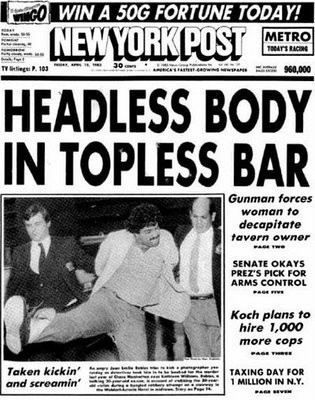
Pulitzer Prize winner Gene Weingarten wrote a column for the Washington Post about the lost art of writing headlines. Like circulation and ad dollars, headlines - good ones - are becoming a victim of online media. As papers transition to the web (don't people use the word transition as a euphemism when people die? Anyway.), witty, clever, amusing and outrageous headlines are no longer needed, or even desired. Instead, as Weingarten wrote, headlines are now "designed for search engine optimization." Great. Paper versions can still deliver the goods, but fewer people see the hard copy version so fewer readers get to appreciate the creativity of copy editors, who are usually seen as a dour group of people only obsessed with proper use of commas.
When I worked as a newspaper copy editor, we wrote the headlines and I liked that part of the job more than anything. We also designed the pages, and some people enjoy that aspect more. But give me the headline writing.
It's not as fun if you're on a news desk. Earthquakes, budget deals and city council meetings rarely lend themselves to creative headlines. Also, copy editors on the news desk often write headlines for stories about investigations. Investigations into politicians and corrupt cops. Investigations into bankers who embezzle and dads who write bad checks. Investigations into college basketball players who cheat on tests and coaches who cheat on their wives. Unfortunately, there are very few synonyms for "investigation." And, for the most part, there's only one similar word that fits into a small one-column space: Probe. And copy editors hate using the word probe. It conjures up images of alien abductions and doctor visits that end with a punchline and humiliation. But no matter how much they dislike the word, a news copy editor will inevitably use the word probe in a one-column headline and probably once a month.
Senate
launches
Goldman
probe
Police
probe
burglaries
Yuck. Back to fun headlines. In sports you get away with more, within reason. A colleague of mine once wrote the headline: FLIP'S FLIP FLIPS FLIP'S WOLVES
Personally, I thought it was genius. Flip Murray tossed in a lucky shot at the buzzer to defeat the Timberwolves, coached by Flip Saunders. Another editor thought it was a bit too much.
The highlight of my time on the sports desk at The Forum in Fargo was when one of our headlines made The Tonight Show, years before everyone hated Jay Leno and stopped watching his show. Most of the headlines Leno displays are mistakes or a typo or an unfortunate picture choice. We knew ours had a chance to get on the air. A few weeks after publication, Leno showed it on his show. This was more thrilling to a copy editor than catching an award-winning reporter misusing there and their.
A writer at the paper, Terry Vandrovec, came up with the headline. All I did was type it onto the page:
FRIKKEN LAYUP DOOMS BISON
The story was about a basketball player named Frikken, who hit a game-winning shot to defeat the North Dakota State men's basketball team. We exchanged high-fives in the newsroom that night.
An old editor of mine, Bob Van Enkenvoort, won an Associated Press award when he penned the perfect headline "Mmm, mmm, goodbye" when the Campbell's Soup factory closed in Worthington.
I still have a dusty file that contains some of my clippings, including old headlines. I have a printout from 2003, when our sports editor sent around a list of some of the department's best headlines of the year, as we debated which ones to enter for competitions.
If I may, some of mine that were up for consideration:
UDDERLY AMAZING (about a kid who owned a dairy herd, had a 4.0 GPA and was a great basketball player. Come on).
BACK ON THE HORSE (gymnastics coach returns to powerhouse he built years earlier)
DEAR JOHN (Feature about a beloved wrestling coach named John who retired)
TWINS PLAY CREDIT CARD (Twins were whining about lack of respect while facing Yankees, who then dispatched Minnesota in the playoffs, proving everyone right, unfortunately)
ANOTHER YANKEE DANDY (Clemens dominates Twins)
HOT COCO BURNS COYOTOES (Player named Coco has big basketball game)
SPANDEX SWAPPER SPARKS SPUDS (Former swimmer became a top-notch wrestler)
And on and on. Some of them are certainly a bit cheesy. But that's part of the fun. Copy editors rely too much on movie and book titles. They rely too much on possibly cliched sayings, but they use them in a way that's usually ironic and puts a new spin on an old line.
You bring readers in with the headline, then tell the real story in the dek right below, then follow with the reporter's story. An older reader used to call periodically and a few times he wanted to know who wrote a particular headline, because he enjoyed it so much. Most of the times readers call to demand why the newspaper hates high school swimming. Or they asks us if we know we possess below-average intelligence. So calls like the headline lover's boost the self-esteem of copy jockeys.
Living in New York, of course, affords me the opportunity to see true headline-writing geniuses at work. I read the Daily News and New York Post every day. Without fail, each paper delivers superb headlines in every edition. I savor papers like The New York Times because of the in-depth reporting and I subscribe to magazines like Esquire and The New Yorker because of the 10,000-word feature stories. But when it comes to summing up a story, a scandal, an arrest, a death or a victory in a short headline, no one competes with the tabloids. Several years ago I had a tryout at the New York Post. It didn't result in a job offer, but during my tryout, I did get to pen a headline that ran with one of the sports section's main stories. It was a simple Mets game story, but it involved Pedro Martinez pitching against the Nationals and Jose Guillen. A game earlier, Pedro had plunked several Nationals hitters, including Guillen. But on that night he shut Guillen down, and the Nationals. The headline: NO WAY, JOSE. Nothing spectacular. An old saying. But seeing it in the next day's newspaper in a giant font gave me a thrill.
Copy editors don't get any credit and if there's a mistake they get all the blame. Many readers think reporters write their own headlines, which proves convenient when an irate subscriber calls in to complain about a headline that "your reporter" wrote. But it also means they don't get the kudos for a superbly crafted headline. And in today's media world, those opportunities are dwindling.
In the big picture, the loss of great headlines obviously isn't the same as the loss of jobs and even entire newspapers. But if newspapers ever do go completely online and great headlines disappear, it means papers would be a little less fun to read. And they'd be a hell of a lot less fun to work at.
UPDATE: Added a link in the post to the Leno clip of The Forum headline. And it's here.
Thursday, June 10, 2010
The madness - and genius - of InDesign spellcheck

Publishing people always debate the merits of the page-design programs Quark and InDesign. It's the layout equivalent of Mays vs. Mantle or Magic vs. Bird, except about 98 percent dorkier. Different magazines and newspapers use different systems and editors and artists often have to adapt and learn both, as a publication might switch systems. I don't have the technical knowledge to really debate the strengths and weaknesses of either. I know how to use the basics of both but certainly don't know enough to be called an expert.
But I do know that InDesign has the best spellcheck system in publishing. Now, using spellcheck isn't the most exciting thing for many people, and rightfully so. It's a vital tool, but not one that usually brings joy, confusion and wonder. It's there to correct typos, not entertain. InDesign is the exception.
Shortly after we started using InDesign, everyone noticed bizarre suggestions popping up on spellcheck. Often the suggestions shared but a single letter with the offending word, as if InDesign simply threw out random words that had no connection to the highlighted choice. Other times InDesign seemed to have psychological insight into the highlighted word. InDesign could be petty, occasionally cruel. A few years ago I put together a list of some of our greatest hits from InDesign. That list has been lost, but I've been accumulating new ones. Here, some favorites.
Ashton (as in Kutcher): Satan - that's a bit harsh, though I briefly considered the possibility the first time I saw the adorable fetus strangle himself at the conclusion of the director's cut of Ashton's Butterfly Effect.
Snooki: Snake, snaky, sneaky - Have never watched an episode of Jersey Shore. But like 93 percent of Americans, I've absorbed the show through osmosis and feel comfortable that InDesign knows what it's talking about with these choices.
Armstrong: Harum-scarum - One of my favorite suggestions. Think of someone editing a story about the seven-time Tour de France champion. Spellcheck flags Armstrong. Great, thinks the writer. Maybe I used two g's or typed an extra m. Instead, InDesign asks if you didn't really mean to spell harum-scarum, which, for the record, means "acting in a reckless or rash way."
Pacino: Pacing, passion, pausing, posing, policing - InDesign nicely sums up Al Pacino's career in five words.
Rihanna: urinal - InDesign possesses a juvenile sense of humor.
Octomom - Ottoman, economy, actinium, outman, etymon
Suleman (Octomom's last name) - Yes-man, Somalian, seaming, sliming, semen
Showtime: Sheikhdom - One of InDesign's more confusing entries. How would anyone possibly spell sheikhdom as showtime? At Adobe, which engineer in charge of InDesign put that in as one of the suggestions for showtime? Okay, they share the first two letters. But the o and e are separated by five keys. The h and w are on different lines and different parts of each line. Just realize that if you ever see a paper talk about Magic Johnson's Sheikhdom Lakers, they most certainly use InDesign and not Quark.
Scooby-Doo: Psychobiology - ?
Wahlberg: liberal, whalebone
Stepkids: seedpods, setbacks, stupidities - The person in charge of InDesign's spellcheck must have had a difficult experience with the new wife's kids as he's obviously not a fan of children that didn't come from his seed.
Stepdad: styptic, skeptic, stupid, estopped, stoppled - InDesign teaches me new things every day. I like to think I have a decent vocabulary, but InDesign has words at its disposal that haven't been used since they were created hundreds of years ago. Ever hear a plumber use the word stopple? And, again, how does InDesign not recognize stepdad, but is perfectly fine with estopped, which is called "archaic" by the dictionary, a Middle English word, meaning it probably came before 1500.. InDesign...so confounding, yet learned.
Aniston: Einstein, nesting, moisten, ingesting, amnestying, nauseating - Einstein, nauseating...okay. But moisten? A girl I used to work with hated the word moist. Moist and probe, two words she refused to ever use when writing headlines.
Beatles: Ablates, oblates, boletus - The most famous group in music history. Perhaps the most influential group in music history. But not to InDesign. InDesign believes Beatles isn't a real word, that you need something that people are actually familiar with. Like ablates (to remove or destroy, especially by cutting), oblates (flattened or depressed at the poles), and boletus (any of a genus of boletes - as a porcini - some of which are poisonous and others edible). John Lennon said the Beatles were bigger than Jesus. But to InDesign they're not even bigger than a mushroom.
Jovi: Devil, Jehovah - InDesign can't decide if it likes the group or hates it.
Gingrich: Gonorrhea - No comment.
B-Cup: Built-up
Tac-toe: Oatcake - Huh?
Google: Gigolo
December: Dismember - A fairly memorable month. Most people are familiar with it. InDesign, though, tends to have more violent thoughts. It asks: In that Christmas story where you mention December 25, are you sure you didn't mean to spell dismember?
Hamptons: Moppets, impaction, impotent
Baldwin: Bulgarian
Beckham: Belching
Beckham: Belching
Minibar: Namibian
Celine: Senile
Celine: Senile
Former Playboy Playmate Kendra Wilkinson (that's her full name, sort of like Rookie Phenom Stephen Strasburg or Radical Cleric Moktada al-Sadr) has been in the news recently for a leaked sex tape. InDesign was ahead of the game. It's suggestion for Kendra? Kinkier. And for Wilkinson: Leakiness, wildness.
Hunky: Andy, hunt, unyoke - Who's Andy? And what's the relation to hunky? Seems obvious that whoever inserted suggestions for "hunky" was busy daydreaming about a strapping youngster named Andrew, perhaps the guy in the adjoining cubicle. The worker couldn't express this love - workplace rules frown on such things - so he/she put a sly joke into the system, so that now, whenever someone using InDesign uses the word hunky in a sentence, they'll be asked if they want to change it to Andy, since Andrew - that handsome co-worker - is just so hot.
Drescher: Deerstalker
Boybander: Bobsledder
Beckinsale: Pekingese
Pitt: Pate, Pete, pita
Gosselin: Tussling, outselling, gassing, goosing
Whisperer: Horsewhipper - Exactly what it sounds like, to flog a horse with a whip. A bit disappointed InDesign didn't offer up Horse Whisperer as an alternate.
Bambi: Bimbo - InDesign has little respect for the classics, or it's been programmed to think of Bambi as a stripper instead of a cartoon. But the suggestion isn't that strange once you've seen that InDesign doesn't even recognize Disney. Suggestions for the most famous animation company in the world? Addison, dowsing.
Baywatch's: Brachiate's, brachial's - InDesign apparently didn't watch TV in the early 1990s. Or, maybe it did and simply didn't like the cast, as its suggestion for actress Yasmine Bleeth is "asinine."
I sometimes look at InDesign's spellcheck as being a living organism, capable of causing great harm, like the computer system that starts the war in Terminator. Or it's a cousin to HAL from 2001: A Space Odyssey. A year ago, the Brigham Young University student newspaper, The Daily Universe, recalled 18,500 copies of the paper after InDesign's spellcheck caused chaos on the campus.
Hunky: Andy, hunt, unyoke - Who's Andy? And what's the relation to hunky? Seems obvious that whoever inserted suggestions for "hunky" was busy daydreaming about a strapping youngster named Andrew, perhaps the guy in the adjoining cubicle. The worker couldn't express this love - workplace rules frown on such things - so he/she put a sly joke into the system, so that now, whenever someone using InDesign uses the word hunky in a sentence, they'll be asked if they want to change it to Andy, since Andrew - that handsome co-worker - is just so hot.
Drescher: Deerstalker
Boybander: Bobsledder
Beckinsale: Pekingese
Pitt: Pate, Pete, pita
Gosselin: Tussling, outselling, gassing, goosing
Whisperer: Horsewhipper - Exactly what it sounds like, to flog a horse with a whip. A bit disappointed InDesign didn't offer up Horse Whisperer as an alternate.
Bambi: Bimbo - InDesign has little respect for the classics, or it's been programmed to think of Bambi as a stripper instead of a cartoon. But the suggestion isn't that strange once you've seen that InDesign doesn't even recognize Disney. Suggestions for the most famous animation company in the world? Addison, dowsing.
Baywatch's: Brachiate's, brachial's - InDesign apparently didn't watch TV in the early 1990s. Or, maybe it did and simply didn't like the cast, as its suggestion for actress Yasmine Bleeth is "asinine."
I sometimes look at InDesign's spellcheck as being a living organism, capable of causing great harm, like the computer system that starts the war in Terminator. Or it's a cousin to HAL from 2001: A Space Odyssey. A year ago, the Brigham Young University student newspaper, The Daily Universe, recalled 18,500 copies of the paper after InDesign's spellcheck caused chaos on the campus.
Some poor copy editor ran spellcheck on a photo caption and clicked a change for the word apostle, making it apostate. So instead of talking about the "members of the Quorum of the Twelve Apostles," it referred to the Twelve Apostates. But that's the evil genius of InDesign spellcheck. By putting apostate as a suggestion, there was a chance - a small chance - that some poor editor would accidentally click on it, changing apostle to apostate. InDesign spellcheck simply waited for the right moment to strike. And what better place to do it than at one of the most religious campuses in the country? Maybe the mistake gets laughed off at a secular school. At Brigham Young it caused a crisis.
One student, a media arts major named Hillary Miller, said, "I hope someone isn't just fooling around. It would be sad if someone was trying to do harm to our church."
No one was trying to harm the church. It was just the InDesign spellcheck, the most playful, arrogant, wise, confounding and mischievous spellcheck in the land.
One student, a media arts major named Hillary Miller, said, "I hope someone isn't just fooling around. It would be sad if someone was trying to do harm to our church."
No one was trying to harm the church. It was just the InDesign spellcheck, the most playful, arrogant, wise, confounding and mischievous spellcheck in the land.
Saturday, April 10, 2010
When cagers meshed and thinclads ran wild
Phil Taylor has a column in the new Sports Illustrated about how sports terminology has worked its way into everyday conversations, whether it's politics or the law. Taylor writes, "We live in a world of knockout blows and three-strike laws. We think we're batting 1.000 at the office until the boss moves the goalposts on us by asking us to pinch-hit for a coworker, putting us behind the 8 ball."
There probably is sports overload in all aspects of life. But at least most of the phrases actually make sense today. My friend John worked with me in Worthington. He wasn't in the sports department but proofread our pages. He was a fan of the English language, but not sports. John loathed sports terms. Reading 75 inches of basketball roundups on a Thursday night tortured him. In particular, the word caroms tormented young John. You know, caroms. Rebounds. As in, "Ben Johnson scored 20 points and grabbed 10 caroms to lead Westville High to a 76-63 victory..." John would strike it out or put a question mark next to a carom and I'd ignore it, gently explaining that in the sports department, we use words that sometimes sound ridiculous. We use them because...well, just because we've always used them, dating back to when everyone smoked in the newsroom.
Countless words have fallen out of favor in sports departments over the past few decades but some still remain. I've used some of them and mocked others. Some favorites?
Harriers, cagers, gridders, thinclads, meshed, roundballers, aerial, keglers, stanzas, netters, second sackers. Add your own.
Anyone who's read a sports section - especially anytime before, say, 1980 - recognizes all of those terms. Some are still used today while others only make rare appearances. Thinclads remains a popular way to describe track and field athletes, who are often...thinly clad. That was always an odd one; it'd be like if basketball players had been described as short-shorts. Or calling football players tightpants. Cross country runners are harriers. Long ago, a hurdler could be labeled a timber topper. Most of these words fit in back when men wore suits and hats to baseball games and everything on television was broadcast in black and white.
Football players go by gridders, of course, because they play on the gridiron. Football fields used to look more like checkerboards, the patterns resembling a grid. A running back will "tote" the "pigskin" while his quarterback - or signal caller - directs the aerial attack.
Cagers is for basketball players. The game used to have a bit more violence. Teams played on tiny courts in small gymnasiums. A team in Trenton, N.J., started playing inside a wire cage to separate the action from the unruly crowds. This set up a scene that most people associate with a grudge match between Hulk Hogan and Macho Man Savage, a steel cage battle. This was back in the 1920s, yet the phrase cagers remained popular long after the wiring disappeared, the same way gridiron remained a viable word a century after it no longer accurately described the field. Thankfully David Stern did not bring this back after the brawl in the Palace.
 It's from playing inside the cage that the word meshed probably made its way into the vocabulary of sportswriters, though it still seems like a strange way to describe scoring. I meshed 20 points at Old Man Basketball on Wednesday night, give or take.
I can say with some pride that I never actually used the word keglers to describe a bowler when I wrote for newspapers (yes, we covered bowling). The only reason I know the term is because we had to take a quiz during the bowling unit of our phy ed classes in high school, and part of it involved being able to define kegler (we also had to accurately score games by adding up a mock card. This was the only math I was any good at after ninth grade). Kegler comes from a German word and has no relation to the amount of alcohol consumed by an average bowler on a Tuesday night at the alleys.
Writers have used stanzas to describe innings and occasionally a quarter in basketball. It was especially useful to break up the monotony of the word inning. The Twins scored a run in the extra stanza on Friday night to defeat the Chicago White Sox, or, as some call them, the Pale Hose. Baseball games used to be tilts, though not so much today.
Break out netters during tennis roundups or a volleyball recap. Basically, anyone playing a sport involving a net, including hoops, can be called a netter. Thankfully I never saw anyone type that a group of netters netted a victory. A cager could rip the nets and mesh 30 points.
An uncle of mine occasionally poked fun at the ways sportswriters had to constantly come up with new ways to describe the same action. How many different ways can you say one team beat another? How many ways can you say someone scored 20 points? It turns out, there are endless ways. You just have to go back to the early 20th century to find some of the terms.
There probably is sports overload in all aspects of life. But at least most of the phrases actually make sense today. My friend John worked with me in Worthington. He wasn't in the sports department but proofread our pages. He was a fan of the English language, but not sports. John loathed sports terms. Reading 75 inches of basketball roundups on a Thursday night tortured him. In particular, the word caroms tormented young John. You know, caroms. Rebounds. As in, "Ben Johnson scored 20 points and grabbed 10 caroms to lead Westville High to a 76-63 victory..." John would strike it out or put a question mark next to a carom and I'd ignore it, gently explaining that in the sports department, we use words that sometimes sound ridiculous. We use them because...well, just because we've always used them, dating back to when everyone smoked in the newsroom.
Countless words have fallen out of favor in sports departments over the past few decades but some still remain. I've used some of them and mocked others. Some favorites?
Harriers, cagers, gridders, thinclads, meshed, roundballers, aerial, keglers, stanzas, netters, second sackers. Add your own.
Anyone who's read a sports section - especially anytime before, say, 1980 - recognizes all of those terms. Some are still used today while others only make rare appearances. Thinclads remains a popular way to describe track and field athletes, who are often...thinly clad. That was always an odd one; it'd be like if basketball players had been described as short-shorts. Or calling football players tightpants. Cross country runners are harriers. Long ago, a hurdler could be labeled a timber topper. Most of these words fit in back when men wore suits and hats to baseball games and everything on television was broadcast in black and white.
Football players go by gridders, of course, because they play on the gridiron. Football fields used to look more like checkerboards, the patterns resembling a grid. A running back will "tote" the "pigskin" while his quarterback - or signal caller - directs the aerial attack.
Cagers is for basketball players. The game used to have a bit more violence. Teams played on tiny courts in small gymnasiums. A team in Trenton, N.J., started playing inside a wire cage to separate the action from the unruly crowds. This set up a scene that most people associate with a grudge match between Hulk Hogan and Macho Man Savage, a steel cage battle. This was back in the 1920s, yet the phrase cagers remained popular long after the wiring disappeared, the same way gridiron remained a viable word a century after it no longer accurately described the field. Thankfully David Stern did not bring this back after the brawl in the Palace.
It's from playing inside the cage that the word meshed probably made its way into the vocabulary of sportswriters, though it still seems like a strange way to describe scoring. I meshed 20 points at Old Man Basketball on Wednesday night, give or take.I can say with some pride that I never actually used the word keglers to describe a bowler when I wrote for newspapers (yes, we covered bowling). The only reason I know the term is because we had to take a quiz during the bowling unit of our phy ed classes in high school, and part of it involved being able to define kegler (we also had to accurately score games by adding up a mock card. This was the only math I was any good at after ninth grade). Kegler comes from a German word and has no relation to the amount of alcohol consumed by an average bowler on a Tuesday night at the alleys.
Writers have used stanzas to describe innings and occasionally a quarter in basketball. It was especially useful to break up the monotony of the word inning. The Twins scored a run in the extra stanza on Friday night to defeat the Chicago White Sox, or, as some call them, the Pale Hose. Baseball games used to be tilts, though not so much today.
Break out netters during tennis roundups or a volleyball recap. Basically, anyone playing a sport involving a net, including hoops, can be called a netter. Thankfully I never saw anyone type that a group of netters netted a victory. A cager could rip the nets and mesh 30 points.
An uncle of mine occasionally poked fun at the ways sportswriters had to constantly come up with new ways to describe the same action. How many different ways can you say one team beat another? How many ways can you say someone scored 20 points? It turns out, there are endless ways. You just have to go back to the early 20th century to find some of the terms.
Sunday, March 28, 2010
Returning to the frightening land of newspaper website comments
I think most people always feel a touch of sympathy for sewer workers. It's a vital job that many people would never do, no matter how much it paid. Wading through all that...stuff.
I feel the same sympathy for people who monitor newspaper website comments. It's, at least according to executives, a vital job that many newspaper employees would never do, no matter how much it paid. Wading through all that...stuff. Racist rants, personal attacks, religious biases, homophobic slurs. Bad spelling.
A different type of controversy has erupted in Cleveland, at the website for the Cleveland Plain Dealer. The newspaper revealed the real identity behind the person known on the site as "lawmiss." Lawmiss had posted a comment about the relative of a Plain Dealer reporter. Editors discovered that lawmiss - or is it Lawmiss, I never know with anonymous online tags - had the same email address as a prominent judge named Shirley Strickland Saffold. She has a reputation as being something of an eccentric, always a reassuring description for a judge. A decade ago she told a female defendant in a credit card fraud case to find a better man. She told her, "Men are easy. You can go sit at the bus stop, put on a short skirt, cross your legs and pick up 25. Ten of them will give you their money. It's the truth. If you don't pick up the first 10, then all you got to do is open your legs a little bit and cross them at the bottom and then they'll stop."
It sounds like she spoke from experience. But what does she tell male defendants in credit card fraud cases? Drop their pants and get a good woman?
Then, a few weeks ago she issued an arrest warrant for a Plain Dealer reporter who wrote about a psychiatric evaluation of a man suspected of being a serial killer. She wanted him to reveal his source. So now the newspaper discovers someone using her email address has been posting for awhile, including commenting on cases where Saffold served as the judge. The judge's daughter says she used the email address to post some comments and that it wasn't her mother,
The paper reports this, and a firestorm ensues.
Lots of the questions center around ethics: the newspaper's and the judge's. Privacy advocates express concern that the paper dug into the online files to find the email address and then the person behind it - or at least the family behind it. Many newspapers don't allow reporting staff any access to those records. And for the judge, the ethical questions are obvious, as it just seems...wrong, for a judge to comment about cases she's involved with. She - or the daughter - ripped defendants, juries and lawyers, all under the moniker of lawmiss. In a post ridiculing the defense attorney of a man convicted in a vehicular homicide case, lawmiss wrote, "If only he could shut his Amos and Andy style mouth. What makes him think that is [sic] he insults and acts like buffon [sic] that it will cause the judge to think and see it his way."
It is nice to see the judge living up to the spelling accomplishments of all the anonymous newspaper commenters who came before her.
I feel a bit queasy about the Plain Dealer searching for the information and writing about it. But the judge's actions seem much worse. That serial killer case where she wanted the reporter arrested? She's of course the judge on that and the man's defense attorney is the same lawyer who represented the vehicular homicide defendant, the one who was acting, according to Saffold or one of her spawn, like a "buffon." Is she going to treat that attorney fairly now, in a capital punishment case?
Of course all of this would have been avoided if the Plain Dealer and newspapers everywhere simply eliminated comments on their sites, which I've been advocating for since the first time I saw a high school basketball tournament loss blamed on "stuppid immgrants!" They're supposed to bring people to the website, which then theoretically leads to cash. Big money! If it really did this, maybe tens of thousands of journalists wouldn't have been laid off the last two years. Maybe the industry wouldn't be flailing, struggling to survive. Instead, all of those web visits do nothing for the bottom line, while also giving a forum to hateful or delusional people who ranked in the first percentile on the reading portion of the Iowa Basics.
I'm not pleading for a Utopian society where there are no hateful online comments. All I'm saying is that there are a million places to find that; why do newspapers provide another outlet? Maybe Saffold doesn't make those comments if she has to do it on a random message board. People will still read a newspaper's stories and they can still comment on them and make fun of anyone they want to and ridicule reporters and editors and the liberal media. There will be no shortage of forums and blogs. But why must papers host those comments?
It's a losing battle, of course. Though some papers have removed comments - and many others moderate them - I doubt the entire industry will alter its thinking about online comments. Just think, some of those anonymous people who hate blacks might buy a car from a dealership whose ad they saw on the web site!
Predictably, the comments below the stories about the judge and the newspaper's action are not exactly Algonquin Round Table material. They go back and forth between belittling the newspaper and the judge. Some of the comments are strange, a few make some good points that get lost in the sea of sludge, others are indecipherable, a handful hateful. Predictable stuff. And just another day of comments on newspaper websites.
I feel the same sympathy for people who monitor newspaper website comments. It's, at least according to executives, a vital job that many newspaper employees would never do, no matter how much it paid. Wading through all that...stuff. Racist rants, personal attacks, religious biases, homophobic slurs. Bad spelling.
A different type of controversy has erupted in Cleveland, at the website for the Cleveland Plain Dealer. The newspaper revealed the real identity behind the person known on the site as "lawmiss." Lawmiss had posted a comment about the relative of a Plain Dealer reporter. Editors discovered that lawmiss - or is it Lawmiss, I never know with anonymous online tags - had the same email address as a prominent judge named Shirley Strickland Saffold. She has a reputation as being something of an eccentric, always a reassuring description for a judge. A decade ago she told a female defendant in a credit card fraud case to find a better man. She told her, "Men are easy. You can go sit at the bus stop, put on a short skirt, cross your legs and pick up 25. Ten of them will give you their money. It's the truth. If you don't pick up the first 10, then all you got to do is open your legs a little bit and cross them at the bottom and then they'll stop."
It sounds like she spoke from experience. But what does she tell male defendants in credit card fraud cases? Drop their pants and get a good woman?
Then, a few weeks ago she issued an arrest warrant for a Plain Dealer reporter who wrote about a psychiatric evaluation of a man suspected of being a serial killer. She wanted him to reveal his source. So now the newspaper discovers someone using her email address has been posting for awhile, including commenting on cases where Saffold served as the judge. The judge's daughter says she used the email address to post some comments and that it wasn't her mother,
The paper reports this, and a firestorm ensues.
Lots of the questions center around ethics: the newspaper's and the judge's. Privacy advocates express concern that the paper dug into the online files to find the email address and then the person behind it - or at least the family behind it. Many newspapers don't allow reporting staff any access to those records. And for the judge, the ethical questions are obvious, as it just seems...wrong, for a judge to comment about cases she's involved with. She - or the daughter - ripped defendants, juries and lawyers, all under the moniker of lawmiss. In a post ridiculing the defense attorney of a man convicted in a vehicular homicide case, lawmiss wrote, "If only he could shut his Amos and Andy style mouth. What makes him think that is [sic] he insults and acts like buffon [sic] that it will cause the judge to think and see it his way."
It is nice to see the judge living up to the spelling accomplishments of all the anonymous newspaper commenters who came before her.
I feel a bit queasy about the Plain Dealer searching for the information and writing about it. But the judge's actions seem much worse. That serial killer case where she wanted the reporter arrested? She's of course the judge on that and the man's defense attorney is the same lawyer who represented the vehicular homicide defendant, the one who was acting, according to Saffold or one of her spawn, like a "buffon." Is she going to treat that attorney fairly now, in a capital punishment case?
Of course all of this would have been avoided if the Plain Dealer and newspapers everywhere simply eliminated comments on their sites, which I've been advocating for since the first time I saw a high school basketball tournament loss blamed on "stuppid immgrants!" They're supposed to bring people to the website, which then theoretically leads to cash. Big money! If it really did this, maybe tens of thousands of journalists wouldn't have been laid off the last two years. Maybe the industry wouldn't be flailing, struggling to survive. Instead, all of those web visits do nothing for the bottom line, while also giving a forum to hateful or delusional people who ranked in the first percentile on the reading portion of the Iowa Basics.
I'm not pleading for a Utopian society where there are no hateful online comments. All I'm saying is that there are a million places to find that; why do newspapers provide another outlet? Maybe Saffold doesn't make those comments if she has to do it on a random message board. People will still read a newspaper's stories and they can still comment on them and make fun of anyone they want to and ridicule reporters and editors and the liberal media. There will be no shortage of forums and blogs. But why must papers host those comments?
It's a losing battle, of course. Though some papers have removed comments - and many others moderate them - I doubt the entire industry will alter its thinking about online comments. Just think, some of those anonymous people who hate blacks might buy a car from a dealership whose ad they saw on the web site!
Predictably, the comments below the stories about the judge and the newspaper's action are not exactly Algonquin Round Table material. They go back and forth between belittling the newspaper and the judge. Some of the comments are strange, a few make some good points that get lost in the sea of sludge, others are indecipherable, a handful hateful. Predictable stuff. And just another day of comments on newspaper websites.
Thursday, March 4, 2010
Whatever happened to that World Wide Web thing?
Someone on a message board for journalists recently posted this old Newsweek column that a blogger unearthed last week. Written in 1995 by astronomer Clifford Stoll, the column decried the hype surrounding the Internet, which was beginning to become a force throughout the world and not just in military circles. Stoll's been slightly ridiculed for some of the predictions in the piece and the overall sentiment.
Journalists were specifically discussing this line:
"Yet Nicholas Negroponte, director of the MIT Media Lab, predicts that we'll soon buy books and newspapers straight over the Internet. Uh, sure... The truth is no online database will replace your daily newspaper."
Oh, if only. As predictions go, it's always fun to look back at people's wayward prophecies, though anyone who's ever made one surely has some groaners in the closet. But most people from the early 1990s don't have to worry about them being saved in online archives, just waiting for a digital archaeologist to dig it up. In a 1994 NBA preview for my community college newspaper - circulation: I don't know, me, my parents and my professor who doubled as the editor - I argued that Derrick Coleman had surpassed Karl Malone as the premier power forward in the NBA. He'd go down as one of the best to ever play that position, I wrote. I thought it was a well-written piece, the type I might someday pitch to Sports Illustrated when they asked for a resume and five clips. About 15 months later, Coleman graced Sports Illustrated's cover, next to the words: Petulant Prima Donnas Like New Jersey's Derrick Coleman Are Bad News For The NBA. Malone, meanwhile, became the second-leading scorer in NBA history.

I actually agree with many of Stoll's lines, even if he was off about what the ultimate impact of the Internet would be. He talks about how when everyone shouts, no one listens. Still applicable to today's online world. He writes about the dangers of relying too much on technology in the classroom, and this was years before every student carried a laptop into history class.
But best of all, he liberally uses the word bah. It's a great word for a crank, though it's rarely used today because people automatically expect it to be followed by the word humbug. Here it's used in the headline - "The Internet? Bah!" - and in the text: "Who needs teachers when you've got computer-aided education? Bah." The only thing missing was a request for nerds to get off his lawn and take their CompuServe subscriptions with them.
Stoll mocked the idea of people buying their books online. Amazon launched in 1995.
But back to those newspaper predictions. In a way, Stoll was right. It was ludicrous to think people would actually buy newspapers on the Internet. If people did do that, the industry wouldn't be drowning in a sea of layoffs and low morale. Newspapers could still charge for their product without being called out of touch and naive, which is what happens today when any paper floats a plan to make subscribers pay for an online version.
"The truth is no online database will replace your daily newspaper."
I'm not sure an "online database" is quite the way to describe Google. The online...behemoth has, in many cases, replaced the daily newspaper, often while using the content from the very papers they end up killing.
Journalists were specifically discussing this line:
"Yet Nicholas Negroponte, director of the MIT Media Lab, predicts that we'll soon buy books and newspapers straight over the Internet. Uh, sure... The truth is no online database will replace your daily newspaper."
Oh, if only. As predictions go, it's always fun to look back at people's wayward prophecies, though anyone who's ever made one surely has some groaners in the closet. But most people from the early 1990s don't have to worry about them being saved in online archives, just waiting for a digital archaeologist to dig it up. In a 1994 NBA preview for my community college newspaper - circulation: I don't know, me, my parents and my professor who doubled as the editor - I argued that Derrick Coleman had surpassed Karl Malone as the premier power forward in the NBA. He'd go down as one of the best to ever play that position, I wrote. I thought it was a well-written piece, the type I might someday pitch to Sports Illustrated when they asked for a resume and five clips. About 15 months later, Coleman graced Sports Illustrated's cover, next to the words: Petulant Prima Donnas Like New Jersey's Derrick Coleman Are Bad News For The NBA. Malone, meanwhile, became the second-leading scorer in NBA history.
I actually agree with many of Stoll's lines, even if he was off about what the ultimate impact of the Internet would be. He talks about how when everyone shouts, no one listens. Still applicable to today's online world. He writes about the dangers of relying too much on technology in the classroom, and this was years before every student carried a laptop into history class.
But best of all, he liberally uses the word bah. It's a great word for a crank, though it's rarely used today because people automatically expect it to be followed by the word humbug. Here it's used in the headline - "The Internet? Bah!" - and in the text: "Who needs teachers when you've got computer-aided education? Bah." The only thing missing was a request for nerds to get off his lawn and take their CompuServe subscriptions with them.
Stoll mocked the idea of people buying their books online. Amazon launched in 1995.
But back to those newspaper predictions. In a way, Stoll was right. It was ludicrous to think people would actually buy newspapers on the Internet. If people did do that, the industry wouldn't be drowning in a sea of layoffs and low morale. Newspapers could still charge for their product without being called out of touch and naive, which is what happens today when any paper floats a plan to make subscribers pay for an online version.
"The truth is no online database will replace your daily newspaper."
I'm not sure an "online database" is quite the way to describe Google. The online...behemoth has, in many cases, replaced the daily newspaper, often while using the content from the very papers they end up killing.
Newspapers have gotten dinged over the years for not adapting earlier to the Internet. People say they should have seen the online revolution coming and acted accordingly. But newspapers had web sites fairly early in the game, long before blogs ever came into creation. Newspapers began giving their stories away for free long before anyone realized that could potentially be a problem for the print edition. But what the papers couldn't figure out then and haven't to this day is how to make as much money online as they once did with the paper product. There might not be a solution to that problem.
Look how far computers and the online world have come since Stoll submitted his article to Newsweek, a magazine that is also struggling to survive. In September 1995, I used email for the first time. Each time, I wore the same stunned, sort-of-stupid expression that graced the faces of the first people to pick up a telephone and talk to someone on the other end. My cousin Matt received my first emails, only he didn't get the whole messages, as they'd just trickle off the side of the screen, out of view, apparently because I didn't hit the Enter key or I hit it too often. Finally after a week I was able to write an email that he read from start to finish. I can see why Stoll had doubts that same year about the effectiveness of online communication.
Just two years earlier, my work-study job involved working in the computer lab at Worthington. The man who ran the computer lab was one of the nicest people in the world and probably its most disorganized. His office looked like the inside of a mom & pop computer repair store damaged by a pipe bomb. Books and manuals littered the floor, along with broken monitors, dusty keyboards and dismantled hard drives. In theory, I was supposed to help him maintain the lab - sign students in, show them how to use the machines. The lab leader knew he had a problem with his student worker when I stared at the mouse, unable to comprehend what it was or how it worked. In high school we used computers, but everything was done on the keyboard.
Just two years earlier, my work-study job involved working in the computer lab at Worthington. The man who ran the computer lab was one of the nicest people in the world and probably its most disorganized. His office looked like the inside of a mom & pop computer repair store damaged by a pipe bomb. Books and manuals littered the floor, along with broken monitors, dusty keyboards and dismantled hard drives. In theory, I was supposed to help him maintain the lab - sign students in, show them how to use the machines. The lab leader knew he had a problem with his student worker when I stared at the mouse, unable to comprehend what it was or how it worked. In high school we used computers, but everything was done on the keyboard.
He rolled the mouse around. I watched enthralled as the thing - later identified as a cursor - moved around the screen, as if guided by an invisible hand.
My time in the computer lab didn't last long, to the relief of my boss and fellow students. Instead of work study, I began working part-time at the daily newspaper. That's where I wanted to be, then and out of college. Newspapers would be around forever, I figured, and I'd be working for them for the next five decades.
They had a bright future. An online database? Didn't even know what it was. The chance such a thing would eventually deliver mortal wounds to the industry? Unthinkable.
I was better in the computer lab than I was at prophecies.
My time in the computer lab didn't last long, to the relief of my boss and fellow students. Instead of work study, I began working part-time at the daily newspaper. That's where I wanted to be, then and out of college. Newspapers would be around forever, I figured, and I'd be working for them for the next five decades.
They had a bright future. An online database? Didn't even know what it was. The chance such a thing would eventually deliver mortal wounds to the industry? Unthinkable.
I was better in the computer lab than I was at prophecies.
Sunday, February 21, 2010
Giggling gymnasts and confusing track meets: The life of a reporter
Today I attended the final day of the the Big East Indoor Track & Field Championships. The two-day event took place at the Armory Track and Field Center, which sits in the heart of the Columbia University Medical Center at 168th Street in New York. The facility in the Armory is considered one of the premier indoor track facilities in the country. It's 10 minutes from our place. I thought it was finally time to visit.
Growing up, I greeted track and field competitions with little enthusiasm. As a little kid we watched my uncle sprint and that was fun. But I fell out of love with track - and field - in about the third grade, when my days of dominance in the elementary school's Track-o-Rama ended and my days of slow-speed sprints began. Until that time I was one of the fastest kids in my class, routinely chasing down my slow-footed classmates during gym class. Don't know what happened, but Track-o-Rama exposed my speed deficiency, although I still managed to usually avoid the "I tried" ribbons, shameful decorations teachers handed out to those who tried, sure, but actually failed.
Basketball, baseball, football, tennis, loved them all. But none of them required me to run short distances in explosive fashion, or long distances with confident strides and strong lungs. Because I no longer possessed the physical skills needed for track and field success, my interest in the sport waned. I went to our high school meets to watch friends. Attended the state track and field meet with my parents a few times. But the point of running just to run - with nothing such as a rabid dog chasing me and nothing waiting at the end, whether a basket, touchdown or home plate - seemed mostly meaningless and slightly inhumane.
I still appreciated the athleticism on display at any random track meet. A teacher who coached three sports once told me that the greatest collection of athletes was always at a state track and field meet. I scoffed, but only because I liked to argue with the guy. Many top stars of the fall and winter sports congregated on the track in the spring, whether it was the running backs dominating the 100-meter dash or the volleyball stars winning high-jump titles. But still, the idea of sitting at a meet for five, six, seven...eight hours, did not appeal to me.
Then I started working as a sports reporter. Track and field meets became weekly fixtures during the spring. Covering them always causes some difficulties for any reporter, as there's simply so much going on that it can be difficult finding a good storyline amidst all the action. Is another victory by a favorite in the sprints a better story than an upset in the mile? Is a close finish in the 1,600-meter relay more interesting than a meet record in the high jump? But newspapers pay reporters 20,000-plus dollars to make those difficult decisions. I covered major regular season competitions and state meets.
Covering track and field was not the most exciting part of my job, but it certainly wasn't the worst. Some random thoughts on covering certain sports:
* The most torturous interview I ever did was with a high school gymnast, a girl in the ninth grade who had the emotional maturity of someone in the second grade. But she was an outstanding gymnast, even if she had the social awareness of a feral child. She was a giggling 14-year-old reared on the legend of Mary Lou Retton and Kerri Strug. I interviewed her at her house. She sat on one end of the couch, with me on the other end. Grinning Mom plopped down in the middle. She answered the questions before her daughter could process them. I'd ask, "So how long have you been in gymnastics," and the stage mom replied, "Jessica (not her real name) has loved gymnastics since she was 5." The girl smiled and giggled, which apparently meant this was a true statement and I could note it. The mom answered questions she liked. She brushed off ones she didn't with the efficiency of a White House spokesman disregarding a pushy pool reporter. The ensuing feature was not one of my better efforts. But the mom loved it.
* Football games were always fun, though they could be brutal when the calendar turned over into November. Most high schools have some type of press box, but even if a school did have one, I'd often watch the game on the sidelines. Cold weather played havoc at many games. I dressed in layers, on my body, hands and feet. But no matter how many socks I wore, my feet froze by halftime. And no matter how many pairs of gloves I sported, my hands froze by the end of the first quarter. Feet are one thing; if the worst happened and I lost both to amputation because of frostbite, I could still work, though my days of pickup basketball would likely end. But frozen hands made it nearly impossible to write. I gripped the pen with my entire hand, the way you'd hold a knife before stabbing. Ink proved no match for the conditions, so I'd bring five or six pens along, hoping that at least one would survive until the end of the game. I never had to resort to writing in my own blood, but I came close.
* Baseball games were always relaxing, when they were actually played. In Minnesota, spring sports seem to last about four weeks and are less-intense than fall and winter activities. Same for softball, provided the teams were fairly equal. The first softball game I ever covered had a final score of 50-0, and it really wasn't that close. Fortunately, the losing team, according to the coach, "played hard." The only thing missing were some purple "I tried" ribbons.
* Basketball. Favorite sport to play, favorite sport to watch, favorite sport to write about. One of the strangest games I saw involved a contest that ended with the wrong score. It was a boys game between Worthington and Marshall. Late in the game, Worthington had a three-point lead but the scoreboard showed it as a two-point lead. The confusion had come from a 3-pointer a few moments earlier. The refs huddled and talked about it for several minutes. But not only was the scoreboard wrong, but so was the scorebook. I was sitting in the front row and had noted when the mistake happened, but didn't volunteer my information. Usually in those situations the fans are watching the scoreboard closely and would yell if anything posted incorrectly, but they didn't in this case. Inevitably, Marshall hit a 3-pointer in the final seconds for the victory, when it should have actually only tied the game. Worthington coach Ron Vorwald recently won his 300th game. He probably should have been credited with it one game earlier.
* Strangely, perhaps the two most exciting events I covered were high school wrestling matches. Strange because for the first 18 years of my life I considered wrestlers to be rivals, sometimes even enemies. Wrestlers and basketball players didn't mix back in high school. It wasn't exactly the Greasers vs. the Socs, but we weren't very friendly. Wrestlers wore shirts bragging about how tough their sport was while we ridiculed their sport, though our practices were roughly 50 times easier than theirs. But as a reporter, I covered two matches between a pair of wrestlers named Nate Baker and Bryan Cowdin. They both won multiple state championships. Both were two of the best wrestlers in the nation at the time.
They met in the regular season two straight years. Both times, the area counted down the days to their showdowns, as if a heavyweight boxing match was coming to town. The team competition wasn't even a competition - Baker's team was one of the best in the state, while Cowdin's was...not. But both guys were physically overpowering, dominant, pinning machines who made a mockery of their other foes. The crowd slept for the beginning of the team match, but when those two came running out and the spotlight lit them up in the middle of the mat, it was Vision Quest brought to life. Even an old basketball player and fan like myself couldn't help but get caught up in the moment. Both years, Baker won in the final seconds as the matches lived up to the hype two straight times. Praising wrestling. As a high schooler, never thought I'd type those words.
But it was fun covering every sport, even day-long track and field meets. Anything beat being in the office taking agate. Track and field agate and swimming agate are the bane of any sports desk worker's existence. They dread the phone call that begins with the person on the other end saying, "I've got the results from the 32-team Swimming Invitational held at Central High School today. Boys. And girls." Agh. The next 45 minutes would be spent on the phone, taking the top five or six finishers in all 87 events. Fingers bled, along with ears. Give me a giggling gymnast over swimming agate any day.
Today I watched as a guy in slacks and a nice shirt with a notebook in his hand approached the winner of the men's 1,000-meter race. The interview lasted about 10 minutes. The reporter shook hands with the victorious runner. Then the writer looked around, slightly confused as the chatty public address announcer rattled off the results of the previous race. Looking for an athlete he apparently couldn't find, the reporter wandered around for a few more minutes before walking back to the media room with a slight shake of his head. I sympathized with him. Track and field meets can be confusing things. But at least the guy didn't have to type up the agate.
Growing up, I greeted track and field competitions with little enthusiasm. As a little kid we watched my uncle sprint and that was fun. But I fell out of love with track - and field - in about the third grade, when my days of dominance in the elementary school's Track-o-Rama ended and my days of slow-speed sprints began. Until that time I was one of the fastest kids in my class, routinely chasing down my slow-footed classmates during gym class. Don't know what happened, but Track-o-Rama exposed my speed deficiency, although I still managed to usually avoid the "I tried" ribbons, shameful decorations teachers handed out to those who tried, sure, but actually failed.
Basketball, baseball, football, tennis, loved them all. But none of them required me to run short distances in explosive fashion, or long distances with confident strides and strong lungs. Because I no longer possessed the physical skills needed for track and field success, my interest in the sport waned. I went to our high school meets to watch friends. Attended the state track and field meet with my parents a few times. But the point of running just to run - with nothing such as a rabid dog chasing me and nothing waiting at the end, whether a basket, touchdown or home plate - seemed mostly meaningless and slightly inhumane.
I still appreciated the athleticism on display at any random track meet. A teacher who coached three sports once told me that the greatest collection of athletes was always at a state track and field meet. I scoffed, but only because I liked to argue with the guy. Many top stars of the fall and winter sports congregated on the track in the spring, whether it was the running backs dominating the 100-meter dash or the volleyball stars winning high-jump titles. But still, the idea of sitting at a meet for five, six, seven...eight hours, did not appeal to me.
Then I started working as a sports reporter. Track and field meets became weekly fixtures during the spring. Covering them always causes some difficulties for any reporter, as there's simply so much going on that it can be difficult finding a good storyline amidst all the action. Is another victory by a favorite in the sprints a better story than an upset in the mile? Is a close finish in the 1,600-meter relay more interesting than a meet record in the high jump? But newspapers pay reporters 20,000-plus dollars to make those difficult decisions. I covered major regular season competitions and state meets.
Covering track and field was not the most exciting part of my job, but it certainly wasn't the worst. Some random thoughts on covering certain sports:
* The most torturous interview I ever did was with a high school gymnast, a girl in the ninth grade who had the emotional maturity of someone in the second grade. But she was an outstanding gymnast, even if she had the social awareness of a feral child. She was a giggling 14-year-old reared on the legend of Mary Lou Retton and Kerri Strug. I interviewed her at her house. She sat on one end of the couch, with me on the other end. Grinning Mom plopped down in the middle. She answered the questions before her daughter could process them. I'd ask, "So how long have you been in gymnastics," and the stage mom replied, "Jessica (not her real name) has loved gymnastics since she was 5." The girl smiled and giggled, which apparently meant this was a true statement and I could note it. The mom answered questions she liked. She brushed off ones she didn't with the efficiency of a White House spokesman disregarding a pushy pool reporter. The ensuing feature was not one of my better efforts. But the mom loved it.
* Football games were always fun, though they could be brutal when the calendar turned over into November. Most high schools have some type of press box, but even if a school did have one, I'd often watch the game on the sidelines. Cold weather played havoc at many games. I dressed in layers, on my body, hands and feet. But no matter how many socks I wore, my feet froze by halftime. And no matter how many pairs of gloves I sported, my hands froze by the end of the first quarter. Feet are one thing; if the worst happened and I lost both to amputation because of frostbite, I could still work, though my days of pickup basketball would likely end. But frozen hands made it nearly impossible to write. I gripped the pen with my entire hand, the way you'd hold a knife before stabbing. Ink proved no match for the conditions, so I'd bring five or six pens along, hoping that at least one would survive until the end of the game. I never had to resort to writing in my own blood, but I came close.
* Baseball games were always relaxing, when they were actually played. In Minnesota, spring sports seem to last about four weeks and are less-intense than fall and winter activities. Same for softball, provided the teams were fairly equal. The first softball game I ever covered had a final score of 50-0, and it really wasn't that close. Fortunately, the losing team, according to the coach, "played hard." The only thing missing were some purple "I tried" ribbons.
* Basketball. Favorite sport to play, favorite sport to watch, favorite sport to write about. One of the strangest games I saw involved a contest that ended with the wrong score. It was a boys game between Worthington and Marshall. Late in the game, Worthington had a three-point lead but the scoreboard showed it as a two-point lead. The confusion had come from a 3-pointer a few moments earlier. The refs huddled and talked about it for several minutes. But not only was the scoreboard wrong, but so was the scorebook. I was sitting in the front row and had noted when the mistake happened, but didn't volunteer my information. Usually in those situations the fans are watching the scoreboard closely and would yell if anything posted incorrectly, but they didn't in this case. Inevitably, Marshall hit a 3-pointer in the final seconds for the victory, when it should have actually only tied the game. Worthington coach Ron Vorwald recently won his 300th game. He probably should have been credited with it one game earlier.
* Strangely, perhaps the two most exciting events I covered were high school wrestling matches. Strange because for the first 18 years of my life I considered wrestlers to be rivals, sometimes even enemies. Wrestlers and basketball players didn't mix back in high school. It wasn't exactly the Greasers vs. the Socs, but we weren't very friendly. Wrestlers wore shirts bragging about how tough their sport was while we ridiculed their sport, though our practices were roughly 50 times easier than theirs. But as a reporter, I covered two matches between a pair of wrestlers named Nate Baker and Bryan Cowdin. They both won multiple state championships. Both were two of the best wrestlers in the nation at the time.
They met in the regular season two straight years. Both times, the area counted down the days to their showdowns, as if a heavyweight boxing match was coming to town. The team competition wasn't even a competition - Baker's team was one of the best in the state, while Cowdin's was...not. But both guys were physically overpowering, dominant, pinning machines who made a mockery of their other foes. The crowd slept for the beginning of the team match, but when those two came running out and the spotlight lit them up in the middle of the mat, it was Vision Quest brought to life. Even an old basketball player and fan like myself couldn't help but get caught up in the moment. Both years, Baker won in the final seconds as the matches lived up to the hype two straight times. Praising wrestling. As a high schooler, never thought I'd type those words.
But it was fun covering every sport, even day-long track and field meets. Anything beat being in the office taking agate. Track and field agate and swimming agate are the bane of any sports desk worker's existence. They dread the phone call that begins with the person on the other end saying, "I've got the results from the 32-team Swimming Invitational held at Central High School today. Boys. And girls." Agh. The next 45 minutes would be spent on the phone, taking the top five or six finishers in all 87 events. Fingers bled, along with ears. Give me a giggling gymnast over swimming agate any day.
Today I watched as a guy in slacks and a nice shirt with a notebook in his hand approached the winner of the men's 1,000-meter race. The interview lasted about 10 minutes. The reporter shook hands with the victorious runner. Then the writer looked around, slightly confused as the chatty public address announcer rattled off the results of the previous race. Looking for an athlete he apparently couldn't find, the reporter wandered around for a few more minutes before walking back to the media room with a slight shake of his head. I sympathized with him. Track and field meets can be confusing things. But at least the guy didn't have to type up the agate.
Monday, February 15, 2010
McSweeney's Panorama: The future of newspapers, a relic, or just a really cool novelty?

Two months ago, McSweeney's published the San Francisco Panorama, a 300-plus-page newspaper that was designed to "demonstrate the unique possibilities of the American newspaper." It had more than 200 contributors, contained 10 sections, a separate 112-page magazine, a book review section, comics and was printed on a broadsheet. In short, it was meant to be a celebration of the newspaper, something to excite people while others eagerly race to write the latest obituary on the industry.
I finally got one this weekend, buying it at a Barnes & Noble for $16. The papers were located behind the checkout counter, encased in a large plastic bag. In the past this might have meant the contents inside featured pictures of topless women or pantsless men. The store placed it behind the counter because they were apparently afraid people might want to steal the newspaper's content. That'd be a crime, of course, even though Google News refers to that as a solid business plan.
Its sheer size stands out, and not just the 300 pages. It was printed on 15X22 broadsheet, the type of size rarely seen these days. Holding it takes a reader back in time, to the days before tighter budgets led to shrinking newsprint. It's definitely a throwback, like one of those giant cellular phones that pop up in movies from the early 1990s, which were often as large as a character's head. But that size is part of the appeal of the Panorama. McSweeney's argues newspapers should embrace its paper format, since it offers possibilities that simply aren't available online or even in tabloid format. In the same way that people still love going to the movies because there's nothing quite like seeing a film on the big-screen, reading a paper that actually looks and feels and smells like a newspaper can offer an experience unavailable in any other form of media.
Newspapers seem embarrassed by their size these days, like a 6-foot seventh-grader who hunches over because he feels out of place and awkward around his classmates. Papers still make money off the paper product but not nearly as much as they used to, and companies often seem to be simply biding their time until everything's online or simply gone for good. The Panorama offers outstanding design. Superb full-page graphics perfectly utilize the format. Of course, countless newspapers still do this seven days a week, but designers seem to be an even more endangered species than writers and copy editors. When the cuts come they're often the first to be sacrificed. The Panorama shows that it'd be a mistake to forget about the look of a newspaper. If they ever do go all online, newspapers will simply be another site that offers nothing but words. It wouldn't just be an aesthetic loss. Readers would also be losing out on the type of information that can't just be summarized in a 50-word paragraph.
But the Panorama does deliver with its words as well, in countless stories, both long and short. My favorite story was by noted author Nicholson Baker, which carried the headline "Can a paper mill save a forest?" The theme of the story - which explores the plight of paper mills in Jay, Maine - is that the digital age might be more damaging to the environment than the newspaper industry. People love to say that if papers die, "At least a lot fewer trees will be killed." They often say this with a certain amount of glee and unjustified pride, as if they're the first person to ever think of this astoundingly uncreative quip. Baker's story shows that, well, that might be alarmingly untrue.
He quotes a man named Don Carli, who works at the Institue for Sustainable Communication.
Carli told Baker, "If the marketplace for timber, harvested sustainably from Maine's forests, collapses because of the propagation of a myth - which some might say is a fraud - that says that using the newspaper is killing trees, then what happens is the landholder can no longer generate the revenue to pay a master logger for sustainable timber harvesting, and can't pay taxes. Then a developer offers to buy the land at a steep premium over what it was worth as a forest, and the developer clear-cuts the land and turns it into a low-density development."
Basically, Carli's saying that - as most 5-year-olds know but some newspaper critics apparently don't - trees grow back. Trees that are used to make newspapers grow back. Trees eliminated to put in apartments or restaurants...those don't grow back. Carli then throws a shot at the data centers and server farms that are taking over the countryside while paper mills die out faster than the newspapers that ultimately emerge thanks to them. Baker writes, "There is now a roughly comparable carbon footprint between server farms and paper mills, but the rate of growth in server and data-center energy consumption is 'metastasizing,' [Carli] said." Carli finishes by saying, "You can't go to ConEd and get another ten megawatts of power. You can buy the computers, you can buy the servers. You just can't get juice for them, because the grid is tapped out. So when we start thinking about transforming more and more of our communication to digital media, we really do have to be asking, 'where will the electrons come from?"
Some of the other top stories:
* A story by J. Malcolm Garcia on the travesty of elections in Afghanistan.
* An incredibly in-depth report on the Bay Bridge, a project will cost tax-payers more than $12 billion.
* A disturbing analysis by Aidan Gardiner about an increase in familicides, when a family member - usually a male - kills a spouse and at least one of the children. There are numerous theories about why they occur more now - the economy is the main reason - but the sobering fact is they do happen more often. When the Panorama published in December, there had already been 20 familicides. In a normal year, there are four to six.
* A chef walks through the 58 steps needed to take a lamb from slaughter to the plate. Complete with pictures (not for the squeamish or vegetarian-inclined).
* In the book section, an amusing, extensive feature by Joshuah Bearman on the search for the next Mr. Romance, the title given to the long-haired warrior types who are Fabio's literary spawn and appear on the covers of romance books.
You'll have to take my word about these stories or go out and get a paper. None of the stories are on McSweeney's website, which was sort of the point of the whole enterprise. They wanted to show the possibilities of print. But that obviously limits the reach of the stories. Thousands - maybe millions - of people who might have read some of these stories never will, simply because they're in the paper version but nowhere else. The reality is that papers continue to struggle with finding the balance between the paper product and their Internet offerings. What should they offer in the hard copy and what should they put on the web? No one's come up with a definitive answer, meaning no one's come up with a definitive answer that brings in money and doesn't simply give away everything for free. The Panorama doesn't offer any insight into that question. And no matter how much I and others love print, it's naive to think there would ever again be a day where a newspaper could completely ignore the Internet, as the Panorama did.
Papers are still working hard to find the solution. The scary thing is that there might not be one.
There is one big benefit to not having the stories on the web: no reader comments. Stories are much more pleasant to read when they don't include racist, poorly spelled rants that blame immigrants and Obama for everything from snowstorms to the lackluster slam dunk contest at the NBA All-Star game.
Many of the pieces are quite ambitious. They are long, spreading out over six, seven, eight pages. They require an investment. Readers have to devote time to the stories. But again, that's something newspapers can provide that other forms of media still can't come close to matching. Everyone can offer 100-word recaps or 500-word analysis. But newspapers can provide the 2,500-word stories that are worth reading, not because they're long, but because they provide information unavailable anywhere else.
There really isn't any breaking news in the Panorama, the area where people still count on newspapers, although the original breaking news then explodes on the web in a million different directions. If print does make a comeback, newspapers will still be charged with providing breaking news, whether it's in crime, politics, or sports. Original reporting providing in-depth looks at news and features will separate newspapers from those who simply pontificate and opine online. Still, papers can't forfeit their position as the provider of breaking news, even if those stories are seemingly on the web eleven seconds after an event happens.
Numerous big-name writers contributed to the issue. They add a buzz to the product, even if I would have preferred to seen those slots taken by some of the thousands of newspaper reporters laid off the past few years. Stephen King wrote a story on the Yankees victory in the World Series. It's entertaining, but King's hardly hurting for work or outlets for his writing, and as someone who's read quite a bit of his baseball writing, I remain a much bigger fan of his horror work.
The paper took nearly a year to put together, from conception to execution. Others have pointed out that a schedule like that hardly qualifies as anything that resembles a newspaper's publishing schedule. And they're right. There's a reason newspaper people still like to call their product the Daily Miracle. A paper like the New York Times publishes a Sunday paper that contains dozens of must-read stories, outstanding graphics, great analysis and unmatched investigations. People take it for granted. Maybe the Panorama will help readers regain an appreciation for what their local paper produces 365 times a year.
Then again, probably not.
In some of my Walter Mitty moments, when I'm not imagining being a shooting guard for the Lakers or a reclusive author who ignores a legion of fawning fans while I collect royalties, I sometimes picture being a media mogul. A mogul. Someone with Bruce Wayne-type money. I acquired the riches in a noble fashion, perhaps by curing a deadly disease, and not through an inheritance or a shady land deal. I buy a struggling paper. The Minneapolis Star-Tribune, for example. My first order of business is to pen a Jerry Maguire-like memo that invigorates the troops. Layoffs have ended, I announce. The paper's hiring 500 new staffers, putting bureaus in Washington and LA and Duluth and Rochester. We'll have a dozen reporters covering the state government. Photographers and copy editors and designers are cherished. Sportswriters will again travel to every major event, on this continent and overseas. We'll start a Sunday magazine. And a book review. Travel budget is now unlimited. We'll send reporters to Iraq and Afghanistan and South America. Free health insurance for all employees, and their families. Free cookies on Fridays. Staff members weep when they read the memo, then forward it to everyone they know.
The paper becomes the envy of the business, and of all media, whether online or in print. 60 Minutes profiles us; maybe Lesley Stahl interviews me. Reporters and editors from throughout the country flock to Minneapolis to work for the paper, attracted by the newspaper's dedication to reporting and my benevolent leadership (I let my underlings do their jobs and I rarely visit the office; perhaps on the major holidays, when I bring in champagne and five-figure bonus checks).
My dream paper would actually look a lot like the Panorama, and would have many of the same ambitions for its stories, although there would probably be fewer celebrities writing them. The Panorama's a superb one-issue collector's piece. No, it doesn't offer a new business plan to save the industry. It looks, feels and smells like a newspaper, even if it isn't necessarily published like one. But it entertains. And informs. Read it and you'll learn a few things you didn't know yesterday. Because of those things, the Panorama's a success.
Whether the dozens of newspapers that produce similar results 365 days a year have a viable future remains unknown. In the end, the Panorama's a love letter to the industry. Hopefully, it's not a goodbye letter to a dying one.
I finally got one this weekend, buying it at a Barnes & Noble for $16. The papers were located behind the checkout counter, encased in a large plastic bag. In the past this might have meant the contents inside featured pictures of topless women or pantsless men. The store placed it behind the counter because they were apparently afraid people might want to steal the newspaper's content. That'd be a crime, of course, even though Google News refers to that as a solid business plan.
Its sheer size stands out, and not just the 300 pages. It was printed on 15X22 broadsheet, the type of size rarely seen these days. Holding it takes a reader back in time, to the days before tighter budgets led to shrinking newsprint. It's definitely a throwback, like one of those giant cellular phones that pop up in movies from the early 1990s, which were often as large as a character's head. But that size is part of the appeal of the Panorama. McSweeney's argues newspapers should embrace its paper format, since it offers possibilities that simply aren't available online or even in tabloid format. In the same way that people still love going to the movies because there's nothing quite like seeing a film on the big-screen, reading a paper that actually looks and feels and smells like a newspaper can offer an experience unavailable in any other form of media.
Newspapers seem embarrassed by their size these days, like a 6-foot seventh-grader who hunches over because he feels out of place and awkward around his classmates. Papers still make money off the paper product but not nearly as much as they used to, and companies often seem to be simply biding their time until everything's online or simply gone for good. The Panorama offers outstanding design. Superb full-page graphics perfectly utilize the format. Of course, countless newspapers still do this seven days a week, but designers seem to be an even more endangered species than writers and copy editors. When the cuts come they're often the first to be sacrificed. The Panorama shows that it'd be a mistake to forget about the look of a newspaper. If they ever do go all online, newspapers will simply be another site that offers nothing but words. It wouldn't just be an aesthetic loss. Readers would also be losing out on the type of information that can't just be summarized in a 50-word paragraph.
But the Panorama does deliver with its words as well, in countless stories, both long and short. My favorite story was by noted author Nicholson Baker, which carried the headline "Can a paper mill save a forest?" The theme of the story - which explores the plight of paper mills in Jay, Maine - is that the digital age might be more damaging to the environment than the newspaper industry. People love to say that if papers die, "At least a lot fewer trees will be killed." They often say this with a certain amount of glee and unjustified pride, as if they're the first person to ever think of this astoundingly uncreative quip. Baker's story shows that, well, that might be alarmingly untrue.
He quotes a man named Don Carli, who works at the Institue for Sustainable Communication.
Carli told Baker, "If the marketplace for timber, harvested sustainably from Maine's forests, collapses because of the propagation of a myth - which some might say is a fraud - that says that using the newspaper is killing trees, then what happens is the landholder can no longer generate the revenue to pay a master logger for sustainable timber harvesting, and can't pay taxes. Then a developer offers to buy the land at a steep premium over what it was worth as a forest, and the developer clear-cuts the land and turns it into a low-density development."
Basically, Carli's saying that - as most 5-year-olds know but some newspaper critics apparently don't - trees grow back. Trees that are used to make newspapers grow back. Trees eliminated to put in apartments or restaurants...those don't grow back. Carli then throws a shot at the data centers and server farms that are taking over the countryside while paper mills die out faster than the newspapers that ultimately emerge thanks to them. Baker writes, "There is now a roughly comparable carbon footprint between server farms and paper mills, but the rate of growth in server and data-center energy consumption is 'metastasizing,' [Carli] said." Carli finishes by saying, "You can't go to ConEd and get another ten megawatts of power. You can buy the computers, you can buy the servers. You just can't get juice for them, because the grid is tapped out. So when we start thinking about transforming more and more of our communication to digital media, we really do have to be asking, 'where will the electrons come from?"
Some of the other top stories:
* A story by J. Malcolm Garcia on the travesty of elections in Afghanistan.
* An incredibly in-depth report on the Bay Bridge, a project will cost tax-payers more than $12 billion.
* A disturbing analysis by Aidan Gardiner about an increase in familicides, when a family member - usually a male - kills a spouse and at least one of the children. There are numerous theories about why they occur more now - the economy is the main reason - but the sobering fact is they do happen more often. When the Panorama published in December, there had already been 20 familicides. In a normal year, there are four to six.
* A chef walks through the 58 steps needed to take a lamb from slaughter to the plate. Complete with pictures (not for the squeamish or vegetarian-inclined).
* In the book section, an amusing, extensive feature by Joshuah Bearman on the search for the next Mr. Romance, the title given to the long-haired warrior types who are Fabio's literary spawn and appear on the covers of romance books.
You'll have to take my word about these stories or go out and get a paper. None of the stories are on McSweeney's website, which was sort of the point of the whole enterprise. They wanted to show the possibilities of print. But that obviously limits the reach of the stories. Thousands - maybe millions - of people who might have read some of these stories never will, simply because they're in the paper version but nowhere else. The reality is that papers continue to struggle with finding the balance between the paper product and their Internet offerings. What should they offer in the hard copy and what should they put on the web? No one's come up with a definitive answer, meaning no one's come up with a definitive answer that brings in money and doesn't simply give away everything for free. The Panorama doesn't offer any insight into that question. And no matter how much I and others love print, it's naive to think there would ever again be a day where a newspaper could completely ignore the Internet, as the Panorama did.
Papers are still working hard to find the solution. The scary thing is that there might not be one.
There is one big benefit to not having the stories on the web: no reader comments. Stories are much more pleasant to read when they don't include racist, poorly spelled rants that blame immigrants and Obama for everything from snowstorms to the lackluster slam dunk contest at the NBA All-Star game.
Many of the pieces are quite ambitious. They are long, spreading out over six, seven, eight pages. They require an investment. Readers have to devote time to the stories. But again, that's something newspapers can provide that other forms of media still can't come close to matching. Everyone can offer 100-word recaps or 500-word analysis. But newspapers can provide the 2,500-word stories that are worth reading, not because they're long, but because they provide information unavailable anywhere else.
There really isn't any breaking news in the Panorama, the area where people still count on newspapers, although the original breaking news then explodes on the web in a million different directions. If print does make a comeback, newspapers will still be charged with providing breaking news, whether it's in crime, politics, or sports. Original reporting providing in-depth looks at news and features will separate newspapers from those who simply pontificate and opine online. Still, papers can't forfeit their position as the provider of breaking news, even if those stories are seemingly on the web eleven seconds after an event happens.
Numerous big-name writers contributed to the issue. They add a buzz to the product, even if I would have preferred to seen those slots taken by some of the thousands of newspaper reporters laid off the past few years. Stephen King wrote a story on the Yankees victory in the World Series. It's entertaining, but King's hardly hurting for work or outlets for his writing, and as someone who's read quite a bit of his baseball writing, I remain a much bigger fan of his horror work.
The paper took nearly a year to put together, from conception to execution. Others have pointed out that a schedule like that hardly qualifies as anything that resembles a newspaper's publishing schedule. And they're right. There's a reason newspaper people still like to call their product the Daily Miracle. A paper like the New York Times publishes a Sunday paper that contains dozens of must-read stories, outstanding graphics, great analysis and unmatched investigations. People take it for granted. Maybe the Panorama will help readers regain an appreciation for what their local paper produces 365 times a year.
Then again, probably not.
In some of my Walter Mitty moments, when I'm not imagining being a shooting guard for the Lakers or a reclusive author who ignores a legion of fawning fans while I collect royalties, I sometimes picture being a media mogul. A mogul. Someone with Bruce Wayne-type money. I acquired the riches in a noble fashion, perhaps by curing a deadly disease, and not through an inheritance or a shady land deal. I buy a struggling paper. The Minneapolis Star-Tribune, for example. My first order of business is to pen a Jerry Maguire-like memo that invigorates the troops. Layoffs have ended, I announce. The paper's hiring 500 new staffers, putting bureaus in Washington and LA and Duluth and Rochester. We'll have a dozen reporters covering the state government. Photographers and copy editors and designers are cherished. Sportswriters will again travel to every major event, on this continent and overseas. We'll start a Sunday magazine. And a book review. Travel budget is now unlimited. We'll send reporters to Iraq and Afghanistan and South America. Free health insurance for all employees, and their families. Free cookies on Fridays. Staff members weep when they read the memo, then forward it to everyone they know.
The paper becomes the envy of the business, and of all media, whether online or in print. 60 Minutes profiles us; maybe Lesley Stahl interviews me. Reporters and editors from throughout the country flock to Minneapolis to work for the paper, attracted by the newspaper's dedication to reporting and my benevolent leadership (I let my underlings do their jobs and I rarely visit the office; perhaps on the major holidays, when I bring in champagne and five-figure bonus checks).
My dream paper would actually look a lot like the Panorama, and would have many of the same ambitions for its stories, although there would probably be fewer celebrities writing them. The Panorama's a superb one-issue collector's piece. No, it doesn't offer a new business plan to save the industry. It looks, feels and smells like a newspaper, even if it isn't necessarily published like one. But it entertains. And informs. Read it and you'll learn a few things you didn't know yesterday. Because of those things, the Panorama's a success.
Whether the dozens of newspapers that produce similar results 365 days a year have a viable future remains unknown. In the end, the Panorama's a love letter to the industry. Hopefully, it's not a goodbye letter to a dying one.
Tuesday, December 29, 2009
Hey, would you lay off newspapers when they maik mistakess?
My former paper in Fargo was a popular topic on the web yesterday for an unfortunate reason. The Forum published a picture of two guys shoveling, with a straightforward caption describing the action. It identified Gene Masseth and Haywood Jablome in the pic. Good ol' Haywood.
It's the plight of papers. A reporter can write an exposé about the local mayor's corrupt behavior and everyone yawns. A columnist pens an emotional tribute to a little-known teacher who died and everyone turns the page, seeking the comics. But a mistake makes it in and everyone's in on the fun. God, how could the paper be so dumb! Stupid mainstream media!
During my time at newspapers I had my own share of cringe-inducing moments. North Dakota State hired a new football coach following the 2002 season, a former Nebraska assistant named Craig Bohl. Shortly after the hiring we ran a mug shot of Bohl for a story (mug shot in this case meaning the small pics papers run, not the frowning portraits police use).
Unfortunately, the picture we published was of a different guy named Bohl, a small-town business owner or local politician, I forget. Probably a nice guy. Middle-aged. But he definitely wasn't the newest football coach at NDSU. The next day at work, I opened my email to see a note from the sports editor, with the simple, yet jarring subject line: Wrong Bohl.
Six years later, those two words - Wrong Bohl - remain a punch line for me and my former co-workers who worked at the paper that night. We were eventually able to laugh about it, but at the time we were mortified and embarrassed.
It wasn't just big mistakes that had readers picking up their phones to complain. A paper can print tens of thousands of words each day, with nary an error. But it's almost a guarantee that if a grammatical mistake appears somewhere in that mass of words, a retired English teacher who's lonely and still bitter about being forced out of her job will take pen to paper. She'll helpfully write, in perfectly maddening handwriting, "In your paper's story about the local baseball team's trip to Cleveland, your reporter wrote, 'their going to be in the city for 10 days. Please note the incorrect use of their. It should have been they're. As an English teacher who taught for 45 years in our underfunded public schools, it troubles me that the local newspaper - which I assume is populated with college graduates and people who care about the English language - would allow such a mistake to be published. It's a disgrace. I'm making a copy of this letter and sending it to each editor and the publisher, in the hopes that this mistake will not occur again."
We accept the written lashing like a chastened student, promising to do better.
We accept the written lashing like a chastened student, promising to do better.
For a short time I worked as a night editor at the paper in Worthington. Part of the job involved checking the page negatives that came off the printer at the end of the night, specifically the front page. It was a last chance to catch a typo, and I was also supposed to check to make sure all of the color separations came through correctly.
One afternoon, as I settled into my desk, optimistic about the day ahead of me, my editor approached, a tight smile adorning his face.
"Have you seen the paper?"
"No, why?"
He held up the front page. The main picture on the page, which was a large, four-column color picture, was...no longer large. And wasn't four columns. And no longer in color. It was black and white. Tiny. And it now sat at an angle on the page, as if a third-grader had glued it there the night before as part of a project called "My first newspaper." I'd apparently failed to properly check the color corrections, leading to the printed fiasco that my editor forced me to look at while shame crippled my body. I apologized. What else could I do, except hope it wouldn't lead to a firing.
Everyone in publishing has similar stories. Sometimes it's the fault of an editor, sometimes a production person or faulty printing press is to blame. The hope is that no one loses their job or receives an angry, taunting email from a reader.
Mistakes can be innocent, like the ones above, or the result of a joke gone horribly wrong. Often, when waiting for a story or information to come in, editors and reporters will put dummy text in until the real stuff arrives. Unfortunately, sometimes the dummy copy runs. The most famous example of this, a legendary incident that's sort of like Babe Ruth's called shot in that everyone's heard about but hardly anyone's ever seen it, is the paper that ran a caption that went with a picture of a junior high basketball team. The smiling youngsters, beaming with such pride, included the normal Joe Johnson, Ben Smith, and Some Fucker.
That story's told around campfires to frighten new copy editors, a harsh warning about the dangers of frivolity and typing while bored. It's not the type of lesson they teach in college. I guess instructors assume students will know that Some Fucker should never run in the paper. That's easy. But maybe they should start teaching the dangers of Haywood Jablome.
Monday, November 23, 2009
And I've worked on Arbor Day
For the past four years I've only had to work a couple of the major holidays, usually Memorial Day and Labor Day. Fourth of July, Thanksgiving, Christmas, New Year's, all free.
For the first eight or nine years of my working life, I rarely had any holiday off. I'd be in the office as the late Thanksgiving football game started. I've watched the Times Square Ball drop while seated at my desk in the Fargo newspaper office. I participated in a competitive Easter Egg hunt in a newsroom.
Come Thursday, I'll again be free of work obligations, but I'll feel sympathy for all of those stuck at a desk or on an assembly line or behind a fast-food counter.
Here, then, some notes about working the various holidays.
* Thanksgiving. Eating a TV dinner is never an entirely pleasing experience, no matter how crisp the brownie or well-buttered the corn. Physically it's fine. It's quick, easy, tasty. But the meal is laced with mystery and a crushing sense of loneliness or incompetency accompanies every kernel and bite of ostensibly mashed potato. Either a significant other isn't there to prepare a meal or a complete lack of cooking skills has led to the point where meat generously defined by Swanson's as chicken is now a viable option.
For the first eight or nine years of my working life, I rarely had any holiday off. I'd be in the office as the late Thanksgiving football game started. I've watched the Times Square Ball drop while seated at my desk in the Fargo newspaper office. I participated in a competitive Easter Egg hunt in a newsroom.
Come Thursday, I'll again be free of work obligations, but I'll feel sympathy for all of those stuck at a desk or on an assembly line or behind a fast-food counter.
Here, then, some notes about working the various holidays.
* Thanksgiving. Eating a TV dinner is never an entirely pleasing experience, no matter how crisp the brownie or well-buttered the corn. Physically it's fine. It's quick, easy, tasty. But the meal is laced with mystery and a crushing sense of loneliness or incompetency accompanies every kernel and bite of ostensibly mashed potato. Either a significant other isn't there to prepare a meal or a complete lack of cooking skills has led to the point where meat generously defined by Swanson's as chicken is now a viable option.
That's for every other day of the year. But eating a TV dinner on Thanksgiving brings someone to a new level of personal debasement and introspection. I did it four or five times, sticking with the chicken despite occasional flirtations with the salisbury steak. While images of family members downing turkey and stuffing danced in my head, I sat on my stained couch and picked around the skin of the chicken, searching for the white meat trumpeted on the packaging. A volunteer shift at a soup kitchen would have ended the personal pity party, but the preservatives sapped me of my strength and ambition. At work, a co-worker often brought in leftovers, a much-appreciated gesture even if it almost felt more like taunting than goodwill.
"Here you go, here are the 12 pieces of turkey my hoggish family didn't stuff into their overfed faces. Make yourself a sandwich. Sorry, uncle Lester ate all the pie, otherwise I would have brought some in. God, was it a feast. What'd you have to eat?"
A few years I was able to eat the normal meal with the family before going into work around 4 p.m., just when the Cowboys were kicking off. That did mean shelving the much-needed 5 p.m. nap.
* Easter. Best thing about not being able to go home or be with family on this day? No church! No guilt about having no church.
Sorry, I mean, it's upsetting not being able to wake at 8 to mark that day's most famous rising. Easter in a newspaper office is a fairly normal day. Unlike the other holidays when many leagues shut down with the exception of a game or two, there can be, depending on when Easter falls, a full schedule of basketball, baseball or hockey games. Sometimes the Masters finishes that day.
Easter's primarily a morning holiday it seems, so working in the afternoon never bothered me. Didn't feel like I was missing anything.
Easter's primarily a morning holiday it seems, so working in the afternoon never bothered me. Didn't feel like I was missing anything.
* Christmas. If I missed a Christmas, I always called back home at some point in the day to get the report on gifts and to speak with relatives I might not get to see for another year. Nothing takes place in the sports world, with the exception of the ABC-sponsored Kobe vs. Shaq/LeBron/Celtics game, so work's a breeze. Wait for the NBA game to finish, slap some 25-inch bowl game previews into the inside sections and format a little agate. If I did work Christmas I usually worked Christmas Eve as well, a dual shift made possible by the fact we'd be celebrating Christmas as a family a few days later, whenever I returned home. That makes Christmas unique, the ability to extend it a week or hold it days earlier, depending on everyone's schedule. No one holds their Thanksgiving meal in early December.
* New Year's Eve. There was never much to do at the paper as the world counts down to midnight. Often the paper implemented early deadlines, meaning we finished an hour or so earlier. But being done at midnight doesn't do much good when everyone else has been drunk since 6. They're already done with the fun stage and are instead reflecting on that awkward pass on the neighbor earlier in the evening. We'd drive to a party after our shift, arriving in time to see someone vomiting or drunkenly vowing to change their ways in the new year, the same resolution the guy's made the previous seven years. Warmed the heart. We snacked on leftover munchies that guests had pawed through, sipped a drink and went home. Happy New Year.
* Fourth of July. In Minnesota most of the big holidays take place in months when snow covers the ground and people actually, unironically say, "Gosh, sure got warm today, didn't it?" when the temperature reaches 30 degrees. While working those days means missing out on family, food, gifts, alcohol and alcoholic relatives, they are all spent indoors. Working the Fourth means missing out on a nice summer day. Pickup basketball in the park, or softball at the local diamond. A day at the beach. No fireworks, illegal or otherwise, at night. That's why I was always sort of secretly happy when bad weather intruded on the Fourth. If I had to be stuck inside reading the AP wire or penning a parasailing feature, others should suffer too. Perhaps the sentiment's vaguely unpatriotic. But at the same I was doing my part for the First Amendment.
The above paragraph also applies to Memorial Day.
Labor Day? Winter holiday in Minnesota.
* Fourth of July. In Minnesota most of the big holidays take place in months when snow covers the ground and people actually, unironically say, "Gosh, sure got warm today, didn't it?" when the temperature reaches 30 degrees. While working those days means missing out on family, food, gifts, alcohol and alcoholic relatives, they are all spent indoors. Working the Fourth means missing out on a nice summer day. Pickup basketball in the park, or softball at the local diamond. A day at the beach. No fireworks, illegal or otherwise, at night. That's why I was always sort of secretly happy when bad weather intruded on the Fourth. If I had to be stuck inside reading the AP wire or penning a parasailing feature, others should suffer too. Perhaps the sentiment's vaguely unpatriotic. But at the same I was doing my part for the First Amendment.
The above paragraph also applies to Memorial Day.
Labor Day? Winter holiday in Minnesota.
Friday, November 6, 2009
Newspaper website comments: Worst writing in the world
As a rule, I try to avoid any and all comments on newspaper websites.
Even after years of reading them, I'm still somewhat shocked whenever a sterling feature story on, say, a woman who lost her husband to cancer but returned to school to get her teaching degree, will bring out people who feel the need to comment on what a horrible man that dead husband was, rant about overpaid teachers, or ridicule the woman's looks.
Or a straight, boring, bland, 25o-word wrapup on a city council meeting somehow devolves in the comments section into an opportunity for someone to blame the city's failure to pave a road on Obama or Reagan or Truman. Or it's the fault of "Mexicans."
A story about students killed in a drunk driving accident will bring out people wisecracking on the deaths, belittling the kids, chastising the families. All of it nauseating, none of it necessary.
A story about a soldier killed in Fort Hood brings out the dregs of society. The horrible comments are surrounded by thoughtful condolences. To me, that hardly makes up for the horrifying ones.
Newspaper comments bring out the worst writing - random all caps, misspellings (libruls, stoopid), missing punctuation - and even worse people.
So I usually just don't click on that tempting little button that says "Read comments." But sometimes I can't help myself, occasionally I want to see just how ridiculous people can be.
The big story in southwestern Minnesota this week was the elimination of 175 jobs from Farley's & Sathers Candy Co. in tiny Round Lake. It's a devastating blow to the entire region, but especially to the small town.
Here's the story from the Worthington Daily Globe. As a news story, it's straightforward, presents all the relevant information, conveys the emotion of the moment, relates the struggles of affected workers and what the possible impact will be on the community. Then you read the comments. A small sampling.
Janelle G. Des Moines, IA 11/06/2009 7:32 AM This is going to continue to happen as long as we allow the Mexicans to INVADE our country. Yes, it is TRUE that they work for little to nothing, BUT AGAIN they should NOT be allowed to liver here unless they are legal citizens!!! DEPORT THEM ALL, get them the hell out of here. What have we had since their arrival in our country, we have LOWERED the hourly wage so the average AMERICAN can't live off of it, we have had our CRIME increased... pat e. Worthington, MN 11/06/2009 6:00 AM This is exactly what obama PROMISED would NOT happen if he was elected! Libs can say this is a stretch but truth is truth.
Horrible comments appear in papers of all sizes, from the smallest weekly to the New York Times. They appear on all stories - sports, news, business and features. No section is immune.
Which always makes me wonder, why do newspapers still allow them? There are those who argue that comments bring people to the website. In today's newspaper world, where papers are going under and thousands have lost their jobs, they need as many people as possible to read the product. And if they comment, that will keep them coming, and maybe advertising will return. Or something. My response would be, how well has that worked as an economic plan so far?
Would papers somehow be in worse shape if they had never allowed comments the last 10 years? Of course not. Not saying they'd be in any better condition, but it's nearly impossible to believe the financial situation and future of the industry would look bleaker. But at least people wouldn't have to feel like they need to shower after looking at the website. At least the papers would maintain some level of self-respect.
Countless stories bring out people who use the comments section to simply ridicule the paper itself, to say, "I'm glad this paper's going under. Looosers. Commie rag." What other industry lets people post on their own websites their feelings about how terrible the product is?
Comments get discussion going, advocates say. So what? If someone wants to discuss the story, they can copy and paste a link or part of the text on whatever message board, personal web site or blog they like to visit. It happens thousands of times a day and good discussions do take place. And the bad discussions? Let the comment sewage find a home on another site.
I can count on my right hand how many rational, thoughtful, inspiring, wise comment threads I've read on a paper's website. And I'm only using the count-on-one-hand cliche because I'm assuming at some point I have seen a worthwhile discussion but simply forgot about it, although the truth is I probably haven't read any.
Many papers now moderate the comments, deleting offensive posts or at least trying to play referee. Meaning already understaffed papers devote crucial employees to a task that a judge wouldn't even make prisoners do, for fear the Supreme Court would strike the sentence down as cruel and unusual.
Some papers - like the Minneapolis Star Tribune - only allow comments on certain stories. So the paper knows that certain stories about politics or a death bring out the absolute worst spellers and humans, yet is fine with allowing those same people to simply migrate to other stories, that in theory won't spark as many emotions, but still always do.
Others make people register, but all that means is they can use a fake email address instead of just logging in as "anonymous."
Papers allow online comments that would never appear in the traditional letters to the editor section. Why? Because...no one knows yet how to deal with this whole Internet thing, because...more eyeballs looking at the web site is a good thing, no matter how evil those eyes are, because...we want the community to have good discussions. Each explanation makes less sense than the previous one.
Forget the ick factor. Or the fact these bottom-of-the-barrel comments really do nothing for the bottom line. They can also have a negative effect on reporters just trying to do their jobs. A few months ago, Star Tribune writer Jon Tevlin told David Brauer that some of his sources are actually fearful of speaking on the record, because they don't want to expose themselves to the vitriol that accompanies the stories online. Tevlin wrote to Brauer after a commenter called a source in one of his stories a pedophile, despite the fact the person was, uh, not a pedophile.
Reporters struggle to get people to talk because that's the nature of the job. The last thing they need is people having to fear being taken apart for no reason on a site that's read by thousands or even millions of people.
So to conclude: Comments have done nothing to help papers financially. If papers were thriving and hiring thousands instead of dumping thousands - and the money brought in from people reading the site and commenting had a major part in it - I could see there being a vigorous debate about what to do with comments. But they haven't.
And they make people not want to talk to reporters. And they make many people not want to even look at stories for fear of what the comments might say. And when people do read them, they make people sad or upset or inspire them to write their own hateful rant.
No one knows what the future holds for newspapers, or even if there is one. But even if they survive and eventually thrive again, the entire industry will suffer in some form as long as the delusional and hateful have a home on their websites.
Even after years of reading them, I'm still somewhat shocked whenever a sterling feature story on, say, a woman who lost her husband to cancer but returned to school to get her teaching degree, will bring out people who feel the need to comment on what a horrible man that dead husband was, rant about overpaid teachers, or ridicule the woman's looks.
Or a straight, boring, bland, 25o-word wrapup on a city council meeting somehow devolves in the comments section into an opportunity for someone to blame the city's failure to pave a road on Obama or Reagan or Truman. Or it's the fault of "Mexicans."
A story about students killed in a drunk driving accident will bring out people wisecracking on the deaths, belittling the kids, chastising the families. All of it nauseating, none of it necessary.
A story about a soldier killed in Fort Hood brings out the dregs of society. The horrible comments are surrounded by thoughtful condolences. To me, that hardly makes up for the horrifying ones.
Newspaper comments bring out the worst writing - random all caps, misspellings (libruls, stoopid), missing punctuation - and even worse people.
So I usually just don't click on that tempting little button that says "Read comments." But sometimes I can't help myself, occasionally I want to see just how ridiculous people can be.
The big story in southwestern Minnesota this week was the elimination of 175 jobs from Farley's & Sathers Candy Co. in tiny Round Lake. It's a devastating blow to the entire region, but especially to the small town.
Here's the story from the Worthington Daily Globe. As a news story, it's straightforward, presents all the relevant information, conveys the emotion of the moment, relates the struggles of affected workers and what the possible impact will be on the community. Then you read the comments. A small sampling.
Janelle G. Des Moines, IA 11/06/2009 7:32 AM This is going to continue to happen as long as we allow the Mexicans to INVADE our country. Yes, it is TRUE that they work for little to nothing, BUT AGAIN they should NOT be allowed to liver here unless they are legal citizens!!! DEPORT THEM ALL, get them the hell out of here. What have we had since their arrival in our country, we have LOWERED the hourly wage so the average AMERICAN can't live off of it, we have had our CRIME increased... pat e. Worthington, MN 11/06/2009 6:00 AM This is exactly what obama PROMISED would NOT happen if he was elected! Libs can say this is a stretch but truth is truth.
Horrible comments appear in papers of all sizes, from the smallest weekly to the New York Times. They appear on all stories - sports, news, business and features. No section is immune.
Which always makes me wonder, why do newspapers still allow them? There are those who argue that comments bring people to the website. In today's newspaper world, where papers are going under and thousands have lost their jobs, they need as many people as possible to read the product. And if they comment, that will keep them coming, and maybe advertising will return. Or something. My response would be, how well has that worked as an economic plan so far?
Would papers somehow be in worse shape if they had never allowed comments the last 10 years? Of course not. Not saying they'd be in any better condition, but it's nearly impossible to believe the financial situation and future of the industry would look bleaker. But at least people wouldn't have to feel like they need to shower after looking at the website. At least the papers would maintain some level of self-respect.
Countless stories bring out people who use the comments section to simply ridicule the paper itself, to say, "I'm glad this paper's going under. Looosers. Commie rag." What other industry lets people post on their own websites their feelings about how terrible the product is?
Comments get discussion going, advocates say. So what? If someone wants to discuss the story, they can copy and paste a link or part of the text on whatever message board, personal web site or blog they like to visit. It happens thousands of times a day and good discussions do take place. And the bad discussions? Let the comment sewage find a home on another site.
I can count on my right hand how many rational, thoughtful, inspiring, wise comment threads I've read on a paper's website. And I'm only using the count-on-one-hand cliche because I'm assuming at some point I have seen a worthwhile discussion but simply forgot about it, although the truth is I probably haven't read any.
Many papers now moderate the comments, deleting offensive posts or at least trying to play referee. Meaning already understaffed papers devote crucial employees to a task that a judge wouldn't even make prisoners do, for fear the Supreme Court would strike the sentence down as cruel and unusual.
Some papers - like the Minneapolis Star Tribune - only allow comments on certain stories. So the paper knows that certain stories about politics or a death bring out the absolute worst spellers and humans, yet is fine with allowing those same people to simply migrate to other stories, that in theory won't spark as many emotions, but still always do.
Others make people register, but all that means is they can use a fake email address instead of just logging in as "anonymous."
Papers allow online comments that would never appear in the traditional letters to the editor section. Why? Because...no one knows yet how to deal with this whole Internet thing, because...more eyeballs looking at the web site is a good thing, no matter how evil those eyes are, because...we want the community to have good discussions. Each explanation makes less sense than the previous one.
Forget the ick factor. Or the fact these bottom-of-the-barrel comments really do nothing for the bottom line. They can also have a negative effect on reporters just trying to do their jobs. A few months ago, Star Tribune writer Jon Tevlin told David Brauer that some of his sources are actually fearful of speaking on the record, because they don't want to expose themselves to the vitriol that accompanies the stories online. Tevlin wrote to Brauer after a commenter called a source in one of his stories a pedophile, despite the fact the person was, uh, not a pedophile.
Reporters struggle to get people to talk because that's the nature of the job. The last thing they need is people having to fear being taken apart for no reason on a site that's read by thousands or even millions of people.
So to conclude: Comments have done nothing to help papers financially. If papers were thriving and hiring thousands instead of dumping thousands - and the money brought in from people reading the site and commenting had a major part in it - I could see there being a vigorous debate about what to do with comments. But they haven't.
And they make people not want to talk to reporters. And they make many people not want to even look at stories for fear of what the comments might say. And when people do read them, they make people sad or upset or inspire them to write their own hateful rant.
No one knows what the future holds for newspapers, or even if there is one. But even if they survive and eventually thrive again, the entire industry will suffer in some form as long as the delusional and hateful have a home on their websites.
Saturday, October 31, 2009
Extra! Extra! Read all about it! Missing the newspaper life
One of the more depressing sites I visit each day is the Braublog. Minnesota journalist David Brauer operates the blog on minnpost.com. Brauer is an outstanding journalist and almost too good at his job. He documents the media scene in Minnesota, shining the light on newspapers every time they cut staff, or eliminate a day of publication, or freeze the pay of its employees. He writes about every troubling issue confronting newspapers. Each post reads almost like a dispatch from the Titanic.
Brauer rarely delivers good news on his blog. Yet I visit the site every day. I haven't worked in newspapers for nearly six years, but I'm as obsessed with them today as I was on my last day in The Forum's offices in Fargo.
Nearly every day I miss working in newspapers. But nearly every day I'm grateful that I'm not caught up in the current turmoil that engulfs papers of all sizes, in all cities. I've got friends at small weeklies in tiny towns and large dailies in major cities. All of them face an uncertain future.
A sportswriter friend in the troubled Gannett chain produces thousands of words each week, superb stories and insightful blogs. Gannett, and several other chains, implemented unpaid furloughs, in addition to layoffs. Every time I read another story about massive cuts in Gannett, I worry about his job and wonder if those who read his work each day understand just what they'd lose if he lost his job.
A friend, who's also my former boss and a mentor, works in Madison, Wisconsin in the features department. He's an award-winning designer, one-of-a-kind headline writer and a newspaperman through and through. The paper's corporate editors have eliminated jobs, with announcements of new cuts seemingly arriving every couple of months. We talked in the past about him giving me a heads-up if a writing job ever opened in Madison. Now I just hope his job remains safe.
One of my best friends writes for the St. Paul Pioneer Press. A decade ago it might have been a dream job, a writing position at a big-city daily. Forget cuts. Now people often talk about whether the paper will survive at all, or if it will perhaps merge with the equally troubled Star-Tribune in Minneapolis. At one time I imagined what it'd be like to have a job for one of the two big-city newspapers in Minnesota. Now I can't fathom how tough life is in those offices.
Friends and former co-workers who have spread out to Texas, Green Bay and Michigan have also been laid off within the past year.
For years The Forum in Fargo was regarded as a solid paper with a great future, perhaps even immune from the troubles confronting the industry. But in the last year they've had to eliminate numerous positions as well, further proving that no newspaper anywhere is completely safe.
Even the New York Times has suffered. A woman I worked with in Worthington reached the top of her profession when she landed a job at the most famous paper in the country. Now I wonder if she'll survive the latest round of buyouts and layoffs.
Everyone knows what the problems are, but no one has the solutions. Or knows if there even are any solutions. Circulation plummets even though more people than ever are actually reading the content of papers. But online sites can't deliver the advertising like the print edition so management cuts staff. The product suffers and circulation drops, as those who pay for the print product see fewer local stories and less in-depth reporting. And as circulation drops more, management again cuts staff. The phrase vicious cycle seems to have been invented for the situation facing newspapers. Throw in a troubled economy that affects advertisers and the problems only get worse.
Some papers now charge people to read it online. But many inside and outside the industry believe it's too late. People today expect information, stories, and basically all media to be free. They'll throw down $4 each day for a cup of coffee. But pay a buck for a newspaper? They'll balk at the idea that stories reported and written by professionals should come with a charge. It's hard to picture those people paying any amount to read a newspaper online, as they surf the web while sipping their overpriced drink.
These difficulties certainly aren't unique to newspapers. Magazines have eliminated thousands of jobs, moves that make me especially nervous these days. The book industry has suffered. So has radio.
But because of my 10-year history with newspapers, that's the industry I think about and worry about the most. I can still picture myself someday returning to newspapers. I loved working at them, loved writing for them. But I might simply be picturing a future in a world that might not even exist at some point. It's a tough concept to deal with, even for those of us not caught up in the day-to-day challenges.
I read several newspapers every day, print editions like The Daily News and New York Times, and online versions from LA, Minneapolis, Fargo, Worthington, Mankato, St. Paul, Chicago, St. Cloud and everywhere in between. And every day I read sites like the Braublog that document the problems at papers in those cities and elsewhere.
If there is a future for newspapers and in them, I'll be grateful to those who have been there during these difficult years. No one ever went into newspapers to get rich. But they did go into them to make a difference, and to make a living. They can still do the former, but if they can't do the latter, nothing else really matters.
Brauer rarely delivers good news on his blog. Yet I visit the site every day. I haven't worked in newspapers for nearly six years, but I'm as obsessed with them today as I was on my last day in The Forum's offices in Fargo.
Nearly every day I miss working in newspapers. But nearly every day I'm grateful that I'm not caught up in the current turmoil that engulfs papers of all sizes, in all cities. I've got friends at small weeklies in tiny towns and large dailies in major cities. All of them face an uncertain future.
A sportswriter friend in the troubled Gannett chain produces thousands of words each week, superb stories and insightful blogs. Gannett, and several other chains, implemented unpaid furloughs, in addition to layoffs. Every time I read another story about massive cuts in Gannett, I worry about his job and wonder if those who read his work each day understand just what they'd lose if he lost his job.
A friend, who's also my former boss and a mentor, works in Madison, Wisconsin in the features department. He's an award-winning designer, one-of-a-kind headline writer and a newspaperman through and through. The paper's corporate editors have eliminated jobs, with announcements of new cuts seemingly arriving every couple of months. We talked in the past about him giving me a heads-up if a writing job ever opened in Madison. Now I just hope his job remains safe.
One of my best friends writes for the St. Paul Pioneer Press. A decade ago it might have been a dream job, a writing position at a big-city daily. Forget cuts. Now people often talk about whether the paper will survive at all, or if it will perhaps merge with the equally troubled Star-Tribune in Minneapolis. At one time I imagined what it'd be like to have a job for one of the two big-city newspapers in Minnesota. Now I can't fathom how tough life is in those offices.
Friends and former co-workers who have spread out to Texas, Green Bay and Michigan have also been laid off within the past year.
For years The Forum in Fargo was regarded as a solid paper with a great future, perhaps even immune from the troubles confronting the industry. But in the last year they've had to eliminate numerous positions as well, further proving that no newspaper anywhere is completely safe.
Even the New York Times has suffered. A woman I worked with in Worthington reached the top of her profession when she landed a job at the most famous paper in the country. Now I wonder if she'll survive the latest round of buyouts and layoffs.
Everyone knows what the problems are, but no one has the solutions. Or knows if there even are any solutions. Circulation plummets even though more people than ever are actually reading the content of papers. But online sites can't deliver the advertising like the print edition so management cuts staff. The product suffers and circulation drops, as those who pay for the print product see fewer local stories and less in-depth reporting. And as circulation drops more, management again cuts staff. The phrase vicious cycle seems to have been invented for the situation facing newspapers. Throw in a troubled economy that affects advertisers and the problems only get worse.
Some papers now charge people to read it online. But many inside and outside the industry believe it's too late. People today expect information, stories, and basically all media to be free. They'll throw down $4 each day for a cup of coffee. But pay a buck for a newspaper? They'll balk at the idea that stories reported and written by professionals should come with a charge. It's hard to picture those people paying any amount to read a newspaper online, as they surf the web while sipping their overpriced drink.
These difficulties certainly aren't unique to newspapers. Magazines have eliminated thousands of jobs, moves that make me especially nervous these days. The book industry has suffered. So has radio.
But because of my 10-year history with newspapers, that's the industry I think about and worry about the most. I can still picture myself someday returning to newspapers. I loved working at them, loved writing for them. But I might simply be picturing a future in a world that might not even exist at some point. It's a tough concept to deal with, even for those of us not caught up in the day-to-day challenges.
I read several newspapers every day, print editions like The Daily News and New York Times, and online versions from LA, Minneapolis, Fargo, Worthington, Mankato, St. Paul, Chicago, St. Cloud and everywhere in between. And every day I read sites like the Braublog that document the problems at papers in those cities and elsewhere.
If there is a future for newspapers and in them, I'll be grateful to those who have been there during these difficult years. No one ever went into newspapers to get rich. But they did go into them to make a difference, and to make a living. They can still do the former, but if they can't do the latter, nothing else really matters.
Subscribe to:
Posts (Atom)