Has there ever been a more earnest show than the original, black-and-white Home Run Derby?
Each week a pair of Major League Baseball stars battled it out in a nine-inning slugfest in an empty stadium, and they did it all for a winner's share of $2,000. Host Mark Scott made Mr. Rogers look cynical. The show, thankfully, was completely void of irony. The banter between Scott and each hitter contained more awkward silences than a blind date.
Yet it still manages to entertain today, primarily because the stars of 1960 are today's legends. Mantle, Mays, Aaron, Banks, Killebrew - they all competed during the show's brief run. Home Run Derby only appeared for one season. The weekly event took place in Wrigley Field - the LA one, the one no one really cared about. The rules were simple: the hitters played an actual nine-inning game, three outs per inning. Anything not over the fence was an out. And the batters had to get the lumber off their shoulders - any pitch in the strike zone they didn't swing at was an out. Today, during the upcoming Home Run Derby at the All-Star Game, you might see a hitter take five straight pitches down the middle, simply because he didn't think he could yank it 400 feet.
Not when Mark Scott was in charge.
The winner received his $2,000 and the loser a grand. If a guy slammed three straight homers, that was another check, for $500. Back then, that was real money for pros, cash that could be used for boozin' or bills. Mantle - who made $5,000 his rookie year - hauled in $60,000 in 1960.
And so here's Mickey Mantle vs. Willie Mays. Who was better? Not in real-life, in Home Run Derby? (It was put on youtube by a guy who filmed it off of his TV; so any awkward heavy breathing you hear is him, not Mays).
Mickey chooses to hit right-handed. According to him, most of his long homers come from that side. As Scott points out to Willie, Mays can only hit from one side (that's about as deep as the analysis goes on the show). Mays hits first and comes out firing, drilling four homers in the top of the first inning. He does this despite the fact producers apparently picked the worst time of day to hold a home run derby in Los Angeles. The pitcher is bathed in sunlight while the hitters stand in the shadows. During the early banter between Mantle and Scott, the Yankees slugger sounds tentative, almost scared, as if he needs some liquid courage before he can start bragging about tape-measure shots and being DiMaggio's heir in center field.
Throughout, Scott guides the proceedings with ease, throwing in an occasional corny joke while always speaking enthusiastically about the players' accomplishments. Scott sounds like a guy calling out Bingo numbers in a small-town Catholic church. A typical exchange goes, "He hit that a long ways, Mickey."
"Yes he did, Mark."
Simple. Maybe boring. But a lot less grating than hearing "back-back-back-back-back-back" for three hours.
Mays surged to a 8-2 lead after five innings, twice missing out on the $500 check when he failed to hit a third straight homer, a fact Scott reminded him with a certain amount of glee and pity. After another homerless inning, Mantle says it's getting embarrassing, and he's right. But after hitting four in the first inning, Mays slowed down and transformed into Willie Mays with the Mets. The Mick rallies. Three homers in the seventh. Two more in the eighth, including an opposite-field blast. Mays, meanwhile, goes homerless over the last four innings, setting the stage for Mantle's heroics in the bottom of the ninth. Somewhere, as Mantle hit the homer that gave him a 9-8 victory in the bottom of the ninth on Home Run Derby, a young Baby Boomer swooned and penned a poem about his idol.
Mickey picks up the winner's check.
Unfortunately, Home Run Derby only lasted the one season. Scott died from a heart attack in 1960 at the age of 45. Without the vocal leader, the show was canceled.
This Mays-Mantle showdown was the first episode. Mantle went on to beat Ernie Banks and Jackie Jensen, before losing to Harmon Killebrew. Fittingly, Hank Aaron ruled Home Run Derby, winning six straight times. According to Wikipedia, Jackie Jensen - who hit only 199 career homers - had the best single-game total, drilling 14 in a victory over Banks. Later in the series, Willie Mays returned and hit 13.
But he probably still regrets losing that first one to Mantle.
Monday, July 5, 2010


Saturday, July 3, 2010
The torture of contact lenses
After falling asleep for a two-hour nap this evening, I woke up and started watching Fury on Turner Classic Movies. I'll watch anything with my name in it. Louise interrupted the Spencer Tracy flick after about 10 minutes, asking, rather loudly, "What are you doing with your eyes?"
Up to that point, I didn't realize I'd been doing anything with my eyes. She imitated the look I apparently wore: one eye closed, one eye open, looking very much like someone who's getting ready to peer into a microscope. I explained that my contacts had gone dry while sleeping. It would take awhile before they felt comfortable again. Until then, I'd be blinking more than normal or closing one eye while keeping another open, anything to relieve the discomfort. At the end of the movie I finally scraped them out and put on my eyeglasses.
I've been wearing contact lenses for 20 years now, and I'm sure there will be a study released any day now that says decades-long contact lens use leads to blindness. Hopefully I'm able to read the report. I started wearing glasses in eighth grade, the victim of genetics - both parents have long worn specs. The first glasses I had were a bizarre pair of white ones. To the best of my knowledge I've destroyed every picture anyone took of me in them, with the exception of a couple from an unfortunate birthday party. Someone - the doctor, a receptionist, a fellow customer with a big heart, a parent - should have stepped in before I picked those out. For God's sake, I could not see when choosing them. I was legally blind.
Contacts entered the picture in 10th grade. When playing basketball, the rim was now only visible when I shot a layup. I could still tell my teammates apart because of the different colored jerseys, but I couldn't distinguish faces. I refused to wear glasses - or rec specs - when playing sports. Refused. Pictures of my dad in his high school basketball uniform, black glasses perched on his adolescent face, haunted me. So we went to an eye doctor in the old Madison East mall in Mankato and got some contacts. The first night back home I practiced putting them in. It took me an hour and a half to get one in. My hand shook violently each time my finger neared my eyeball. It felt like open-heart surgery. I couldn't believe that people actually did this every day. I resolved to leave them in permanently if I ever succeeded. But of course they both had to come out that night.
My first contacts were hard ones. Each night I "cleaned" them by putting them in a small contraption that baked them. I didn't understand the technology and I'm pretty sure the doctor didn't either.
On the court, during practices, everything came into focus. I could see again! Then the games began. In the first one, a contact fell out in the first quarter. I picked it up, ran back into the locker room and tried putting it back in. It took several minutes. My re-emergence out of the locker room and onto the court was not exactly greeted with the enthusiasm Willis Reed received before Game 7 in 1970. Staring up into the stands, I could see my dad shaking his head, the look he usually reserved for a bad pass, a traveling violation or giving up an offensive rebound off of a missed free throw. I played terrible the whole game and blamed the contact fiasco. I could see, yes, but now I could see my mistakes even more clearly. Second game, same as the first. A contact fell out in the first quarter, dropping to the filthy floor in tiny Medford, Minnesota. Even with the one good eye, I could see my dad again shaking his head in the stands. Once again I emerged a few minutes later and played the rest of the game while praying the contact lens stayed lodge onto my eyeball. No wonder I struggled again.
After the game I was told that the contacts were done for basketball, it'd be glasses. God, no. Yes, I loved Kurt Rambis with the Showtime Lakers, but I sure as hell didn't want to look like him. Goggles were always an option, an accessory that has looked good on two players in basketball history: Kareem and James Worthy. Desperate, we found a new eye doctor, who changed me to soft contacts. They worked. The next game, they stayed in and my shot returned.
And that's what I've worn since the winter of 1990. Occasionally I think about whether I should look into Lasik surgery, but no matter the success rate with that procedure, I still fear being a statistic, being the one guy who ends up blind or wearing a patch.
I still fight with them, just in a different way than I did while playing B-squad basketball. The current batch of lenses tears easily, a flaw I'm sure the company deliberately designed so I'd have to buy more boxes. My current eye doctor is a friendly woman who seems very knowledgeable. She replaced an older doctor at the same practice, who I only saw once. When we went into the building, the temperature had to be near 100. Children screamed, parents pouted. The girl behind the counter said the air conditioning had died. We sat in the waiting area for 15 minutes, melting. When the doctor finally emerged, another customer complained to him about the heat - and the humidity.
"Well, it's a hell of a lot hotter where Hitler is, I can tell you that!"
Uh, yes, I suppose it is (by the way, Hitler supposedly refused to allow the public to see pictures of him wearing glasses). That did little to help the situation and did not inspire me with confidence in his ability to diagnose glaucoma. I suppose the heat finally got to him, or maybe it was just an existential crisis, as he felt inadequate about the decades spent peering into people's eyes while coming within an inch of their face, all the while holding that tiny light. How many times can you tell someone "blink," or, "Is it clearer here...or now," without going insane?
I long ago became an expert at putting contacts in. While it took nearly two hours that first night I had them, today I only need seconds to get them in and can do it anywhere - on a sidewalk, an airplane bathroom during turbulence, an airplane seat or in a car going down a gravel road. I don't even need solution, just a little water, maybe some spit. Mishaps still occur. I've put one contact right on top of another, after forgetting which eye I'd already worked on. Very blurry. But that's not as bad as pulling on my eyeball and realizing I already took the contact out. Very painful.
Forty years from now I'll probably still be putting them in every morning and taking them out every night. I've had a parent complain about me wearing them playing basketball and a wife complain about how I look while watching TV with them. If I'm lucky, someday I'll have a grandkid talk about how gross it is watching me put them on my eye each morning.
Wednesday, June 30, 2010
The time David West threw a no-hitter in Strato

The cover story in the new Sports Illustrated - which arrives here on Wednesdays, a perk of living in New York - is about the dominant pitching performances this season. It's the year of the pitcher, just like in 1968, only without the ridiculously high pitching mound.
There have already been four no-hitters. When a real-life baseball accomplishment makes the news, I often think back to make-believe baseball. Specifically, Strato.
I wrote about my obsession with the game here. Most of the time, we used cards from the 1987 season. But one year, my friend Brandon bought cards from the strike-shortened 1994 campaign. Like 1987, that year had some absurd numbers, from Matt Williams to Frank Thomas to Tony Gwynn. It was one of the years of the steroid.
But those cards also produced the only no-hitter we ever witnessed in Strat-O-Matic baseball. It's gotta be even harder in fantasy baseball to throw a no-hitter than it is in the real thing. In Strato, you're utterly dependent on the roll of the dice. No matter how good a pitcher's card, if it lands on 1-5 and you're facing a power hitter, the ball is being launched an imaginary 400 feet over the wall of whatever stadium you and your equally in-need-of-a-girlfriend friend are playing in.
In all the hundreds (thousands?) of games we played, there was only one no-hitter. And the man who threw it had a better career as a trivia answer than he did on the mound.
David West was an underachieving left-hander who at one time was supposed to be a star of the future for the Mets. Like so many Mets products, he failed to live up to the hype. In 1989, the Twins acquired West in the Frank Viola trade. He toiled in Minnesota for a few years. In 1994, the year of our Strato cards, he went 4-10 with the Phillies, although he had a respectable 3.55 ERA. Still, there were hundreds of pitchers who were better candidates to throw a no-hitter in Strato. He didn't have a bad card, but no one would call it good. He probably only made my Strato team that year because it was one of those ludicrous seasons when we decided to play with 50-man rosters.
One Saturday afternoon, I sent West out to face Brandon, in a game that took place, as always, in my parents' basement. From the beginning, both of us sensed something in the air - and not just dangerous levels of Radon. West cruised through the early innings, though he gave up a couple of walks. But for some reason, Brandon kept rolling the dice and it'd go in West's "good column," or in the bad column for each of his hitters. I scraped together a few runs in the middle innings, giving West all the support he needed. By the fifth, I began needling Brandon about the history taking place, though I didn't really think we'd see a no-hitter. By the time we played this game, we'd been playing Strato for several years. We'd seen everything in Strato, from three-homer games to a disgraceful performance by Team Brandon when he kept Frank Viola on the mound for a 14-inning affair, simply out of spite and against our unwritten rule that we adhered to reality with game situations. But never had there been a no-hitter. As far as we remembered, no one had even taken a no-no into the seventh.
But West did. He kept walking hitters; I think he ended up with seven walks. But Brandon kept hitting into lazy fly balls or weak grounders. Breaking all baseball tradition, I openly talked about the no-hitter, but only to remind Brandon of the humiliation being inflicted on his squad.
West struck out about eight and by the eighth inning, Brandon screamed with every out. His team always seemed to have a black cloud hanging over it, but it seemed impossible that his franchise would suffer a no-hitter at the hands of the too-tall West.
As we went into the ninth, Brandon seemed resigned to his fate, like a man on death row who hasn't heard officially that the governor's turned him down but knows what is coming. I taunted Brandon, and his hitters. The first man struck out, the second hit into a ground ball.
The game ended with a strikeout, the 10th of the game for West. I threw West's card in the air, the same way the imaginary lefty threw his glove sky-high after making baseball history. To this day, it remains one of the more improbable sporting experiences I've ever witnessed. It wasn't like a scrub throwing a no-hitter in baseball. Any pitcher can get hot in real-life and throw one. No, this was more improbable. For comparison, you almost have to look at a different sport. This was like that night Willie Burton scored 53 points in an NBA game.
David West! The man who had an ERA of infinity in the 1991 World Series - he never recorded an out while giving up four runs on two hits and four walks. That David West. It was all too much for Brandon, who simply said, in a quiet voice, "I hate my team."
And he did. But a decade later he still remembers that game. He might have hated his team - and David West - but he loved Strato. And he was part of Strato history.
Tuesday, June 29, 2010
Playing tour guide in New York City
My aunt and uncle spent the past weekend visiting New York for the first time. They live on a farm in southwestern Minnesota, near a town whose entire population could probably squeeze onto a pair of subway cars. They arrived Thursday afternoon, left Monday morning and in between walked about 19.8765 miles, give or take .0023 miles - at least according to the gadget on my uncle's cell phone.
I love having friends and family members visit the city but it hasn't happened often the last six years. When they do come east I go into full tour guide mode. If it's someone's first visit, they certainly want to see the most famous tourist spots - Times Square, Empire State Building, Central Park. On subsequent visits you might hit a few more museums, or a few more out-of-the-way spots. After that, they're showing me new parts of the city.
I love playing tour guide because I love living here and want to show people just some of the reasons I do savor every day in this city. I love playing tour guide because it helps keep me from becoming complacent about where we live. It helps me appreciate the fact I live in a city that's often at the top of people's desired destinations. Perhaps most of all, I love playing tour guide because when you visit a landmark or a building or a park with someone who is seeing it for the first time, it helps you see it through their eyes. In a way, it's like seeing it for the first time yourself, as you notice different things about sites you might otherwise look at without a second glance, even though most people in the world spend countless hours thinking about seeing them just once.
Mary and Steve came out for her 50th birthday, which was on Friday. Steve bought her tickets to the Twins-Mets game that night at Citi Field. The seats were down the third-base line, just past the Twins dugout and the section where photographers sit. They were basically on the field. If I had decided to run out onto the field, I'd have been twenty feet out before a security guard could have reacted. Great seats. We watched both teams take batting practice and before the game we wandered up to the Delta Club, where we bought overpriced beer but only after being asked to prove we were of legal drinking age. But we wanted to be near the action.
The worst part about the seats - the only negative - was the possibility of dangerous foul balls rocketing toward our faces. The security guards and usher warned us multiple times to be aware at all times. One guy told the tale of a woman who had her face smashed after her boyfriend ducked out of the way. During previous times to a stadium, I've probably ridiculed people who brought their gloves to the game. What were the chances they'd need to snare a ball while sitting in the upper deck in right field? Now I wished I had my old Fred Lynn-signed special. I debated the chances of catching one with my bare hands. I thought about whether I'd throw myself in front of my aunt. It was her birthday, after all. Hopefully Steve would be doing the same thing, so maybe my sacrifice wouldn't be necessary. On Monday, I talked with a friend at work about these internal discussions. He said my courage reminded him of Martin Sheen's character in the movie The Dead Zone. Specifically, the final scene.
Come on, I'd never put an infant in harm's way like that. In the end it didn't matter. Foul balls did rocket down the third-base line, but they stayed away from our little area.
We met a great group of characters who mingled with us, from fellow fans to the workers. Mr. Met even showed up.
One of the ushers was a man named Gil, an elderly fellow with a quick wit and an endless library of anecdotes. Gil first worked as an usher at Ebbets Field in Brooklyn in 1946, a year before Jackie Robinson made his Dodger debut. He hated the Yankees during his days at Ebbets and disliked them to this day. Even after the Dodgers left the city, he refused to cheer for the Pinstripes, and he's now a fixture with the Mets, who started play in 1962. When Citi Field becomes obsolete in about 2035 and they build another new stadium, Gil will probably still be wearing the same green shirt, still serving as an usher.
My aunt's favorite player is Minnesota's Michael Cuddyer. She has the type of ballplayer crush that's cute and endearing, until the restraining orders come into play and everyone - including her children - becomes a bit creeped out. But Friday night she wore her Cuddyer jersey and entered the stadium hoping to secure his autograph. Shortly before first pitch, Steve finally got Cuddyer's attention. The big lug wandered over. He signed her autograph and also took a picture with her. Mary's never washing the shirt she was wearing again. At the end of the first inning, Denard Span fired the ball into our section as he jogged off the field. Steve caught it and they had yet another souvenir.
We saw everything and we saw it up close, except for a Twins victory. Unfortunately, I don't think Mary made it on TV back home. She came with a Circle Me Bert sign, a placard she spent 30 minutes creating back home and hauled halfway across the country, in hopes that Twins broadcaster Bert Blyleven would circle her with a telestrator during the Twins telecast (I know. It's a Minnesota thing).
If anyone in Minnesota saw us let me know. It would have been a (just turned) 50-year-old woman holding up a bright yellow sign while two men cowered next to her out of embarrassment. To her credit, she stood up after every half inning, held the sign and turned toward a camera, any camera. Some Mets fans probably thought she was one of those criminals who's sentenced to a bizarre penalty by a wacky judge, like the guys who have to stand on a street corner with a sign that reads I BOUGHT BEER INSTEAD OF PAYING CHILD SUPPORT. To the fans' credit, they never threw hot dogs or a baseball at us, though that might have changed if the Twins had ever done anything on the field. In the later innings, a group of kids even broke out into song, serenading Mary with "Happy Birthday."
After the game we hit a bar near the Hotel Pennsylvania, where Mary and Steve stayed. We sipped on our drinks in peace until a pair of blowhards dressed in Mets jerseys stumbled in, freshly ousted from a nearby establishment. They were drunk, loud, obnoxious, fun (for three minutes), graceless, tactless, and annoying. When most people think Loudmouth New Yorker, these guys' voices are what they hear. When they call into talk radio to complain about Jerry Manuel or A-Rod, they're Vinnie from the Bronx or Billy from Brooklyn. They claimed to hold important jobs with "Fortune 500 companies," though that was impossible to confirm and I still have my doubts. Boasts about careers have as much credibility in bars as tales of bedroom conquests.
The bouncer at the previous joint kicked them out because one buddy convinced a total stranger to punch his friend in the face, which the guy did. The friend, taking exception to the blow, punched back. Mayhem ensued. Very funny, according to them. I'm guessing you had to be there. Like all drunks, they kept telling the same story over and over, getting sidetracked from baseball talk by another retelling of the hilarious punching tale. I began to see why that complete stranger found the idea of punching one of these men so damn appealing. We left shortly after their arrival. My guess is they were still telling the story three hours later.
On Sunday afternoon, following a visit to the Intrepid, we took a three-hour tour around Manhattan on a Circle Line cruise. Four women sat in front of us. After one overheard Steve talking about hog barns, they started talking and it turned out they were from Amboy, Minnesota, a small town in southern Minnesota that's maybe a half hour from Janesville. It's a big city, but still a small world.
We all enjoyed the cruise, a relaxing three hours that go by quickly as you coast south down the Hudson before going north up the East River. We saw the Statue of Liberty and all the bridges and even our neighborhood Target. Our tour guide provided a running commentary, though some of his information was wrong, leaving me to wonder how much other incorrect information he delivered. To be fair, he was probably delusional from the oppressive heat. And after delivering the same lines while wearing the same white shirt day after day, a slipup has to be expected. But he had a few. He told us the Intrepid fought in the Korean War (it didn't). He pointed out Governor's Island (it was Roosevelt Island). He told us the Statue of Liberty's index finger was 2-feet long (it's 8 feet).
At one point, near the end of the adventure, numerous people on Jet-Skis came flying past the boat, splashing waves near the people on the lower level. Some passengers (like Louise) even got soaked. The guide told us the cruise has previously called the Coast Guard on the "hooligans" and while he chuckled as the crowd enjoyed the show, it seemed obvious he was just waiting for an excuse to call in the machine guns and air support to take out the miscreants. It must be an ongoing war, the cruise lines versus the Jet Skis. On the 4:30 cruise on June 27, the personal watercraft prevailed. But Bill the guide will again have his day.
Throughout the cruise - and again at the end - he reminded us that if we wanted to thank him "personally" that would be very much appreciated. He said this while clutching a roll of dollar bills, evidence of the thanks he had already received. He repeated the refrain four or five times, as persistent as any subway panhandler. As we walked off, it looked like people gave him plenty of thanks, despite the fact they'll be spouting off several wrong facts about New York to their friends.
Mary and Steve hopped back onto a taxi Monday morning and were back in Minnesota by late in the afternoon.
They saw a lot on their trip, from Ground Zero to St. Patrick's. They discovered several little Irish pubs in the neighborhood and even adopted one as their own. We took them to a couple of cool New York City restaurants during their stay, both on the Upper West Side: Flor de Mayo and Carmine's. They walked countless blocks and rode on a horse-drawn carriage. They effortlessly swiped their MetroCards. They drank plenty of beer and ate some new food. They bought a mug at Mickey Mantle's restaurant and some shorts at Macy's. They spoke with lifelong locals and fellow tourists, with Muslim taxi drivers and folks from a bible camp.
They had a fun time. They probably appreciated the return to the farm and a bit of silence, but I think they'd love to return again for another visit.
If they do I'll be here ready to again play tour guide, anxious to show them the city I now call home, a city I never stop appreciating. A city I love seeing for the first time, time and time again.
Wednesday, June 23, 2010
With the fourth pick, the Timberwolves select...a bad center
In the run-up to the NBA draft, NBA TV has been replaying past drafts, from the legendary 1984 event to the depressing 1986 draft. No matter the sport, I've never gotten real excited about drafts, simply because it's usually several years before anyone knows if it was worth celebrating a selection. A team that gets an A on draft night might get a D if the pundits graded three years later. Or maybe my enthusiasm died during a June night in 1990, when I went with my parents to the Timberwolves draft party in Minneapolis. It was a very cool event. A drive north to the big city, food and drink, big-screen televisions, Timberwolves celebrating a new day.
The Timberwolves selected Felton Spencer that year. A lot of things kill parties. Bad music. Running out of beer. Felton Spencer. The next years affirmed our fears about Felton (a year later, remarkably, the Wolves drafted another center who did nothing for them - Luc Longley - although at least Luc found success while filling the lane for Jordan's Bulls).
Still, it's fun watching these old drafts. Drafts don't interest me much as they happen, but looking back always provides highlights.
They just played the 1996 one. Rick Pitino served as an analyst, an NBA expert based on his sterling success with the Knicks - he was still a year away from leaving Kentucky for Boston. At one point, Pitino, Ernie Johnson and Hubie Brown welcomed new Nets coach John Calipari to their desk, where the former Massachusetts coach praised the team's pick of Kerry Kittles. There had been talk the Nets would take high school phenom Kobe Bryant. Peter Vecsey, the longtime New York Post columnist who often has the word acerbic used before his name, was working for TNT. Vecsey said the Nets should have taken Bryant. Calipari smiled that same grin he gives recruits who express concern about an upcoming SAT exam and said the team liked Bryant, but got the man they wanted. They envisioned Kittles playing a pair of spots, "the 1 or the 2."
Calipari - the only NBA coach in history to have more Final Four appearances vacated (2) than playoff appearances (1) - proved right. In their rookie years, Kittles averaged an impressive 16 points per game, compared to Bryant's meager and embarrassing 7 points a game.
NBA Reference has all the drafts. It's fun clicking on a random year. Take 1985. Four centers went in the top six picks, headlined by Patrick Ewing. The other centers were Benoit Benjamin to the Clippers (of course), Jon Koncack to Atlanta and Joe Kleine to Sacramento. Oy. Three players who made it to the NBA thanks to the cliche, "You can't teach height." Later in the draft, there was another run on tall stiffs, as Denver grabbed Blair Rasmussen with the 15th pick, Dallas took Bill Wennington at 16, and remarkably - bizarrely, ridiculously, inexcusably, heinously - took Uwe Blab with the 17th choice.
And it's almost a guarantee that after each of those picks, the general managers of those teams looked a reporter in the eye and said with a straight face, "We wanted him all along. We got the guy we wanted the whole time."
Karl Malone, incidentally, went to Utah with the 13th pick. Detroit grabbed Joe Dumars at 18. In 1985 the NBA had an absurd seven rounds. If you were white, 7-feet tall and didn't get drafted that year, it was only because your pre-draft physical indicated there was a 95 percent chance you'd die within nine months. There are some great names there, though. Mario Elie - who became known as one of the grittiest players during his NBA career and played on numerous title teams - went 143 spots after Uwe Blab, as Milwaukee took him at 160. Dallas took Minnesota Gopher Tommy Davis in the fifth round. Davis did nothing in the pros, but he became a star overseas, especially in the Philippines. I remember stories that he once scored more than 70 in several games, but couldn't find anything online verifying that.
The diminutive Spudd Webb emerged from the Class of 1985, as did the late Manute Bol, the gentle giant with a great soul. Atlanta took a guy who actually was a great center - Arvydas Sabonis - but it would be 10 more years before he played in the NBA, and that was with Portland, a decade after his prime and years after his knees went out.
The Wolves have the No. 4 pick this year. In the past teams have found franchise players there, and franchise killers. In between the centers from hell in 1985, Seattle grabbed Xavier McDaniel with the fourth pick, a standout player for a number of years. Three years later, the Nets - being the Nets - took Chris Morris at No. 4, one spot ahead of Mitch Richmond. Other players who went in that position include Glen Rice, Dikembe Mutombo, and Donyell Marshall in 1994 - to the Wolves. Marshall certainly did nothing spectacular in the Target Center, but it's hard to criticize the Timberwolves considering the lack of depth in that draft. The 12 picks after Marshall: Juwan Howard, Sharone Wright, Lamond Murray, Brian Grant, Eric Montross (who, in a previous life was taken in the 1985 draft), Eddie Jones, Carlos Rogers, Khalid Reeves, Jalen Rose, Yinka Dare, Eric Piatkowski and Clifford Rozier. A few guys you'd take over Marshall, but nothing that would have altered the franchise.
But no matter who the Wolves take on Thursday it seems unlikely the player will fix the team or improve their fortunes dramatically. Outside of Kevin Garnett, that's the history of the team. How bad has it been? That depressing night in 1990, the night of Felton? That was actually one of the best draft nights in team history.
Tuesday, June 22, 2010
The history of the toothpick. And gum. And pens
It's time for another look at that genre of books that focus on one animal or mineral or limb and detail - in 350 pages - the larger influence it's had on the world and our culture. There have been famous ones on salt, rats, fat, milk, oysters and pigeons. Among other creatures and inanimate objects.
I wrote about these microhistories previously. But each trip to the bookstore or tour around Amazon brings new titles to the field. Many of them must make writers think, "I wish I'd thought of that." Some of them make people think, "Why'd anyone write about that?" I still want to write one of these someday, but I might be running out of time, as it appears there might not be anything left to analyze.
That's the only conclusion I can draw when seeing the book Flow: The Cultural Story of Menstruation by Elissa Stein and Susan Kim. Critics love the book. Booklist gave it a starred review. Can't say I've read it.
On a somewhat related note - at least according to Amazon's computers - is Get Me Out: A History of Childbirth from the Garden of Eden to the Sperm Bank. That book came out this year. Three years ago, the similar - but not as creatively titled - book Birth: The Surprising History of How We Are Born was released. It's hard to see a topic that would be more important than birth - conception, I suppose - and there are actually seemingly countless titles that cover the same ground. Books like Pushed: The Painful Truth About Childbirth and Modern Maternity Care, by Jennifer Block.
Those books can be valuable, especially for those who failed to heed the lessons in Condom: One small item, one giant impact or The Humble Little Condom: A history.
For masochists - and sadists - there's The Excruciating History of Dentistry: Toothsome Tales & Oral Oddities from Babylon to Braces. Or give your favorite dentist Chewing Gum: The Fortunes of Taste.
Ever think about the history of the comb? Ever wonder about the developments of plastics in the 19th century that gave us the comb technology we enjoy today? No? Someone did:
One of the longest titles you'll see - and one of the more daring claims - is An Entirely Synthetic Fish: How Rainbow Trout Beguiled America and Overran the World by Anders Halverson. Have rainbow trout really overrun the world? That makes it sound like they're on the verge of world control, of overtaking humans as the dominant species. That's gotta be at least a generation away.
For the Minnesotan in your life, a good present might be Mosquito: A natural history of our most persistent and deadly foe.
Here's part of the description of a microhistory. Try to figure out the subject.
"The BLANK tells the story of the BLANK's painful development, it's cacophonous launching, the public hysteria accompanying its debut, and its outrageous and scandalous promotion."
Sounds fascinating, right? Maybe a history of Playboy. Or an examination of the creation of the atom bomb. Actually, it's The Incredible Ball Point Pen. I'm a pen guy. So I'd read that book over The Pencil: A History of Design and Circumstance. There's a book on everything. Henry Petroski wrote the pencil book. And he wrote The Toothpick: Technology and Culture. People might mock the titles and question the need for a thorough examination of a piece of wood that removes old pieces of chicken from teeth, but like most of the books listed here, it received outstanding reviews. The LA Times wrote, "Petroski writes...with the observant eye of an engineer and the imaginative heart of a novelist."
With all of these, it's not so much the subject that draws people in, but the writing. A good writer - who's also a thorough researcher - can bring anything to life.
I'll keep searching for a subject, one that's gone unexamined. Something like, The Eyes Have it: A short history of the retina, the world's most important - and misunderstood - tissue. Or The Big Flop: The rise and fall of the floppy disk.
Someone wrote a history of the toothpick. Anything's possible.
Saturday, June 19, 2010
Lakers and legacies
I can remember watching Game 6 of the 1987 Finals. The Lakers clinched their fourth title of the decade with an afternoon (!) victory over the Celtics, a game highlighted by James Worthy's steal and dive along the sideline in the second half. I never forget Lakers cheers, or Celtic tears. I watched the end of the game at my grandpa's farm, two days after finishing up a basketball camp against Fulda youth.
The Lakers won and the Celtics lost and fans from both cheered or mourned. CBS broke out Steve Winwood and the final clips to end the telecast played to "Back in the High Life Again." People debated what the victory meant in the Larry vs. Magic debate and the Celtics vs. Lakers arguments that dominated the decade. But as far as I remember writers and analysts did not spend hours and hours arguing about whether this meant Magic was better than Oscar Robertson and Jerry West. And if people did debate it, no one got offended at the idea. No one wondered if the loss - which dropped him to 3-2 in the Finals - damaged Larry Bird's legacy. Can you imagine, he was barely .500 in the Finals?
Yet in the days leading up to Game 7 of the 2010 Finals - and in the days since - the word legacy has appeared in countless stories, and almost always in stories about Kobe Bryant. Before the game people contemplated what kind of damage a loss would do to his legacy. It'd be a third loss in the finals and he'd be 4-3. Four and three! Embarrassing, right? A shameful blight on his resume, a number that, one writer noted, would go in the first line of his NBA obituary. And two of those losses would be against the Celtics. In the same story these people would mention how that would prove Kobe could never be better than Magic. After all Magic went...5-4 in the Finals. And lost a Game 7 to the Celtics. And choked in that particular series.
Then they actually played the game and the Lakers won. But Kobe struggled, shooting an Iverson-like 6-for-24. Sure, he won the MVP but people wrote that the game could damage his...legacy. After all, Michael Jordan would never perform like that in a Game 7. And Michael Jordan never even needed a Game 7, he always won in five or six games. But if he had - if he had gone to 7 - rest assured, he would have scored 47 points on 18-24 shooting.
It's all a little maddening. No matter what Kobe Bryant does on the basketball court, people want to write about a North Carolina native who hasn't played an NBA game in seven years and hasn't won a title in 12. No, I don't think Kobe's as good as Jordan. But I think it's okay to say that there are some things that Kobe has done that Jordan didn't (for instance, no one in the NBA had ever averaged 40 points in a month since Elgin and Wilt did it in the absurd scoring days of the 1960s. No one - not even Jordan - did it until Kobe, that is. And he's done it three times, in February 2003, January 2006 and March 2007). And there's a chance, a chance, that he might win more titles than Jordan.
It's okay to say those things. It doesn't hurt Michael Jordan's legacy. Or his feelings. The first commandment - the one about not having any other gods in front of the big guy - was not, in actuality, about Michael Jordan. It's not blasphemous to mention other players in the same sentence as Jordan. Even one of Michael Jordan's kids tweeted that Kobe should not be compared to his father, a modern day version of My Dad Can Beat Up Your Dad, or at least sell more shoes and underwear.
There are other odd arguments when it comes to those who sometimes try to diminish Bryant's accomplishments. One of the oldest is he had Shaq for the first three titles, which means, apparently, that they don't really count. Or maybe they count for, say, half a title. And, sure, he's now won two titles in a row but he needed Pau Gasol to do it. Why couldn't he win a title with Kwame Brown, huh?
Again, in the 1980s - and today - did anyone hold it against Magic that he played with Kareem and Worthy, a pair of Hall of Famers, one of whom might be the best center in the game's history? Did anyone hold it against Bird that his last two titles came when he had three Hall of Fame teammates? Who are the three other Hall of Famers in the Lakers lineup now? Put Gasol in, though he'd be a stretch now. Can you find two more? Powell? Vujacic? Bryant's the leader of a great team. He's now repeated as a champion three times, something Bird, Duncan and so many others never even did once.
How can that hurt a legacy?
All of that legacy talk actually centers around a larger trend that seems to be even more prevalent in today's media world. The complete inability to simply enjoy a moment. People often seem unable to savor a game or a performance without comparing it to a hundred others they've seen.
Game 7 was not a classic in terms of beauty. The offenses were offensive, the defenses dominant. But it was memorable, intense and historic, just like any game 7 and especially one between the Lakers and Celtics. I enjoyed the result, even if the actual game took at least two years off my life. Down below I'll try and put it in some historical perspective. And I'll do the same thing in 10 years. But whenever I break out the tape of that game, I hope I can always enjoy the game for what it was, the same way I enjoy Game 4 of the 1987 Finals or Game 7 in 1988 or Game 4 against Indiana in 2000.
People are often so caught up in comparing the present to the past that they don't enjoy what they're watching right now. I'm as obsessed with NBA history as anyone - as this blog and my tape collection proves - but I always try and appreciate the game as it's played now. The only people more annoying than those who ridicule past players, teams and styles of play are those who are stuck in the past and refuse to acknowledge the greatness of today's players and teams. It's fun to talk about legacies, unless you let the legacies of former players overwhelm the guys who are still writing theirs.
Oh, here's Kobe scoring 40 points in 19 minutes. Against Michael Jordan.
******
And now let's talk about history. And legacies. Ahem.
The Lakers have now won 11 titles in LA. I can remember 10 of them, starting with Magic's legendary performance in Game 6 of the 1980 Finals. Which one was the most satisfying? One man's rankings. And these are most satisfying, not necessarily which Lakers team I think was the best or the most dominant. Satisfying. Starting with...
1. 1985. I think most Lakers fans place this one at the top. The Lakers finally beat the Celtics after eight straight losses to Boston. A year before, the Lakers choked in two games as Boston won in seven. The '85 Finals started with the Memorial Day Massacre, but ended with Kareem, Magic and Worthy dancing off the court in victory. As Dick Stockton said in the should-have-been-nominated-for-an-Oscar-or-an-Emmy video Return to Glory, "It was the greatest of the Lakers nine NBA championships. For Wilt, Elgin, Jerry and everyone who wore a purple and gold uniform, this was the fulfillment of a promise, and a return to glory."
2. 1988. There are about four different titles that could reside here. I'm going with 1988 because of the history. The Lakers became the first team since Russell's Celtics to repeat as champions. It'd been 19 years. In the last two decades we've gotten used to teams repeating, from Jordan's Bulls to Houston to the Lakers from the first part of the decade. But through the 1970s and '80s, no one could go back-to-back, not even legendary teams. A year before, Pat Riley had guaranteed the Lakers would repeat, a motivational ploy that ultimately worked. Today it seems like a player makes a ludicrous guarantee every week - Patrick Ewing seemed to specialize in this - but Riley's proclamation put pressure on the team and they actually responded to it. The Lakers outlasted Utah and Dallas in seven games and then survived Detroit. The victory also clinched the title of Team of the Decade, as the Lakers won their fifth of the '80s, two more than Boston.
Here are a few videos from a couple of the key games that year. In Game 5 against Utah, the Lakers needed a late jumper by Michael Cooper to prevail, giving them a 3-2 lead.
And here's the seventh game against Dallas. The Mavericks hung in through part of the second half before Magic and the break took over.
3. 2010. Hey, this one's familiar. The elements that put it here: It's the Celtics. It was a Game 7. It was a repeat. It's revenge from 2008. Kobe himself called it the sweetest of his five titles. They came back from 13 down in the second half. And Ron Artest's post-game conference also elevates it. Oddly, Jerry West acted the same way after the '72 title.
4. 1972. After years of frustration, the Lakers finally win a title in LA. It wasn't just the losses to Boston. In 1970 the Knicks humiliated the Lakers in Game 7 as a guy with one leg - Willis Reed - sparked New York, further cementing LA's reputation as being chokers. They erased those memories - or at least scratched over them a bit - with the help of an absurd 33-game winning streak.
5. 1980. This game set the stage for the next decade, and the clinching game - the aforementioned Game 6 - remains one of the most famous games in Finals history.
6. 1987. This was the rubber match between the Celtics and Lakers, after each team had won a title from the other. The Celtics battled injuries but it was the Lakers year, regardless. This game included the most famous shot of Magic's career, the junior skyhook in Game 4. It was also satisfying because the year before, many people had written at least the first line to LA's obit, and it started with, "The Twin Towers have replaced Showtime..." Houston stunned the Lakers in five games in 1986 and many expected the Rockets to control the West the rest of the decade. The Lakers entertained the thought of trading James Worthy to Dallas. They kept the team intact - while adding Mychal Thompson - and went on to win two more titles and appear in four more Finals.
7. 2000. It'd been 12 years since the Lakers won a title, but Shaq, Kobe and Phil Jackson combined with Devean George to start the three-peat. This renewed the Lakers franchise while kickstarting a mini dynasty.
8. 2002. The Finals were anticlimactic that year - the Lakers swept that year's East patsy, the Nets. But the series against the Kings - Horry's shot, the Game 7 victory, cries of conspiracy from Kings fans - made this season memorable. It was also the third straight title, a feat the Lakers will accomplish again in 2011.
9. 2009. Kobe proved he could win without Shaq, provided he had a sidekick not named Kwame or Chucky. After four years in mediocrity, the Lakers returned to the top of the league.
10. 2001. The most dominant postseason run of any team in league history. The Lakers went an amazing 15-1 in the playoffs, the only loss coming in Game 1 of the Finals, an overtime defeat against Philadelphia. An even more remarkable stat: the Lakers won the final eight games of the regular season that year. And to start the 2001-02 season, they started the season 16-1. So over a 41-game span - half a season - they went 39-2. Of course, if Michael Jordan had been on that team instead of Kobe, they'd have gone 40-1.
11. 1982. Sort of the forgotten title of the Showtime years. Nothing real spectacular happened in the six-game victory over Philly. The other titles that decade all had an iconic moment. Still, this was a dominant team, led, of course, by Magic and Kareem, but Jamaal Wilkes and Norm Nixon also enjoyed standout seasons. One reason this title doesn't get enough credit is that the championship video is one of the worst produced by any sports organization. It's all creepy music and fan shots, with little game action. It looks like a high school sophomore prepared it and came home with a C-minus grade. That video's not on YouTube, but here are some clips from LA stations.
And some leftover thoughts from the Finals:
* ABC can't compete with the old intros from CBS and NBC - memories of Brent Musburger's narration and John Tesh's sweet notes are too strong. The network does compile a pretty good montage that plays after the player intros. It includes clips from previous finals, played to stirring music. I have one minor complaint. The montage begins just after the one-minute mark.
My complaint's about the famous Michael Jordan shot against the Lakers in 1991. Go back and watch, it's at the 2:40 mark. See if you notice anything wrong with the clip. Only NBA nerds and those with Michael Jordan tattoos on their stomachs might see it. The problem? They have the shot going in as a swish. In reality, he banked it. To swish it, he would have had to defy all known laws of physics. Not a big deal. And I'm sure they did it because it helped the graphics flow better, but damn it, if you're setting the stage for a historical game and you're using the history of the game to set the scene, use the facts.
Here's the real shot. Off glass.
My letter of complaint to ABC is in the mail.
* Adam Morrison now has more rings than Jerry West, Charles Barkley, John Stockton, Patrick Ewing, Karl Malone, J.J. Redick and LeBron James combined.
* Game 7 might have been the final game of Rasheed Wallace's career. What an odd career. An unblockable turnaround jumper on the block, nearly unlimited range on his jumper. Yet he'll almost certainly be remembered mostly for his temper and his technicals. He was there the last time a team collapsed in a Game 7 like that - with Portland in 2000, when the Blazers blew a 15-point lead in the fourth quarter, in a game that shared many similarities to last Thursday's. Here's one of Rasheed's more enjoyable ejections. Ejected for staring, with the referee saying, "Whack, get out!"
* The Celtics certainly missed Kendrick Perkins in Game 7. But ultimately I don't think he would have made a difference. And even if he did, I wouldn't feel bad about the Lakers winning in his absence. Do the Pistons have any regrets about the 1989 title, being that Byron Scott didn't play and Magic played basically a game and a half? Do the Lakers feel bad about the 1988 title, being that Isiah played Game 7 on a sprained ankle, the same injury that might have kept him from winning Game 6 for Detroit? The Bulls clinched their first title in 1991 against a backcourt of Magic Johnson and...Tony Smith, who was filling in for an injured Scott. There are countless examples of injuries damaging teams in the finals. Perkins's knee injury is the latest, and it won't be the last. Of course, it goes without saying the Lakers would have won in 2008 if Bynum had been healthy...
Thursday, June 17, 2010
The rats of New York
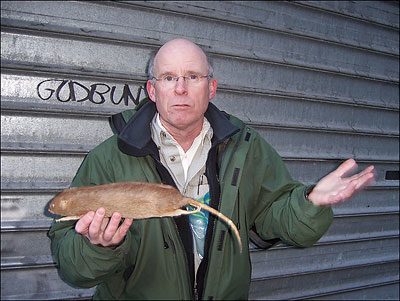
"Not every station has rats, although plenty do. Of 18 stations examined in Lower Manhattan, about half of the subway lines got a fair or poor rating for infestation, meaning they exhibited the telltale culprits - overflowing trash cans, too much track litter - that can lead to a rodent jamboree."
Rodent jamboree. A good phrase, and a disgusting image. That's the New York Times writing about a study the city conducted that attempted to finally analyze just how prevalent the evil rats are in the subway system. There are lots of them, just not the millions that people fear. The good news, as reporter Michael M. Grynbaum wrote, is that "the legend of teeming rat cities tucked deep into subway tunnels is, in fact, a myth. The electrified tracks, scientists said, are far too dangerous."
So the rats don't actually own the city, it just seems that way. Most people are lucky if they only see them while waiting for a subway. Inevitably my eyes gaze down onto the tracks as I wait, searching for any movement. A rat shows up often enough, usually alone although sometimes with family members. They'll devour some food or drag a McDonald's bag to their secret home. The creepy thing about seeing a rat in a subway tunnel isn't that they're invading our space. It's the feeling that we're invading their space.
Unfortunately, I see them everywhere, not just on public transportation. But start with the subway. For years I'd only seen them on the tunnel, never the platforms. When my parents, aunt and uncle and cousins visited three years ago, I assured them the rats didn't patrol the platform. Maybe we'd see one on the tracks, I teased, as if I was a safari guide explaining the likelihood of seeing a lion. But as we sat at the 145th Street stop, waiting to go to Yankee Stadium, a rat scampered on the platform, right next to us, bringing out screams and shattering my assurances. Since then I've seen a rat on two other occasions on the platform. Once the creature scattered behind a ticket machine and I was the only person who saw him take up residence there. I walked past and through the turnstile, while waiting for the panicked cries of some poor soul destined to encounter the rat while buying a weekly Metrocard.
If the rats stayed underground they'd be curiosities, a tourist attraction. But they do invade our space, or at least the land we've taken over and now live on. Several years ago all our building's garbage went in one place - the couches, computer chairs and newspapers mingled with rotting food. Four containers held the garbage in the building's basement. On weekends or on holidays when the garbage didn't get taken out, it was a miserable experience going down there. The stench overwhelmed the senses. Still, I never thought of rodents living down there. I was naive.
One day I went down with a bag, stepped off the elevator and threw it on top of the mountain that had formed. Out of the corner of my eye, I saw something dart toward my foot. It was a large (is there another kind?) rat. It scurried over my foot. I had sandals on the time, no socks. A rat ran over my barefoot and disappeared into a dark corner of the basement. Too shocked to scream or to weep, I jumped up and back, while simultaneously pushing the button for our floor. Back in the safety of our apartment, I wondered if the plague could be transferred from rat hair to human skin.
From that moment on I never did the laundry in the basement, which I'd done for years. The area's been cleaned up. All the food now goes into a separate chute and the super keeps things as clean as possible.
The residents don't always help.
Several weeks ago our building's management posted a brief letter in the elevator, explaining that an unknown person - but a resident of our building - had been throwing garbage bags out the window and onto an adjoining building. I'd seen the bags down there. It's a hell of a toss.
This, the letter stated, was unacceptable, not to mention against the law and a violation of the lease. Plus, the refuse would attract rodents, specifically, rats. I hoped they would catch the garbage tosser, and subject them to strict interrogation. There'd be only one question: Why? Who thinks it's okay to take a large garbage bag, filled with meat and milk cartons, and heave it out a window, onto an adjoining building? The building has chutes for food and the regular garbage for everything else. Is the 18-second trip on the elevator too much? Do they want their children attacked at night by roving gangs of rats?
Everyone in the city has a rat story. Maybe their favorite restaurant popped up on a WNBC investigation as a secret camera recorded dozens of rats running over the grills at a place that charges $50 for a steak. Maybe they saw one "as big as a cat" prowling a park. When I first moved to the city some guy made the papers because he went around at night on the Upper West Side with a baseball bat hammering away on rats that terrorized the neighborhood. To many he was a local hero, but some people objected to the treatment of the rats (not sure what the argument was; it's not like he was using an aluminum bat).
One morning a month, I stand outside our apartment building at 4:30, waiting for a car to pick me up for work. It's a time for drunks who stumble home. It's a time for those with long commutes to leave their homes. And it's the time for rats. A few weeks ago I stood and watched a pair of them run out from a building down the block and into the garbage sitting on the curb. I stood there for five minutes and they never re-emerged. One middle-aged woman walked past with her dogs, who apparently didn't smell a thing. She was comfortable in her obliviousness, while I squirmed with my knowledge.
The car finally arrived. I quickly hopped in and tried to forget about them. But the message was clear, no matter what the studies say: the rats run this city.
Monday, June 14, 2010
The Natural vs. Hoosiers

My two favorite sports movies are Hoosiers and The Natural, and in that order. In the end, Hoosiers gets the nod because it's about basketball, my favorite sport. But it's a close competition. In the past few weeks, each popped up on cable TV, one after midnight, another right before. And both times I dropped everything else to watch until the dramatic, over-the-top endings. I know practically every line from each movie by heart and use those lines in conversation the way other people reference Caddyshack and Airplane!
The teams in both movies feature grumpy, seen-it-all coaches, superstars, decent supporting role players, memorable music and boring women. A comparison:
SUPERSTARS: Jimmy Chitwood vs. Roy Hobbs. There's no doubt Roy Hobbs was a more charismatic performer, away from the game at least. Roy dated a glamorous blond woman. A femme fatale shot him early in his life. And through it all, Glenn Close apparently remained chaste, waiting for her one true love. Jimmy, on the other hand, probably never kissed a girl. The only woman he's close to is his tutor. With his soft voice and monosyllabic vocabulary, there's no way he was wooing the gals with his words. Still, he must have surely had a gaggle of farm gals waiting to offer themselves up to the local hoops star. In small town Indiana, the star basketball player ruled. And after that winning shot in the state finals, he could have had any girl in the land. But he probably simply went home and worked on the Mikan Drill.

On the court, though, the two were equally dominant. Both completely changed the fortunes of their teams. Both performed in the clutch, Jimmy hitting the winning jumper, Roy slamming the winning homer. Each awed coaches: Wilford Brimley's character, Pop, told Roy that he was the best goddamn hitter he'd ever seen. Cletus tells coach Norman Dale he's never seen a better player in 40 years than Jimmy Chitwood. High praise. Maybe a slight edge to Hobbs, since at that time there were many more great baseball players around than basketball players. Hobbs proves he can play with pain. He plays while knowing one swing could kill him. We never see Jimmy perform with a sprained ankle or injured finger. I'm sure he was a strong farm boy who would play through anything, but, again, the edge goes to Hobbs.
Both made legendary plays in their final games. Roy's was perhaps slightly more memorable - exploding lights trump a ball softly dropping through the net. Jimmy's overall effort in the championship was far superior, he completely carried the Hickory offense while Hobbs hobbled around like a 35-year-old with a bullet lodged in his intestine. His effort was so weak, the starting pitcher thought Roy might also be throwing the game for the Judge.
But still, the overall edge goes to Roy. It's the character, but maybe it's also the actor, too. Perhaps I'm just biased because Maris Valainis is no Robert Redford.
COACH/MANAGER: Norman Dale vs. Pop Fisher. A pair of classic old-school leaders. Both great coaches, certainly. But both also needed rescuing by their superstars. Pop and the Knights bumbled along in front of an empty stadium until Roy Hobbs strolled in, much to Pop's chagrin. He hated that his scouting department signed Hobbs. Coach Dale installed his patient, soul-crushing offense and discipline with Hickory, but was on the verge of being canned until Jimmy stepped forward and spoke some of his few words in the movie. Without Jimmy coach Dale's riding out of town, probably done with coaching for good. Who else would hire his tired old bones? Without Hobbs, Pop's team is dead. He loses the team to the Judge. And if Bump Bailey doesn't run into that wall, Hobbs probably remains a pinch-hitter, if that.
The edge goes to coach Dale. A basketball coach almost always has a bigger impact on his team than a baseball manager. Once the Knights started rolling, Pop settled into a Joe Torre role and had little to do, other than warning Roy away from his niece. He worked the media and massaged some egos and filled out his little lineup card but that's about it. Dale, meanwhile, led little ol' Hickory to the state title, bleeding every point out of his undermanned team and nearly nonexistent bench. He juggled Shooter's benders with the townsfolk's anger. He gave kick-ass speeches. It's still inexplicable that he called a play for someone other than Jimmy with the final shot - it'd be like Phil Jackson drawing up a play for Luke Walton in Game 7 of the Finals - but he eventually came to his senses after the team spoke up. We never learn how long Dale stayed in Hickory but I can't believe it was a long tenure. His style wears on players. He was always one bad pass away from pulling a Woody Hayes. Pop probably stayed on the bench until the day he died. They likely buried him in his tobacco-stained uniform. But give the overall edge to coach Dale.
ASSISTANTS: Shooter vs. Red. Big edge to Shooter, even with the violent outbursts and poisoned internal organs. Red's a nice enough guy, the Don Zimmer to Pop's Joe Torre. He subtly encourages Roy early, when it looks like Pop won't give the middle-aged rookie a shot. But again, a baseball bench coach has little effect on the overall product. If the Knights replaced him with an inanimate object, few would notice. He likely stepped in a few times when Pop got ejected but his main duties involved handling games of pepper and keeping up the lively chatter on the bench. Shooter's genius literally won a game, even though his madness nearly destroyed Hickory in the playoffs. Again, we need an epilogue. Red probably stayed on the bench until he was 90 and eventually retired to a small cabin in Minnesota. Shooter likely died in a single-car traffic accident or of cirrhosis. But he'll always have the picket fence.
SOURCE MATERIAL: Hoosiers is loosely inspired by the 1954 Milan team, the small school that captured the Indiana state title on a last-second shot by Bobby Plump. The Natural comes from the classic novel of the same name, written by Bernard Malamud. It's an outstanding book, but those who have only watched the movie might be disappointed reading it, as Roy Hobbs is slightly less heroic. In fact, he strikes out to end the final game after making a deal with the sinister Judge. No exploding lights, no reunion with a glowing Glenn Close in the fields. Instead, a boy - echoing the Shoeless Joe Jackson legend - asks Roy if the papers are right, if it's true that he threw the game. Hobbs begins weeping. Edge to Hoosiers and Milan, but only because it's not as depressing (but seriously, you should read The Natural, it's superb).
BARBARA HERSHEY: The veteran actress appeared in both films. It's a brief role in The Natural. She's the lady in black, Harriet Bird, who's apparently assassinating star athletes across the country. She sets her sights on "The Whammer" until Roy Hobbs upstages him at Janesville's Hay Daze, or some other small town fair. She's sexy and dangerous. In Hoosiers, Hershey's character, Myra Fleener, is neither of those things. She's a schoolmarm, a harsh woman who has little use for games or the people who play them. Even she gets caught up in Hickory's title run, but you get the feeling that after the team got home and had their welcome home party, she pulled Jimmy aside and reminded him that his 10-page paper about Andrew Jackson needed to be finished in time for Monday's 9 a.m. history class. Harriet Bird gets the edge. I'd like to see what Harriet Bird would have done with Jimmy Chitwood. Jimmy's so robotic - such a remorseless shooting machine, who might have been afraid of females - he probably wouldn't have even notice her flirting. And that would have saved his life.
ANNOYING CHARACTER/MASCOT: We all love Ollie in Hoosiers, but he's still a bit grating. Too small, too slow, just not good enough. Yes, he wins a game with his ludicrous granny free throw but his gaffes before that nearly cost the team the game. The most annoying character in The Natural, to me, is the pudgy bat boy, Bobby. The bat he made, the Savoy Special, does come to the rescue after Wonderboy breaks. But that comes right after my least-favorite scene in the movie. After giving the bat to Roy, the bat boy stands there, dumbfounded, paralyzed, unable to move his chubby legs, looking like someone just hit him in the head or stole his chocolate bar. His slow-developing smile looks like the one Danny Glick had when he floated outside the window in Salem's Lot. Roy has to nudge him off the field, as if he's saying, "Hey, kid, mind leaving so I can take this young flamethrower deep, destroy the lighting system, save the franchise for Pop and win the pennant, all in front of my one true love and my son?" I dislike everything about this kid: his hair, his too-high pants, his ridiculous hat, his gait.
MUSIC: Randy Newman created The Natural soundtrack, which has some of the most famous songs in sports movie history. Hoosiers isn't quite as memorable, although the music that plays after Jimmy's famous shot has traces of The Natural. When I played college ball, a teammate, who was so obsessed with Hoosiers he may have named his first kid Norman Dale Chitwood, bought the soundtrack to the movie. He hoped that it contained speeches and dialogue from the movie, the way soundtracks to films like Pulp Fiction had clips from the movie mixed in with the music. Nope. No Norman Dale speeches. No Jimmy Chitwood announcements. Nothing from Ollie. All it has is the instrumental music from the movie, which, by itself, is enjoyable but not very inspiring. Edge to Randy Newman and The Natural.
VILLAINS: Not really a fair comparison, since Hoosiers is a feel-good story that lacks a bad guy, other than early in the movie when George delivers his odd and uncomfortable "There's two kinds of dumb" speech involving naked guys barking at the moon. But even George joined the coach Dale cult by the end of the movie, though I'm sure he thought he could have led the team to a title as well with a wide-open offense. He's the kind of parent that lives in every small town, a coach's nightmare, until the coach wins. The Natural had numerous villains, from the Judge to the gambler Gus Sands. Then there's Harriet Bird. And Kim Basinger's Memo Paris, who might not be evil but was certainly bad news for Roy. Even Bump Bailey was something of a dark figure, right until the moment he ran through that wall.
ENDURING USE IN SPORTS AND LIFE: How many times did you hear Hoosiers referred to this year as Butler made its stunning run in the NCAA tournament? A hundred? That was impossible to avoid. Not only was Butler an underdog, but they came from Indiana. And they had a gangly white guy who led them in scoring and had a vague resemblance to Jimmy Chitwood. But people talk about Hoosiers all the time, not just when the team hails from Indiana. For 24 years, any basketball underdog that makes a surprising run brings out talk about Hoosiers, whether they're in the pros, college or high school. Hoosiers is now shorthand for a scrappy team that overcomes long odds and captures the hearts of millions, or at least thousands, or perhaps dozens. The phrase "the natural" still lives as well, but it doesn't seem quite as prevalent. It's usually referenced whenever a sweet-swinging lefty makes a big impact early in the majors. People often called Ken Griffey Jr. the natural and it fit. But sometimes it can be a bit premature, like when Sports Illustrated splashed Jeff Francoeur on its cover. Jeff Francoeur: decent player, no Roy Hobbs. Edge to Hoosiers.
 Both movies have some flaws. But the genius of the movies hides the flaws, the same way Jimmy's perfect shooting made up for Hickory's lack of depth and size. They both came out a quarter century ago but nothing since has topped them. And chances are, nothing ever will.
Friday, June 11, 2010
With the Finals tied 2-2, I search for more history that validates my favoritism
Sports messageboards rank somewhere between newspaper websites and YouTube for hosting the strangest, most outrageous, passionate posters. Assuming there are decent moderators keeping things sane, there isn't the racism or homophobia that litters the online sites of newspapers, and the spelling is much better than on YouTube. Still, they can be an odd place, filled with fanatics whose only concern in life is watching their team win and, more importantly, watching their least-favorite teams lose.
These people want Phil Jackson fired after a December loss. They want Kobe Bryant traded after a 6-19 shooting performance, then, two days later, following a 40-point effort from Kobe, the same people start a discussion that asks: Is there any doubt Kobe's now the best of all-time? These people want Pau Gasol traded back to Memphis and lament the day Kwame Brown left town, when they're not speculating about whether Gasol is the best big man in the game today and/or better than Kevin McHale. Some posters use three exclamation points with every sentence, when they use any punctuation at all. They spin vast conspiracies inolving David Stern and the NBA and how the league doesn't want the Lakers to win, a theory 29 other teams and fans rightfully find laughable.
Yet I drop in often and also contribute. There are knowledgeable posters. There are good historical discussions amidst the carnage.
But I also read for entertainment sake. They make my little outbursts look sane and amateurish. And, last night, after Big Baby and Little Baby dismantled the Lakers in the fourth quarter, Lakersground.net was flying high. People despaired. They whined. They cried. One person even speculated about whether it was wrong to trade Vladomir Radmanovic. It's a place to unwind.
But as always, when I'm trying to predict the Lakers future, I retreat to the past to look for precedent.
I've already written about what happens when a team wins Game 3 in a 1-1 series in the 2-3-2 format. They're 10-0 all-time, so the Lakers are guaranteed victory this year. Right? And Phil Jackson's never lost when his team wins the first game of a series, so, again, the Lakers are guaranteed to win. Right? Unfortunately, the Celtics keep winning every other game and now it's a best-of-three.
Back to the history books.
Since the 2-3-2 format began in 1985, there have been eight series tied at 2-2:
1985: Celtics had homecourt advantage, lost Game 5 in LA, lost Game 6 in Boston.
1988: Lakers owned homecourt, lost Game 5 in Detroit, won Games 6 and 7 in LA.
1992: Chicago owned homecourt, won Game 5 in Portland, won Game 6 in Chicago.
1994: Houston owned homecourt, lost Game 5 in New York, won Games 6 and 7 in Houston.
1997: Chicago owned homecourt, won Game 5 in Utah, won Game 6 in Chicago.
2003: San Antonio owned homecourt, won Game 5 in New Jersey, won Game 6 in San Antonio.
2005: San Antonio owned homecourt, won Game 5 in Detroit, lost Game 6 in San Antonio, won Game 7 in Detroit.
2006: Dallas had homecourt, lost Game 5 in Miami, lost Game 6 in Dallas.
So...the game on Sunday is more important to the Celtics than the Lakers, no matter how hysterical Laker fans would get after a defeat. No team has won both Game 6 and Game 7 on the road. Portland, Utah, New Jersey and Detroit tried and failed. Only Detroit even managed to push things to an ultimate game in 2005.
On the other hand, two teams have lost Game 5 on the road and then won Games 6 and 7. Houston did it in 1994, thanks in part to John Starks' meltdown in Game 7.
And the Lakers did it in 1988. Isiah Thomas scored 25 points in the third quarter of Game 6 but sprained his ankle. Detroit led by three with a minute to go before a Byron Scott jumper and two free throws by Kareem lifted the Lakers. In Game 7, the Lakers exploded in the second half, then held on in the final moments.
So teams have done what the Lakers would have to accomplish if they lose Game 5 on Sunday.
But I still don't want to see them have to try and win two in a row.
Another stat: The Lakers have won a remarkable 14 straight games when the series has been tied, dating back to Game 1 against Houston last year. I saw a graphic that said Jordan's Bulls won 16 straight and Russell's Celtics 19 straight. The Lakers have also won six straight closeout games. I'm hoping both of those trends continue the next two games: Lakers win Sunday, then finish it off Tuesday in LA.
But if they lose Sunday, I'll be talking about remembering 1988 and the Rockets in 1994. And I'll be forgetting about the Celtics in 1985 and Dallas in 2006. And I'll retreat to the occasionally strange world of Lakersground, where someone will demand that Rudy Tomjanovich replace Phil Jackson, preferably before Game 6.
Subscribe to:
Posts (Atom)