On Thursday night we went to Mankato to watch Iron Man 2. I missed much of the dialogue from the first 20 minutes as I discretely checked the Lakers score online. Yes, I hate those people who do that. We all do. I was ashamed (to be fair, I put my hands over it, blocking off the light and only let out a quiet yelp when I saw the Lakers won). But this was a Game 5 in a 2-2 series, always the most crucial game in a best of 7.
We try to get to Mankato for a movie on every trip home. We usually go during the week, almost always to a late show. Most times, the workers outnumber the customers, a welcome break from crowded New York City theaters. It feels like we rented out the whole theater to ourselves. Mankato was my movie home for 25 years. I've seen countless movies there. It's the go-to city in southern Minnesota for those who lived in towns that were often dismissed as places where kids "have nothing to do."
The first one I remember is Star Wars and I cried through most of it and people in the seats next to us probably looked at my parents - and their not-so-adorable baby - with the same looks people reserve for cell phone users in theaters today (the worst movie I ever saw a small child at has to be Saw II. I fully expect to read a story in 15 years about a young man who went on a killing rampage involving dynamite and cryptic clues and blames it on the fact his parents took him to the second Saw movie when he was 4 years old).
For years Mankato had two main theater spots: downtown and the Stadium theaters, across the street from the college formerly known as Mankato State University. Then in the early 1990s, River Hills mall opened and a dollar theater came along with it. The downtown theater - there used to be a fairly popular mall there as well - has always possessed a slightly creepy vibe. You usually parked in a garage, the type of dark structure often used as sets in movies involving serial killers or cities under siege from violent criminals. Something starring Charles Bronson, or Stallone in a Cobra remake.
As a teen we went to movies every weekend. We saw Home Alone in the downtown theater. Great movie for kids. Delightful for parents. Critics adored it, as did Macaulay Culkin's money-hungry parents. Unfortunately, we were all 16 years old. In the pre-Internet age, we didn't even know what the movie was about. One of our friends had heard it was really good. He insisted we go to it. He made it sound slightly dark: "Some kid gets left alone at home and two guys break in and chase him."
We realized it was a mistake - that we weren't quite the right demographic - early, but it probably didn't sink in for sure until the 23rd time Joe Pesci got hit in the head with a frying pan. We didn't listen to Martin's movie recommendations after that night.
But our main moviegoing days coincided with the opening of the dollar theater. A buck. They didn't get new releases, that was the catch. They were second-run movies, so the new ones appeared a month or two after they opened. Today, of course, movies are on DVD about two months after they open and the dollar theater long ago started charging normal prices. But we took full advantage of it as teens.
The dollar theaters kept their movies for weeks, months. As long as they made money, they stayed. Two movies held the record, I think, for longest stay: Wayne's World and Basic Instinct. And we saw each movie at least a dozen times. I'm pretty sure we saw Basic Instinct a few more times, probably around 16 or 17 viewings. Sharon Stone's crotch ultimately had more staying power than Mike Myers' catchphrases - insert obligatory Schwing joke. After the sixth or seventh viewing of Basic Instinct, it became a grim mission, almost as if it was our duty to watch it again. A week passed, we drove to Mankato, entered the theater and scanned the listings.
"Jesus, there's still nothing new."
"Basic Instinct?"
"No, we can't."
"Come on."
"Okay."
We knew every horrific line, including the immortal "He got off before he got offed." We waited for Sharon Stone to uncross her legs while an aroused Newman from Seinfeld stared in glee. By the 13th or 14th viewing, there was nothing sexual about it, even if we were teens with runaway hormones. Oh, there's the crotch. Hot. Come on, get to the ludicrous car chases again. We were addicted to the damn movie. Seeing it that many times felt dirty; it probably made an appearance in one of my Catholic confessions that year. But for a buck, you couldn't beat it.
We mourned when Gus died. Again. We cheered Michael Douglas. We shook our heads at the ending (for years, I wasn't sure that Stone's character was the killer, until finally, one late night in Worthington, my friend John completely convinced me. "Why else would she have the ice pick under the bed? That was the point of that shot. She was the killer. Everyone knows this." But I didn't want her to be the killer, she seemed like such a decent woman caught up in a web of murder, mayhem and laughable dialogue.) To this day, if I see Basic Instinct on TV, I instantly drift back in time to the dollar theater and their overpriced but delicious popcorn.
The dollar theater could delight. One night I went with my cousin Matt. A movie called Fortress caught our eye. Neither of us had ever heard of it. We didn't know anything about the plot or who starred in it. This was always dangerous; we were both still bitter about our Home Alone experience. It turned out to be a futuristic prison movie with Christopher Lambert. He wants to have a baby with his wife, the authorities don't allow it, fighting ensues. We loved it.
We only saw Fortress once. In the end, as entertaining as it was, it was no Basic Instinct. Thank God.
Sunday, May 30, 2010


Wednesday, May 26, 2010
1948 NCAA title game: March...whatever the opposite of madness is
Another video from the YouTube legend WiltatKansas. I thought I had a lot of videotapes. This guy, or gal, must be drowning in them. There's a decent chance a future episode of Hoarders will be devoted to helping this man clean out his basement. They'll find three or four dead pets under old tapes from the 1963 NBA playoffs and the 1958 NAIA national title game. But until that moment, I'll continue to enjoy his incredible array of old basketball games. Seriously, the guy has a game from 1942 involving Minnesota and Illinois. Spend some time browsing his selection.
The one above is the 1948 NCAA title game between Kentucky and Baylor. The 1948 tournament wasn't quite the tourney we picture when thinking about March Madness. Eight teams competed in the tourney. It started on March 19 and finished four days later. Adolph Rupp's Kentucky team defeated Baylor 58-42 for the championship.
What an odd game. Start with the introductions. They actually were a precursor to the spotlight intros of today, with some unique variations. Baylor comes out first. Each player dribbles a ball to center court as the spotlight follows them. It's the type of setup that someone probably organized seven minutes before tipoff. After dribbling to halfcourt, they then fire a pass back to a teammate, the next person introduced. They throw it in the dark. Meaning the next guy has to make a great catch. As seen immediately on the video, it wasn't easy. The second guy fumbles the pass and has it bounce off his foot as he bends down to scoop it up. Embarrassing. The third player, who looks like a point guard, is more eager than a 5-year-old who just learned to ride a bike and now wants to show off for daddy. He finishes with a flourish, a pass back followed by outstretched hands. It's the best pass of the game.
The fact there's no sound on the video adds to the strangeness. And this was obviously before basketball was desegregated. In fact, it'd be another 18 years before Texas Western famously upset Kentucky.
Kentucky's introduced second. The players are impressively bulky, though an average 8-year-old with minimal experience today has better ballhandling skills than guys who competed in the national title game in 1948. If anyone ever talks about the glory days and how better everything was back when guys knew fundamentals and knew the right way to play the game, please interrupt them if they in anyway reference 1948 and the NCAA title game.
I should say I believe Baylor's wearing the dark jerseys. It's hard to tell, but during the highlights, the team in dark scores much more than the team in white.
Some more highlights:
* At the 1:30 mark, an incredibly ghastly underhanded free throw. Ghastly because of the result, not the form. Rick Barry proved the granny shot works. This Baylor player proves you still need to practice. Not sure when the first chant of "airball, airball" appeared at a basketball game. Might have been this one, since the crowd would have had about 17 opportunities to use it.
* To me, it looks like the refs called a lot of cheap pushing fouls. I think they mistook the clumsiness of many of the players for infractions on the defender. Let 'em play.
* Every time I watch Ron Artest brick a 3-pointer, I'll rewatch this video and be thankful that at least he has better form than the Baylor player at the 2:45 mark, who unleashes a running one-handed shot that hits nothing but air.
* Between the 3:10 and 3:15 mark, the teams combine for three turnovers. Three TOs in five seconds, a record that lasted 41 years, until a pair of 7th grade girls basketball teams in Iowa broke it with four turnovers in five seconds.
* There are almost no points shown in the first four minutes of the video. It's almost like a video a prosecutor would splice together to show the jury at a point-shaving trial. A trial where players from both teams stand accused.
"Ladies and gentlemen. If you watch at the 3:48 mark, you'll see someone attempt the worst 'dipsy do' layup in history, followed by a fullcourt pass that didn't come within 10 feet of its intended target. These players weren't trying to score. They weren't trying to win. The fix was in. And it's obvious."
Speaking of point-shaving...Kentucky's star was Alex Groza. The NBA suspended Groza for life after he was implicated in the point-shaving scandals that rocked college hoops in the early 1950s. He was arrested for his involvement in a 1949 game. I guess this '48 game was clean. Watching the video, I have my doubts. Groza received a suspended sentence for his involvement, but he never again played in the NBA. He averaged 22.5 points per game in his two years.
* At the 4:31 mark, a Kentucky...marksman, launches a two-handed setshot that falls woefully short of the rim. I couldn't help but think back to a 3-on-3 tournament I played in. It was called Weir Hoopin', a play on words as an insurance agency named Weir sponsored the event. One year a friend of mine, who shall remain nameless to protect the guilty, shot a two-handed set shot from about 18 feet. Unfortunately the shot went 15 feet. He knew this would happen the moment the ball left his tiny hands, which is why, as the ball floated 25 feet in the air and got caught by a gust of wind, he announced, "I'm sorry," before it even had a chance to miss the rim by three feet. We've never let him live this moment down. He apologized as his shot was in the air. But I can say this Kentucky shot was worse. At least Mike, er, John Doe's shot in the Weir Hoopin' tourney was outdoors.
I love watching these old games for a variety of reasons. One, it's just cool to see this type of history, when the game was really in its infancy, even though it was decades after Naismith created his little sport. The video quality's bad and the play worse, but it's still an important game in the best game around. Secondly, it allows me to fantasize about going back in time to dominate play back then. Can you imagine being transported back in time to play in this game? Obviously both teams had great athletes--for their time. But dribbles with the offhand were simply a rumor. The jumper was as foreign as the idea of landing a man on the moon. No-look passes probably led to revoked scholarships.
I cant' say this video shows basketball at its finest. But it is YouTube at its finest.
Sunday, May 23, 2010
Minnesota: Hamburger feeds and bird crap
On nearly every trip we take to Minnesota, something odd happens to Louise, as if the state senses that a woman not of this continent or hemisphere has invaded and needs to be dealt with. It's the same types of things that happen to natives of this fine land, but that's not surprising if they've lived here their whole life. But Louise can be here for 10 weeks - or 10 minutes - and something strange or horrifying will dampen her spirit, if just for a few moments. They're the types of things that usually end up as deleted scenes in a Renee Zellweger or Reese Witherspoon fish-out-of-water romantic comedy.
One year it was frostbite. Nothing severe, just a small case of it, in a circular form on her index finger. She'd had real frostbite before on a couple of fingers, an African native unfamiliar with the concept of freezing temperatures and gloves. I told her she'd be fine if she wore gloves in Minnesota. We stepped outside my parents' house one day and walked a single block. On our return, she took off her glove to reveal the frostbite on her finger. We inspected the glove and found a hole in the finger, the exact size as the frostbite. Minnesota didn't need much of an opening to leave a lasting impression.
Today, after a delightful family picnic in the park, we capped off the night with a walk up to the bustling Dairy Queen. A hundred feet from our house, I turned around after hearing Louise squeal. She stood motionless, her arms outstretched. She said nothing for a second. Then, in a South African accent, "I got bird shit on me!"
A Minnesota bird, probably a robin, maybe one of the two bluejays we've seen around the house, had indeed left a disgusting deposit on her face. I'm sure it wasn't aiming for her. Right?
It somehow managed to avoid her curly mass of hair. Instead it hit her hand and near her eye, like it was shot out of a cannon from 50 feet away. My nephews and sister helped out by laughing uncontrollably. I felt terrible, of course, but a bird shitting on someone's head is funny anywhere, in every language, on every continent. It's the equivalent of football in the groin. I escorted her back to the house to get washed up. Minnesota struck again. It gets her during the winter and during the 90-degree spring days. She's not safe here. But, fortunately, she still loves visiting here. Living here, on the other hand...
On Friday, our first night in Janesville, we went uptown for a hamburger feed, which supported youth baseball in the town. Louise acted the way most people do when they learn they've won an all-expenses-paid trip to London. She'd never been to a "hamburger fry." She was like a sociologist, eager to see how us small town folk constructed hamburgers with all the fixins. As hamburger feeds go it was standard stuff. Throw the meat on a bun, top it with some condiments, add a few fries, grab some pickles, sit down on a long table and talk with your neighbors. I looked back in line and saw Louise taking pictures, documenting every drop of ketchup and capturing the atmosphere.
"I've never seen such a thing," she said excitedly. She was more excited than Jane Goodall the first time she went to Tanzania.
New York City people are tough to impress? They've seen it all? I suppose. Until you take them to a hamburger feed in a town of 2,000.
The trip's been everything I want when we return home. Relaxing, but we've also had the chance to already see numerous family members and friends we hadn't seen in way too long. Today we had a picnic in the park and invited everyone from both sides of the family. I got to see people I might not have been able to visit during our 10-day stay. It's great seeing them and it's days like this when I realize how much I do miss them and my friends and my tiny hometown and my home state. But I'm also grateful, and lucky, that I have a great life I love in New York City. Minnesota will always be home, but how many people are fortunate enough to have two places that feel like home?
The night ended with me in the basement watching the Lakers in the playoffs. It was a scene out of 1985 or 1991. My folks and sister upstairs, me in the basement screaming at the latest reffing atrocity or three-point brick from Odom or Artest. At one point my nephew Bronson visited me downstairs to watch a few minutes. I think he might have studied me the same way Louise analyzed the hamburger feed. He must have wondered, how can a calm, mild-mannered easygoing person transform into this grotesque creature? Earlier in the game, when I was still upstairs, I looked around for something to fire across the living room. My dad handed me an old pair of socks, figuring they'd do the least damage. I threw them and added some newspaper flyers for good measure. Out of respect for everyone else in the house, and because I do like to set an example for the younger kids, I refrained from swearing (although it's difficult when watching Robin Lopez play).
It's what I also do in New York City. I'm not proud of the behavior. God no. But it's what I do in our one-bedroom apartment, in the comfort of my home. And it's what I do in my parents' house, in the comfort of my other home.
One year it was frostbite. Nothing severe, just a small case of it, in a circular form on her index finger. She'd had real frostbite before on a couple of fingers, an African native unfamiliar with the concept of freezing temperatures and gloves. I told her she'd be fine if she wore gloves in Minnesota. We stepped outside my parents' house one day and walked a single block. On our return, she took off her glove to reveal the frostbite on her finger. We inspected the glove and found a hole in the finger, the exact size as the frostbite. Minnesota didn't need much of an opening to leave a lasting impression.
Today, after a delightful family picnic in the park, we capped off the night with a walk up to the bustling Dairy Queen. A hundred feet from our house, I turned around after hearing Louise squeal. She stood motionless, her arms outstretched. She said nothing for a second. Then, in a South African accent, "I got bird shit on me!"
A Minnesota bird, probably a robin, maybe one of the two bluejays we've seen around the house, had indeed left a disgusting deposit on her face. I'm sure it wasn't aiming for her. Right?
It somehow managed to avoid her curly mass of hair. Instead it hit her hand and near her eye, like it was shot out of a cannon from 50 feet away. My nephews and sister helped out by laughing uncontrollably. I felt terrible, of course, but a bird shitting on someone's head is funny anywhere, in every language, on every continent. It's the equivalent of football in the groin. I escorted her back to the house to get washed up. Minnesota struck again. It gets her during the winter and during the 90-degree spring days. She's not safe here. But, fortunately, she still loves visiting here. Living here, on the other hand...
On Friday, our first night in Janesville, we went uptown for a hamburger feed, which supported youth baseball in the town. Louise acted the way most people do when they learn they've won an all-expenses-paid trip to London. She'd never been to a "hamburger fry." She was like a sociologist, eager to see how us small town folk constructed hamburgers with all the fixins. As hamburger feeds go it was standard stuff. Throw the meat on a bun, top it with some condiments, add a few fries, grab some pickles, sit down on a long table and talk with your neighbors. I looked back in line and saw Louise taking pictures, documenting every drop of ketchup and capturing the atmosphere.
"I've never seen such a thing," she said excitedly. She was more excited than Jane Goodall the first time she went to Tanzania.
New York City people are tough to impress? They've seen it all? I suppose. Until you take them to a hamburger feed in a town of 2,000.
The trip's been everything I want when we return home. Relaxing, but we've also had the chance to already see numerous family members and friends we hadn't seen in way too long. Today we had a picnic in the park and invited everyone from both sides of the family. I got to see people I might not have been able to visit during our 10-day stay. It's great seeing them and it's days like this when I realize how much I do miss them and my friends and my tiny hometown and my home state. But I'm also grateful, and lucky, that I have a great life I love in New York City. Minnesota will always be home, but how many people are fortunate enough to have two places that feel like home?
The night ended with me in the basement watching the Lakers in the playoffs. It was a scene out of 1985 or 1991. My folks and sister upstairs, me in the basement screaming at the latest reffing atrocity or three-point brick from Odom or Artest. At one point my nephew Bronson visited me downstairs to watch a few minutes. I think he might have studied me the same way Louise analyzed the hamburger feed. He must have wondered, how can a calm, mild-mannered easygoing person transform into this grotesque creature? Earlier in the game, when I was still upstairs, I looked around for something to fire across the living room. My dad handed me an old pair of socks, figuring they'd do the least damage. I threw them and added some newspaper flyers for good measure. Out of respect for everyone else in the house, and because I do like to set an example for the younger kids, I refrained from swearing (although it's difficult when watching Robin Lopez play).
It's what I also do in New York City. I'm not proud of the behavior. God no. But it's what I do in our one-bedroom apartment, in the comfort of my home. And it's what I do in my parents' house, in the comfort of my other home.
Thursday, May 20, 2010
Strat-O-Matic Baseball: Best game ever? Yes
Come on, kids, it's Action Baseball!
By all accounts, Roger Maris was a humble, nice, down-to-earth superstar. The qualities served him well on the field, if not with the New York media. Those aren't necessarily the traits that translate into a great pitchman - he's no Billy Mays. I've never seen an actual version of Action Baseball, though there's probably still one buried in a box somewhere, either in my parents's basement or the old family farm. This game actually looks like a lot of fun. Unlike many board games, in this one you actually control a bat, in a version of pinball as your opponent fires "fastball," a "slowball," and a curve. Fake crowd noise not supplied.
When it comes to baseball games, though, there remains only one king: Strat-O-Matic. My cousin Matt Fury owned a Strato game. Between 1993 and 1997, we must have played hundreds of games, scheming, plotting, and swearing at each other and our other friends who were Strato regulars: Mike and Brandon. On an unrelated note, only one of us had a girlfriend during this time. The ladies of Janesville, Waldorf, Pemberton and the surrounding villages did not go for spending eight straight hours in a radon-infested basement, rolling dice, cursing the fates of the cards and berating the surprisingly lackluster fielding skills of Paul Molitor. Matt owned the 1987 season cards, a great year to play as the season provided a nice prelude to the homer-crazed '90s. George Bell, Andre Dawson and a skinny Mark McGwire all enjoyed dominant years. Wade Boggs, Molitor and Tony Gwynn put together superb seasons at the plate.
One of the more overused sports cliches - and I do realize that's saying something in the "we're taking it one game at a time and giving 100 percent and anything can happen world" - is that [insert sport] doesn't build character, it reveals it. I've heard it said about basketball, golf, football, baseball, soccer, swimming and once about jai alai.
Same thing for Strato. It doesn't build character, it reveals it. And when we played Strato, it revealed that all of us were romantically challenged sore losers with superiority complexes.
Same thing for Strato. It doesn't build character, it reveals it. And when we played Strato, it revealed that all of us were romantically challenged sore losers with superiority complexes.
Some Strato memories, first of a multipart, potentially neverending series:

* The highlight of any Strato night/weekend/month/year was the draft. It usually took place in our basement, a marathon session fueled by Coke as we prayed for access to the top players, many of whom were also fans of coke, though with a small "c." We threw every players' card into a pile - hundreds of cards - then scattered them and brought them together again. We didn't want one team's players congregating together, and we didn't want all the bad players in one pile. The draft usually lasted about 50 rounds. Each player randomly grabbed a card and was stuck with it. But that's why we employed flexible draft rules. It was scheduled to be 50 rounds but could be stretched to 60, 70, or more, depending on if we had grabbed too many subpar players. Accusations of cheating occasionally flew, as some of the more well-used cards stood out, their worn edges giving them away.

* Here's a Strato hitter's card. This is Barry Bonds from his insane 2001 season, when he hit 73 homers. A player rolls the dice. If, in this case, they come up 1-4, it's an automatic homer. The player with Bonds is morally obligated to simply say, "Gone." In the 1987 game, many of the greats had 1-5 as a homer, including McGwire. Some, like Mike Schmidt, were dominant in the three column. So a 3-6 would simply be "Gone." 2-3 means a flyball to centerfield. The A next to it indicates what happens to the runners on the play, whether they tag up, stay, etc. Roll a 3-4 and that means you draw a card, which were 1-20. If it's a number between 1-8 it's a single and the runners advance one base (which is what the Ford Frick honorary asterisk means). See those diamonds in the 1 column? That indicates you go to the cards and bring the stadium into play. All the stadiums had different standards. It was easier to hit homers in Atlanta than, say, San Francisco. Or it might be easier to get triples in Kansas City. Now, Bonds's card is not typical. In fact, it's ludicrous. It would be nearly impossible to get him out if the dice sent the play to his card, so a player had to hope he got it on his pitcher's card.
* The highlight of any Strato night/weekend/month/year was the draft. It usually took place in our basement, a marathon session fueled by Coke as we prayed for access to the top players, many of whom were also fans of coke, though with a small "c." We threw every players' card into a pile - hundreds of cards - then scattered them and brought them together again. We didn't want one team's players congregating together, and we didn't want all the bad players in one pile. The draft usually lasted about 50 rounds. Each player randomly grabbed a card and was stuck with it. But that's why we employed flexible draft rules. It was scheduled to be 50 rounds but could be stretched to 60, 70, or more, depending on if we had grabbed too many subpar players. Accusations of cheating occasionally flew, as some of the more well-used cards stood out, their worn edges giving them away.
* Shortly after each draft, we sliced our rosters down to a 30-man squad. Some cuts were easy. With others, we struggled more than Truman debating about use of the atom bomb. A man could spend 25 minutes debating between Ron Kittle and Jim Rice. Inevitably, we began dealing our guys. In a four-team league, there aren't a lot of trade partners. The most enthusiastic trader was always Brandon, who as a Strato owner was a combination of Branch Rickey, Ted Stepien, the lady owner from Major League, George Steinbrenner, and Mark Cuban. He never met a deal he didn't like. The second he drafted a player, he began contemplating how he could trade him. It bordered on maniacal. One night over hushpuppies and batter cooked to look something like chicken and fish, we sat in Long John Silvers and put together a trade that eventually involved more than a dozen players. The grease made us delirious, especially Brandon, as he sold his entire team just so he could land his favorite player, the man whose home runs he fantasized about: Mark McGwire. It was unnerving. He'd do anything in his power to own Big Mac, who hammered 49 home runs in 1987, his rookie season. Brandon infuriated us after games if he won. He pored over his scoresheet - yes, all the players keep book - with the concentration of a prosecutor looking at Enron's books. He wore a smirk, but was usually silent. Eventually he's softly say, sort of to himself but loud enough so his vanquished foe could hear, "McGwire, 3-for-4, 2 dingers, 6 RBIs. I don't know. Not a bad game." More than once I threw a pencil at him after such a proclamation.
* Numerous players had two cards. If they were traded during the season, Strato created a card for his performance with each team. This often led to Good Card and Bad Card syndrome. For example, journeyman pitcher Dennis Rasmussen was a below average pitcher with the Yankees. But he finished with the Reds, where he went 4-1. The Dennis Rasmussen Good Card made him an extremely effective starting pitcher, a solid No. 2 man, maybe even a No. 1 guy. Dennis Rasmussen Bad Card was putrid, a slug you threw out on the fifth day if you ran out of options. Another guy was Bill "Gully" Gullickson, another journeyman who shared the name of a bizarrely popular Mankato radio host.
But the king of Good Card, Bad Card was Doyle Alexander. Remember Doyle? No. Don't worry, most people don't. Except for Tiger fans from 1987 and the four of us who played 7,678 games of Strato with that season's cards. In 1987, Alexander and his ridiculous mustache started the year with Atlanta. He went 5-10 with the Braves with a 4.13 ERA. Bad Doyle. Very Bad Doyle. Then they sent him to Detroit in a deal involving John Smoltz. With Detroit, Doyle went 9-0 with a 1.53 ERA! He transformed into a combination of Bob Gibson and Sandy Koufax. That was Very Very Good Doyle. If you got that card, you had a No. 1 starter. In real life he sparked the Tigers to the ALCS - where the Twins slapped them around while Kirk Gibson took out his frustrations on the dugout - but in Strato he was nothing short of a god. When someone pulled a card and announced he drafted Doyle Alexander, three other voices simultaneously asked, "Good Doyle or Bad Doyle?"

* Each owner always "named" a manager (again, no girlfriends, active imaginations, time on our hands). Matt always hired Gene Mauch, or, as he called him, Gene Mauch IV. Fake Gene Mauch won much more than the real one. Brandon had an infatuation with Billy Gardner. Mike, strangely, liked Chuck Tanner, one of least charismatic managers to ever wear an ill-fitting jersey. Bizarrely, each of their teams somehow took on the personality of their imaginary manager. My guy was Earl Weaver. The fiery genius. One day I dug through my overwhelming collection of books and found one from my childhood. It was about "Baseball's Greatest Managers." And the chapter on Weaver was called "The Bantam Rooster." What? Guess that was his nickname. I also dug out an old toy of mine, a contraption that made animal sounds when you pulled a string. Dog, cow, sheep. And a rooster. So for a few weeks, whenever one of my guys hit a homer, I'd pull the string and taunt my foe with the voice saying, "The Rooster says, 'Cock-a-doooodle-do.'" I was incredibly proud of finding that toy and converting it into a Strato psychological weapon.
* Each of us had our obsessions. Brandon had McGwire, Mike had Devon White (?). Mine was Nolan Ryan. The Express had a bizarre 1987. Led the league in ERA at 2.76, yet was only 8-16 with Houston. And, of course, he struck out a ridiculous number of players. It seemed like I always drafted him. I loved his strikeouts, I could mentally picture the leg kick, the powerful stride, the little grunt, and the explosive fastball. He had a better strikeout rate than Danny Almonte at the 2001 Little League World Series. Strato pitcher cards have four, five and six columns. Ryan's dominant area was the five spot. My opponent would roll a 5-6 and I'd simply say "sit down," "go away," or "goodbye." Sadly, I never threw a no-hitter with the man who tossed seven of them in his noncard life. He could be hurt by the long ball and always seemed to give them up in a crucial situation. So, just like in real life, he'd go nine innings, strike out 13 and lose 3-1. Damn it.
* Matt's obsession was Eric Davis, the former Reds star who never quite lived up to his potential. Somehow Matt always got Davis in the draft - I'm convinced he knew the feel of Davis's card in the same way a husband knows the feel of his wife's back. He'd pretend to be upset. "I don't even want him. He strikes out way too much." No one bought it. During the Strato season he whined constantly about Davis's strikeouts, and always said Mauch IV would bench him. But he never did. And every time Davis did hit a homer - which was often - Matt complained, "Why doesn't he do that more?" Like everyone he played for in his career, Davis's untapped potential tormented Matt.
* A few of our favorite Strato phrases, which we repeated constantly and drove into the ground faster than Fletch and Airplane quotes.
"Dot?" No, he can go 8." - Each pitcher's card indicated how many innings they could go before theoretically tiring (today, they'd probably let each starter go five innings). There would be random dots on some of the numbers. So if it said flyball, but had a dot on it, the play was actually a hit, because of the pitcher's fatigue. We often accused Brandon of not admitting when his pitchers had reached dot phase. He'd call a strikeout and someone would ask, "Dot?" Brandon always got angry, that his pitcher and integrity were being questioned, and would say, "No, he can go 8." I still think he fibbed a few times.
"Reggie, Reggie, Reggie, Reggie!" - Reggie Jackson was one of the greatest power hitters ever. But not in 1987. He finished his Hall of Fame career with the Athletics. He hit 15 homers in part-time duty. One year Matt drafted him and kept him on the roster, purely as a bench player and for a bit of nostalgia. Who didn't love Reggie? He rarely used him. But one game against Mike - whose team often transformed into the Washington Generals - Reggie brought back memories of his blast in Tiger Stadium at the All-Star game and the 1977 World Series. With his team trailing by a run and a man on base, Matt brought Reggie in with two outs in the ninth. Matt started the chant, trying to rattle Mike. "Reggie, Reggie, Reggie, Reggie." Eventually I picked it up. I could picture Reggie at the plate, wearing his glasses, bat cocked, waiting for the pitch. Matt rolled the dice. Incredibly, improbably, it came up as a "home run thing," the aforementioned diamond that meant you drew a card for the stadium homer. Matt pulled the little pink card and it qualified. Homer. Dinger. Game over. The chants escalated as Mike held his head in his hands. It wasn't quite as exciting as three homers in three swings, but it was close.

"How many more picks should we have?" - Heard on draft night. As I wrote, drafts went on and on and on and on. Someone asked this, others answered, "Five," or "Ten." And then we'd have 20 more.
"I'm stealing." Perhaps the two most-hated words in our Strato league. And only one man, Mike, ever said them. As a high school player, Mike prided himself on being a "quick" guy on the bases and apparently thought that carried over into Strato. No one ever tried stealing in Strato. It wasn't done. Like in slow-pitch softball, it was basically illegal. It involved looking at a catcher's throwing arm strength, the player's speed, the pitcher's ability to hold runners, and a mathematical formula involving pi. It was pointless. Except for Mike and Zombie Chuck Tanner, who believed in a Whitey Herzog version of smallball that had no place in the Fury Strato League. With those two words, we'd grow enraged. We belittled Mike, trying to break down his defenses and bully him into giving up the speed game. To his credit, he persisted. Mike's a purist - he probably hates the DH, astroturf and night baseball - and in real baseball it still has a place in the game, though obviously not like it used to. But there was no place for it in Strato. He usually succeeded with the attempt, but on the rare times when a catcher gunned his man out, nothing felt more satisfying.
* The most dominant Strato player from 1987? McGwire? Clemens? Strawberry? Molitor? Not even close. Tim Burke. Tim Burke, the man who was also the subject of more arguments in Strato history than any other player. Burke was a good reliever with a career ERA of 2.72. But in 1987 he was better than Mariano Rivera. Hell, he was better than Good Doyle Alexander. Burke went 7-0 with a 1.19 ERA. Dominant in real life, literally impossible to score upon in Strato. His card did not allow a hit. Or a walk. In other words, if the dice put the game on his card, you couldn't get on base. Ridiculous. We accused Matt of overuse. It seemed like Burke pitched every game (we liked to keep some reality in our fantasy games; five-man rotations, couldn't use same relievers every single day, etc.). Burke never blew a save. Mauch IV turned the games into seven-inning contests because, under Matt's ownership, they encouraged two-inning saves, the way Gossage and Fingers used to collect them. I hated Tim Burke, who was apparently a tremendous humanitarian who adopted several children. No matter. Tim Burke, unhittable, but highly hateable. At least in Strato.
Tuesday, May 18, 2010
When Chuck Nevitt won a ring
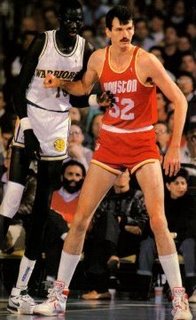
The last five playoff games for the Lakers have been mini-flashbacks to the 1980s, when LA beat up on the rest of the Western Conference while the Eastern Conference superpowers did battle on the other side.
Monday night's game also brought back memories of those days because of the score - 128-107. During the Showtime run, the Lakers consistently scored 120 to 130 points while trouncing the likes of Phoenix, Portland and Denver. Magic would get 15 assists, Kareem and Worthy would score 25, Mike McGee would add 10 and it'd be so lopsided that even Chuck Nevitt would make a cameo in the final two minutes, but only after the crowd chanted his name and begged Riley to put him in.
Chuck, the 7-5, 217-pound center who probably didn't deserve a roster spot but was a nice guy. I can't imagine Nevitt being on a roster in today's NBA, which makes it even more remarkable he carved out a 10-year career. Ten years. Career numbers: 251 total points, a 1.6 average. He did pull down 1.5 boards per game, which has to be the worst height-to-rebound ratio in NBA history. His career makes no sense, except it seems obvious a series of teams thought a freakishly tall white guy with nice hair might bring in an extra fan or two.
"Come on, kids, the Lakers are in town. It's Chuck!"
His career is unfathomable. In college, at North Carolina State, Chuck averaged 3 points per game in four years. And that number only reached three because of an offensive explosion in 1982, his senior season, when Nevitt tossed in 5.5 points per game. Otherwise he averaged 1.3 as a freshman, 1.6 as a sophomore and 1.9 as a junior. Perhaps NBA execs saw that improvement and thought he might score 6.7 a game in the pros. He averaged 2.4 rebounds in college. As a 7-5 center. He never started a game in the NBA. He shot 58 percent from the free throw line. He did block .7 shots per game, which is...something. But not quite enough to justify a 10-year NBA career. People talk about someone like Shaq or LeBron winning the genetic lottery. But what about Nevitt? Houston took him in the third round of the 1982 draft. In 1983 they took Ralph Sampson, followed by Hakeem in '84.
If the Rockets had been around in 1935, there's no way they don't draft Robert Wadlow.
By all accounts, Nevitt was a great guy and a better teammate - a chemistry guy, quick with a joke. He recognized his good fortune. Sports Illustrated even wrote a lengthy feature on him in 1989.
But the story did include this section:
Being that tall, of course, is the reason Nevitt is still in the NBA. But the assumption that he can't really play the game is a false one. The Rockets seem to appreciate his talents. Says head coach Don Chaney, "When we picked Chuck up, we figured he was still a project. But he's much better on the court than I imagined, and I like having him on the bench, because not only does he root for the other guys, but he also says things that reinforce what we're trying to coach. Believe me, he's not here to be a mascot."
You now have a better understanding of why Don Chaney had a career coaching mark of 337-494. And actually, the assumption that he can't really play was a true one.
Bethany Lutheran College is in Mankato, Minnesota. They were a big rival of Worthington Community College. Growing up we went to a lot of their basketball games. Bethany always put together outstanding game programs, filled with facts and stats. They also included biographical details on each player. Some of them had lines like, "An explosive scorer with great leaping ability." That was a good player. Or, "A dominant defensive player who grabs every rebound." Another good player. Then you'd get the players at the end of the bench, the guys and gals who filled the seats but not the scorebook. The school struggled to find positives for these players. You could recognize them by lines like, "Always has a positive influence on practices." "A great hustle player. Always on time for the team bus." "Fills out a uniform nicely." "Consistently makes left-handed layups in pregame warmups." It had to have been a bit humiliating for the players. Couldn't they have included their high school exploits?
If Chuck Nevitt had played at Bethany - and he actually probably couldn't have played there - his biographical information would have surely included parts of Chaney's quote.
"Not a mascot."
"Reinforces what we're trying to coach."
Despite all that, Chuck Nevitt is a champion. He has a ring. He took up space on the bench for the 1985 Lakers, who defeated the Celtics in six games. As I said, the Western Conference back then was one dominant team and a bunch of other squads jockeying for the right to get beat in the WCF. Houston, of course, broke through in 1981, taking advantage of Magic's hobbled knee and some dissension, and then the Twin Towers (but not the Triple Towers) of Sampson and Hakeem drilled the Lakers in 1986. And if drugs hadn't ruined Houston's chances in 1987 - and if Roy Tarpley had stayed clean for the Mavs - maybe another team could have consistently challenged the Lakers.
Instead you had seasons like 1985. Check out the Lakers playoff scores:
Phoenix: 142-114
Phoenix: 147-130
Phoenix: 119-103
Portland: 125-101
Portland: 134-118
Portland: 130-126
Portland beats Lakers 115-107
Portland: 139-120
Denver: 139-122
Denver beats Lakers - in LA - 136-114. Strange game.
Denver: 136-118
Denver: 120-116
Denver: 153-109 (!)
It was a similar story in 1982, 1983, 1984, 1987 and 1989. They did go to seven games twice in 1988, as they fought their way to the repeat.
But for most of the decade, the Lakers relaxed through May while waiting to play the Eastern Conference champion in June. While the Lakers feasted on their foes, Boston, Philadelphia, Detroit, Milwaukee and eventually the Bulls beat each other up. Celtic and 76ers fans complained about this back then, and they had a point. Too bad for them. In 1989, of course, the ease with which the Lakers cruised through the West cost them, as Pat Riley worked them hard after they swept through the first three rounds, leading to Byron Scott and Magic's hamstring injuries. I'm still upset with Riley over that.
The West certainly isn't like that today, no matter how dominant the Lakers have been the last few games. The Oklahoma City team that took the Lakers to six games in the first round is better than many of the teams LA faced in the WCF in the 1980s. There's much more depth, with all eight teams winning 50 games. No, it's not like it was in the '80s. The West was pretty bad. How bad? How lopsided were the games?
Chuck Nevitt averaged 5 minutes of action in the 1985 playoffs and played in seven games.
Friday, May 14, 2010
Appreciating a police officer, and a cousin
This is National Law Enforcement Appreciation Week. There's pretty much an appreciation month, week or day for every profession - with the possible exception of copy editor - and they can border on the ridiculous. But some of them actually deserve it. Police officers qualify.
President Obama spoke today at a ceremony honoring several TOP COPS. Among his comments:
"But that's exactly what makes these officers - and all of our men and women in uniform - real heroes. It's the ability to put on a badge and go to work knowing that danger could be waiting right around the corner. It's the understanding that the next call could be the one that changes everything. And it's the knowledge that, at any moment, they could be called upon to stop a robbery, to participate in a high-speed chase, or to save a life."
I read things like that and think of my cousin, Matt Brake. Matt's nine years younger than me but already has several years of service with the Roseville police department, a Twin Cities suburb. Unfortunately, I also think about him when reading stories like the one nearly two weeks ago, when a Minnesota police officer was shot in cold blood by two men who were being sought in connection with a carjacking. Joseph Bergeron of Maplewood was killed while sitting in his car, still wearing his seat belt. He never had a chance. Any officer who had been in that same car at that same time would have met the same fate. One of the men in the carjacking later attacked another officer, who shot and killed the man. For several hours, officers from numerous cities searched for the second suspect. Matt was one of those scouring backyards and homes for the man, who police eventually apprehended.
When I read stories like that or ones about high-speed chases near Minneapolis and St. Paul I always wonder if Matt's involved. I always hope he's not, the same thought his mom must have as well. But at the same time, I've heard some of his stories and know that if he is on duty when something goes down - whether it's mundane or tragic - he'll be ready. In addition to his patrol duties, Matt's also on a SWAT team, a unit that suffered injuries in 2008 when a man fired on them as they entered a house. Matt, fortunately, wasn't hurt.
Matt grew up on a farm and went to a small high school and I grew up in a town of 2,000. In small towns, police officers aren't always treated with the most respect. They're not exactly looked at as Barney Fife's, but the respect level isn't much higher. Most people think they spend their time cruising around aimlessly, or setting up speed traps on the outskirts of town to snare unsuspecting outsiders or locals who forgot that you'd better not be going 36 when the speed limit changes to 35 miles per hour. And when they're not battling the scourge of low-speed offenders, they're handing out minors to kids at parties. It's not a fair portrayal, of course. Usually.
And having lived in New York for six years, I know many people resent big-city officers. Many of the criticisms are legitimate. They can be heavy-handed - like the cop in NYC who bullied a bicyclist. People get arrested and harassed for having the wrong skin color in the wrong neighborhood. Innocent people get killed.
But then I'll see a story on the news, whether it's in New York or somewhere else. A story about a madman with a gun shooting up a crowd. Or a guy in a mask holding up a bank and taking a hostage. Or a story about a home invasion. And I always think, some police officer is going into that situation and there's no guarantee they'll come out of it alive. It's like what they said about firefighters after 9-11: they run in while others run out. Same thing with police officers.
When a doctor at Fort Hood in Texas killed fellow soldiers last year, a pair of cops took him down. On a military base filled with highly trained soldiers, it was still the police officers who were called to end the killing spree.
Do some bad people sign up to be officers? I'm sure. Are some power hungry? Of course. Do some abuse the authority that comes with the uniform? Absolutely. But for the rest - for the majority - they do what they can to keep people safe. They perform their jobs with courage and skill.
When we were kids, Matt admired me. He was a cousin but for the first years of his life he was like a little brother. When I played college basketball and our team ran a camp for kids, Matt was thrilled that I'd be one of the guys instructing the youngsters. We didn't see each other as much once I graduated from school and entered the real world. I attended his high school graduation party in 2002. That was the last time I saw him until the fall of 2007, when he took a trip to New York with a friend. I met them at Columbus Circle. I recognized them right away but that's only because Matt's face hadn't changed. In every other way, he'd grown. Instead of a skinny, somewhat quiet, high school senior - which is what he was the last time I saw him - he was a muscular, fit, confident 23-year-old. This was the same kid who tagged along with me as a little kid?
He was a man. And he was a police officer. He's always been mature and cool-headed, attributes that are probably more important to his job than physical abilities. He told stories about his job that left me shaking my head or laughing. Two years later I saw him again at our grandma's funeral. He again had more stories that left me shaking my head and laughing. We didn't talk quite as much about those stories that are more frightening, the tales his mom doesn't want to hear about. The dangers are real and he must confront them every day, while learning to never dwell on them.
I've talked with Matt about riding along with him on one of his shifts. Stories like officer Bergeron's death might make me think twice about it. I want to experience and be with Matt on a typical day of work. He'll pull over some drivers, issue a few citations, respond to a break-in. But a police officer never knows when a boring day at work will become an extraordinary one. Bergeron had a typical day of work that day, right up until the moment the killers approached his car.
I want to know about Matt's work life, the good and the bad, the strange and the normal. Police officers tell fascinating stories - they see people at their worst but occasionally at their best. I want to know about it all but I'm not sure how close I want to get. There's a difference between documenting the life of officers and living it.
He's a big-city police officer. There are always dangers, just as there are surely always rewards. I appreciate his work, this week and every other one. Sometimes I worry about him. I respect him for becoming an officer in the first place. But mostly I admire him. He's not just my little cousin anymore - he's one of the guys that runs in when everyone else runs out.
Tuesday, May 11, 2010
Shhhhhhhhhhhh


In the past week, I've spent two days at the main branch of the New York City Public Library, one of the most famous libraries in the world. The building is on Fifth Avenue, between 40th and 42nd Streets. It's known as one of the great research libraries and is an architectural marvel. Spider Man's uncle, Ben, also died outside the building in the first movie.
I've spent most of my time working in the reading room, pictured above. Much of the library's material is actually located underground. The library added miles of bookshelves starting in the 1980s, as facilities were built below famed Bryant Park. Visitors often come to the library looking for mountains of bookshelves, but if they actually wanted to find them they'd have to burrow below.
The outside of the building - perhaps best known for the two lions standing guard - is basically unrecognizable now as it undergoes a renovation that is supposedly going to be completed sometime this year.
I come here when I really need to finish some work. Few distractions. I feel more studious, sitting underneath the chandeliers, my laptop sharing space on the long wooden tables with the brass lamps. It feels like I'm in a movie, maybe something like The Pelican Brief where I'm searching for clues in an international conspiracy, or Philadelphia, where I'm scouring the books for obscure laws that will win the big case. A friendly but stern security guard enforces the rules, telling my neighbors to take out earphones and put away soda bottles (my Coke was well-hidden). He is more intimidating than the stereotypical 68-year-old woman who reminds people to be quiet, although that's only because he's armed. When it comes to verbal intimidation, there's nothing quite like an elderly librarian. Someone coughs more than once and another patron shoots them a dirty look.
Earlier I was down in the room that houses the library's microfiche collection. They have practically every issue of every New York City paper - and numerous out-of-city papers - just waiting to be read. After an early fiasco with the microfiche, I finally received some help on the machine. I'm very old school when it comes to technology - no iPod, no Facebook, no TiVo, pro-VCR - but even I wish there was something out there that could have replaced microfiche. But they are invaluable, as they're the only record that remains for countless newspapers and magazines. And there's nothing like looking at old newspapers (I now sound like a 58-year-old former journalism professor). Today I was looking at Daily News issues from July of 1961. There are the standard stories and photos that would rightfully shock people today: pictures of car accident victims or murder victims. They're horrific, even in black and white. But by God, readers needed to see the crumpled remains of those six people killed in a head-on collision.
Then there are the ads. How about a 3/4-page ad for Alpine cigarettes? A picture of a middle-aged man, smirking. The ad text: Now the menthol cigarette is as much at home in a man's shirt pocket as it is in a woman's handbag...the reason is Alpine.
Cancer: not just for women anymore.
Reminds me of the old Onion story: New 'Small 'n' Flaccid Ad Campaign Least Successful Ever
I could have spent the entire day poring over the film and old papers, but I eventually had to work in the reading room. It's peaceful, civilized, a tribute to what man can accomplish.
Quite different than the subway ride here. The car only had about 20 people. A well-dressed woman in her 40s sat on the other end of the car. A younger woman, looked like her daughter, sat next to her. I only noticed the older woman when I heard someone sneezing at 150 decibels. It's hard to phonetically replicate the sound. Something like, "KAPAFLOOOOEY." I looked up to see her doing it time and again, and each time, she sprayed liquid out of her mouth and nose and on to the pole in front of her and the opposite seats. Good lord. She did it five times as people moved to the opposite end. A middle-aged black guy, who looked like he'd seen it all in his time in New York, even said, "God damn. What the fuck lady?" He spoke for all of us. We watched her spray her germs and Ebola. She acted like nothing was wrong. Finally the younger woman got up and walked to the end of the car, through the end door that you're never supposed to go through and into the next car. About five minutes later they returned, this time right next to me and another gentleman.
Typhoid Mary stood over him, again ready to explode. He gingerly tried moving toward the wall while staring at her. She looked down at him and yelled, "What is your problem?"
"Nothing," he replied. He returned to his newspaper. Like me with my magazine, I assume he read the same paragraph six times. Meanwhile, the younger companion kept wordlessly moving around while the woman followed. They finally went to the next car while everyone on ours breathed a sigh of relief, while trying not to actually inhale. An incident like that does bond passengers. Usually everyone has their nose buried in a book or stares straight ahead. But when something like this happens, and in the moments afterward, we make eye contact and grin, sharing war stories.
"Did you see the snot?"
"What was that other lady doing with her?"
"We should warn someone not to grab that pole."
Maybe the woman didn't want to give everyone a disease. Maybe she just wanted everyone to chat, get to know our subway neighbor.
The library proved to be a refuge. And it had a lot of great research material about infectious diseases.
Friday, May 7, 2010
Beer and danger: Life in slow-pitch softball
Eric Byrnes was hitting .094 for the Seattle Mariners this season when the team mercifully released him. He's been around for 11 seasons and pops up on TV because with his unkempt hair and quick wit he can play the "wacky" broadcaster - following in the footsteps of Steve Lyons. His newest gig will be a slight step down in competition, though he'll still be receiving $11 million from a contract he signed a few years ago with Arizona. Byrnes will play for a slow-pitch softball team that's sponsored by a bar called Dutch Goose.
I always wondered how dominant Major League Baseball Players would be in softball. How hard would they hit the ball? Would they kill anyone with their line shots? Just how much beer could they consume, and would they be able to play six games in one day while nursing a hangover? The answers to those questions would probably be Very, Probably, Gallons, Yes.
I haven't played in a softball league or a tournament in 10 years. It was always fun, if occasionally dangerous. I usually played third, shortstop or second. With the first teams I played on, the competition wasn't the greatest and there's not much difference between any of those positions. But as the competition gets better, the dangers rise. Many people consider slow-pitch to be a joke, something played by God-fearing church groups on outings to the local park or overweight boozers who pick up the glove and throw on the ketchup-stained jersey every Wednesday night.
That's certainly a part of it. But there's another world, the one I'd find myself in while standing at third base, staring at a 6-foot-4, 250-pound, steroid-ridden (probably) monster with a lethal weapon in his powerful arms. We often played Class A teams, which was the top level in the state. Muscular guys with power to all fields filled these lineups. Every time one of them strolled to the plate, a third baseman was one swing away from a trip to the emergency room. These guys could hit the ball pretty much wherever they wanted. And often they wanted to send the pitch screaming down the line. As someone who didn't believe in using a cup, this was especially dangerous for me and my chances of having future Fury children. I trusted my glove would save me.
Against those teams I was always happier to play short or second. Even at shortstop, you have a bit more time to react. And at second, there aren't a lot of left-handed hitters so there aren't as many line shots. Righties can hit it to the opposite field, but even though it will be hit hard, it's easier to handle. Third base was all about reacting in a split second. One guy hit a ball so hard it took my glove off after I thought I had caught it. The ball dropped out of the glove and he was safe. My teammates were upset the guy got on base; I was thankful I still had the use of two hands.
Lots of softball memories over the years.
* Speaking of injuries, my dad broke his leg playing first base in a game. I was maybe 10. Janesville always hosted tournaments out "at the lake." One Saturday, mom left while I stayed to watch him play. He went for a catch at first. A runner hammered him. Broken leg. I stayed behind while they transported him to the Mankato hospital. Mom returned a few hours later to hear me saying dad was in the hospital. I'm surprised there wasn't a forced retirement.
* I once struck out in slow-pitch softball. Swinging. There's not much in sports that is more humiliating. Scoring a basket for the wrong team might be one. But even that can be brushed off as a temporary mental meltdown. To strike out swinging in slow-pitch means you knew what you were doing, but you just weren't capable of doing something that even the worst athlete can do from the time they're 8 years old. And it wasn't one of those pitches that's a mile in the air and tough to hit. It was a regular little lob. My teammates didn't even heckle me. There was just silence, perhaps a "wow."
* Even at the highest level, it is a skill to play after a night of drinking. It was amazing watching a guy who was vomiting and begging for death at 1 in the morning crawling out of bed and to the field for a 10 a.m. game. It usually takes until about the fourth inning for them to wake up. After a few games they're fully functional. It's especially difficult if the team has to work its way through the losers bracket. That could mean five or six games in a single day, in stifling temperatures.
* One year the Fury family cobbled together a team to play in the Hay Daze tournament. Over the years, the Hay Daze tournament has gone from having great competition to terrible competition to great and back again. That year was a good tournament, a lot of strong teams. I was 9 and it was a great time. My dad, his two brothers, a couple of cousins, a couple of cousin's kids and then a couple of non-Fury family folks completed the roster. One of the non family members was the pitcher, Charlie. Charlie's a great guy, a Janesville favorite. He pitched forever. Charlie's a big guy, but even he can't take a softball fired at his chest from a short distance. During one of the games, my uncle fired home. Unfortunately, the ball never got there, as a surprised Charlie took the throw right in the middle of his chest. He went down to one knee while everyone gasped. His teammates ran to him to make sure he was all right. And, maybe more importantly, they still needed a pitcher. Charlie was fine, though branded by the ball.
The team won a couple of games, but lost a heartbreaker. It was against a team loaded with many of the best players from Janesville, a team that had a couple of guys who played with Class A teams. The Fury family battled throughout. They led late. In one of the innings, the opposition flagged one of the outfielder's gloves. They said it was illegal. Sure enough, it was. They'd suspected all along, but waited for just the right moment - the same way Billy Martin knew George Brett's bat was probably illegal before the pine tar incident but waited for a crucial time to tell the umps. It was a ridiculous rule, nitpicking. The momentum changed. They hit a couple of homers and won the game. Jerks.
* Speaking of humiliation at the plate, one year in a major tournament, the team I played for got no-hit. It had to have been one of the few times in slow-pitch history a team didn't get a single hit. And it wasn't a bad team. In fact, one of the players was one of the key instigators on the team that beat team Fury a decade earlier. He was a Class A player, a bit past his prime but still monstrous at the plate. Even he couldn't get a hit that day. Part of the problem was that there was a no-homer rule. Any home run was an out. So our guys did technically hit some long balls, but they were recorded as normal outs. The good news was that while I didn't get a hit, I also didn't strike out.
* Slow-pitch lends itself to loudmouths and jerks. Sometimes they're fueled by alcohol, often it's just their real personality. Verbal exchanges are frequent. One game in particular, the fool on the other team kept screaming, for seven innings, "STATION TO STATION SOFTBALL, BABY!" Christ. It called for a brushback pitch, fired underneath his chin or at the small of the back. Unfortunately, all we could do was bark back. The guy wasn't even any good, just loud. Is there anything worse than an average athlete who talks all the time and can't back it up? That, of course, describes the current version of Kevin Garnett. But at least Garnett could back it up for most of his career. This guy on the diamond in his tight pants wasn't even a has-been. He was a never-was.
* A friend of mine in Madison played on a team last year with Heisman Trophy winner Ron Dayne. You'd think Dayne would be one of those guys who frightens third basemen and makes them weep at the thought of fielding a liner off of his bat. But he actually wasn't that great. He ass, apparently, a nice guy, a good chemistry guy on the team.
* For two summers, I played with my dad's company team, a ragtag collection that was doomed to lose, and lose often. They were the Bad News Bears, but not as cuddly. There were a lot of good guys and a handful of good players, but many of the players looked like they brought a glove for the wrong hand. Still, we had a good time. In the very first game I played with them, we managed to beat a superior team, one of the better squads in the league. It was like Villanova knocking off Georgetown, only more improbable. The season went downhill from there, with the occasional victory mixed in with lots of frustration. But we had that one victory. We celebrated with beer, while hanging out in the parking lot. It was a real sports victory. But it was still slow-pitch softball.
Tuesday, May 4, 2010
Fewer posts for next two weeks
Reader(s): The posts might be a bit scattered here for the next two weeks. I like to do one at least every other day and sometimes several days in a row, but that might not be the case for the next few weeks. I'm working on a writing project that's due in mid-May so I'll be focusing on that for the most part.
Then again, it's more than likely that at some point a memory of the 1984 NBA Finals or a thought about Charles Ingalls or Janesville will pop into my head and I'll write a post. But if a few days do go by, that's the reason.
In the meantime, here's something you don't see anymore in the NBA: an old brawl, this one with a coach. Golden State's Al Attles flips out in the 1975 NBA Finals.
Then again, it's more than likely that at some point a memory of the 1984 NBA Finals or a thought about Charles Ingalls or Janesville will pop into my head and I'll write a post. But if a few days do go by, that's the reason.
In the meantime, here's something you don't see anymore in the NBA: an old brawl, this one with a coach. Golden State's Al Attles flips out in the 1975 NBA Finals.
Sunday, May 2, 2010
Anniversaries and memories
In a few weeks we're going to Minnesota for a 10-day stay. It'll have been a year since I was last home, the longest time I've ever been away from the Midwest. Wonder if I lost my accent. Will I remember how to say ya? Will I still appreciate the taste of a well-done hotdish?
For the first time in 34 years, I didn't experience a single month of Minnesota winter. Can't say I missed that part. But I am looking forward to going home, to see my folks and sister and my niece and four nephews and my aunts and uncles.
Since 2004, whenever we went back to Minnesota, we always made plans to "get to Fulda" so we could see my grandma. This will also be the first year our trip doesn't involve a trip to see her. She died last May 19, at the age of 91. A stroke. We flew back on May 21 last year for her funeral. This year, we're flying to Minnesota on May 21. It's purely a coincidence, not a plan. At the same time, May 21, 2009 has become one of those days where I'll always remember what I did, the same way I'll always remember hearing about grandma's stroke and death two days before.
Two days ago was another one of those anniversaries. On April 30, 1999, my grandpa died at the age of 86. He had been sick for a year. He died in a hospice. That was a day of double heartbreak. One of my uncle's best friends, my former basketball coach Mike Augustine, lost his father on the same day, just hours after my grandpa died. My uncle coached the women's basketball team at Minnesota West, Augie the men. On the same morning, both lost their fathers.
April 30, 1999 was a sad, devastating day, but it's not a sad, devastating anniversary. The same will be true for May 19. I thought about grandpa quite a bit on Friday, but even though it was the anniversary of the day he died, I thought about his life. But then, I think about him often, every day of the year, not just on April 30.
I think about him when I read a story about a veteran. Grandpa won a Silver Star in World War II. Growing up, I never heard him talk much about his service. I'd hear from my parents that grandpa suffered nightmares, ones where German soldiers came up from the lake at the farm. But like so many veterans, particularly of that war, he didn't talk a lot about his service or his heroics, only to say he never got mad after the war - a somewhat dubious claim. I only heard about the specifics of his service two months before he died, when I interviewed him for a newspaper story related to the Silver Star and some other medals, including the Purple Heart, he received in a ceremony while he lived in the hospice. I spent two days at his bedside, listening to him talk and replay those years. He talked about the men he served with, ones who died and those who made it back with him. He talked about his training. He talked about Patton. He talked about the incident that led to the Purple Heart.
The only thing he didn't talk about in depth was the event that led to his Silver Star, when he took out a German machine gun nest.
He kept those details to himself for more than 50 years of his life and held them close two months before his death. Those nightmares he suffered proved the memories of those German soldiers who had been in that nest never left him.
After Germany's surrender, grandpa volunteered to serve in Japan for the expected invasion, saying the sooner the war ended, the quicker he'd get home. The atomic bomb kept him from the Pacific.
I often think about grandpa when watching baseball, his favorite sport. He was a standout player, but that, of course, was way before my time. He still played with us in the large open area at the farm, where family games often broke out. One year, when I was maybe seven or eight, grandpa patrolled the outfield while I played short. A hit got through him and grandpa, in his 70s, took chase. A bit too slowly for my taste.
"Come on old man, go get the ball," I yelled. Grandpa finally picked it up and fired it back to me. Most of the family laughed while others were probably a bit horrified at my demands on the ol' ballplayer. But grandpa just laughed. He wasn't offended by my...uh, youthful exuberance. Besides, he knew better than anyone the importance of getting the ball to the cutoff man.
I think about him when watching basketball. I can picture him sitting in the top row of whatever gym I played in, watching quietly from above, the same scene he repeated while watching my cousins and my uncle's college team.
I remember his days in the hospice, the months he spent there, dying, surrounded by caring workers and other dying residents. But when I picture him, and when I dream about him, he's not in the hospice bed. He's wearing his ever-present bib overalls, sitting at the the kitchen table at the farm or in his chair in the living room.
I think about all of those things throughout the year. I don't need an anniversary to remember him, but each year April 30 does remind me of what we lost, while also making me appreciate what we had.
I'm sure the same feelings will come on May 19. Just like with grandpa, I think about grandma all the time. Being home for the first time since her death will be strange, possibly a bit upsetting. But the memories of the life she led overwhelm the memories of hearing she died.
My maternal grandpa died when I was 9. My memories of him are limited, fleeting visions that become harder to remember with every passing year. My paternal grandma died nearly eight years before I was born. I also think about both of them often, but with them it is more about their deaths, only because I didn't have the chance to enjoy their lives.
Everyone deals with these types of things differently. Some people remember the exact time their loved one died, others might not even recall the day. In the end, it's ultimately not that important what you do or how you remember the anniversaries. There's no right way. But it's not surprising that for many people those are difficult days to get through - it's the day the person stopped providing memories and instead became one.
But for me, last Friday wasn't a sad day. This May 19 won't be, either. Those days remind me of their deaths, but more importantly, they make me think about grandpa and grandma's lives. And those memories don't make me sad. They make me grateful.
For the first time in 34 years, I didn't experience a single month of Minnesota winter. Can't say I missed that part. But I am looking forward to going home, to see my folks and sister and my niece and four nephews and my aunts and uncles.
Since 2004, whenever we went back to Minnesota, we always made plans to "get to Fulda" so we could see my grandma. This will also be the first year our trip doesn't involve a trip to see her. She died last May 19, at the age of 91. A stroke. We flew back on May 21 last year for her funeral. This year, we're flying to Minnesota on May 21. It's purely a coincidence, not a plan. At the same time, May 21, 2009 has become one of those days where I'll always remember what I did, the same way I'll always remember hearing about grandma's stroke and death two days before.
Two days ago was another one of those anniversaries. On April 30, 1999, my grandpa died at the age of 86. He had been sick for a year. He died in a hospice. That was a day of double heartbreak. One of my uncle's best friends, my former basketball coach Mike Augustine, lost his father on the same day, just hours after my grandpa died. My uncle coached the women's basketball team at Minnesota West, Augie the men. On the same morning, both lost their fathers.
April 30, 1999 was a sad, devastating day, but it's not a sad, devastating anniversary. The same will be true for May 19. I thought about grandpa quite a bit on Friday, but even though it was the anniversary of the day he died, I thought about his life. But then, I think about him often, every day of the year, not just on April 30.
I think about him when I read a story about a veteran. Grandpa won a Silver Star in World War II. Growing up, I never heard him talk much about his service. I'd hear from my parents that grandpa suffered nightmares, ones where German soldiers came up from the lake at the farm. But like so many veterans, particularly of that war, he didn't talk a lot about his service or his heroics, only to say he never got mad after the war - a somewhat dubious claim. I only heard about the specifics of his service two months before he died, when I interviewed him for a newspaper story related to the Silver Star and some other medals, including the Purple Heart, he received in a ceremony while he lived in the hospice. I spent two days at his bedside, listening to him talk and replay those years. He talked about the men he served with, ones who died and those who made it back with him. He talked about his training. He talked about Patton. He talked about the incident that led to the Purple Heart.
The only thing he didn't talk about in depth was the event that led to his Silver Star, when he took out a German machine gun nest.
He kept those details to himself for more than 50 years of his life and held them close two months before his death. Those nightmares he suffered proved the memories of those German soldiers who had been in that nest never left him.
After Germany's surrender, grandpa volunteered to serve in Japan for the expected invasion, saying the sooner the war ended, the quicker he'd get home. The atomic bomb kept him from the Pacific.
I often think about grandpa when watching baseball, his favorite sport. He was a standout player, but that, of course, was way before my time. He still played with us in the large open area at the farm, where family games often broke out. One year, when I was maybe seven or eight, grandpa patrolled the outfield while I played short. A hit got through him and grandpa, in his 70s, took chase. A bit too slowly for my taste.
"Come on old man, go get the ball," I yelled. Grandpa finally picked it up and fired it back to me. Most of the family laughed while others were probably a bit horrified at my demands on the ol' ballplayer. But grandpa just laughed. He wasn't offended by my...uh, youthful exuberance. Besides, he knew better than anyone the importance of getting the ball to the cutoff man.
I think about him when watching basketball. I can picture him sitting in the top row of whatever gym I played in, watching quietly from above, the same scene he repeated while watching my cousins and my uncle's college team.
I remember his days in the hospice, the months he spent there, dying, surrounded by caring workers and other dying residents. But when I picture him, and when I dream about him, he's not in the hospice bed. He's wearing his ever-present bib overalls, sitting at the the kitchen table at the farm or in his chair in the living room.
I think about all of those things throughout the year. I don't need an anniversary to remember him, but each year April 30 does remind me of what we lost, while also making me appreciate what we had.
I'm sure the same feelings will come on May 19. Just like with grandpa, I think about grandma all the time. Being home for the first time since her death will be strange, possibly a bit upsetting. But the memories of the life she led overwhelm the memories of hearing she died.
My maternal grandpa died when I was 9. My memories of him are limited, fleeting visions that become harder to remember with every passing year. My paternal grandma died nearly eight years before I was born. I also think about both of them often, but with them it is more about their deaths, only because I didn't have the chance to enjoy their lives.
Everyone deals with these types of things differently. Some people remember the exact time their loved one died, others might not even recall the day. In the end, it's ultimately not that important what you do or how you remember the anniversaries. There's no right way. But it's not surprising that for many people those are difficult days to get through - it's the day the person stopped providing memories and instead became one.
But for me, last Friday wasn't a sad day. This May 19 won't be, either. Those days remind me of their deaths, but more importantly, they make me think about grandpa and grandma's lives. And those memories don't make me sad. They make me grateful.
Subscribe to:
Posts (Atom)