A place to read about life in New York City, life in small Minnesota towns haunted by dolls, publishing, newspapers, writing, classic sports events and more.
My former paper in Fargo was a popular topic on the web yesterday for an unfortunate reason. The Forum published a picture of two guys shoveling, with a straightforward caption describing the action. It identified Gene Masseth and Haywood Jablome in the pic. Good ol' Haywood.
During my time at newspapers I had my own share of cringe-inducing moments. North Dakota State hired a new football coach following the 2002 season, a former Nebraska assistant named Craig Bohl. Shortly after the hiring we ran a mug shot of Bohl for a story (mug shot in this case meaning the small pics papers run, not the frowning portraits police use).
Unfortunately, the picture we published was of a different guy named Bohl, a small-town business owner or local politician, I forget. Probably a nice guy. Middle-aged. But he definitely wasn't the newest football coach at NDSU. The next day at work, I opened my email to see a note from the sports editor, with the simple, yet jarring subject line: Wrong Bohl.
Six years later, those two words - Wrong Bohl - remain a punch line for me and my former co-workers who worked at the paper that night. We were eventually able to laugh about it, but at the time we were mortified and embarrassed.
It wasn't just big mistakes that had readers picking up their phones to complain. A paper can print tens of thousands of words each day, with nary an error. But it's almost a guarantee that if a grammatical mistake appears somewhere in that mass of words, a retired English teacher who's lonely and still bitter about being forced out of her job will take pen to paper. She'll helpfully write, in perfectly maddening handwriting, "In your paper's story about the local baseball team's trip to Cleveland, your reporter wrote, 'their going to be in the city for 10 days. Please note the incorrect use of their. It should have been they're. As an English teacher who taught for 45 years in our underfunded public schools, it troubles me that the local newspaper - which I assume is populated with college graduates and people who care about the English language - would allow such a mistake to be published. It's a disgrace. I'm making a copy of this letter and sending it to each editor and the publisher, in the hopes that this mistake will not occur again."
We accept the written lashing like a chastened student, promising to do better.
For a short time I worked as a night editor at the paper in Worthington. Part of the job involved checking the page negatives that came off the printer at the end of the night, specifically the front page. It was a last chance to catch a typo, and I was also supposed to check to make sure all of the color separations came through correctly.
One afternoon, as I settled into my desk, optimistic about the day ahead of me, my editor approached, a tight smile adorning his face.
"Have you seen the paper?"
"No, why?"
He held up the front page. The main picture on the page, which was a large, four-column color picture, was...no longer large. And wasn't four columns. And no longer in color. It was black and white. Tiny. And it now sat at an angle on the page, as if a third-grader had glued it there the night before as part of a project called "My first newspaper." I'd apparently failed to properly check the color corrections, leading to the printed fiasco that my editor forced me to look at while shame crippled my body. I apologized. What else could I do, except hope it wouldn't lead to a firing.
Everyone in publishing has similar stories. Sometimes it's the fault of an editor, sometimes a production person or faulty printing press is to blame. The hope is that no one loses their job or receives an angry, taunting email from a reader.
Mistakes can be innocent, like the ones above, or the result of a joke gone horribly wrong. Often, when waiting for a story or information to come in, editors and reporters will put dummy text in until the real stuff arrives. Unfortunately, sometimes the dummy copy runs. The most famous example of this, a legendary incident that's sort of like Babe Ruth's called shot in that everyone's heard about but hardly anyone's ever seen it, is the paper that ran a caption that went with a picture of a junior high basketball team. The smiling youngsters, beaming with such pride, included the normal Joe Johnson, Ben Smith, and Some Fucker.
That story's told around campfires to frighten new copy editors, a harsh warning about the dangers of frivolity and typing while bored. It's not the type of lesson they teach in college. I guess instructors assume students will know that Some Fucker should never run in the paper. That's easy. But maybe they should start teaching the dangers of Haywood Jablome.
One of the great things about YouTube is that it offers a glimpse at a world unknown to regular television viewers. For years now, stations instantly cut away from the on-field action if some attention-seeking idiot sprints onto the field and runs around in circles until security finally tackles him. They do this because showing it would apparently encourage others to do the same thing and they don't want to give attention to someone for committing a crime. Fortunately, the majority of these people are harmless. The only damage they do is to their family's sense of pride.
As security drags the drunken man or woman off in cuffs, the announcers will either ignore it completely, aside from a somber announcement that "security is escorting a gentleman off the field," or they'll ridicule the person, explaining, "Some moron has decided to show off for his friends and will now spend the night in jail. Good."
I have no problem with TV refusing to show these people. Attention-starved people with below-average intelligence already litter our televisions on reality shows; we don't need them polluting sporting events.
Still, there's something exhilarating about watching a fool run onto a baseball field or football field in an attempt to...what? Impress a girlfriend? Win a dare he made with his frat buddies? Prove his parents wrong when they told him he'd never amount to anything in his life? For a few seconds, these people must feel like Barry Sanders breaking free into the open field. They now know what it feels like to be cheered by 30,000 people. Sometimes they'll dodge overweight security guards, who must get some secret thrill out of the chase as well. Most of the time those workers simply watch the stands for drunken brawls.
Here's a chance to beat up a real-life hippie!
Baseball attracts most of these people. Rarely does it happen in basketball, despite the fact it'd seem to be an easier accomplishment. Perhaps baseball fans - who these days sit through games that last anywhere from three and a half hours to six hours - simply have a longer time frame in which to get drunk. I'd like to see a study that analyzes when people run onto a field. My guess is it'd be in the later innings of a game, or in the second half of a football game.
What's the thought process? Does the idea first spark in the fifth inning? Does the guy think about doing it, but fears telling his friend? Then, sometime in the bottom of the seventh, as he's chugged his seventh beer, he finally broaches the subject:
"Hey, wouldn't it be cool if I ran onto the field?" "No." "No, it would be. You remember, I was a pretty good running back in high school. Ran for 875 yards senior year. Made all-conference." "That was 11 years ago. And 85 pounds ago." "Dude, I'm just saying. I could do it and probably last a minute out there before they'd catch me. Look at those security guys."
The guy's friend forgets the conversation. He passes it off as one of those ideas drunk guys always come up with; it's the same thing he does when his friend openly dreams about opening a bar, a real "kick-ass joint, we can even have live music."
Then, in the bottom of the eighth, it happens. The guy jumps over the short wall down the right field line. As his friend breaks out the camera phone so he can document the carnage for the buddies back home, the guy's off to the races.
You know the drunk guy you hate sitting next to at a professional sporting event? The one who doesn't shut up or sit down and screams at every player? That's the type of guy who runs onto the field. The only good thing is he's no longer bothering you.
Here, then, are some of the finest examples of just how stupid humans can be.
Dodger Stadium. Who says LA fans don't get excited? Here, the crowd acts like Kirk Gibson just took Dennis Eckersley deep again, as they wildly cheer a man getting hammered on the field by security staff, presumably after he got hammered in his seat. Boy, do fans love when someone runs onto the field. It wakes them from their slumber. "Look, dad, someone's zig-zagging across the outfield while four people in jackets chase him! Who-whooooo!" It's the same type of reaction that happens when a beach ball gets tossed into a crowd. Inexplicably, it becomes the highlight of the game for many people as they bounce it to and fro. On the beach, the sight of a beach ball would elicit yawns. But in the stands at Camden Yards? Chaos! Excitement!
And would anyone blame the security staff or police officers if they took a few extra shots at these cretins? Especially when five or six of them gather around the sprinter. It'd be easy to toss in a few jabs to the ribs. Guy's drunk, he's not going to remember anything.
Wrigley Field. This one is labeled Drunk Cubs Fan Gets Tackled on Mother's Day. Again, pure joy from the crowd. Are they cheering the man or the security people who took him down? And would they be anymore excited if the Cubs finally made the World Series? I say no.
Here's one of New York's finest citizens, running around the old Yankee Stadium. The same grass Mickey Mantle used to patrol! The highlight is toward the end, when one of the fans can be heard saying, "He gets to go into the dugout too!" as if police are taking him there so he can give Joe Girardi some advice about whether to bring Rivera in during the 8th inning or save him for the 9th.
Here's the same guy...from a different angle. One known photo exists of Abraham Lincoln during the Gettysburg Address, and it came seconds after he completed the speech. Yet, at least two videos exist of this guy shedding his shirt and tacklers as he makes his way around the basepaths at baseball's most hallowed cathedral.
The one below is an old-school version. From 1989, at a Steelers game. Shirtless, pantsless, shoeless. Thankfully, the guy's wearing boxers, not briefs. He falls on the old, tough artificial turf at Three Rivers Stadium, the type of turf that's all but disappeared today because it was so brutal on players, and, most likely, fans.
Speaking of the Steelers, here's Pittsburgh linebacker James Harrison taking justice into his own hands with a fool from Cleveland. This might also be why more people run onto the field at baseball games. Who's more likely to take out a runaway fan? A right-fielder, or a middle linebacker?
It's not like this is just a problem on the coasts. Not even Minnesota - with its presumably nice security guards and nice fans - is immune. In this one a pair of fans, egged on by their testosterone and low IQs, venture out together. One even makes it to home plate - he's safe - before a Red Sox bat boy flattens him, finally ending the fiasco.
Every year Sports Illustrated publishes a Where are They Now issue. It's always one of the more fascinating issues, as the magazine tracks down athletes and coaches from the past who have fallen off the radar. For the next issue, I hope they track down some of these people, or their brethren. Did any of them go on to become a CEO? Did any of them get promoted to head of sales? Did their hometowns throw them a parade, or present a key to the city? Most importantly, did any of them father any children? And if so, are their children as dumb as their parents?
I've read about 100 pages of a new book I got for Christmas, When the Game was Ours, by Larry Bird and Magic Johnson, though sportswriter Jackie MacMullan handled the actual writing of the book. I read several chapters today while avoiding my dad's taunting phone calls during the Lakers debacle against Cleveland.
Remarkably, the book's managed to reveal new details about the players, details I didn't even know, though I thought I'd read pretty much every story and anecdote about each Hall of Famer. My favorite quote so far comes from Bird. Apparently, Bird's Indiana State teammates and Magic's Michigan State teammates expressed some jealousy about the attention each player received while in college, even though each player was nearly single-handedly responsible for turning the programs into national powers. When asked about the jealousy of his teammates, Bird said, "Somebody asked me once how I felt about all that. I told them, 'Hell, I'm jealous of them too. I'm jealous because I never got to play with a Larry Bird."
It's an amazingly arrogant quote, something that would be the subject of a special 2-hour episode of Outside the Lines on ESPN if Kobe Bryant said something similar about his teammates today. And it's also a perfect quote, the type of reply only one of the 10 best players in NBA history could get away with.
Later, in his early years with the Lakers, some of Magic's teammates also became jealous of the attention heaped on the young star. Much of it stemmed from the 25-year, $25 million contract he signed early in his career, a pact that was remarkable not for the money, but for the length. Although at the time, the money too - a million a year - was also fairly staggering.
Today of course someone making a million dollars a year in the NBA is probably a guy who plays about 5 minutes a game and is kept on the roster simply because he's a good chemistry guy and practices hard.
Who makes the most money in today's NBA? Kobe? Duncan? Shaq? LeBron? No, no, no, and no.
This is the last year of his deal, meaning McGrady's days of seeing that type of money will be long gone when he signs his next deal in the Summer of LeBron.
It's obviously preposterous that McGrady is the highest-paid player in the league, but then again, Jermaine O'Neal is the third-highest paid player, so it's not the only deal that doesn't make much sense. But then, it's always been like that in the NBA.
Browsing through Basketball Reference is an eye-opening experience when searching out salary history.
Take the 1988 Chicago Bulls. The Bulls finished 50-32 that season as Michael Jordan averaged 35 points and five assists a game. That year he solidified his spot as a basketball legend, and a sporting icon off the court. Those results were good enough to land him the second-highest-paid contract on the team, as he made $845,000. The highest-paid Bull? Artis Gilmore, whose professional career had peaked a decade earlier in the ABA. Big Artis pulled in $863,00 that season.
Sticking with the late 1980s, the 1987 Lakers were one of the best teams in NBA history, winning 67 regular season games and the title thanks to a devastating fastbreak and Magic's first MVP season. Magic won the MVP, Kareem was still effective, and another Hall of Famer, James Worthy, averaged 19 points per game. So, of course, the highest-paid player was Michael Cooper. Granted, Coop was the Defensive Player of the Year. And he was a vital role player. But he should not have been pulling in $3,565,500 when Magic took in $2,500,000. I'm sure no one was jealous of Magic's contract that season.
Sometimes bad contracts literally destroy franchises, which is basically what happened with Seattle in the 1990s. The Sonics took the legendary Bulls team to six games in the NBA Finals in 1996. In several of those games, Shawn Kemp was the best player on the floor, despite the fact Jordan, Gary Payton and Scottie Pippen were sharing it with him. Seattle appeared set to contend for the next decade.
Then they signed a 7-foot stiff disguised as a center, who went by the name of Jim McIlvaine. Looking for a center in the Jon Koncak/Uwe Blab/Bill Wennington/Will Perdue/Joe Klein mold - tall, personable, pale-skinned, and bad at basketball - the Sonics inked McIlvaine to a seven-year deal worth $33.6 million. The previous season, Big Mac averaged 2.3 points and yanked down 2.9 boards per game. The move infuriated many of the Sonics, most notably Kemp. The star forward did make more than McIlvaine that year - $3.3 million compared to $3 million for McIlvaine - but he'd also been asking for an increase, which the organization refused to give him. At the end of the year Seattle dealt Kemp to Cleveland, assuring his career would become most notable for his epic weight gain and the number of children he sired. Seattle, meanwhile, faded from power. McIlvaine? Oh, McIlvaine was fine, finishing his career in 2001 with the Nets, a season that saw him make $5.4 million. That year he averaged 1.6 more points per game than I did for the Nets, appearing in 18 games.
Speaking of Jon Koncak, long before McIlvaine gave below-average centers a bad name with his outrageous contract, Koncak signed a famous six-year deal worth $13 million with the Atlanta Hawks. At the time, it meant Koncak made more money than Jordan, Bird and Magic, the only time his name was ever mentioned with those three. Koncak averaged 4.5 points per game in his career. The 1992 Hawks were a fascinating team. Not on the court, where they finished 38-44, but off it. Dominique Wilkins rightfully made the most money on the team, pulling in $3.1 million. Koncak was next with two million. Third? Blair Rasmussen, with $1.5 million. Blair Rasmussen, the seventh-leading scorer on the team, a guy who scored 9 points a game.
But then again, Blair was white. And seven-feet tall. In the NBA, those two qualifications often seem to be more important than a decent jump shot or rebounding skills.
So maybe McGrady's 2010 contract isn't so outrageous. We should just be thankful Joel Przybilla isn't the highest-paid player in the league.
As a kid we opened presents on Christmas Eve and Christmas morning, visiting grandma's house on December 24 and waking up the next morning at grandpa's farm for more goodies.
In New York, we now open exclusively on Christmas Eve, primarily because Louise has the patience of a 2-year-old. It's a battle of wills just to keep her from ripping everything open a week before Christmas. I've accused her - and she's only offered vague and unconvincing denials in return - of actually opening up some of the presents when I'm not around and then re-wrapping them.
Actually, her denials probably are truthful, because it'd be impossible for her to recreate my wrapping, which has been the subject of mockery since the first time I presented her with a haphazardly taped, sloppily wrapped gift, which looked like it'd been put together by a dim-witted 5-year-old or an adult without opposable thumbs. My wrapping incompetence is the best defense I have against her opening up presents 10 days early.
I've never learned how to wrap a present properly. It's one of those skills that should have been picked up through simple repetition, but is impossible for me to learn. Sort of like how I still don't know how to blow a bubble with chewing gum. Or make a decent paper airplane.
I believe in the use of overwhelming force when wrapping a gift, beating it into submission through layers of decorated paper. Even if I'm simply wrapping a paperback book, I'll tear off enough paper to cover a TV. If there was a worldwide shortage of wrapping paper, I might reconsider the strategy. Folding down the top part, then the sides, I try my best to wrap it in such a way that it's impossible to guess what's hidden beneath. Whenever I see a wrapped gift from Louise or anyone else who has the dexterity to pull it off in a proper fashion, I always marvel at how little tape they use.
My god, the efficiency.
By the time I'm done, I'll have used maybe 15 pieces of tape, and even more have been lost during my pathetic battle. They are victims of my inability to properly tear it off the dispenser, so a one-inch piece gets tangled like a pretzel or ends up wrapped around my own finger instead of on the paper.
No matter how much paper I use, the inefficient wrapping ensures there's almost always a tiny opening where the present can still be viewed. Instead of perhaps altering my strategy, I'll simply rip off more paper to cover that spot. By this time I've grown frustrated, convinced the tape and paper somehow have a vendetta against me. Now I'm angrily taping, wrapping more and more paper around the tiny object, drowning it in layer after layer of snowman-covered material. Once finished, I now take pride in my accomplishment, holding it aloft, offering it up to the gods.
That's for square objects. Anything that's oddly shaped or soft or both of those things presents unique problems. Like a stuffed animal. Where do you even start? I start where I always do, with about 12 feet of paper, suffocating the cuddly beast. First the head, the torso, finishing with the feet. Because I don't want Louise to guess what it is, I'll add 10 more feet of paper. By the end, anything could be under that wrapping. All she'll feel is paper, when her fingers aren't getting stuck on the wayward tape that's popped up at different points.
Fortunately, not everything has to be wrapped. Now we have bags. Just stick the present in, close the bag and all wrapping worries vanish. But even those can cause problems. One of the presents I bought sort of fits in the largest bag we have, but not quite. Stumped, I debated stapling the top of the bag shut, but pictured the reaction from Louise: "Why didn't you just use the string to shut it?"
So that present got the wrapping treatment as well, a 20-minute exercise littered with curses and vows to take advantage of the gift-wrapping at all stores.
And now it sits under the tree, joined by its ugly siblings and the perfectly wrapped gifts from Louise, which are so well put together I almost feel guilty tearing the paper off. Now that I think about it, perhaps Louise's eagerness to open the presents has nothing to do with being excited about the gift. Maybe it has everything to do with ridding the world of my wrapping, at least for one more year.
This is a new book that readers of mysteries and detective stories should check out. It's called The Lineup: The World's Greatest Crime Writers Tell the Inside Story of their Greatest Detectives. Otto Penzler edited the book.
Penzler gathered many of the most famous names in crime writing - from Lee Child to Michael Connelly - and had the authors discuss the fictional heroes in their books. They produce a series of biographies about fictional people, with analysis provided by the real authors who brought them to life.
So, for instance, Michael Connelly reveals the background of Harry Bosch. Jonathan Kellerman talks about the religious beliefs of his crime-solving psychologist, Alex Delaware. And so forth. One of the featured writers is David Morrell, who created Rambo. Yes, the tortured Vietnam vet was a literary creation long before he became the subject of Ronald Reagan's fantasies. The only disappointment to me was that John Sandford's Lucas Davenport wasn't featured.
I liked the book, even though pop psychology studies and background sketches of fictional characters usually don't appeal much to me. The credit goes to the spotlighted authors for providing fascinating details about their characters.
What has always intrigued me is wondering what the real-life reaction would be to some of the more famous fictional characters, especially those in mysteries or crime thrillers. As a former newspaper reporter, I always wondered how some of these people would be covered, if they had to deal with ink-stained wretches on a daily basis.
Take Alex Delaware, who stars in two dozen books by Jonathan Kellerman. A psychologist by trade, Delaware spends his spare time tracking down depraved killers while helping his detective friend, Milo Sturgis. In the series, Delaware's been involved in a bizarre island experiment gone wrong, had various attempts made on his life, been the victim of an arson fire that destroyed his beloved home, and helped put away or kill countless psychos. Exciting life.
With those kinds of credentials, Delaware would almost certainly be among the five most-famous Americans in the country. We'd see him chatting with a maniacal Nancy Grace on a nightly basis, when he wasn't thoughtfully entertaining Larry King with his thoughts on Elizabeth Smart. Psychology groupies would stalk him, throwing their panties at him while confessing their innermost secrets.
Time magazine once put Bill Bratton on its cover. Bill Bratton. All he did was help lower the crime rate in New York City in the 1990s. Bratton pulled it off with innovative crime-fighting ideas that warranted a magazine feature, but he wasn't exactly a superman. So what kind of coverage would Delaware receive, a guy who has single-handedly killed serial killers and solved countless cold cases? Like I said, he'd be one of the most famous Americans. If he got really lucky, his dating exploits might make the pages of People magazine.
How about another Alex, James Patterson's superhero Alex Cross. In the increasingly ludicrous plots, Cross has: stopped the kidnapping efforts of madman Gary Soneji, stymied a pair of killer friends who operated on each coast, dealt with a British serial killer (the worst kind), battled a cult of vampires; been betrayed by former friend Kyle Craig, an FBI agent gone very, very bad who cryptically calls himself The Mastermind; fought several people going by the name The Wolf; traveled to Africa to solve murders on that continent; and dealt with Ku Klux Klan killings. And while all this is happening, someone killed his wife, another lover turned out to be an evil kidnapper who was executed by lethal injection, a girlfriend was kidnapped, and the aforementioned Mastermind brutally murdered a female partner.
Yet he keeps plugging away, as seemingly optimistic as ever. Remarkably Cross keeps finding success with the ladies, though any woman capable of Googling him would stay 20 miles away at all times, fearing a bizarre and painful death at the hands of a Cross rival.
It's not just books, of course. Angela Lansbury's Jessica Fletcher solved murder mysteries for a decade on Murder, She Wrote, despite living much of the time in a tiny Maine town that should be immune from the brutality of the real world. It's probably a nice town, but who in the hell would want to live there when a resident is murdered on a weekly basis? And how does a kindly old woman keep stumbling into these situations?
How about Perry Mason? Forget the portly lawyer's remarkable record of success. Take a look at the LA district attorney's failings. Marcia Clark and Christopher Darden's careers as prosecutors basically ended the moment the O.J. jury returned with the not-guilty verdicts. Yet every week, the hapless, bumbling, confused Hamilton Burger found himself on the wrong end of a murder case. Not only did Burger lose, but Mason proved that the prosecutor arrested the wrong person. Blame the police, I suppose, but how did voters not oust Burger after, I don't know, the 324th case he lost? How did he not get disbarred?
And, more importantly, what would Nancy Grace and her special guest Alex Delaware say about Burger?
ESPN just launched a Los Angeles-based version of its website, espnlosangeles.com, as the omnipresent network continues its quest for world domination. In the not-too-distant future, there's a decent chance espnjanesvilletheoneinminnesotanotwisconsin.com will join the fray, providing 24-hour coverage of JWP athletics and the Hay Daze softball tournament, along with columns analyzing the best bar in town for catching a drunken fistfight.
As part of the launch, writer Dave McMenamin cobbled together a list of the 50 greatest Los Angeles Lakers of all time, making a point to specify that these players are the best in LA Lakers history, meaning the old Minneapolis greats like George Mikan don't qualify. Like all lists, it confuses and sometimes infuriates anyone with knowledge of the subject. And like other Laker rubes, many of the choices left me wondering about the qualifications of the man chosen to compile the list. Here's the story with the list at the bottom.
Not much to quibble with there. I might put Kobe ahead of Kareem. Kareem did win five titles with the Lakers, but for the last one in 1988, his contributions were way down, although he did, as always, come through in the clutch with the game-winning free throws in Game 6 of the Finals. Until last year people criticized Kobe for never winning a title without Shaq, but no one ever uses the same argument when talking about Magic or Kareem, though each played with a teammate who might have been the best ever at his respective position. Not to mention another Hall of Famer, James Worthy, filled the lanes alongside them for a decade. And even though Shaq won three titles compared to just one for West, it seems wrong to have a mercenary such as Shaq ahead of a guy who will probably be buried in purple and gold. Shaq's bitter departure from the team counts for something. So bump Mr. Clutch ahead of the Big Whatever He's Calling Himself Now.
Wilt Chamberlain comes in at number 6, ahead of Elgin Baylor at number 7. If we're talking career, sure. But as a Laker? Wilt played five seasons with the Lakers, and in one of those - 1970 - he only played 12 games. Worse, that season ended with Wilt watching helplessly as Willis Reed scored the most important four points in NBA history at the start of Game 7 of the Finals, sparking the Knicks to a rout. Wilt's days of ludicrous numbers were in the past by the time he came to LA; his highest average in a season where he played more than 80 games was 20.7 points per game. Baylor, meanwhile, famously retired just before the Lakers went on their historic 33-game run in 1972. Hne ever did win a title, foiled by the ever-evil Boston Celtics. But before that he played nine seasons in LA, not including the 1971 season that saw him play just twice. He averaged 27 a game as a Laker, along with 13 rebounds. Along with West, Baylor was the face of Lakers in the 1960s, a decade that saw them dominate everyone in the NBA but a certain team from Boston. He's gotta be ahead of Wilt.
Byron Scott comes in at 10, Gail Goodrich at 9 and James Worthy at 8. My old sports editor loved Gail Goodrich. Gail was his favorite player, partly, I think, because they sort of looked like each other, even though Doug's afternoon game at the Y most certainly did not resemble Goodrich's. Those three seem well-ranked.
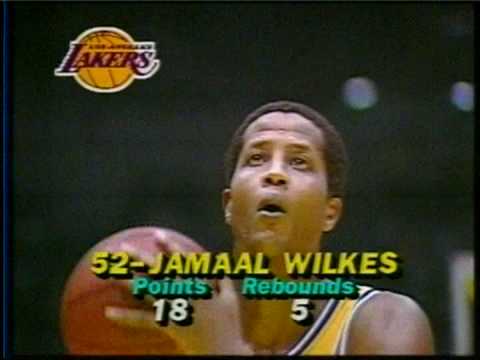
At number 11 we run into more problems. Derek Fisher. Everyone loves Fisher, the scrappy, flopping guard who has knocked down numerous clutch shots for LA, most memorably the tying 3 in the 2009 Finals and the .4 shot against the Spurs. But I don't see how he can be ranked above Michael Cooper and Jamaal Wilkes, who come in at 12 and 13, respectively. Cooper delivered vital contributions to five titles, won a defensive player of the year award, started a fashion trend by playing with the drawstrings of his shorts out, patented the phrase Coop-a-loop and was the toughest defender Larry Bird ever faced, according to the Hick from French Lick himself.
And Wilkes, also known as Silk?
Between 1980 and 1983, he averaged no less than 19.6 points per game, with a high of 22.6 He also scored 37 points in Game 6 of the 1980 Finals, when the Lakers clinched the first title of the Showtime era. The performance would be among the more memorable clutch games of the decade, but is instead mostly forgotten, thanks to Magic's 42-point, 15-rebound, career-defining performance.
Some other curious choices. Trevor Ariza at 29. Ariza came to the Lakers at the start of the 2007-08 season, had a decent month, hurt his foot, missed most of the season and returned in an ineffective role in the playoffs. Then last year he had a solid year as a role player, saving his best basketball for the playoffs. That's his Laker career. A documentary on his career in the purple and gold could be wrapped up in about two-and-a-half minutes. He should not be ahead of guys like the bespectacled Kurt Rambis (33), Cedric Ceballos (34), Sam Perkins (36), Elden Campbell (35), Sedale Threatt (42) or even Jim Chones (41), Ron Harper (43) and Horace Grant (49). Twenty-ninth? Gah.
That rating's bad enough, but it gets worse when talking about the guy who replaced Ariza on this year's Lakers. Ron Artest could be the key to a repeat title for the Lakers. He's already improved their defense and has had a fairly pain-free transition to the team. He's also played 26 games.
And McMenamin ranks him as the 50th best Laker ever! After 26 games. In one of his other lists, he has Johnny Flynn as the second-best Timberwolves player in history. According to Basketball Reference, the Lakers have had 337 players on their roster. Pick a name, any name, and it will probably be more deserving than Artest. In two years will Artest belong on this list? Almost certainly. In a year he probably will deserve a slot. But 22 games in? Devean George, Chuck Nevitt, Travis Knight, Mark Madsen, Karl Malone and Brian Shaw all want to know what they have to do to gain entry.
The old-time Lakers fans can judge better than I can whether Mel Counts is too high at No. 30, though it seems way too far up the list for a guy best known for being the center who played instead of Wilt in the final minutes of the Game 7 loss to the Celtics in 1969.
Sedale Threatt should be several spots higher. Certainly ahead of someone like Luke Walton at No. 40, or even Andrew Bynum, who's due for a season-ending knee injury any day but is 38th on this list. Threatt came to the Lakers before the start of the 1992 season. At the time, it was considered another great signing by Jerry West because it gave the Lakers their first legitimate backup to Magic since Cooper began fading in the late 1980s. Then, a few games into the season, Magic called a press conference to talk about the HIV he'd "attained" and Showtime officially ended, along with Magic's career. But in an impossible situation - following Magic as Lakers point guard was like following Wooden at UCLA or Jordan as the Bulls's shooting guard - Threatt performed admirably. He led them to the playoffs in 1992, averaging 15 points per game. He sparked them the following season as well, leading them to a near-upset of the Suns in the first round.
Those years are sort of forgotten in Lakers history books, coming after Showtime and before Shaq's arrival. Threatt ensured that no matter how bad things got, they never reached Clippers-level of incompetence. Move him up that list.
Lists serve little purpose beyond igniting arguments, which is why they're so popular in sports. No matter how the rankings fall, someone argues they are wrong. This list isn't any different than any other. Except it has even more wrong with it.
It was about four years ago - a day after a snowstorm like the one that is hammering New York City tonight - that I severely damaged my wife's internal organs with an ice-packed weaponized snowball.
That's her version, anyway. Even after 10 years in America, Louise's African blood has yet to fully adapt to the change of seasons, specifically winter. She still has no concept of "cold," so each morning she asks what the temperature is going to be and then, "What does that mean," as if I have to translate ancient Greek text before she realizes it's time to break out the mittens.
"Well, it's going to be 25, but the wind's going to be really blowing, so it will be pretty brutal."
"What does brutal mean? Hat, gloves?"
Say brutal to someone from Minnesota - or perhaps nasty - and they'll know immediately that it's a day to spend inside or bundled up in layers outside. It means biting wind, a face that aches after about 10 feet of walking. But Louise needs specifics, charts, pictures of what can happen to the human body if exposed to wind chills of zero and below. It's a tough way for her to go through life, always wondering if she'll drop dead in a snowbank between December and March because she forgot to ask her winter-veteran husband what to wear.
Winters have tortured her since her arrival to the country in March 1999. She flew into New York, leaving the sun of Cape Town for the distant States. A snowstorm and bitterly cold temperatures greeted the fresh-faced immigrant, who was wearing a short-sleeve shirt and open-toe shoes as she stepped off the plane. Her luck - and winter fashion sense - hasn't improved much since.
This continental confusion goes both ways. During our last trip to Cape Town, I scoffed when Louise said the African sun was different. Different? It's the same giant mass of hydrogen and helium, same Earth, same body, what's the difference?
"You'll see."
A few days later, as I struggled to breathe and suffered hallucinations, I finally did understand. It wasn't as hot as a few summer days I spent in Vegas, but the African sun - which sounds like a mythical creature - really did seem different. It sapped me more than the, what, American sun? And in a month, when we're again in Cape Town in the middle of their summer, I'll be the one asking, "What does 32 degrees Celsius mean?"
But in this land my experience guides us. Mostly it's the cold temperatures that torment her. In Minnesota - where the phrase Minnesota winter is as ominous as the words African sun - she's a defenseless creature. Any exposed South African skin is ripe for frostbite. I didn't really totally believe that until last year, when she somehow got frostbite in the shape of a tiny circle on her finger, from a nearly undetectable hole in one of her gloves, despite the fact we were only outside for about 90 seconds. She held it up inches from my face as the final piece of evidence, showing it to me with the zeal of a prosecutor detailing the DNA evidence against a murderer.
"See. My skin can't handle winter."
But she sort of likes snow, thinks it's pretty and adds something to the drab winter. Still, she claims - and I believe her because I've never seen it in the nearly eight years I've known her - that she's never touched snow with her bare hands. On the surface it seems like a ludicrous argument, sort of like Pat Robertson famously claiming he could leg press 2,000 pounds. But I believe her.
She maintains her curiosity about the foreign white substance. She likes sledding. She likes the idea of skiing.
And, a few years ago, she wanted to know what it felt like to be hit by a snowball. Later she said she had images of sappy movies in her head as she pictured a young lady playfully traipsing through the snow as her husband softly threw a clump of snow at her that burst into a thousand snowflakes, each as beautiful as they are unique. Reality wasn't quite so romantic. Or painless. One day, as we walked across the bridge to the Bronx, I told her to run up ahead of me and I'd hit her with a snowball. She eagerly sprinted as fast as her short legs could take her. I, meanwhile, constructed a snowball. It had to be one she'd remember. I grabbed a bunch of wet snow. Packed it together, rolling it around in my hands a bit to get a better feel of it. Then fired.
I knew I'd made the snowball too hard and thrown it with too much velocity when she went down to one knee, crying out in pain as onlookers stared. I knew I'd done some damage when a large welt formed on her lower back. Um, sorry, honey?
In my defense, it's not like I Nolan Ryaned the snowball at her fragile kidneys. I've never had the strongest arm, though as I proved with my perfectly placed killshot, I did always pride myself on my accuracy. As she rubbed her wound, she wondered, while glaring at me with the eyes of someone who just lost their innocence, "What did you do?"
Looking back it was a bit more solid than it should have been, but I had to explain to her the physics of snow and the weapons we make out of it. Nice, puffy snow does not work. Mine did splatter slightly at the point of impact, but not quite enough. As I said, it was too much like an iceball instead of a snowball. But still, they do sometimes sting, physically and emotionally. They're nonlethal grenades designed to help us get through the drudgery of winter and a snowstorm.
She needed to experience what it was like to be hit by one. It was, inevitably, the last time she's been hit by one. The mark disappeared. No scars formed, at least not visible. But it did give her one more reason to hate winter.
A question for everyone who's ever played basketball and taken a shot that was longer than 15 feet (post players who operate solely in the paint, sorry, sit this one out).
What makes a gym or arena a shooter's gym? What are the ideal conditions - from the background to the net - for a shooter? Everyone has a favorite basket they've shot at and a favorite arena they've played in. Many times it's even possible to just walk into a gym and tell if it's a shooter's paradise or hell. The lights are too bright or too dim. The floor's too slick. The seats are located too far back on the ends of the court, creating a strange background. And a single shot in warmups on the too-tight rims confirms the suspicions.
I'm still debating whether the little gym we use Wednesdays qualifies. The biggest thing working against it is a slight obstruction and overhang that occasionally threatens 3-pointers. At first glance it seems like it'd be much too high up to cause any problem. But I've had a couple of shots nearly hit, putting just enough doubt in my mind to be annoying. Other three-point shooters have fallen prey. Getting blocked by Bill Russell is one thing. Having an architectural quirk reject a shot is another. The rim seems unfriendly, but it provides plenty of "shooter's touch" baskets. Best of all the nets often hang after a swish, the most satisfying achievement for any player. So I'm thinking it is a shooter's gym, though that could change with my next subpar outing.
But if I was building a gym designed for shooting, what would I want in it?
(NOTE TO DEFENSIVE-OBSESSED COACHES, PLAYERS AND FANS: Yes, everyone knows defense is crucial to basketball. We shuffle our feet and get a hand up and lock down our guy late in the game. But this particular post is about offense, and shooting. And in the end, the game is about scoring. As my grandpa used to say, "Give me five shooters and I'll win a lot of games." Of course he never coached a game, but I think he would have won a hell of a lot with that strategy. For defensive purists, I'm sure Jeff Van Gundy has a blog somewhere detailing the pros and cons of switching or fighting through screens.)
Start with the basket. The rim has to have a little give, providing aid on the occasional wayward shot. No one wants a rim that's as unforgiving as a wall at a NASCAR event, or one that conjures up images of the baskets used to sucker people out of their money at small-town carnivals.
"But the basketball's bigger than the rim, this isn't fair."
"Dollar gets you two shots, take it or leave it. Or don't you want to win an overpriced, poorly manufactured stuffed animal for your girl?"
Companies and leagues constantly tweak baskets. The NBA switched rims before the start of the season. Here's a link showing the difference. They replaced the old one with an "Arena Pro 180 Goal" rim, a fancy way of saying it breaks away at the front and on the side.
Then there's the backboard. Today, of course, the square glass backboards - or bangboards as some old-school coaches like to call them - corner the market. My high school only implemented the square backboard my senior year. Before that it was the half-moon-shaped backboard. In this case square rules. At the school for our Wednesday night games, it's square but also wooden, an artifact transplanted from the set of Hoosiers.
Thankfully, in our league, only the backboard is left over from the 1950s, not the minuscule shorts. Love the shoes, though. Wooden backboards don't bother me much; bank shots seem just as effective on them as they are on the glass versions, even if the sound of the ball hitting the board and then ripping through the net isn't quite as pure.
Now the net. In theory the net shouldn't have any effect on a shot, since all it does is provide passage for the ball on its way to the floor. But not a single player who's picked up a basketball since Naismith started his little game has enjoyed shooting at a rim without a net. Without a net, savoring the artistry of a great jumper - the sound of a swish, the hanging of a net - is impossible. But it's not all about the aesthetics. Depth perception becomes difficult when shooting at a bare rim. Frustrations rise as the ball always bounds away from the players when it goes through the hoop. And doesn't it seem like there are more airballs shot at a netless rim, no matter how many great shooters are playing in the game?
A damaged net hanging by half its cords is nearly as bad. It's undignified, like a ball that gets stuck in the crotch of the rim. A net hanging by half its cords is begging to be put out of its misery. Give me a chain over no net. Chains are practically an admittance that a park's administrators don't trust the locals. "They're not mature enough to not cut down the nice nets, so we'll give them these shackles." While obviously not ideal, at least a shooter gets to savor the sound of a swish, or whatever we call the sound of a ball hitting nothin' but chain.
Some people like to put up red, white and blue nets, obvious look-at-me ploys that are designed to convince the neighbors they're living next to patriotic hoops fans. Leave those for July 4 exhibitions.
Basketball was designed to be played with white nets dangling under orange rims. Ah, but not just any white net. They can't be too short, which robs us of a true swish. And a net that dangles too low looks garish and amateurish, something an elementary school might use so the short children can jump up and grab it, giving them the illusion that they actually possess leaping ability.
The monstrosity below is made of "non-rotting nylon thread." I think a D-minus student in a home economics class created it. Not sure why anyone would ever embarrass their basketball hoop with this decoration, but I'm sure people have their reasons.
Below is a great picture. Ice forms on the net, creating the ideal photo op and an inviting target. During the winter I'd trudge out in freezing temperatures to the neighbor's basket. The challenge presented by a frozen net was that a made shot struggled to get through it, requiring the ball to be popped up out the top after a basket. Still, better than a chain. Better than no net.
According to my uncle Mike, a college basketball coach, schools now use something called an anti-whip net, which robs shooters of their ultimate prize: the hung net. Shooters collect these like hunters collect heads. Steve Alford said that when he did shooting drills as a player, he wouldn't quit until his final shot hung the net. Technology's making basketball rims more accessible to shooters, but it's robbing them of their chance for perfection, because nothing said "great shot" like hanging the net.
Lighting's key for any great gym or arena. Bright lights are great when conducting sleep-deprivation experiments on exhausted subjects, but aren't necessarily good things for great shooters. Dim them a bit. And for god's sake, don't put them in the line of sight. Before he was a coach, uncle Mike was a standout guard in high school and college, a long-range gunner who could hit from three-point land a decade before the shot even came to basketball. But the gym at rival Rochester - which also became notorious for sporting approximately 187 lines on its playing surface - caused headaches for him as player. No matter where he shot on the court, the lights were always in his eyes.
It sounds like an excuse, but for a shooter it's simply an explanation, like a golfer stymied by a last-second gust of wind. The execution's fine; the environment's flawed. Every shooter employs these explanations, whether the ball's slightly too heavy or the crowd's too far away from the action. Maybe an open door in the lobby leads to a slight breeze.
I think a great shooter's gym has the fans sitting right next to the court. The gym at Mankato West High School - where we often played tournament games - had stands behind the basket but they were too far away, throwing off the angles. Get the fans next to the action. That goes for any level, and the best shooting arenas prove it. Williams Arena has always seemed like the perfect home for a shooter, even if the hometown Gophers haven't always produced the deadliest marksmen. At the old Boston Garden, fans could practically breathe on the players. Magic Johnson called it his favorite place to shoot, even better than LA's Fabulous Forum. I'm assuming Larry Bird agreed.
The older places are also a little dingy, meaning the lighting's not up to par, meaning they're perfect environments for shooters. Rat Hall at St. John's hosted countless games over the years. Once home to the Johnnies, it became a place for pickup games during my years there. But I much preferred the old place - which got its name from the nickname of the fans, not from a rodent infestation - to the more modern Warner Palestra, where the Johnnies now play.
So our perfect shooter's gym won't be too large. It will seat maybe 12,000 people at the most. No domes with their 50,000 fans. The front rows will hug the court, with the folks on the baseline also sitting just feet from the action. White net, obviously. Before the gym opens we'll invite 100 of the best shooters in the country in to play for a few hours, in order to test the sight lines to see if the lights will cause any problems.
Of course basketball's an outdoor game nearly as often as it's an indoor one. Growing up, I spent most of my hoops time at the Janesville City Park and the neighbor's. Loved the neighbor's garage hoop. Accepted the park's shortcomings, which included a too-high basket, a dangerous playing surface and an exposed area susceptible to the prairie winds. I also spent countless hours at my grandpa's farm, the same place my dad and uncles learned to shoot (although they didn't learn how to cope with the Rochester lights). The hoop was attached to a barn and I probably shot 70 percent during my lifetime there, even though I often launched from 20-plus feet away. The net seemed magnetic, almost like it grabbed the ball mid-flight. So maybe the old rim and net from the farm will find a home in my perfect gym.
Shooters can shoot anywhere, of course, whether it's an NBA arena or a Midwestern farm. A great shooter's gym just makes them better and maybe helps the below-average chuckers drain a few more.
In the end it's still more about the player than the venue. But I'll still keep searching for the perfect shooter's gym. One thing I know for sure: That gym's not going to be home to anti-whip nets.
Three or four years ago I bought what I believed was going to be one of the best presents of the year for Louise: A Christmas Story DVD. I've yet to meet a single person who hasn't seen it and everyone that's watched it loves it.
To many people it's the most classic of Christmas movies, even ahead of another perennial favorite, It's a Wonderful Life. Every scene is memorable, every line quotable.
The tongue on the cold post. "My little brother had not eaten voluntarily in over three years." "You'll shoot your eye out, kid." "Some men are Baptists, others are Catholics; my father was an Oldsmobile man." The leg lamp. Randy lay there like a slug. It was his only defense. Scut Farkus My father worked in profanity the way other artists might work in oils or clay. It was his true medium, a master.
And on and on. Anyone who doesn't own the movie can usually watch it during TNT's annual 24-hour marathon, a perverse programming decision that somehow only delights fans of the movie. Of course it's overkill, but the only reason it seems to upset people is that it's not a 48-hour marathon.
So I just knew Louise would love the movie. This is someone who actually bought a leg lamp - just like Ralph's old man - during a trip to Fargo, and didn't understand when several people told her it was just like from A Christmas Story. So how could she not enjoy the movie that gave birth to the lamp? She'd unwrap it and pop it into the DVD in one motion. Then we'd sit back and laugh.
Four years later, and she's still never seen it. No reason, really. It's just sort of...happened, or not happened. She hasn't had any desire to watch it. Maybe she's heard too much about it and it's been built up too much. Maybe she's sick of me quoting the best lines. And somehow she's avoided it during those all-day marathons. I feel like restraining her, taping her eyes open and forcing her to watch every second. Then she would learn to love it. I'd say she hates Christmas and that's the reason for the boycott, but judging by the crazed Christmas tree decorating session and December shopping excursions, that's not true either. Instead, A Christmas Story is that one movie that everyone has seen that she hasn't, something most people have in common, though the films are always different.
I know people who have somehow never seen the first two Godfathers. But have seen Part 3. Friends of mine who are avid baseball fans haven't seen The Natural. Talk to them about Roy Hobbs' final at-bat and they greet you with a blank stare.
"The bloody shirt. Old bullet wound. Pennant on the line. Broken bat. Home run. Exploding lights."
"Meh, doesn't sound that great."
Some so-called basketball fans have never seen Hoosiers. Up until a few years ago, a close relative of mine had never seen Braveheart, which would make sense if the person was a descendant of Edward Longshanks but seems improbable for anyone else.
The movie I've never seen that always surprises people when they hear about it? Grease. Some people take pride in the fact they've never seen movies or read a famous book that seemingly everyone else has seen or read multiple times. It's not like that with me, at least not consciously. It's just that I've never gone out of my way to watch it. While I'm not the biggest fan of musicals, people whose opinions I trust rave about the movie and insist I'll love it upon first viewing. But I've never rented it and have never stopped on whatever channel it's playing on Saturday afternoons. I know the characters, the story and the songs. I know the look and the styles. For all intents and purposes, I feel like I've seen it.
But the thing that bothers people the most when I tell them I've never seen Grease is that I have seen - and thoroughly enjoyed - Grease 2, the much-maligned sequel starring a young Michelle Pfeiffer and an unknown English actor named Maxwell Caulfield. I saw it with a friend in the theater when it first came out. We went with his parents. After the movie, we stopped at a small liquor store. Knowing now how many people hate Grease 2, perhaps his folks were trying to drink away memories of the night. But I liked it then, and I'll stop and watch it anytime it's on these days. The foreign exchange student trying to win the heart of the girl he loves - or at least lusts after. The songs about patriotism and getting laid. "A girl for all seasons." The epic motorcycle jump over the pool. Highly enjoyable.
"If you've seen that one, and liked it, then you will love Grease because the original is about 100 times better," I've been told. And I believe them. But there's a mental block, something keeping me from finally sitting down and watching the damn thing.
Everyone has these movies. Or maybe it's a TV show. For instance, I've never seen an episode of HBO's The Wire, even though friends of mine stutter and practically pass out when talking about the show. Numerous critics have called it the greatest show in the history of television, which sounds like a Bill Walton-type overreaction but is probably true. I don't doubt its greatness. But we don't have HBO and I've never rented it and have turned down offers for the DVD. Don't know why. And I understand when people get incredulous; it's the same reaction I have when they profess no desire to ever watch Curb Your Enthusiasm.
Yes, we all have these shows. If I was into resolutions, maybe that would be one of mine: to watch Grease. But I'm not so 2010 will likely be another Grease-free year. I'm not ashamed of this but I'm also not proud of it.
But, if you haven't seen Godfather or Godfather II...how do you live with yourself?
About once a year, a high school sporting event makes national news for the lopsided nature of the final score, whether it's a blowout in football or an embarrassing rout on the basketball court. Pundits pontificate and outsiders mock the losing team, when they're not castigating the winning side. I'm also a junkie for these types of games, though I have little interest in assigning blame or shame.
Early in the prep basketball season, a game between two small schools in northern Minnesota broke through the noise to earn some recognition. Last week Moose Lake-Willow River defeated Wrenshall 65-0 in girls basketball. It's the type of score a local sportscaster will introduce with a chuckle and the line, "Folks, this is not a typo."
Countless teams have lost by more than 65 points, but when a shutout's involved, the result's going to bounce from the weekly paper, to public radio, to national blogs and newspapers. It was 40-0 at half. Moose Lake-Willow River played reserves the second half, and Wrenshall had, according to the coach of the winning team, about 11 layups that failed to go in, which would have sliced the deficit to a more manageable 63 points.
One message board I saw devolved into a debate about whether the two teams should even be playing against each other. The person was unaware of the geography of Minnesota and the fact the two teams are of similar size. They play in the same conference. This wasn't a big school from the Twin Cities beating up on a small school in rural Minnesota. A few years ago Wrenshall made the state tournament. If they have some decent younger players in the program, they could be beating Moose Lake-Willow River by 30 in a few years. These types of ups and downs are common in all programs, but especially in small towns, which rely on the luck of the gene pool and the reproduction rate of the townsfolk. Some years a team will be blessed with four or five outstanding players, other times the talent pool is bare for three or four grades. It's accepted that the winning and losing is usually cyclical, though there are also traditionally strong programs that churn out winners every season.
But for everyone else, the bad comes with the good, or, more accurately, after the good.
Unlike similar results in the recent past, there haven't been any premature calls for the head of the winning coach. No one's been accused of bad sportsmanship. If the opponent's missing layups, what's the responsibility of the winning team, especially if the reserves are in the game? Aside from scoring in the wrong basket to get a 2 on the other side of the scoreboard. The reserves have the right to play as hard as possible. If they too are much better than the losing team, routs happen. And, occasionally, but thankfully not often, historic shutouts happen.
Once the sportsmanship questions are dealt with, people then turn to how it affects the players, specifically the losing players. What kind of damage will it do? Will they be on their therapist's couch in 25 years, blaming Moose Lake-Willow River for their three failed marriages, when they're not blaming their overbearing mother and distant father? Will the kids drop out and start drinking and drugging, trying to wash away the shame of being shut out in a basketball game?
What about the children? It's the type of cry we hear often, whether it's involving athletics or Janet Jackson's exposed breasts.
The players will be fine. Whatever embarrassment the kids or coaches or townspeople might feel now - and it is just a basketball game, so they really shouldn't feel bad at all - will dissipate as the season goes on, even as they'll likely continue to rack up eye-opening defeats (they've lost 78-8 and 102-20, as well). In six months it will be a footnote to their school year. In 10 years it will be an anecdote at a class reunion.
Ever since I've been a reporter, I've usually been more interested in the losing team and players. When Trinity Bible lost 105-0 on the football field six years ago, I wondered what the players felt and how they kept moving forward.
The players and coaches were embarrassed, hurt, but hardly permanently damaged. Certainly most of the people involved with that game remember it to this day. But that might have less to do with the score and more to do with the fact someone wrote a book about it with the subhead calling them the worst college football team in the nation.
Many of the players and coaches involved with that game were still at Trinity a year later when I covered the team for my book. That year, in the Lions's first home game of the season, they lost 12-7 in heartbreaking fashion. On the final play of the game, with Trinity a yard away from a victory against Principia, the Lions's running back plunged into the end zone for the winning touchdown. At least that's what it looked like live, and on the videotape. The officials, however, saw things differently. After a few seconds of discussion, they ruled the back down just inches from the goal line. That play - and that game - hurt 105 times more than the 105-0 defeat. That game hurt more because one play meant the difference between a win and a loss. The deciding play in the 105-0 game was the opening kickoff.
The 105-0 game was the reason I was at Trinity a year later. The game put Trinity on the map, even if as just a dot. It helped convince a publisher to back a book about the program. The players remember being beat up that day on the field, they remember the injuries that decimated the team, and they remember the long bus ride home.
But it didn't do any lasting harm, at least not emotionally. The details from the 105-0 game have probably been mostly forgotten. But I bet most of the players remember nearly every play from the final minute of that 12-7 loss.
The losses that hurt, the ones that linger and sometimes even damage, aren't the 50-point defeats, but the final-second losses. If you're a former player, think about the games you remember most from your playing days. If you're a fan, think about the games that stick out most, no matter the level, whether professional or high school. I can still remember the details of the close losses suffered on the high school basketball court and in college. I still wonder how the outcomes would have been different if one shot would have gone in, or we would have grabbed one more rebound. Those are the games we remember, not the ones that were over by halftime.
The Wrenshall girls will be fine. Unless they lose one at the buzzer.
Routs can be quickly forgotten. And if anything, they just make players stronger. It's the heartbreaking losses that torment them.
I mentioned this Little House on the Prairie episode in a previous post on the epic, enjoyable, not-always-faithful-to-the-geography-of-southern-Minnesota show.
This shows Charles Ingalls at his finest. I couldn't find the episode before, but now we can see this man of morals standing up for what's right on the prairie.
Miss Beadle, the blond bombshell, finds herself unable to control the unruly children, including Willie Oleson at his most annoying, a poster child for corporal punishment in the classrooms. The shrill Harriet Oleson reminds Miss B. that "when harvest ends" there will be even larger misbehaving boys for her to handle.
Enter Mr. Applewood, the substitute teacher from every child's nightmares. Throw a spitball at this guy, and it's likely to end up shoved down your mouth.
Poor half-pint. Laura immediately stumbles into trouble because she gets stuck with a note disparaging the new teacher, although the insult is simply a cliched play on the guy's name: Crab-Apple. Walnut Grove children could be brutal, if not witty. He takes out his trusty weapon - a wooden ruler - and whacks her on the hand, seemingly enjoying it a bit too much. Then a juvenile ink prank torments Applewood, leading to more punishment for Laura. In fact, the ultimate punishment: expulsion. The guy might have been a hard-ass but his detective skills were severely lacking. Not only did he ignore the back entrance to the school, but he seems unaware of the likely suspects. Just look into Willie Oleson's eyes and you see the definition of a troublemaker and future delinquent.
One of the odd things in this episode is the three brutes in the background, the terrible trio Miss Beadle was apparently unable to handle. I understand the school was for kids of all grades. But these guys appear to be closer to 30 than 15. If they haven't learned to read at this point and haven't yet figured out how to spell Lincoln, it's time to let them stay in the fields.
Finally, just past the six-minute mark, Charles enters to shut down Applewood's reign of domestic terror. When he walks in on Applewood preparing to hammer Laura again - this time with a much, much larger and more lethal weapon - Walnut Grove's conscience steps in. Charles breaks the instrument, and Applewood's control of the school.
Miss Beadle returns, this time with a better understanding of how to control her middle-aged problem children.
Later, she'd send some of these same children to their death in a classic Minnesota snowstorm. But today was her day to shine.
Think of all the things that can make someone nervous at a dentist's office. Old equipment, blood-stained tools, the smell of the drilling, the taste of the fluoride, a dentist with shaky hands, the first glimpse of the picking tool that will soon be scraping plaque from its home, the sound of the suction tool lodged at the bottom of your mouth, the fear that the numbness will never go away. Of all those things, nothing quite compares with having a dentist who screams fuck every three sentences and warns you to control your numb tongue or it's going to get cut.
When you experience all of those things in a single visit, well, you've gone to my dentist.
About a month from now, I'll walk a few blocks to my dentist's office for a regular cleaning. It's the type of procedure that should take maybe 15 minutes and be devoid of any drama. The receptionist will lead me to the chair. She'll tell me to lean back, relax. Once positioned, I'll glance up and to the right. There, in the corner, I'll see a stain on the ceiling. A stain that's been on the ceiling since my first visit to this dentist, 21 months ago.
When I needed to find a dentist, I focused on location and figured we found the perfect option in one that's a five-minute walk from the apartment. I'd neglected the dentist for too long. Long enough where I was fearing the toothless possibilities, though those thoughts ended up being overblown. But the gums...the gums needed work. Always the gums.
On the first trip in March of 2008, a kindly, grandmother-type greeted me. She stared at me and with concern etched on her face, asked, "How's your mom doing?"
Mom was good. Mom was back in Minnesota. Mom didn't know this lady.
"Um, I think you have the wrong person."
"No, no," she replied. "It's you. Your mom wasn't doing well before, remember?"
Actually, I think I would remember if my mom had been sick - back in Minnesota! - and I'd mentioned that in this office. An office I'd never visited in my life until that day.
I finally convinced her I was not the man she was thinking of and she eventually figured out that she was thinking of a guy named Furry, or Furrey, or maybe Furey, but definitely not Fury.
After the obligatory paperwork, she led me to the torture chair, which seemed to have been transplanted from my childhood dentist's office, bringing terrible memories flooding back. The same kind, caring woman handled the X-rays. I've heard of how other people get their X-rays done these days. Lasers. Pain-free. Quick. Easy.
This dentist is as old-school as the pick-and-roll. First comes the 25-pound vest, draped on my chest to save my internal organs and ensure the procedure doesn't leave me sterile. Lasers? No. It's still those tiny, pointy, painful applications. She shoved them into my mouth with her gloved hand. "Hold it with your forefinger," she said. What?
"Bite down on it. There we go."
Biting down nearly brings tears. It's not so bad in the back, but those front teeth, the points jab at the gums.
The X-ray machine itself is something out of a 1940s science textbook, the type of model that probably got phased out beginning in the early '60s, likely after a government warning. A giant, lumbering machine, it growls as it takes the picture. Poison shoots through me. Chernobyl probably didn't give off as much radiation as this contraption. She must have shot pictures from 15 directions, ensuring that every part of my face and brain would receive the proper dosage of radiation.
Later she gave me the early brushing, commenting, "Yes, there's a lot of inflammation here." The gums, always the gums.
Eventually my dentist arrived. A tall, imposing, balding man. He was bombastic and arrogant, coming off like a frat boy forcing a freshman pledge to drink his 12th beer of the hour while standing naked in front of the school soccer teams.
"I got good news and bad news," he said.
The good news was there was no permanent damage, no freakish, toothless existence in my immediate future. But he needed to do a thorough gum scaling. Gum scaling? Two words that shouldn't be placed anywhere near each other. It would certainly involve something pointy, loud, angular and painful, which would produce enough blood to make Tarantino cringe. Otherwise the teeth were good, only a single cavity, which, considering I drink at least three sodas a day, was an even bigger upset than Villanova's win over Georgetown in 1985.
He began the scaling. Not two minutes into it, the doctor says to his assistant, "You're so goddamn stupid."
Huh? I thought it was a joke between the two, a pair of longtime co-workers who feel comfortable busting each other and they're both fine with the superior belittling the efforts of an underling, a little like Bobby Knight calling an assistant a stupid SOB because the guy didn't teach Uwe Blab the proper way to block out on a free throw.
Minutes later, as the dentist wrenched my mouth, he grew frustrated with the weapon in his hand. Out of the corner of my eye, I saw him wheel back two feet on the tiny chair he was perched on. He pounded on the cupboard with his elbow. Once. Twice. Three times. Punctuated with a loud "fuck."
At that point it became clear that the man charged with repairing my gums, with coaxing them back to a pinkish hue, might have been certifiable. Perhaps he escaped from Bellevue, donned a white coat and had been playing dentist in this office and holding the women hostage when I innocently stumbled into the madhouse.
"Get me some fucking equipment that works," he yelled. Another assistant, this one young and frightened, came in shortly after. The dentist greeted her with, "Get me some fucking cotton balls, god damn it." She did. The swearing, the belittling, the roid rage, it all lasted four hours. Four hours, from the time I first sat in the chair to my ultimate release. During that time, the seemingly demented dentist dropped a half dozen fucks. He started the scaling without much numbing to see how much they could do, a tactic last seen at Guantanamo. And if you're eventually going to numb - and they did - why not do it right away? He scraped, screamed and clawed, destroying the gums so he could save them.
Once that was finished, he set to work on the broken filling. Shortly after inspecting it, he discovered the shoddy work of my previous dentist, badmouthing his peer and telling me it was going to be more complicated than first thought.
To borrow the word of the day, fuck.
That's when he turned his anger from his assistants to his patient. With the filling needed in a back tooth at the top, it took some dexterity and force for him to get back there. Naturally, this caused me to gag.
"Move your tongue. Move your tongue. Control your tongue!"
I can't! It's numb. I can't feel it, that's the way the medicine works. I don't know what it's doing. You're telling me to move something I have no control over. Tell me to telepathically move your ancient X-ray machine so it hits you on your balding head. I'd have just as much luck. I don't feel the tongue, the mirror or your overly hairy hand.
"If you don't move it from where it is, you will get cut." At one point a cotton ball failed to materialize. He again screamed for a fucking cotton ball.
"Oh, you shut up," the assistant finally responded. "Act like a professional."
Thank you. Thank you. If a studio audience was watching this scripted horror show, this would be the moment when they erupted in applause.
By this time I have tears coming down my face as my mouth's been pried open for hours.
For the composite filling, he took some glue-gun-looking apparatus and injected me with an odd fluid. Blue, orange, yellow, it looked like, I guess, a "composite" of colors.
"God damn it!" he yelled while pulling the gun away from me. Out of the corner of my eye, I could see there's now blue liquid covering the top corner of the wall behind him, as if a giant bug had been squashed in the spot. Somehow the ammunition dislodged and squirted up the wall. Hygenic.
"Get someone in here to clean that shit up," the doc said. Someone did come in, but didn't do the most thorough job, as, more than a year later, it still lingers, taunting me on every trip.
(Quick sidebar: When I was first brought into the room, the lady opened the shades, saying, "We don't want it looking like a morgue in here." At the time I thought it was a joke, a bit of levity to relax me. Now I realize it might have to throw authorities off the scent if they walked past the room. They don't want it to *look* like a morgue. Doesn't mean it isn't one.)
While the general breakdown of society was taking place in the room, the receptionist was talking to Louise in the waiting area, distracting her from the screams. "He's a genius," she said of the dentist. "He's the best cleaner I've ever seen in the business. He will leave no plaque behind."
No plaque left behind? What is he, some type of deranged marine wannabe?
"But," she added, "he's a complete nut job."
If only I'd known that before being strapped in. Meanwhile, back in the chair the dentist launched into a tirade against my former dentist. "Dentistry is such a joke. Just a fucking joke. It's a hodgepodge of people who don't care about their work or what the fuck they're doing. This was so sloppy."
Ladies and gentlemen, the last honest dentist. Give the man his due. He pulled off the miracle filling, which he called one of the toughest of his career. Failure would have meant a root canal.
Out in the reception area, he showed off his handy work to his minion. "But see, now he's not moving his tongue like he was, so you can't tell how difficult this was." Yeah, I can feel it now, so I have a slightly better idea where it's going.
After receiving another stern warning about flossing - the fourth of the day - I was on my way.
That probably should have been the first and last trip. But I returned several times over the next few months as he completed the gum work he started with that scaling. Six months later, when he discovered I had new insurance, he gleefully ordered up some more X-rays, blasting me with some more radiation from the antiquated death machine. After that trip, they messed up our insurance information by sending in the wrong social security number, so it took an extra three weeks to get our money from the company. Hadn't been back since.
Until last month. Despite Louise's protests, I returned to this man, this crazy man and his insanely run office that's populated by frightened, cowering workers who get so flustered by their boss's actions that they screw up everything from ordering enough cotton balls to insurance forms. The office is a reality show waiting to happen. Louise demanded that I refuse any X-rays they tried to give me, citing studies and common sense that say three dental X-rays in that time frame isn't the best thing for a person's skin, organs or nerves. But there I found myself...holding the pointy things in my mouth as the machine took its pictures and the same lady talked about how she knew me as a boy and what a wonderful boy I was and how was my mother feeling these days after her sickness?
"You're thinking of that other guy again, the one with a similar name."
"No, it's you."
It wasn't.
Surprisingly I wasn't glowing at the end of my session. The dentist fixed another cavity but complimented me on my flossing, filling me with pride. Thirty minutes into the session, Louise wandered in during a break in the chaos. As we chatted, she said, "What is that?" Glancing back, I saw the suction tool. The dreaded suction tool. And it was covered in...something. Something dark, dried-blood-like. I laughed it off, not wanting to think about the possibilities. She got a napkin and cleaned it, shaking her head. It was probably just coffee.
Why do I keep going? Because the man is a genius. Genius sometimes leads to madness, but the combination can produce great art. That and he's so close I can nearly hit his office with a 5-iron. Then there's the fear, of course. If I do leave, I picture him tracking me down, bursting in and pulling out every tooth and then eating them, all the while he lectures me about the dangers of not flossing.
A week ago, we received the explanation of benefits from the insurance company. Patient is not covered by plan. Which was an odd thing to read, since I am a patient covered by the plan. A quick check of our records revealed the problem: the receptionist, flustered, intimidated and scared, had put my social security number down again. The only problem: for the last four digits, she put the last four digits of my phone number, not my social security number.
That was the last straw for Louise. She pleaded with me to find a new dentist. She begged me to go to her dentist in Brooklyn, which takes an hour to get to on the subway but the woman is a caring, soothing professional with ultra-modern equipment. For now I refuse. I keep going, somehow convinced this man is the only person keeping me from a future of false teeth. Call it Stockholm Syndrome, call it laziness because I don't want to have to travel more than five minutes. Whatever the reason, I'll return in about a month. And I'll look back and see the stained ceiling, although hopefully no stained tools.
Then I'll wait. And when I hear that first obscenity from out in the hall, I'll know the dentist is ready for me, even if no one in the office is ready for him.
Here's the tragedy. General Mills announced it would reduce the amount of sugar in cereals that are primarily marketed to kids, ie., Lucky Charms, Trix and Cocoa Puffs. The story focuses on how this will affect children, as I guess it should, since it's the most vulnerable among us who will suffer - er, benefit - the most from this change.
But Minneapolis-based General Mills is also messing with my midnight snack. I've been a Lucky Charms consumer for 30 years. For a change this big and life-altering, I feel like General Mills should have polled its most ardent supporters, preferably those of legal drinking- and sugar-eating age. Tell children what's good for them, but can't adults who know what's bad for them have the chance to enjoy themselves?
Disclaimer: I'm extremely healthy and have been since childhood. Haven't had a sick day at work in three years, probably only a handful in 12 years of full-time employment. As a kid I rarely got sick, unless the Lakers lost. Is there a correlation between my good health and the massive amount of Lucky Charms I consume on a yearly basis? I'm not saying that. But I'm also not not saying that.
So with that out of the way, yes, I ate Lucky Charms a couple times a week as a kid. It wasn't the end of the world, or my teeth, though I realize that has pretty much everything to do with genes and metabolism. I continue to eat it today, usually two bowls sometime after 11 p.m. No, it's not always Lucky Charms. Often it will be something healthy, like Wheaties or Life. Cheerios sometimes get a run. But when it's Lucky Charms or Cap'n Crunch or another of the targeted "sugar cereals," all is right with the world.
I used to pity my friends who never got to enjoy a sugar cereal. Did their parents also deprive them of love? Those kids are just fortunate they didn't turn out like Todd Marinovich.
So, what's General Mills going to do for me? Our children will be skinnier and will fit into their clothes better and diabetes rates will plummet as our morbidly obese youth are slimmed if no longer shunned. But what about Lucky Charms-eating adults? Do we have any platform to protest?
I didn't see any specific numbers in the story for Lucky Charms, though it says 10 cereals will be reduced to single-digit grams of sugar per serving. Great. Wonderful PR move. And Cocoa Puffs could see a 25 percent drop. Will that be a 25-percent drop in deliciousness?
"The reduction ... doesn't represent perfection but it represents improvement," said Kelly Brownell, noted buzzkill and director of the Rudd Center for Food Policy and Obesity at Yale. Brownell later bragged, "The cereal companies have really been under a lot of pressure."
So now that Big Tobacco has been somewhat humbled and reduced to Medium Tobacco, I guess it's time to set our sights on the evils of Big Cereal, tempting our kids with their magically delicious products.
Maybe we do need to protect children from themselves and the marketing genius that is the leprechaun. Isn't there a way to do that without offending those of us who are old enough to decide how much sugar we eat during the day?
Give us an adult version, one loaded with insane amounts of sugar. Put warning labels on it, something with a skull, or a 450-pound man with no teeth. Slap an NC-17 rating on the flap. Wrap the inside bag in the stuff used on CD casing. Force nervous, pimply faced teens to show fake IDs as they buy their Lucky Charms before picking up the beer their 22-year-old sister bought them at the nearby liquor store. Make the eating of sugar cereals a shameful thing. Just don't deprive adults of the thing that's made us loyal General Mills consumers: sugar.
We know the dangers of sugar cereals. Cocoa Puffs turn your milk a putrid brown. At the bottom of a Cap'n Crunch box, you'll be forced to pour out the crushed pieces that are now in a yellow powder form and pollute the bowl. The marshmallows in Lucky Charms get soggy if the box is left open. These are very real dangers. Cavities and diabetes...meh.
I'm sure someday I'll be forced to consume a diet rich in fiber and other bland substances. And when that time comes I'll dutifully pour my Wheaties or Total, and I won't even add a few spoonfuls of sugar. But until I'm following doctor's orders, I need my sugar cereal, day or night. I need my Lucky Charms. And Lucky Charms with less sugar just ain't Lucky Charms.
I'm a freelance writer and editor, former newspaper reporter and the author of Keeping the Faith: In the trenches with college football's worst team. I'm obsessed with the Los Angeles Lakers, sports from the 1980s and Super Tecmo Bowl. I'm a Minnesota native and am married to a South African, but I now live in Manhattan. Also visit me at my website www.shawnfury.com. Write to me at shawnfury05@yahoo.com. Or, to read even more of my ramblings, visit tvfury.wordpress.com.